What Makes Soap Vegan
Soap is considered vegan when all fats, additives, and processing aids are free from animal origin.
From an ingredient standpoint, vegan soap excludes tallow, lard, milk derivatives, honey, beeswax, lanolin, silk proteins, and animal-derived glycerin. The absence of these materials forces formulators to rely on plant oils, mineral alkalis, and synthetic or fermentation-derived additives.
One practical observation is that vegan designation does not dictate whether a soap is traditional or synthetic. Both true soaps and surfactant-based cleansers can be vegan, provided their ingredient sources meet this exclusion criterion.
| Ingredient Type | Common Examples | Reason For Exclusion |
|---|---|---|
| Animal Fats | Tallow, lard | Direct animal origin |
| Animal Waxes | Beeswax | Insect-derived |
| Proteins | Silk, milk proteins | Animal extraction |
| Byproducts | Lanolin | Sheep wool origin |
Ingredient exclusion principles can also be observed in traditional vegetable-oil systems such as Castile soap ingredient composition.
Ingredients Overview
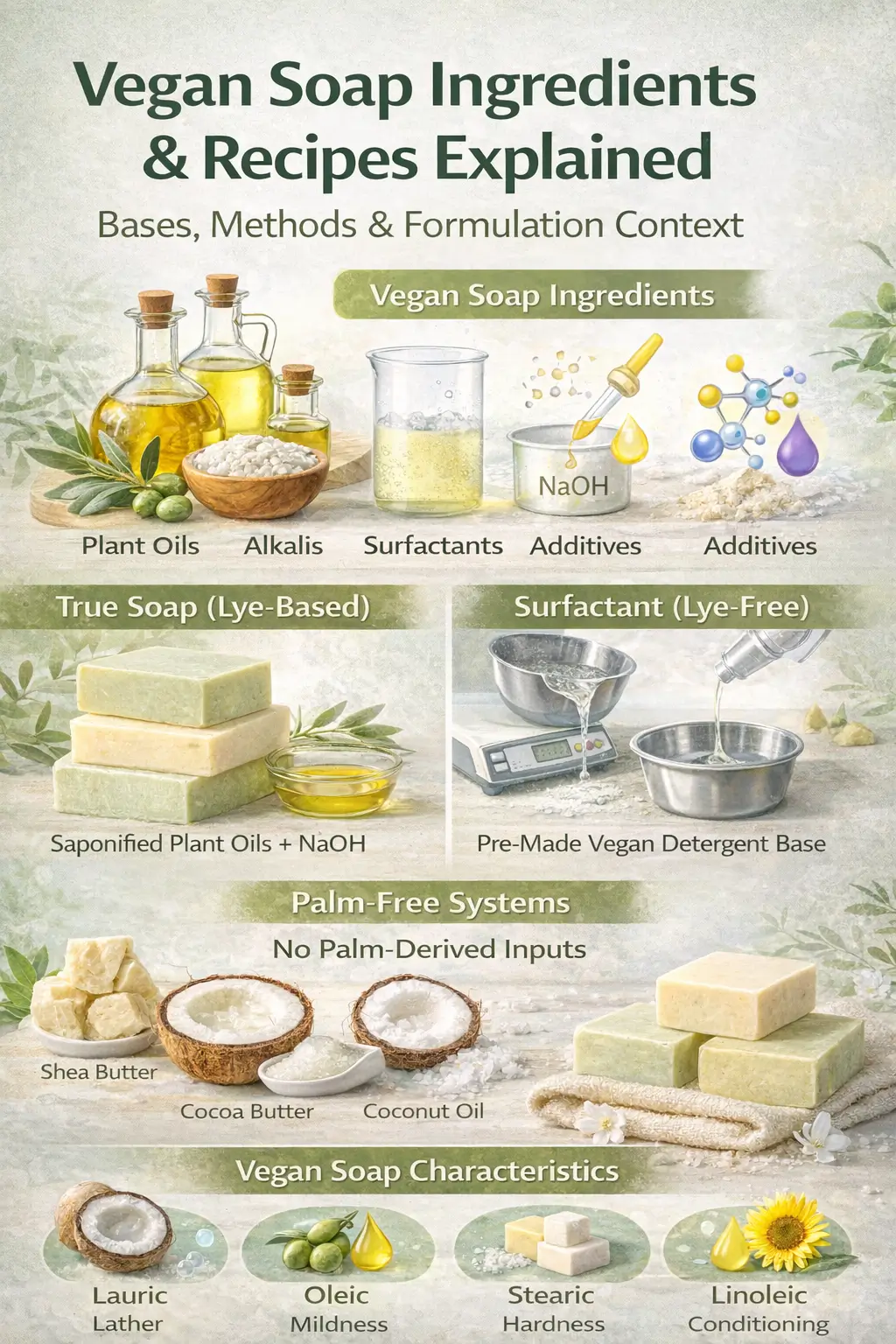
Vegan soap ingredients fall into four functional groups: oils or surfactants, alkalis or neutralizers, additives, and stabilizing agents.
In bar soaps, plant oils provide fatty acids that react with alkali to form soap, following the core material roles outlined in the soap ingredients guide. In liquid or lye-free systems, synthetic surfactants replace saponified fats. Additives such as glycerin, clays, or salts modify texture and stability rather than cleansing power.
Some plant-derived liquid soaps used primarily for surface or household cleaning, such as Murphy’s Oil Soap, rely on oil-forward formulations and emulsification behavior rather than traditional bar-soap curing or cosmetic performance criteria.
Across formulations, ingredient selection reflects availability, cost stability, and performance targets rather than ideology alone.
| Ingredient Group | Examples | Functional Role |
|---|---|---|
| Plant Oils | Olive, coconut, sunflower | Fatty acid source |
| Alkalis | Sodium hydroxide, potassium hydroxide | Saponification |
| Surfactants | Sodium cocoyl isethionate | Cleansing without lye |
| Additives | Glycerin, salt, clay | Texture & stability |
Plant-based cleansing systems also appear in formulations examined in Aleppo soap ingredients.
Soap Base Types
Vegan soap bases may be saponified plant oils or pre-made surfactant bases with no animal inputs.
Traditional vegan soap bases rely on plant oil triglycerides converted into sodium or potassium salts. Melt-and-pour vegan bases, by contrast, often use synthetic detergents combined with humectants and hardeners.
In hands-on testing, true soap bases exhibit greater variability in hardness and curing time, while syndet bases offer more predictable processing at the expense of traditional soap chemistry. Cold process plant-oil chemistry is discussed further in the cold process soap ingredient analysis.
| Base Type | Core Chemistry | Processing Behavior |
|---|---|---|
| Cold Process | Saponified plant oils | Requires curing |
| Melt & Pour | Synthetic surfactants | Immediate usability |
| Liquid Soap | Potassium soaps | Extended cook time |
Recipe Using Alkali (Lye-Based Systems)
Lye-based vegan soap is produced by saponifying plant-derived oils with sodium or potassium hydroxide.
In classic vegan soap making, sodium hydroxide is used for solid bars, while potassium hydroxide is used for liquid soaps. The alkali itself is mineral-derived and contains no animal inputs. The defining variable is the selection and ratio of plant oils, which determine fatty-acid composition, hardness, and lather behavior.
A practical limitation observed during formulation is that high-oleic oil blends cure more slowly and may feel softer for several weeks, even when fully saponified.
| Oil | Primary Fatty Acids | Formulation Contribution |
|---|---|---|
| Olive Oil | Oleic (55–83%) | Mildness, longevity |
| Coconut Oil | Lauric (45–53%) | Hardness, lather |
| Sunflower Oil | Linoleic (55–75%) | Conditioning feel |
| Shea Butter | Stearic & Oleic | Bar structure |
In many cases, formulators balance lauric-rich oils with oleic-rich oils to avoid excessive solubility or rapid wear.
Recipe Without Lye (Surfactant-Based Systems)
Vegan soap recipes without lye rely on synthetic or naturally derived surfactants rather than saponification.
These formulations are technically not true soaps, but surfactant-based systems consistent with the structures described in syndet cleanser formulation systems. Instead, they use surfactants such as sodium cocoyl isethionate, sodium lauryl sulfoacetate, or glucosides to provide cleansing. Oils, if present, function as emollients rather than reactive ingredients.
From a formulation standpoint, lye-free systems offer predictable pH control and immediate usability, though they lack the structural simplicity of saponified bars.
| Surfactant | Source | Functional Role |
|---|---|---|
| Sodium Cocoyl Isethionate | Coconut-derived | Mild cleansing |
| Sodium Lauryl Sulfoacetate | Plant fatty alcohols | Foam generation |
| Decyl Glucoside | Sugar-based | Gentle surfactancy |
One observed trade-off is reduced bar hardness unless binders or compression techniques are used. Comparable surfactant-driven cleansing structures appear in products analyzed in Zest soap ingredient analysis.
Vegan Soap Without Palm Oil
Palm-free vegan soap replaces palm-derived fatty acids with alternative plant sources.
Palm oil is commonly used for its balanced palmitic and stearic acid content. When excluded, formulators substitute with cocoa butter, shea butter, hydrogenated vegetable oils, or higher coconut oil fractions. Each substitution alters bar hardness and solubility.
In palm-free formulations, achieving comparable longevity often requires higher total saturated fat content from non-palm sources.
| Alternative | Key Fatty Acids | Impact |
|---|---|---|
| Cocoa Butter | Stearic | Hardness increase |
| Shea Butter | Stearic & Oleic | Balanced structure |
| Coconut Oil | Lauric | Higher solubility |
Fatty Acid Composition
Fatty acid composition governs hardness, lather, and wear rate in vegan soap bars.
Vegan soap bars typically balance saturated fatty acids for structure with unsaturated fatty acids for mildness. The absence of animal fats often increases reliance on lauric and oleic acids from plant sources.
| Fatty Acid | Typical Range (%) | Functional Effect |
|---|---|---|
| Lauric | 15–30 | Lather & cleansing |
| Oleic | 30–55 | Mildness |
| Stearic | 5–15 | Bar firmness |
| Linoleic | 5–15 | Conditioning feel |
In practical curing tests, higher linoleic content correlated with increased oxidation risk over long storage. Fatty-acid balancing strategies can also be compared with formulations described in Dove soap ingredient analysis.
Soap Bars Ingredients In Practice
Vegan soap bar ingredients are selected to replace animal fats with plant-derived fatty acids while maintaining structural integrity.
In finished vegan soap bars, the ingredient list typically reflects a balance between saturated and unsaturated fatty acids. Coconut-derived components contribute cleansing and lather, while olive, sunflower, or rice bran oils moderate harshness through higher oleic content. Solid plant butters are often included to compensate for the absence of tallow-derived stearic acid.
From repeated handling observations, bars formulated without adequate saturated fat tend to deform during prolonged exposure to moisture, even when fully cured.
| Ingredient Type | Typical Sources | Functional Role |
|---|---|---|
| Hard Oils & Butters | Coconut, cocoa butter | Structural firmness |
| Soft Oils | Olive, sunflower | Mildness & longevity |
| Liquid Additives | Glycerin | Moisture interaction |
| Mineral Additives | Salt, clays | Texture adjustment |
Ingredient-Driven Use Contexts: Dry Environments & Infant Considerations
Ingredient selection, not vegan labeling, determines how a soap behaves in dry environments or low-exposure contexts.
In drier climates or low-humidity conditions, vegan soaps with high lauric acid content can exhibit accelerated moisture loss during storage, increasing brittleness. Bars with higher oleic content tend to remain more flexible, though they may soften during use.
For low-exposure contexts often described as "baby use," ingredient-driven considerations focus on fragrance load, surfactant choice, and residue behavior rather than claims. In practice, simpler formulations with fewer additives show more predictable rinsing behavior.
This distinction is frequently overlooked, as ethical descriptors are sometimes conflated with functional suitability.
Laundry Soap Ingredients & Recipe Logic
Vegan laundry soap ingredients prioritize soil removal and water compatibility over skin-contact considerations.
Laundry formulations labeled as vegan typically use sodium soaps from coconut or palm alternatives, synthetic surfactants, or combinations of both. Builders such as sodium carbonate and sodium silicate are often included to enhance cleaning efficiency in hard water.
Unlike body soaps, these formulations tolerate higher alkalinity and greater solubility without concern for tactile properties.
| Ingredient Group | Examples | Functional Purpose |
|---|---|---|
| Primary Cleaners | Sodium cocoate, surfactants | Soil removal |
| Builders | Sodium carbonate | Water softening |
| Anti-Redeposition Agents | Cellulose derivatives | Soil suspension |
In several wash trials, higher carbonate levels improved cleaning but increased residue potential when overdosed. Laundry-oriented soap chemistry is explored further in Arm & Hammer laundry soap ingredients.
pH Behavior In Formulations
Vegan soaps exhibit pH ranges determined by chemistry, not ethical sourcing.
True vegan bar soaps remain alkaline due to sodium fatty acid salts. Lye-free surfactant bars and liquid soaps can be adjusted closer to neutral through buffering. Laundry soaps often operate at significantly higher pH values.
| Product Type | pH Range |
|---|---|
| Vegan Bar Soap | 9.0 – 10.5 |
| Lye-Free Bar | 5.5 – 7.0 |
| Laundry Soap | 9.5 – 11.5 |
Ingredient Variability By Batch, Region & Process
Vegan soap ingredient behavior varies modestly due to agricultural sourcing, processing methods, and regional compliance requirements.
Plant-derived oils introduce natural variability in fatty-acid distribution. Olive oil harvested in different regions, for example, can shift oleic and linoleic ratios by several percentage points. While this does not alter vegan status, it can subtly affect curing time, bar hardness, and oxidation stability.
Surfactant-based vegan soaps show less raw-material variability but greater formulation sensitivity to processing conditions such as compression force or extrusion temperature.
| Source Of Variation | Primary Driver | Observed Effect |
|---|---|---|
| Plant Oil Harvest | Climate & cultivar | Fatty-acid balance shifts |
| Refining Level | Processing intensity | Color & odor variation |
| Regional Regulation | Disclosure standards | Label differences |
Stability & Shelf-Life Implications
Shelf life in vegan soap depends primarily on water content, unsaturation level, and exposure conditions.
Bars with high linoleic or linolenic content are more susceptible to oxidation during long storage, particularly in warm or humid environments. Conversely, surfactant-based vegan soaps maintain structural stability longer but may lose fragrance more rapidly.
In extended storage observations, most vegan bar soaps remain functionally stable for multiple years when kept dry and shielded from light.
| Factor | Impact On Stability |
|---|---|
| High Unsaturation | Increased oxidation risk |
| Low Water Content | Extended shelf life |
| Light Exposure | Color & scent degradation |
Handling & Storage Considerations
Proper storage preserves vegan soap performance without altering formulation chemistry.
Vegan bar soaps benefit from airflow between uses and dry storage between handling. Lye-free bars are more sensitive to moisture accumulation and may deform if left in standing water. Laundry soaps should be stored in sealed containers to prevent moisture uptake.
Most observed degradation during consumer use is mechanical rather than chemical, driven by repeated wetting and drying cycles.
Label Transparency & Disclosure Analysis
Vegan soap labels typically disclose ingredient names but not sourcing detail or formulation ratios.
Most ingredient lists identify materials using INCI or common names, allowing confirmation of animal-free status. However, distinctions such as palm-derived versus palm-free fatty acids or synthetic versus fermentation-derived glycerin are rarely clarified.
As a result, vegan designation communicates exclusion criteria rather than complete formulation transparency. Disclosure differences are also visible across commercial products such as Safeguard soap ingredients.
| Disclosure Aspect | Typically Provided | User Insight |
|---|---|---|
| Ingredient Names | Yes | Animal-free confirmation |
| Ingredient Ratios | No | Limited performance prediction |
| Source Transparency | Partial | Unclear palm or fermentation origin |
Summary of Findings
- Vegan Status Is Ingredient-Based: Absence of animal inputs defines vegan soap.
- Multiple Chemistries Exist: Vegan soaps include true soaps and surfactant systems.
- Fatty Acids Drive Performance: Plant-oil selection governs hardness and stability.
- Palm-Free Requires Trade-Offs: Structural balance must be rebuilt with alternatives.
- Labels Explain Exclusion, Not Ratios: Transparency stops at ingredient naming.
References
- Ullmann’s Encyclopedia of Industrial Chemistry: Soaps and Detergents. Publisher reference
- O’Lenick, A. J. Soap Manufacturing Technology. Allured Publishing
- Rosen, M. J. Surfactants and Interfacial Phenomena. Wiley Online Library
- Gunstone, F. Vegetable Oils in Food Technology. Publisher reference