Definition and Functional Context
Lauric Acid is a saturated medium-chain fatty acid commonly used in soap and cleansing formulations as a structural and functional precursor to high-cleansing soap salts. It plays a central role in shaping lather behavior, cleansing intensity, and bar firmness.
In formulation systems, it is typically converted into its salt form, such as sodium laurate, during saponification. This transformation allows it to act as a primary contributor to foam generation and rapid emulsification of oils and soils.
Its molecular structure, defined by a 12-carbon chain, positions it between short-chain solubility and long-chain structural rigidity. This balance makes it highly influential in both liquid and solid cleansing systems.
In observable terms, formulations rich in this fatty acid tend to produce quicker lather, stronger cleansing action, and a firmer bar structure compared to longer-chain fatty acid systems.
This page is part of the CleanFormulation Ingredient Library, a research system analyzing how ingredients behave inside real cleansing formulations rather than in isolation.
Quick Facts
| Property | Description |
|---|---|
| Ingredient Type | Fatty Acid |
| Chemical Class | Saturated Medium-Chain Fatty Acid |
| Functional Role | Lather generation, cleansing enhancement, bar structuring |
| Ionic Class | Non-ionic (acid form), becomes anionic in soap salt form |
| Typical Use Context | Bar soaps, syndet blends, liquid cleansing systems |
Why This Ingredient Appears on Cosmetic Labels
Lauric acid appears on ingredient labels either as a raw fatty acid or indirectly through oils that are rich in it, such as coconut-derived inputs. In finished formulations, it may also be listed in its converted soap form depending on labeling conventions.
Its presence reflects a formulation decision to enhance cleansing efficiency and foam responsiveness. It is particularly associated with systems that prioritize rapid lather development and strong interaction with oils and particulate soils.
From a label-reading perspective, its inclusion signals a formulation built around medium-chain fatty acid chemistry rather than long-chain conditioning-focused systems.
In practical terms, products containing higher proportions of this component tend to feel more cleansing-forward, with faster foam generation and less residual film after rinsing.
Chemical Identity and Classification
Lauric Acid is identified by the INCI name Lauric Acid and belongs to the family of saturated fatty acids. It is chemically defined as dodecanoic acid, consisting of a 12-carbon linear hydrocarbon chain with a terminal carboxylic acid group.
It is classified as a medium-chain fatty acid, positioned between shorter-chain acids that favor solubility and longer-chain acids that contribute to structural rigidity. This intermediate chain length is central to its functional behavior in cleansing systems.
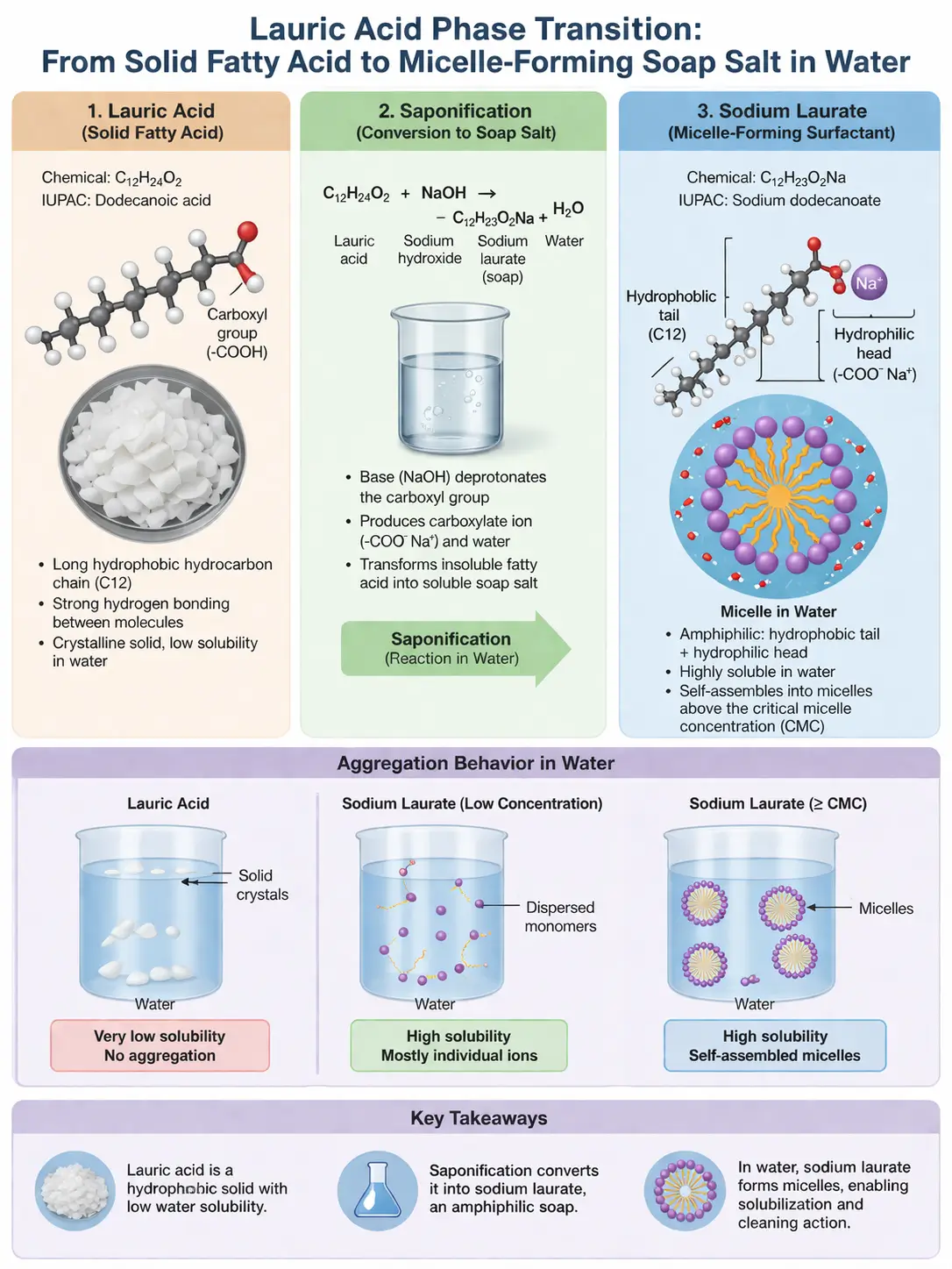
In its native acid form, it is non-ionic. However, during saponification, it reacts with an alkali such as sodium hydroxide or potassium hydroxide to form ionic soap salts, such as sodium laurate or potassium laurate, which act as active cleansing agents.
It is commonly derived from triglyceride-rich sources such as coconut oil and palm kernel oil, where it exists as part of a broader fatty acid distribution. During formulation, it may be introduced either as a pure fatty acid or through these natural oil inputs.
This dual identity, raw acid and converted soap salt, is essential to understanding how it behaves within formulation systems rather than as an isolated compound.
Functional Role in Soap Systems
Lauric acid plays a central role in defining cleansing strength and foam dynamics in soap-based systems. When converted into its salt form, it produces surfactant molecules with strong affinity for both water and oils, enabling efficient removal of surface contaminants.
One of its most defining contributions is rapid lather generation. Compared to longer-chain fatty acids, its salts dissolve more readily and form micelles quickly, leading to immediate foam formation upon contact with water.
It also contributes to cleansing intensity. The relatively shorter hydrocarbon chain allows for more aggressive interaction with lipids and soils, making it effective in formulations designed for higher removal efficiency.
In solid soap bars, it contributes to structural firmness. Its crystalline packing behavior supports harder bar formation, especially when balanced with longer-chain fatty acids that add durability and reduce solubility rate.
However, it does not significantly contribute to conditioning or emollient effects. Systems dominated by this fatty acid tend to prioritize cleansing and foam over residual skin feel or film formation.
In observable terms, formulations with higher proportions of this component tend to produce quicker foam, stronger cleansing sensation, and a cleaner rinse profile with reduced residual softness.
Ingredient Interaction Logic
The behavior of lauric acid within a formulation is not defined in isolation but through its interaction with other structural and functional components of the system.
Within soap matrices, it interacts with other fatty acid salts such as stearates and palmitates. While laurate salts contribute rapid solubility and foam generation, longer-chain salts provide structural stability and slower dissolution, creating a balance between performance and longevity.
In aqueous systems, its soap salts participate in micelle formation. These micelles encapsulate oils and particulate matter, allowing them to be suspended and removed during rinsing. The efficiency of this process depends on the surrounding water chemistry and total surfactant concentration.
When combined with humectants such as glycerin, the system behavior shifts. Glycerin can moderate the drying feel associated with strong cleansing systems, but it does not alter the underlying surfactant strength of laurate salts.
Interaction with chelating agents such as EDTA influences performance in hard water conditions. Without chelation, divalent ions like calcium can react with laurate salts to form insoluble residues, reducing effective cleansing performance.
Fragrance components may also interact with the micellar environment created by laurate salts. Volatile compounds can be solubilized within micelles, influencing fragrance release during use rather than remaining uniformly dispersed.
From a system perspective, this ingredient acts as a performance driver, but its final behavior is shaped by how it is balanced with structural fatty acids, water phase modifiers, and auxiliary additives.
In practical terms, this means that two formulations containing the same fatty acid can behave differently depending on how the surrounding system controls solubility, structure, and interaction with water minerals.
Phase Behavior and Physical Characteristics
Lauric acid exhibits distinct phase behavior depending on whether it is in its free acid form or converted soap salt form. In its acid state, it is a solid at room temperature with relatively low melting point compared to longer-chain fatty acids.
Upon saponification, its salts become water-dispersible and participate in micellar structures. These micelles form above a threshold concentration, allowing the system to transition from simple dispersion to active cleansing behavior.
Its relatively shorter carbon chain increases solubility compared to stearic or palmitic systems. This contributes to faster dissolution in water and quicker activation of cleansing performance.
However, in the presence of hard water ions such as calcium and magnesium, laurate salts can form insoluble complexes. These precipitates reduce clarity in liquid systems and can leave visible residue on surfaces.
Thermally, systems rich in this fatty acid tend to melt and soften faster than those dominated by longer-chain components. This influences both processing conditions and storage stability in solid formats.
In observable terms, this translates into faster bar wear during use, quicker foam activation, and potential residue formation in mineral-rich water environments.
Comparison With Related Fatty Acids
| Feature | Lauric Acid | Stearic Acid | Oleic Acid |
|---|---|---|---|
| Chain Length | Medium (C12) | Long (C18) | Long (C18, unsaturated) |
| Lather Behavior | Fast, high foam | Low, creamy foam | Low, stable foam |
| Cleansing Strength | High | Moderate | Lower |
| Bar Hardness Contribution | Moderate to high | Very high | Low |
| Solubility | Higher | Lower | Moderate |
This comparison highlights how chain length and saturation influence system behavior. Lauric acid favors rapid performance and solubility, while longer-chain fatty acids contribute durability and slower release characteristics.
Regulatory Context
Lauric acid is recognized as a standard cosmetic ingredient and is listed under its INCI name for labeling purposes. When used in formulations, it must be declared according to ingredient listing conventions based on concentration order in finished products.
Within the European Union framework, it is not classified as a restricted substance under Regulation (EC) No 1223/2009 for cosmetic products. Its use is governed by general safety and formulation compliance requirements rather than ingredient-specific limitations.
When present as part of natural oils, it may not appear individually on labels but contributes to the overall fatty acid profile of the formulation.
Its regulatory treatment reflects its role as a structural and functional ingredient rather than an active requiring specific claims or concentration thresholds.
Common Misunderstanding
A common misconception is that lauric acid itself acts directly as the cleansing agent in finished soap products. In reality, its functional role emerges after chemical conversion into soap salts during saponification.
The free fatty acid form does not exhibit the same surfactant behavior as its ionic salt counterpart. This distinction is critical for understanding why raw ingredient properties do not directly translate to finished product performance.
Another misunderstanding relates to source interpretation. While often associated with coconut-derived inputs, its behavior in formulations is governed by its molecular structure rather than its origin.
Structural Limitations in Formulation Systems
Lauric acid introduces several formulation constraints that must be balanced carefully within a system.
Its high solubility leads to faster consumption in solid bars, reducing longevity compared to systems dominated by longer-chain fatty acids.
In hard water conditions, its salts readily form insoluble complexes with calcium and magnesium ions. This can reduce effective surfactant availability and contribute to residue formation.
Its strong cleansing behavior, while functionally effective, can dominate the system if not moderated by conditioning or structural components, leading to imbalance in overall formulation performance.
It also provides limited contribution to emollient or conditioning properties, requiring complementary ingredients when a softer sensory profile is desired.
These limitations are not defects but inherent structural characteristics that define how it must be positioned within a balanced formulation.
Formulation References Using This Ingredient
Summary of Findings
- Classification: Saturated medium-chain fatty acid that functions as a precursor to anionic surfactants
- Primary Role: Drives rapid lather formation and strong cleansing behavior in soap systems
- Interaction Logic: Works in balance with longer-chain fatty acids, humectants, and chelators to define system performance
- Phase Behavior: Transitions from crystalline fatty acid to micelle-forming surfactant upon saponification
- Limitations: Sensitive to hard water ions, contributes to faster bar wear, and lacks conditioning contribution