Definition
Oleic Acid is a monounsaturated fatty acid belonging to the long-chain fatty acid group, commonly used in soap systems, detergent formulations and cosmetic formulations systems as a structure-modifying and fluidity-influencing component.
Within cleansing systems, it contributes to softer and more flexible structures compared to saturated fatty acids, affecting how the formulation interacts with water and surfaces.
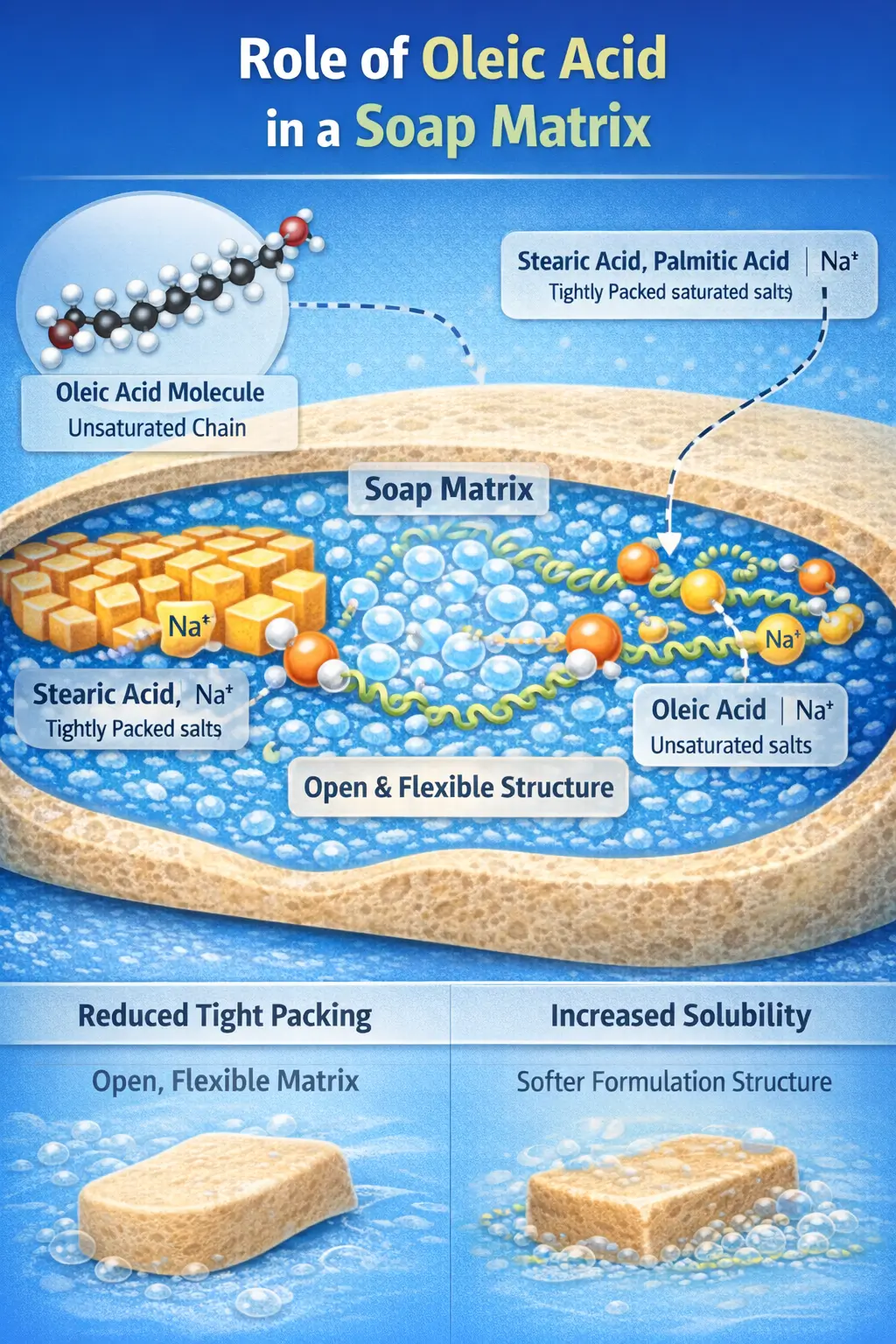
Its behavior is shaped by its unsaturated molecular structure, which reduces tight packing and alters solubility in water relative to more rigid fatty acid systems.
This page is part of the CleanFormulation Ingredient Library, a research-focused project examining how ingredients behave within real formulation systems.
Quick Facts
| Property | Description |
|---|---|
| Ingredient Type | Fatty acid component |
| Chemical Class | Monounsaturated long-chain fatty acid (C18:1) |
| Functional Role | Structure modifier, fluidity enhancer, texture regulator |
| Ionic Class | Non-ionic in free acid form, forms anionic salts after saponification |
| Solubility Profile | Low intrinsic solubility in water, increased dispersion after conversion to salts |
| Typical Use Context | Soap systems, detergent blends, cleansers, creams and emulsified cosmetic formulations |
| Chain Length | C18 carbon chain |
| Degree of Unsaturation | Monounsaturated (one double bond at Δ9 position) |
| Physical State | Liquid at room temperature |
| Melting Point | Approx. 13–16°C |
| HLB Contribution | Contributes to lower HLB systems; supports oil-phase fluidity in emulsions |
| Foaming Behavior | Reduces foam stability when present in higher proportions |
| Cleansing Profile | Mild cleansing with higher emolliency compared to saturated fatty acids |
| Skin Feel Impact | Provides soft, conditioning, and lubricating feel |
| Oxidative Stability | Moderate stability; prone to oxidation due to unsaturation |
| Compatibility | Compatible with most fatty acids, surfactants, and emulsifiers |
| pH Behavior | Neutral in free form; contributes to alkaline pH after saponification |
| Formulation Impact | Improves spreadability and reduces rigidity in structured systems |
| Source Variability | Commonly derived from vegetable oils such as olive oil, palm oil, and sunflower oil |
Why This Ingredient Appears on Labels
Oleic Acid appears on ingredient lists because it contributes to formulation structure and flow behavior rather than acting as a primary cleansing agent. In soap systems, it is converted into oleate salts that influence how the product interacts with water.
In creams and other cosmetic emulsions, it plays a role in modifying texture and spreadability, supporting a more fluid and adaptable system compared to rigid fatty acid structures.
In shampoo and liquid cleansing systems, its presence is typically linked to balancing formulation behavior, particularly where flexibility and dispersion are required.
From a system perspective, this translates into softer product structures, smoother application and a different interaction profile with water compared to saturated fatty acid-based systems.
Chemical Identity and Classification
Oleic Acid is chemically identified as a C18 monounsaturated fatty acid containing one double bond within its hydrocarbon chain. This structural feature distinguishes it from fully saturated fatty acids.
The presence of a double bond introduces a bend in the molecular structure, reducing the ability of molecules to pack tightly. This directly affects its structural behavior in formulations.
In its acid form, it is non-ionic. When reacted with an alkali, it forms oleate salts, which function as surface-active components within cleansing systems.
It is commonly derived from plant-based oils such as olive oil and other triglyceride sources, though its functional behavior is defined by its molecular structure rather than its origin.
This classification explains why it contributes to more flexible and less rigid systems compared to long-chain saturated fatty acids.
Functional Role in Soap Systems
Within soap systems, Oleic Acid contributes to flexibility and reduced structural rigidity compared to saturated fatty acids. When converted into oleate salts, it forms part of a more open and less densely packed matrix.
This structural difference affects how the product interacts with water. Systems with higher oleate content tend to dissolve more readily, leading to faster release of surface-active components.
In terms of lather behavior, oleate-based systems typically generate a looser and less stable foam compared to formulations dominated by saturated fatty acids. The reduced packing density limits foam persistence.
From a formulation standpoint, it is often used to balance rigid components, preventing excessive hardness or brittleness in solid soap systems.
In practical use, this translates into softer bars that wear down more quickly and produce a lighter, less dense lather during washing.
Ingredient Interaction Logic
The behavior of Oleic Acid is strongly influenced by how it interacts with other fatty acids and formulation components. Its unsaturated structure introduces flexibility into systems that might otherwise become overly rigid.
When combined with saturated fatty acids, it moderates structural density by reducing tight molecular packing. This interaction creates a balance between rigidity and usability within the formulation.
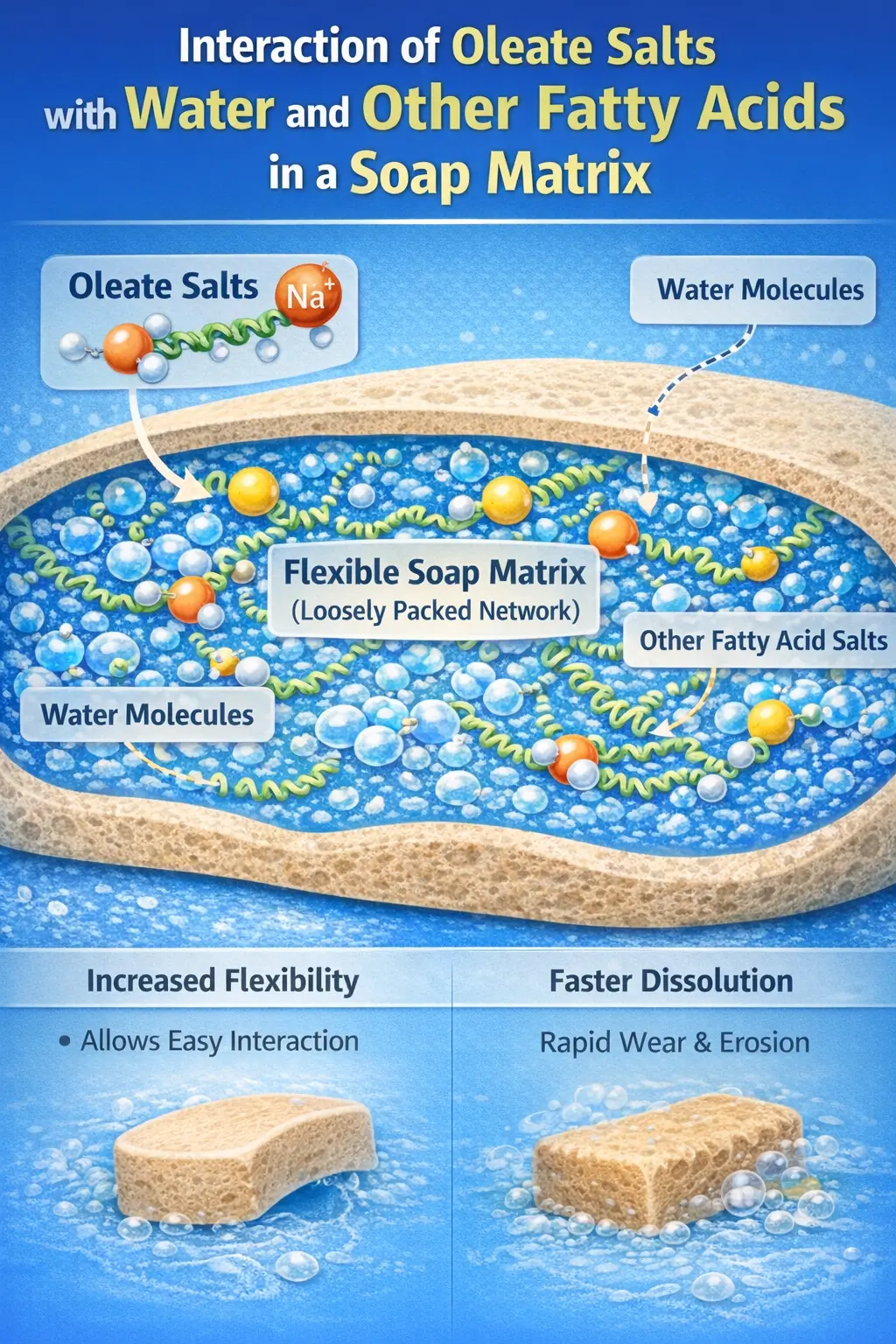
Its interaction with water is more dynamic than that of long-chain saturated fatty acids. While its intrinsic solubility in water remains low, its converted salts disperse more readily, supporting system-level functionality.
In emulsified cosmetic systems, it interacts with emulsifiers and co-structuring agents to influence internal phase distribution. It does not act as a primary emulsifier but contributes to system flexibility and spread behavior.
Fragrance and minor formulation components are influenced by the less rigid matrix it helps create, which can alter release characteristics during application.
These interactions define a system where structure, solubility and performance are governed by the balance between saturated and unsaturated components.
Phase Behavior
Oleic Acid exhibits limited solubility in water in its free acid form, but its behavior changes significantly after conversion into its salt form. This transformation increases its ability to disperse within aqueous systems.
The presence of a double bond reduces crystallization tendency, leading to less ordered structures compared to saturated fatty acids. This affects both physical stability and texture.
Temperature plays a role in its behavior, though it does not form highly rigid crystalline domains. Instead, it remains more fluid across a broader temperature range.
In emulsions, its phase behavior contributes to softer internal structures and improved spreadability rather than rigid stabilization.
This explains why formulations containing it tend to feel less solid, dissolve faster and exhibit more fluid system dynamics during use.
Comparison With Related Ingredients
| Feature | Oleic Acid | Linoleic Acid |
|---|---|---|
| Structure | Monounsaturated (one double bond) | Polyunsaturated (two double bonds) |
| Molecular Packing | Moderately disrupted | Highly disrupted |
| Solubility Behavior | Low water solubility, moderate dispersion after conversion | Lower structural stability, higher disruption of packing |
| Oxidation Stability | More stable | Less stable |
| Role in Formulations | Balances flexibility and structure | Increases fluidity but reduces stability |
This comparison highlights how increasing unsaturation affects structure, solubility behavior and overall formulation stability.
Regulatory Context
Oleic Acid is listed under its INCI name and is widely recognized across cosmetic and cleansing product regulations. It is not classified as an active substance but as a functional formulation component.
Under EU cosmetic regulation frameworks, it is permitted for use without specific concentration limits when used within standard formulation practices. Its classification is based on chemical identity rather than origin.
In ingredient labeling, it must be declared using its INCI designation, regardless of whether it is derived from plant oils or other sources.
Its presence across soap, detergent and cosmetic ingredient lists reflects its functional role in system design rather than any singular performance attribute.
Common Misunderstanding
A common misunderstanding is that Oleic Acid directly determines cleansing strength in soap or detergent systems. In practice, its contribution to cleansing is secondary compared to more active surfactant components.
Its primary role lies in modifying structure and influencing how the formulation behaves in contact with water, rather than acting as a dominant cleaning agent.
Another misconception is that higher levels always improve formulation performance. In reality, excessive presence can disrupt structural balance and reduce overall system stability.
Understanding its role as a structural and behavioral modifier helps clarify why it is included in controlled proportions within formulations.
Structural Limitations
One limitation of Oleic Acid is its tendency to reduce structural rigidity in solid systems. This can lead to softer products that dissolve more quickly when exposed to water.
Its unsaturated structure also makes it more susceptible to oxidative changes compared to saturated fatty acids, which can affect long-term formulation stability.
In liquid systems, excessive use may result in overly fluid textures or reduced viscosity control, particularly if not balanced with structuring agents.
Its limited intrinsic solubility in water means that its functional performance depends on conversion into its salt form within the formulation.
From a user perspective, this may appear as faster product wear, softer texture or reduced structural firmness during use.
Summary of Findings
Oleic Acid is a monounsaturated long-chain fatty acid that functions primarily as a structure-modifying component within soap, detergent and cosmetic systems.
- Classification: Monounsaturated fatty acid within the fatty acids subcategory.
- Functional Role: Modifies structure, enhances flexibility and influences formulation flow behavior.
- Interaction Logic: Balances rigid fatty acids by reducing molecular packing density.
- Phase Behavior: Exhibits low intrinsic solubility in water with reduced crystallization tendency.
- System Boundaries: Limited by reduced rigidity, oxidation sensitivity and dependence on salt formation.