Ingredient Definition
Lard is an animal derived triglyceride fat obtained primarily from porcine adipose tissue. Within cosmetic and soap formulation systems it functions as a lipid base material composed of fatty acid esters bound to glycerol. In ingredient labeling contexts it may appear as Lard or under broader fat classifications depending on formulation disclosure practices.
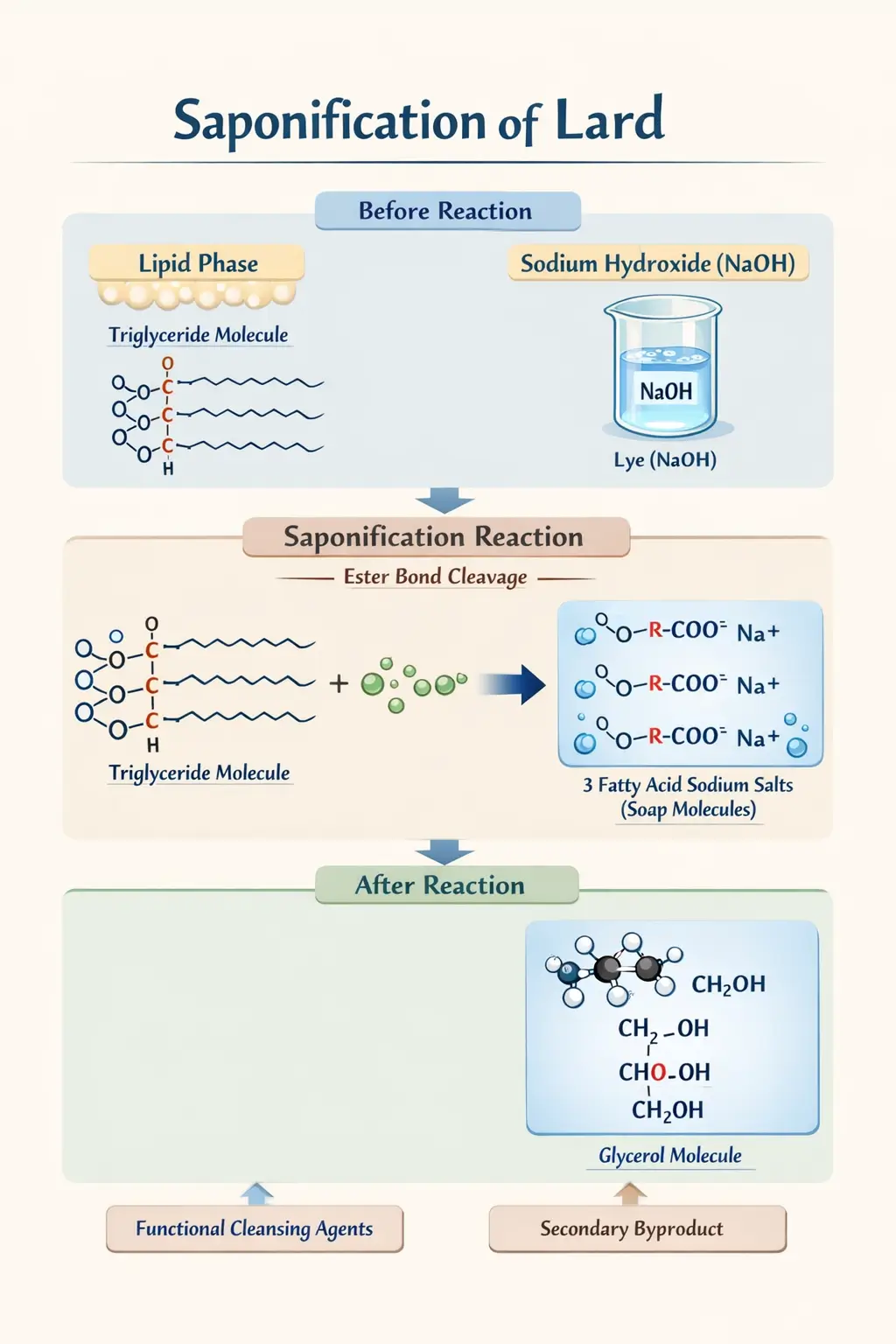
In cleansing systems such as lard in soap or traditional lard shampoo bar formulations, the material serves as a foundational oil phase that undergoes alkaline transformation when exposed to lye. This reaction converts triglyceride molecules into fatty acid salts that act as the active cleansing components. In non saponified systems such as lard lotion structures, the fat remains intact and behaves as a hydrophobic lipid phase contributing to texture and occlusive film formation. The general saponification reaction for a triglyceride like lard can be represented as:
(C17H35COO)3C3H5 + 3NaOH → 3C17H35COONa + C3H5(OH)3
This page belongs to the CleanFormulation Ingredient Library, a research project focused on analyzing how ingredients behave inside real cleansing formulations rather than evaluating products or providing dermatological guidance.
Quick Facts
| Property | Description |
|---|---|
| Ingredient Type | Animal derived fat |
| Chemical Class | Triglyceride lipid composed of saturated and unsaturated fatty acids |
| Functional Role | Soap base precursor, structural lipid phase, texture modifier in emulsions |
| Ionic Class | Non ionic prior to saponification |
| Typical Use Context | Bar soap systems, lard shampoo bar formulations, traditional lye based soap processes, lipid phase in emulsions |
Ingredient Interaction Logic
The behavior of lard within formulations is defined by its interaction with other components rather than by isolated properties. The most critical interaction occurs with alkaline agents such as sodium hydroxide or potassium hydroxide during soap production. These compounds initiate the hydrolysis of triglycerides, leading to the formation of fatty acid salts and glycerol.
Water acts as the medium that enables this reaction, allowing the oil phase and alkaline phase to come into contact. Initially, lard exists as dispersed lipid domains within the aqueous environment. As saponification progresses, amphiphilic molecules begin to form and organize into structures capable of interacting with both hydrophobic and hydrophilic substances.
In multi ingredient systems, humectants such as glycerin influence the hydration dynamics of the formulation. Glycerin may be generated during the reaction itself or added separately, affecting water retention and modifying the internal structure of the soap matrix.
In liquid cleansing systems where lard is not fully converted, surfactants and emulsifiers play a key role in stabilizing the oil phase. These components surround lipid droplets, preventing separation and enabling the oil to remain dispersed within the aqueous system.
Fragrance materials can also interact with the lipid phase. Because lard has its own inherent odor profile, it may influence how added fragrance components are perceived within the final formulation.
Why This Ingredient Appears on Labels
Lard appears on ingredient labels primarily because it serves as a base lipid within certain cleansing and emulsion systems. In traditional soap manufacturing, particularly in lard soap recipe with lye processes, the fat is introduced as a raw material that reacts during production. Even though the original triglyceride structure is altered during saponification, labeling practices may still reflect the starting ingredient depending on formulation disclosure conventions.
In products such as lard shampoo bar systems, the presence of lard indicates that the cleansing matrix originates from animal derived triglycerides rather than plant oils or synthetic surfactants. The fatty acid composition contributes to how the resulting soap behaves during use, including foam formation and structural integrity of the bar.
In non soap systems such as lard lotion formulations, the ingredient appears on labels because it remains chemically intact within the formulation. In this context it functions as a lipid phase that interacts with emulsifiers and water to form a semi structured system rather than undergoing chemical transformation.
The appearance of lard on labels therefore reflects its role as either a reactive precursor in soap systems or a retained lipid component in emulsion based formulations.
Chemical Identity and Classification
Lard is a triglyceride based lipid derived from animal adipose tissue, primarily composed of glycerol esterified with a mixture of fatty acids. In cosmetic ingredient terminology, it may be declared simply as Lard, although standardized INCI naming can vary depending on processing and refinement. From a formulation perspective, it belongs to the broader class of neutral lipids that function as oil phase components in both soap and emulsion systems.
The fatty acid composition of lard typically includes palmitic acid, stearic acid, oleic acid and smaller proportions of linoleic acid. This combination results in a semi solid material at room temperature, reflecting a balance between saturated and unsaturated fatty acid chains. Saturated components contribute to structural rigidity, while unsaturated components influence spreadability and melting behavior.
Prior to chemical transformation, lard behaves as a non ionic substance with no inherent surfactant activity. The triglyceride molecules do not possess hydrophilic and hydrophobic regions required for interaction with water and oils simultaneously. However, during lye driven saponification, these molecules are converted into fatty acid salts that exhibit amphiphilic behavior, forming the active cleansing matrix within soap systems.
Because of this transformation pathway, lard is best understood not as a surfactant itself but as a precursor that becomes part of the surfactant system after chemical conversion.
Functional Role in Soap Systems
In soap systems, lard plays a central role as a structural lipid input that determines the physical and functional characteristics of the final product. When used in lard in soap formulations, the triglyceride structure undergoes reaction with lye, producing sodium or potassium salts of fatty acids. These salts act as the cleansing agents responsible for interacting with oils and water during washing.
The fatty acid profile of lard leads to the formation of soap with relatively stable bar structure and moderate hardness. Palmitic and stearic acid derivatives contribute to structural integrity, allowing the soap to maintain its shape over time. Oleic acid derivatives introduce a softer component, influencing how the bar responds to repeated wetting and drying cycles.
Foam characteristics in lard based soap systems are typically described as stable and low to moderate in volume. Unlike oils rich in shorter chain fatty acids, lard does not produce rapid or highly voluminous lather. Instead, it contributes to a denser and more persistent foam structure that develops gradually during use.
In lard shampoo bar formulations, the same principles apply. The resulting soap matrix forms the cleansing base, while additional formulation components may be introduced to adjust performance characteristics such as foam behavior or bar durability.
When incorporated into emulsion systems such as lard lotion formulations, the fat does not undergo saponification. Instead, it acts as part of the oil phase, influencing viscosity, spread behavior and film formation on surfaces. In this context, its role shifts from reactive precursor to structural lipid component.
Phase Behavior in Cleansing Formulations
Lard exhibits characteristic phase behavior associated with triglyceride fats. At room temperature it typically exists as a semi solid material due to the presence of both saturated and unsaturated fatty acids. This semi crystalline structure influences how the material melts and integrates into formulations.
When heated, lard transitions into a liquid oil phase that can be mixed with other formulation components. During soap production, elevated temperature facilitates interaction between the lipid phase and the aqueous alkaline phase, improving reaction efficiency.
As saponification proceeds, the original triglyceride structure is replaced by fatty acid salts that form organized crystalline and semi crystalline domains within the soap matrix. These domains contribute to the hardness and durability of the finished bar.
In non reactive systems such as emulsions, lard remains as a hydrophobic phase dispersed within water. Stability depends on emulsification mechanisms, droplet size distribution and viscosity of the surrounding aqueous phase. Without proper stabilization, phase separation can occur due to the inherent immiscibility of lipids and water.
Regulatory Context
Within cosmetic labeling systems, lard may be declared using its common name or under standardized ingredient naming conventions depending on the jurisdiction and level of processing. In the European Union, ingredient labeling follows the International Nomenclature of Cosmetic Ingredients framework, where materials are listed according to recognized naming standards under Regulation EC No 1223 2009.
Ingredients are required to be listed in descending order of concentration at the time of formulation. As a result, lard appears in ingredient lists based on its relative proportion within the formulation rather than its functional transformation during processing.
Regulatory databases such as the European Commission CosIng database provide classification and description of cosmetic ingredients used within formulations. These references support consistent naming practices across products marketed within regulated regions.
In products where lard undergoes saponification, labeling may reflect either the starting material or the resulting soap depending on formulation disclosure practices and regional requirements. This variability highlights the importance of understanding ingredient role within the formulation rather than relying solely on label terminology.
Common Misunderstanding
A common misunderstanding is that lard itself acts as the cleansing agent in soap. In practice, raw triglyceride fats do not possess surfactant properties. The cleansing function arises only after the fat reacts with lye during the saponification process, producing fatty acid salts capable of interacting with oils and water.
Another misconception relates to the assumption that the presence of lard on a label always indicates unchanged fat within the product. In many soap systems, the original triglyceride structure is no longer present in its initial form after processing, even though the ingredient may still be referenced based on formulation inputs.
Structural Limitations in Formulation
Lard presents certain formulation limitations that must be considered during product development. One limitation relates to oxidative stability. The presence of unsaturated fatty acids means that the material can undergo gradual oxidation when exposed to environmental factors such as oxygen and light, potentially altering odor characteristics over time.
Another limitation involves formulation balance in soap systems. While lard contributes to structural integrity, it does not independently provide the full range of properties required for all cleansing systems. Formulators often combine it with other fats or oils to adjust lather behavior, hardness and overall performance.
In emulsion systems, the hydrophobic nature of lard requires effective emulsification to maintain stability. Without appropriate emulsifiers or stabilizing systems, phase separation can occur due to incompatibility between oil and water phases.
Formulation References Using This Ingredient
Summary of Findings
- Chemical Classification: Lard is a triglyceride based animal fat composed of fatty acids esterified with glycerol.
- Formulation Role: It functions as a precursor to soap salts in lye based systems and as a structural lipid phase in emulsion formulations.
- Interaction Logic: The ingredient reacts with alkaline agents during saponification and interacts with surfactants, water and emulsifiers in multi component systems.
- Phase Behavior: It exists as a semi solid lipid phase that transitions to liquid upon heating and forms structured matrices after chemical conversion.
- System Boundaries: Oxidative sensitivity and the need for formulation balance influence how lard is incorporated into cleansing systems.