Definition and System Role
Cocoa butter is a triglyceride-based lipid classified as a vegetable fat, used in soap and cosmetic formulations as a structural and emollient component that influences bar firmness, texture, and phase behavior.
It is composed primarily of saturated and monounsaturated fatty acid triglycerides, which remain solid at room temperature but melt near skin temperature. This transition behavior defines how it performs inside formulations.
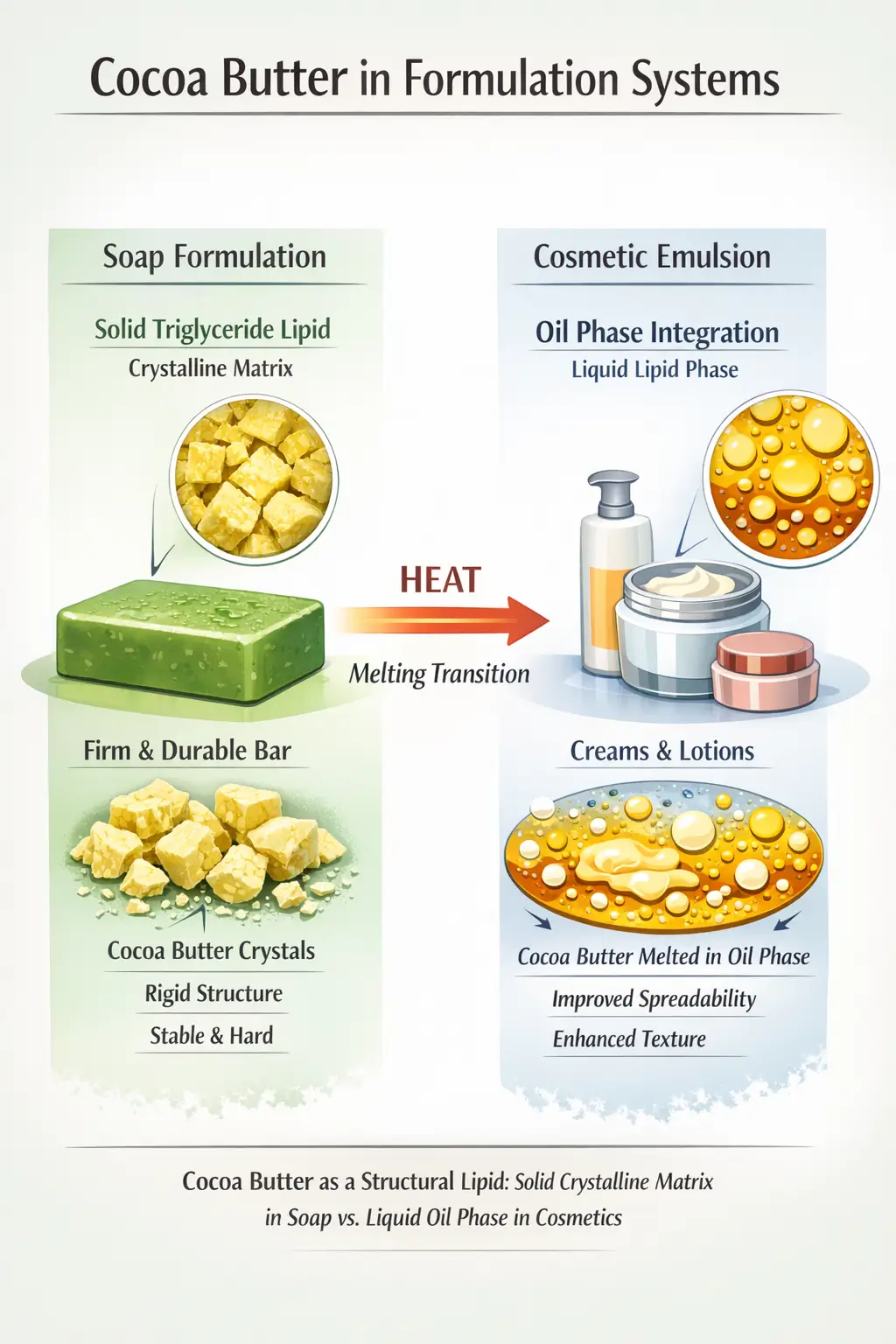
In soap systems, it contributes to the formation of a more rigid matrix, while in emulsified products it acts as a lipid phase component that modifies spreadability and consistency.
This page is part of the CleanFormulation Ingredient Library, a research-focused system examining how ingredients behave within real formulation environments rather than in isolation.
Quick Facts
| Property | Description |
|---|---|
| Ingredient Type | Lipid-based structural component |
| Chemical Class | Triglyceride mixture (primarily saturated and monounsaturated fatty acids) |
| INCI Name | Theobroma Cacao Seed Butter |
| CAS Number | 8002-31-1 |
| Primary Function | Structural fat and emollient phase contributor |
| Secondary Function | Occlusive agent, skin conditioning agent, viscosity builder |
| Physical State | Semi-solid at room temperature |
| Melting Range | ~30°C – 36°C (near skin temperature) |
| Typical Use Context | Soap bars, creams, lotions, balms, and conditioning systems |
| Solubility | Insoluble in water, dispersible in oil phase |
| Fatty Acid Composition | Rich in stearic, palmitic, and oleic acids |
| Crystallization Behavior | Polymorphic; forms stable β-crystals influencing texture and firmness |
| Skin Feel | Rich, smooth, non-greasy with moderate absorption rate |
| Barrier Function | Forms protective film reducing transepidermal water loss (TEWL) |
| Oxidative Stability | Relatively stable due to saturated fat content; resistant to rancidity |
| Comedogenicity | Moderate (may clog pores in high concentrations for some skin types) |
| Compatibility | Compatible with most oils, waxes, emulsifiers, and surfactant systems |
| Processing Consideration | Requires controlled heating to avoid graininess due to uneven crystallization |
| Usage Level | 2% – 20% depending on product type (higher in balms and bars) |
| Source | Extracted from cocoa beans (Theobroma cacao) |
| Appearance | Pale yellow to off-white solid fat |
| Odor | Mild characteristic chocolate aroma |
| Formulation Role in Systems | Provides structure, enhances texture, improves emolliency, and stabilizes oil phase |
Why This Ingredient Appears on Labels
Cocoa butter appears on ingredient lists because it functions as a lipid component that shapes the physical structure and texture of the formulation.
In soap bars, it contributes to a denser and more stable matrix by increasing the proportion of higher-melting triglycerides. This affects how the bar holds its shape during use and storage.
In creams and lotions, it forms part of the oil phase, influencing thickness and spreadability when applied. Its melting behavior allows it to transition during application, altering how the product feels on the surface.
For consumers reading labels, its presence reflects a formulation choice related to structure, consistency, and phase balance, rather than a direct cleansing function.
Chemical Identity and Classification
Cocoa butter is identified as a natural lipid composed of triglycerides, primarily derived from the fat fraction of cocoa beans. In ingredient declarations, it may appear as “Theobroma Cacao Seed Butter,” reflecting its botanical origin.
Chemically, it belongs to the class of triacylglycerols, which are esters formed from glycerol and fatty acids. The dominant fatty acids include stearic acid, palmitic acid, and oleic acid, arranged in specific combinations that define its physical behavior.
Unlike free fatty acids used in soap formation, these triglycerides remain intact until they undergo reaction with sodium hydroxide during saponification. This distinction is important because the ingredient enters the formulation as a lipid but may transform depending on the system.
Its classification is therefore dual-context. Before reaction, it functions as a structural fat. After reaction in soap systems, it contributes to the formation of sodium salts that influence hardness and durability.
Functional Role in Soap Systems
In soap bars, cocoa butter contributes to the formation of a firm and stable matrix due to its relatively high proportion of saturated fatty acids. These components create a tighter crystalline network when converted into soap salts.
This structural contribution influences how the bar behaves during use. A formulation containing cocoa butter tends to resist rapid softening and maintains its shape more effectively in wet conditions.
Its presence also modifies lather behavior. Compared to more soluble fatty acid sources, it contributes less to immediate foam generation, resulting in a denser and slower-forming lather profile.
In non-soap systems such as creams and lotions, it acts as part of the oil phase, influencing viscosity and application spread. Its melting range allows it to soften upon contact, altering perceived texture without dissolving.
In practical terms, this means formulations containing cocoa butter often feel more structured at rest but soften during use, creating a balance between stability and application behavior.
Ingredient Interaction Logic
Cocoa butter interacts primarily within the lipid phase of a formulation, but its influence extends to the overall system through structural and phase relationships.
In soapmaking, it reacts with alkaline agents to form soap salts. The resulting composition depends on its fatty acid distribution, which contributes to the final bar’s hardness and resistance to dissolution.
When blended with other oils such as more unsaturated triglycerides, it helps balance structural rigidity with fluidity. This interaction allows formulators to adjust properties such as hardness, lather, and longevity without relying on a single lipid source.
In emulsified systems, it integrates into the oil phase alongside other lipids and interacts with emulsifiers to form stable dispersions. Its relatively high melting point influences how the emulsion behaves under temperature changes.
It also interacts indirectly with water by resisting dispersion, which affects how quickly a formulation hydrates or breaks down during use.
Phase Behavior and Physical Characteristics
Cocoa butter exhibits a well-defined melting range, transitioning from a solid to a liquid state over a narrow temperature window. This behavior is central to its role in both solid and semi-solid formulations.
It forms crystalline structures when cooled, and these structures can exist in different arrangements depending on processing conditions. This variability influences texture, firmness, and stability.
In soap bars, the crystalline structure contributes to rigidity and resistance to deformation. In creams and lotions, it affects thickness and consistency, particularly in temperature-sensitive environments.
Because it is insoluble in water, it remains within the lipid phase and does not dissolve during use. Instead, it softens and disperses gradually, influencing how the formulation changes during application.
From a formulation perspective, this results in a system that is stable at rest but responsive to temperature and mechanical interaction during use.
Comparison With Related Lipid Ingredients
Cocoa butter is often compared with other solid lipids used in cleansing and cosmetic formulations. While these ingredients share a triglyceride base, their fatty acid distribution leads to different structural outcomes.
| Feature | Cocoa Butter | Shea Butter |
|---|---|---|
| Dominant Structure | More crystalline, tightly packed lipid matrix | More amorphous and flexible lipid structure |
| Melting Behavior | Narrow melting range near skin temperature | Broader melting range with softer transition |
| Effect in Soap | Increases hardness and bar durability | Contributes to softness and conditioning feel |
| Phase Stability | More sensitive to crystallization patterns | More tolerant to formulation variation |
| Use Context | Structural lipid component in soap and creams | Flexible emollient component in cosmetic systems |
Regulatory Context
Cocoa butter is listed in ingredient declarations under the INCI name “Theobroma Cacao Seed Butter.” It is recognized as a standard cosmetic ingredient and does not fall under restricted substance lists when used within conventional formulation practices.
Within the European Union cosmetic framework, it is treated as a raw material contributing to formulation structure rather than as an active component associated with specific claims.
Its classification remains consistent across rinse-off and leave-on systems, where it functions as a lipid phase contributor. Regulatory focus remains on overall product compliance rather than the ingredient in isolation.
In soap formulations, its presence is reflected through its role as a triglyceride source that participates in saponification, rather than requiring separate regulatory categorization.
Common Misunderstanding
Cocoa butter is often assumed to act primarily as a skin-conditioning or “nourishing” component. In formulation terms, its primary role is structural rather than functional in a biological sense.
Its contribution is defined by how it behaves within the formulation matrix, influencing texture, melting behavior, and stability. These effects may alter how a product feels during use, but they do not represent a direct functional action beyond formulation performance.
Another misconception is that higher amounts always improve product quality. In practice, excessive inclusion can disrupt balance by increasing rigidity or reducing lather efficiency in soap systems.
Structural Limitations
Cocoa butter exhibits polymorphic behavior, meaning it can form different crystalline structures depending on cooling and processing conditions. These variations can influence texture and stability over time.
In soap formulations, high concentrations may reduce lather efficiency due to the increased presence of less soluble fatty acid salts. This can result in slower foam formation during use.
Its relatively narrow melting range also introduces sensitivity to temperature fluctuations. In warmer environments, partial softening may occur, affecting product consistency.
Additionally, because it is insoluble in water, it does not contribute to cleansing directly and must be balanced with surfactant or soap components that perform the primary cleaning function.
Summary of Findings
- Classification: Cocoa butter is a triglyceride-based vegetable fat used as a structural lipid component in formulation systems.
- Functional Role: It contributes to bar hardness, formulation stability, and texture through its crystalline lipid structure.
- Interaction Logic: Interacts with alkaline agents during saponification and with other lipids to balance rigidity and flexibility.
- System Boundaries: Performance depends on concentration, crystallization behavior, and interaction with other formulation components.