Definition and System Role
Potassium Hydroxide is a strong alkaline compound belonging to the class of hydroxide bases, used in cleansing formulations primarily for saponification and pH control.
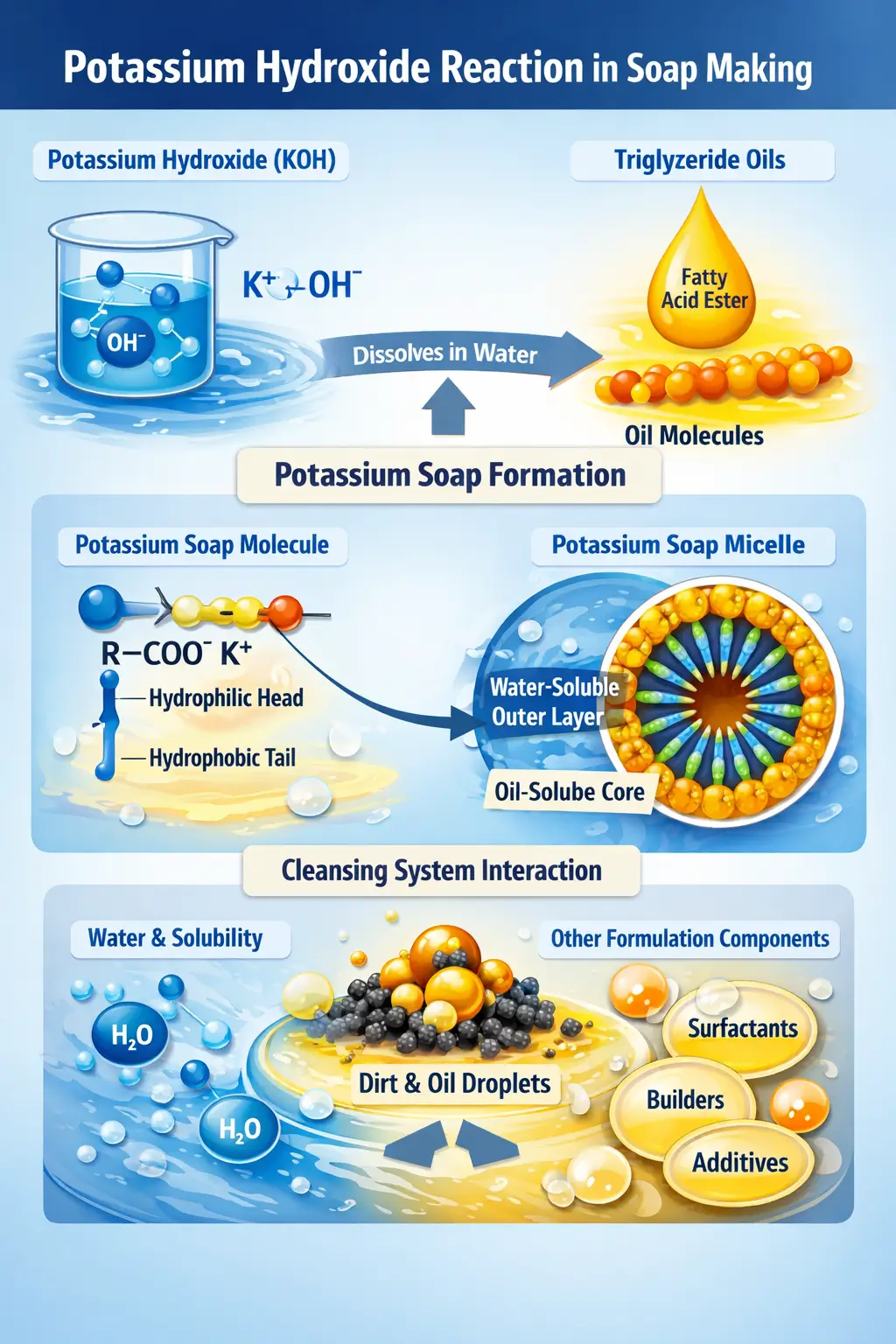
Within soap systems, it reacts with triglyceride oils to form potassium soap salts, which differ structurally from sodium-based soaps produced using sodium hydroxide.
This distinction directly influences the physical behavior of the final product, leading to softer or liquid soap systems rather than rigid bar structures.
The page is part of the CleanFormulation Ingredient Library, a research project focused on analyzing how ingredients behave within real formulation systems.
Quick Formulation Facts
| Property | Description |
|---|---|
| Ingredient Type | Alkaline agent |
| Chemical Class | Inorganic hydroxide base |
| Functional Role | Saponification agent, pH regulator |
| Ionic Character | Strongly alkaline, dissociates into potassium and hydroxide ions |
| Typical Use Context | Liquid soap, soft soap, cosmetic cleansing systems |
| Solubility | Highly soluble in water |
| Primary Reaction | Reacts with fatty acids to form potassium soap salts |
| Cleansing Role | Indirect, enables formation of soap rather than acting as a surfactant itself |
| Physical Influence | Leads to softer or liquid soap systems |
| Formulation Dependency | Requires oils or fatty acids for functional role |
| Dissociation Strength | Fully dissociates in aqueous phase producing high hydroxide ion concentration |
| pH Contribution | Generates highly alkaline systems typically above pH 13 |
| Reaction Mechanism | Base-catalyzed hydrolysis of triglycerides (saponification reaction) |
| Reaction Speed | Fast reaction kinetics under typical formulation temperatures |
| Soap Solubility Outcome | Produces potassium soaps with higher water solubility than sodium-based soaps |
| Foam System Impact | Supports formation of more soluble, quicker-rinsing lather |
| Water Interaction | Dissolution is strongly exothermic, releasing heat into the system |
| Phase Behavior | Operates entirely in aqueous phase during reaction and mixing |
| Air Sensitivity | Absorbs carbon dioxide forming potassium carbonate over time |
| Moisture Interaction | Highly hygroscopic, absorbs water from environment affecting stability |
| Compatibility Constraint | Reacts with acidic components, requiring separation in formulation design |
| Processing Control | Requires controlled dilution and staged addition to prevent localized overreaction |
| Formulation Stage Role | Used during primary reaction stage, not as a post-additive |
| Residual Presence | Ideally fully consumed; minimal free alkali remains in finished product |
| System Limitation | Excess leads to overly alkaline, potentially unstable or harsh systems |
| Comparison to Sodium Hydroxide | Produces softer, more soluble soap systems compared to harder sodium soaps |
| Hard Water Interaction | Potassium soaps formed show slightly improved solubility in hard water conditions |
Why This Ingredient Appears on Labels
Potassium Hydroxide appears in ingredient lists because it is used during formulation to enable the conversion of oils into soap through chemical reaction.
Even though its primary role occurs during processing, it may still be listed depending on labeling conventions explained in the ingredient list interpretation guide.
In many formulations, its presence indicates that a saponification process has been used rather than a purely synthetic surfactant system.
This provides context about how the cleansing system is structured, rather than indicating a standalone functional role in the final product.
Chemical Identity and Classification
Potassium Hydroxide is an inorganic alkaline compound with the chemical formula KOH, commonly classified within the group of strong hydroxide bases.
In aqueous environments, it dissociates into potassium ions and hydroxide ions, creating a highly alkaline system that can drive chemical reactions such as saponification.
Its INCI designation is identical to its chemical name, reflecting its straightforward classification within formulation systems.
Unlike surfactants, it does not reduce surface tension or form micelles, but instead enables the formation of cleansing agents through reaction with fatty materials.
Functional Role in Soap and Cosmetic Systems
The primary function of Potassium Hydroxide in formulation systems is to initiate and sustain the saponification reaction that converts triglyceride oils into potassium soap salts.
Role in Saponification
When combined with oils such as palm oil or palm kernel oil, it reacts with fatty acid chains to produce potassium-based soap molecules.
These resulting soap salts are more soluble in water compared to sodium-based equivalents, leading to a different physical behavior in the final formulation.
Influence on Product Form
This increased solubility contributes to the formation of liquid or soft soap systems rather than solid bar soaps.
In observable terms, this results in formulations that are easier to dissolve, spread and rinse during use.
pH Adjustment Function
Potassium Hydroxide also plays a role in establishing and maintaining alkaline pH conditions within a formulation, which influences how fatty acids and other components behave.
This is part of a broader alkaline formulation system that defines soap chemistry.
Non-Surfactant Nature
It is important to distinguish that Potassium Hydroxide itself is not a cleansing agent. The cleansing function emerges only after it reacts to form soap salts.
Ingredient Interaction Logic
Potassium Hydroxide operates within a formulation through interactions with oils, water and other system components rather than acting independently.
Interaction with Oils and Fatty Acids
Its most critical interaction occurs with triglycerides and free fatty acids, where it breaks ester bonds and forms potassium salts of fatty acids.
This reaction defines the transformation from raw oil into a functional cleansing system.
Interaction with Water Phase
In water, Potassium Hydroxide dissolves rapidly, creating a strongly alkaline environment that facilitates chemical conversion processes.
The availability of water determines how effectively the reaction proceeds and how uniformly the system develops.
Interaction with Soap Matrix
The resulting potassium soap integrates into the aqueous phase, forming a system that can interact with oils and dirt through mechanisms enabled by surfactant-like behavior of soap molecules.
Interaction with Additives
Other formulation components such as fragrance systems or colorants are incorporated after or alongside the saponification process.
Their behavior depends on the structure of the soap matrix formed through the alkaline reaction.
Phase Behavior and Physical Characteristics
Potassium Hydroxide exhibits distinct behavior across formulation phases, primarily due to its high solubility and strong alkalinity.
Solubility in Water
It dissolves completely in water, forming a homogeneous alkaline solution that acts as the reactive medium for saponification.
Absence in Oil Phase
It does not dissolve in oil phases, meaning its interaction with oils occurs at the interface where aqueous and lipid components meet.
Transformation During Reaction
As the reaction proceeds, Potassium Hydroxide is consumed and converted into soap salts, altering the composition of the system over time.
This transition from reactive base to structured soap matrix is central to how the formulation evolves.
System Outcome
The final phase behavior is dominated by potassium soap, which remains more fluid and water-compatible compared to sodium-based systems.
This leads to products that maintain a softer consistency and disperse more readily in water.
Comparison With Sodium Hydroxide
Potassium Hydroxide and sodium hydroxide are both strong alkaline agents used in soap formulation, but they produce different types of soap systems due to differences in solubility and ionic behavior.
| Feature | Potassium Hydroxide | Sodium Hydroxide |
|---|---|---|
| Chemical Formula | KOH | NaOH |
| Soap Type Produced | Potassium soap | Sodium soap |
| Solubility of Soap | Higher | Lower |
| Physical Form | Liquid or soft soap | Solid bar soap |
| Dissolution Behavior | Faster in water | Slower in water |
| Typical Applications | Liquid cleansers, soft soaps | Bar soaps |
This distinction explains why Potassium Hydroxide is commonly used when fluid or gel-like cleansing systems are required.
Regulatory Context
Potassium Hydroxide is regulated as an ingredient within cosmetic and cleaning formulations under established regulatory frameworks.
Its use is evaluated within the context of the final formulation, particularly considering its role in processing and transformation during saponification.
In ingredient labeling, it may appear directly by name depending on formulation and regulatory requirements, as explained in the ingredient list interpretation guide.
Common Misunderstanding
A common misconception is that Potassium Hydroxide acts as a cleansing agent in its own right.
In reality, it functions as a reaction agent that enables the formation of soap. The actual cleansing action comes from the soap molecules produced during saponification.
Another misunderstanding is that it is interchangeable with sodium hydroxide. While both are alkaline agents, their resulting soap systems differ significantly in physical form and behavior.
Formulation Considerations and Limitations
- Requires reaction: does not function without interaction with oils or fatty acids.
- Strong alkalinity: must be controlled within formulation systems.
- System dependency: performance depends on formulation composition and reaction conditions.
- Transient role: primarily active during formulation rather than as a final functional component.
These characteristics highlight that Potassium Hydroxide is a process-driven ingredient whose role is defined by transformation rather than direct functional activity.
Formulation References Using This Ingredient
- Can You Make Soap Without Lye
- What Is Castile Soap? Definition, Composition, Properties, and Practical Uses
- What Is Pacha Soap Made Of? Ingredient Breakdown & Formulation Context Analysis
- Lard in Soap, Shampoo Bars and Lotion
- Laurel Oil in Soap & Cleansers
- Liquid Lye Soap
- Amish Soap Ingredients Analysis
- Cold Process Soap vs Hot Process Soap
Summary of Findings
- Classification: Potassium Hydroxide is a strong alkaline hydroxide base.
- Functional Role: It enables saponification and pH control in formulation systems.
- Cleansing Role: It does not directly clean but enables soap formation.
- System Outcome: Produces more soluble potassium soaps, leading to liquid or soft formulations.
- Comparison: Differs from sodium hydroxide in resulting product structure and behavior.