Definition and System Role
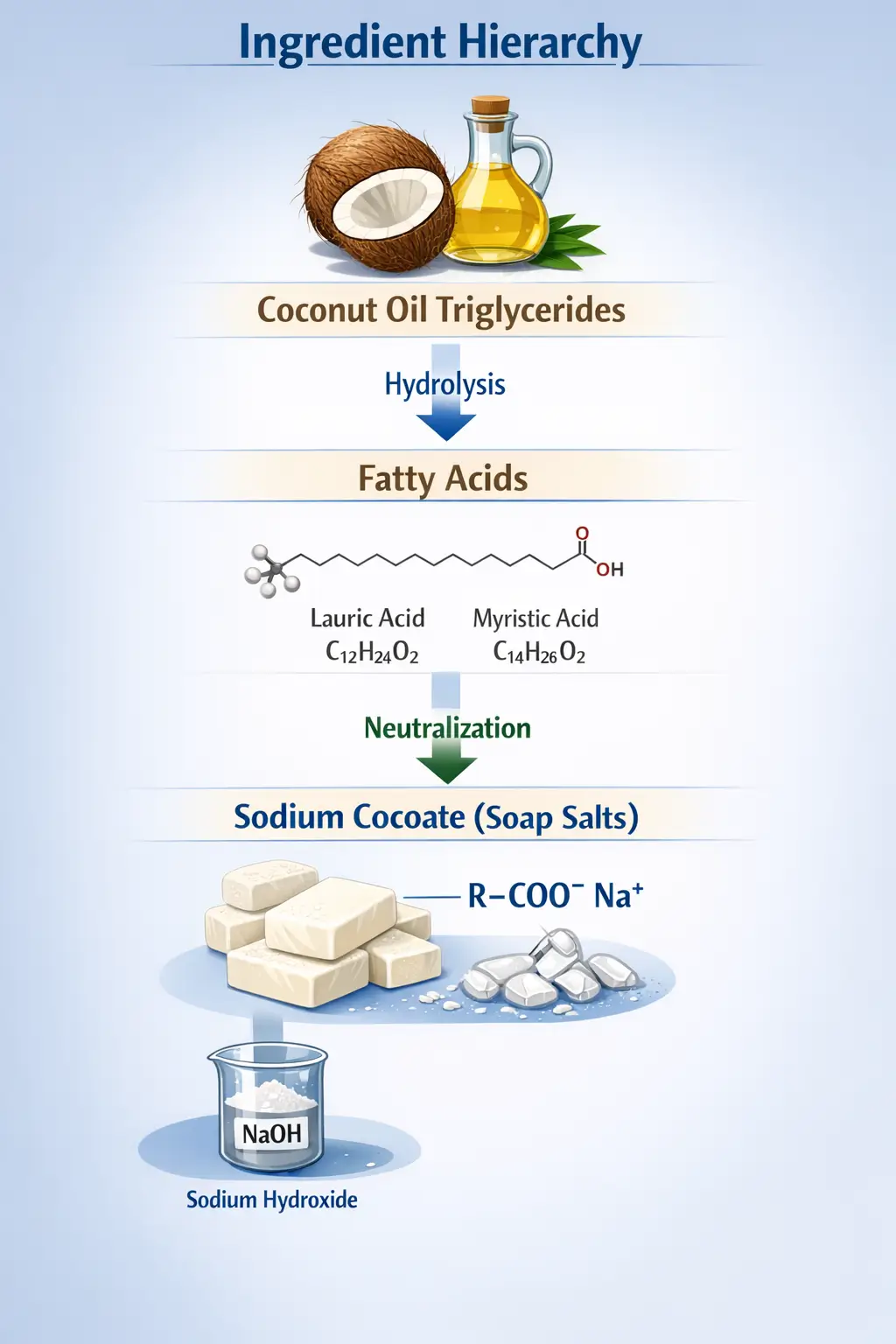
Sodium Cocoate is a soap base ingredient consisting of sodium salts of fatty acids derived from coconut oil. It functions as a primary cleansing agent in solid soap systems.
It belongs to the broader class of alkali-derived fatty acid salts formed through saponification, where triglycerides react with an alkaline agent.
This reaction typically involves Sodium Hydroxide, converting coconut oil fatty acids into water-soluble sodium salts.
In finished formulations, Sodium Cocoate defines core behavior such as lather formation, cleansing strength, and bar solubility.
Within the CleanFormulation Ingredient Library, this page explains how Sodium Cocoate behaves inside real soap systems rather than evaluating it in isolation.
Quick Facts
| Property | Description |
|---|---|
| INCI Name | Sodium Cocoate |
| Source Material | Coconut oil (rich in C12–C18 fatty acids) |
| Saponification Reaction | Triglyceride + 3NaOH → Glycerol + 3R–COONa |
| pH (1% Solution) | 9.5 – 11.5 (alkaline nature) |
| Solubility | Highly soluble in water; forms micellar systems above CMC |
| Critical Micelle Concentration (CMC) | ~0.2 – 0.5 g/L (depends on fatty acid profile) |
| Foaming Profile | High initial foam; rapid flash foam generation |
| Foam Stability | Moderate; declines in hard water conditions |
| Hard Water Sensitivity | Forms insoluble Ca/Mg salts → soap scum (R–COO⁻ + Ca²⁺ → precipitate) |
| Cleansing Strength | Strong lipid removal due to high lauric acid fraction (~45–50%) |
| Skin Interaction | Can disrupt lipid barrier at high concentration (TEWL increase observed) |
| Typical Usage Level | 60 – 90% in bar soap base formulations |
| Melting Behavior | Softens ~40–50°C depending on fatty acid distribution |
| Biodegradability | Readily biodegradable (>90% under aerobic conditions) |
| Compatibility | Incompatible with cationic surfactants; forms complexes |
Why This Ingredient Appears on Labels
Sodium Cocoate appears on ingredient labels as the standardized INCI name representing saponified coconut oil. It indicates that coconut-derived fatty acids have been chemically converted into soap.
Instead of listing raw oils and reaction products separately, labeling systems use unified names to reflect the final material present after processing. This is part of structured disclosure explained in the ingredient list interpretation guide.
Its presence signals that the formulation uses a traditional soap base rather than a fully synthetic surfactant system. Broader classification of such ingredients is covered in the soap ingredient guide.
Chemical Identity and Classification
Sodium Cocoate represents a mixture of sodium salts derived from coconut oil fatty acids, primarily lauric, myristic, and palmitic acid fractions.
It is classified as an anionic surfactant because it carries a negatively charged head group in aqueous environments, enabling interaction with oils and dirt particles.
The ingredient is not a single compound but a distribution of fatty acid salts, which explains variation in behavior depending on source oil composition.
Its formation requires an alkaline agent system, where triglycerides undergo hydrolysis and neutralization.
Functional Role in Soap Systems
Sodium Cocoate functions as the primary cleansing driver in many traditional soap bars. Its fatty acid profile results in strong interaction with oils and particulate matter.
It contributes to rapid lather formation due to high lauric acid content, producing a characteristic quick-foaming behavior.
The same structure also increases solubility in water, leading to faster bar dissolution compared to longer-chain fatty acid soaps.
In formulation terms, this creates a balance challenge between cleansing efficiency and bar longevity.
From a user perspective, this translates into soaps that lather quickly but may wear down faster during repeated use.
Ingredient Interaction Logic
Sodium Cocoate interacts strongly with water, forming micelle-like structures that trap oils and facilitate rinsing.
It works alongside humectants such as glycerin, which influence water retention and modify perceived mildness.
In hard water conditions, it can react with calcium and magnesium ions, forming insoluble residues. This interaction often necessitates the inclusion of chelating agents.
Fragrance systems are typically dispersed within the soap matrix, but their volatility means they behave independently from the cleansing function. Functional context of such additives is explained in the fragrance in cosmetic formulation article.
Phase and Physical Behavior
Sodium Cocoate exists as a solid crystalline structure in bar soaps, forming an organized matrix that holds shape and controls dissolution rate.
When exposed to water, it transitions into a hydrated state, enabling surfactant activity and lather formation.
Temperature influences its structural rigidity, with higher temperatures softening the matrix and accelerating solubility.
This explains why soap bars may become softer in warm environments and harder in cooler conditions.
Comparison With Related Ingredients
| Feature | Sodium Cocoate | Sodium Tallowate |
|---|---|---|
| Fatty Acid Source | Coconut oil | Animal fat (tallow) |
| Lather Behavior | Fast, high foam | Creamy, stable foam |
| Solubility | High | Moderate |
| Bar Hardness | Moderate | High |
Regulatory Context
Sodium Cocoate is listed using standardized INCI naming conventions required for cosmetic labeling in multiple regulatory systems.
Its classification as a soap ingredient depends on formulation and claims, which are governed under frameworks explained in the soap regulatory classification system.
Label structure and naming conventions may vary slightly across regions, as discussed in global labeling differences.
Common Misunderstanding
A frequent assumption is that Sodium Cocoate represents raw coconut oil in the final product. In reality, it is a chemically transformed material.
The original oil no longer exists in its initial triglyceride form after saponification.
This distinction is important when interpreting labels and is related to broader classification differences explained in the natural vs synthetic ingredient classification.
Formulation Architecture and Phase Structure
Sodium Cocoate functions within a solid-phase soap matrix where fatty acid salts form the primary structural network. This network traps residual moisture and minor additives, creating a stable bar format.
The formulation typically consists of three interacting layers: the soap matrix (sodium salts), retained moisture phase, and dispersed additives such as fragrance or colorants.
During use, water penetrates the surface, partially dissolving the matrix and activating surfactant behavior. This dynamic transition between solid and hydrated states defines soap performance.
Performance Profile
| Parameter | Observed Behavior | Formulation Implication |
|---|---|---|
| Lather Speed | Rapid foam generation | High lauric acid contribution |
| Cleansing Strength | Strong oil removal | Effective for high soil loads |
| Bar Longevity | Moderate to low | High solubility increases wear rate |
| Water Interaction | Highly responsive | Quick activation during use |
| Hard Water Sensitivity | Forms insoluble residues | Often requires chelation support |
Stability System and Shelf Behavior
Sodium Cocoate-based soaps exhibit high chemical stability once fully cured. The absence of free water and low reactivity of the salt form contribute to long shelf life.
Physical stability, however, is influenced by environmental factors such as humidity and temperature. Moist environments increase surface softening, while dry conditions improve bar hardness.
Fragrance stability depends on volatility and interaction with the soap matrix, with gradual scent reduction over time.
Hard Water Interaction Mechanism
In the presence of calcium and magnesium ions, Sodium Cocoate forms insoluble salts that precipitate out of solution. This reduces effective surfactant availability.
The result is visible residue formation commonly referred to as “soap scum.” This is not a formulation defect but an inherent property of soap chemistry.
To manage this behavior, formulations may include chelating systems such as Tetrasodium EDTA, which bind metal ions and improve performance.
Soap vs Synthetic Surfactant Systems
| Feature | Sodium Cocoate (Soap) | Synthetic Surfactants |
|---|---|---|
| Origin | Fatty acid salts (natural oil-derived) | Petrochemical or plant-derived synthesis |
| pH Range | Alkaline | Neutral to mildly acidic possible |
| Hard Water Behavior | Forms precipitates | Remains soluble |
| Formulation Flexibility | Limited | Highly adjustable |
| System Classification | True soap | Syndet (synthetic detergent) |
Ingredient Interaction Map
Sodium Cocoate interacts with multiple formulation components that influence final behavior:
- Water: Activates surfactant function and controls dissolution rate
- Glycerin: Modifies hydration behavior and physical flexibility
- Fragrance: Dispersed within matrix but chemically independent
- Metal Ions: Reduce efficiency through precipitation reactions
These interactions define the real-world performance of soap beyond its base chemistry.
Formulation Limitations
Sodium Cocoate systems have inherent limitations due to their chemistry. These include high alkalinity, sensitivity to mineral ions, and limited ability to adjust pH independently.
Unlike synthetic surfactant systems, soap formulations cannot be easily modified without altering fundamental structure.
This makes them predictable but less flexible in formulation design.
Technical System Summary
Sodium Cocoate represents a classic soap surfactant system where fatty acid salts define both structure and function. Its behavior is governed by chain length distribution, ionic interactions, and phase transitions during use.
Understanding this ingredient requires viewing it not as an isolated chemical, but as part of a complete formulation system that includes water interaction, environmental factors, and supporting components.
Within the ingredient library, Sodium Cocoate serves as a foundational reference point for understanding traditional soap chemistry.
Structural Limitations
Sodium Cocoate-based systems are sensitive to hard water due to precipitation reactions with mineral ions.
Its high solubility can also reduce bar lifespan compared to formulations containing longer-chain fatty acid salts.
Additionally, its cleansing strength may require balancing with other components to modify overall system behavior.
Formulation References Using This Ingredient
- Cold Process Soap vs Melt & Pour Soap
- ABC Soap
- Lava Soap Ingredients Analysis
- Zote Soap Ingredients Analysis
- Kirk’s Soap Ingredients Analysis
- ABC Laundry Soap & Washing Powder
- Dial Antimicrobial Soap Ingredients Analysis
- Dial Bar Soap Ingredients Analysis
- Fels Analysis
- Irish Spring Soap Ingredients Analysis
Summary of Findings
- Classification: Sodium Cocoate is an anionic soap base derived from coconut oil fatty acids.
- Function: It drives primary cleansing and lather formation in soap systems.
- Interaction: Works with water, humectants, and chelators to define performance.
- Limitations: Sensitive to hard water and influences bar durability.