Definition
Stearic Acid is a saturated fatty acid classified within long-chain fatty acids, primarily used in soap and cosmetic formulations as a structural and consistency-modifying component.
Within cleansing systems, it contributes to the formation of rigid soap matrices through its conversion into stearate salts, influencing bar hardness and resistance to deformation.
Its behavior is not primarily driven by cleansing strength, but by how it organizes the internal structure of the formulation, especially in solid systems such as bar soap.
This page is part of the CleanFormulation Ingredient Library, a research-focused project analyzing how ingredients behave within real formulation systems.

Quick Facts
| Property | Description |
|---|---|
| Ingredient Type | Fatty Acid |
| Chemical Class | Saturated Long-Chain Fatty Acid (C18:0) |
| Carbon Chain Length | C18 (high structural contribution) |
| Functional Role | Structural agent, thickener, consistency modifier |
| Ionic Class | Non-ionic in acid form, forms anionic salts after saponification |
| Water Solubility | Very low (contributes to slow dissolution) |
| Melting Point | ~69–70°C |
| Foam Behavior | Low lather generation, stabilizes existing foam |
| Bar Hardness Impact | Very high (increases rigidity and durability) |
| Dissolution Rate | Slow (reduces bar wear during use) |
| Skin Compatibility | Generally low irritation; may be comedogenic in leave-on systems |
| Common Sources | Palm oil, animal fats, vegetable oils |
| Typical Use Context | Bar soap, creams, emulsions, shampoos, detergent systems |
Why This Ingredient Appears on Labels
Stearic Acid appears on ingredient labels because it plays a structural role in formulation systems rather than acting as a primary cleansing agent. In soap manufacturing, it is converted into stearate salts, which contribute to the physical integrity of the final product.
In cosmetic emulsions such as creams and lotions, it functions as a thickening and stabilizing component, helping maintain a uniform texture across the product lifecycle.
Its presence in shampoos and detergent-based systems is typically related to viscosity control and formulation balance rather than direct interaction with surface impurities.
From a user perspective, this translates into firmer soap bars, denser cream textures and more stable product consistency during storage and use.
Chemical Identity and Classification
Stearic Acid is chemically identified as octadecanoic acid, a straight-chain saturated fatty acid containing eighteen carbon atoms and no double bonds.
It belongs to the broader class of fatty acids, which are characterized by low water solubility and a strong tendency to form crystalline structures under ambient conditions.
In its raw form, it is non-ionic. However, when reacted with an alkali such as sodium hydroxide, it forms sodium stearate, an anionic compound within surfactant systems that becomes part of the soap matrix.
It is commonly derived from both plant-based oils and animal fats, though the functional behavior remains consistent regardless of origin because the molecular structure is identical.
This structural simplicity contributes to predictable formulation behavior, particularly in systems where phase organization and solidity are critical.
Functional Role in Soap Systems
Within soap systems, Stearic Acid contributes primarily to structural integrity rather than cleansing efficiency. When converted into stearate salts during saponification, it forms part of a dense crystalline network that defines the mechanical strength of the soap bar.
This structural contribution directly affects how the bar behaves under repeated exposure to water. A higher proportion of stearate content typically results in reduced solubility and slower erosion during use.
In terms of lather behavior, stearate-based systems tend to produce a more compact and stable foam rather than rapid, airy bubbles. This reflects the lower solubility of long-chain fatty acid salts compared to shorter-chain counterparts.
From a formulation perspective, it functions as a balancing component, often combined with more soluble fatty acids to adjust the relationship between cleansing efficiency and physical durability.
In practical use, this translates into a firmer bar that retains its shape longer and generates a denser, cream-like lather instead of a fast-rising foam.
Ingredient Interaction Logic
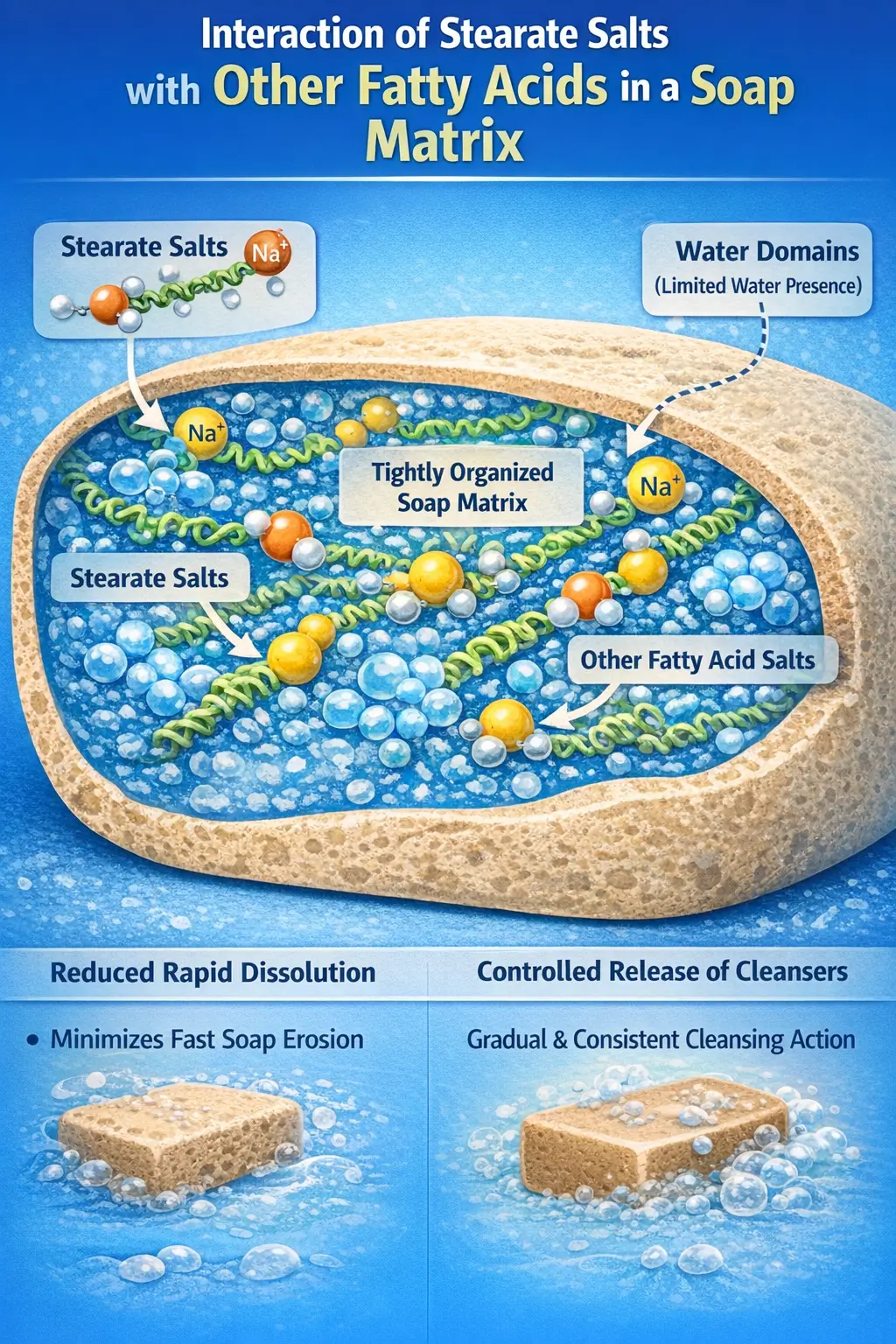
The behavior of Stearic Acid in a formulation is strongly influenced by its interaction with alkali, water and co-existing fatty acid salts. Its conversion into stearate during saponification establishes its role within the overall soap matrix.
combined with more soluble components such as lauric acid or myristic acid, it modifies the internal structure by increasing rigidity while reducing overall solubility. This interaction creates a system where different fatty acids contribute complementary properties rather than acting independently.
Its interaction with water is limited due to its hydrophobic nature, which restricts rapid dissolution and supports gradual release of surfactant material during use.
In emulsified systems such as creams, it interacts with emulsifiers and co-structuring agents to stabilize the oil-water interface. It helps maintain a consistent internal phase distribution rather than acting as the primary emulsifying agent.
Fragrance components and minor additives are often embedded within the structural network it helps form, which can influence how these components are released during application.
These interactions collectively define system-level behavior, where hardness, stability and texture emerge from the combined effect of multiple ingredients rather than a single dominant component.
Phase Behavior
Stearic Acid exhibits low solubility in water and a strong tendency to crystallize, which plays a central role in how it behaves within formulation systems. Its long hydrocarbon chain promotes tight molecular packing, especially in solid or semi-solid environments.
In soap systems, this results in the formation of crystalline domains that limit water penetration. These domains contribute to the mechanical strength and longevity of the product.
Temperature influences its behavior significantly. At elevated temperatures, it transitions into a more fluid state, allowing better dispersion during formulation. Upon cooling, it recrystallizes into a stable structure that defines the final product texture.
In emulsions, its phase behavior supports thickening by contributing to a semi-solid internal structure. It does not dissolve fully but instead participates in a dispersed structural network.
This phase behavior explains why products containing it tend to maintain shape stability while resisting rapid breakdown when exposed to water or mechanical stress.
Comparison With Related Ingredients
| Feature | Stearic Acid | Palmitic Acid |
|---|---|---|
| Carbon Chain Length | C18 | C16 |
| Solubility | Lower | Slightly higher |
| Bar Hardness Contribution | Higher structural rigidity | Moderate rigidity |
| Lather Profile | Dense, stable foam | Creamy but slightly more soluble foam |
| Dissolution Rate | Slower | Faster than stearic acid systems |
This comparison highlights how small differences in chain length influence solubility and structural behavior, which in turn affects how the final product performs during use.
Regulatory Context
Stearic Acid is listed under its INCI name and is widely recognized within global cosmetic ingredient inventories. It does not function as a regulated active substance but is classified as a general-purpose formulation component.
Under EU cosmetic regulation frameworks, it is permitted for use without specific concentration limits when used within standard formulation practices. Its role is considered structural and functional rather than pharmacological.
In labeling systems, it must be declared using its INCI designation, regardless of whether it originates from plant or animal sources, as regulatory classification is based on chemical identity rather than source variation.
Its presence across multiple product categories reflects its versatility in formulation design rather than any single dominant function.
Common Misunderstanding
A frequent misconception is that Stearic Acid acts primarily as a cleansing agent in soap and detergent systems. In practice, its contribution to cleansing is limited compared to more soluble surfactant components.
Its primary function is structural, influencing how the formulation holds together rather than how it interacts with surface impurities.
Another misunderstanding is that its presence directly determines product richness or moisturizing effect. These sensory outcomes are typically influenced by broader formulation design rather than a single fatty acid component.
Recognizing its role as a structural contributor helps clarify why it is included even in systems where cleansing is not the primary function.
Structural Limitations
One of the key limitations of Stearic Acid is its low solubility, which can restrict formulation flexibility in systems requiring rapid dispersion or high clarity.
Its strong tendency to crystallize can also lead to overly rigid structures if not balanced with more soluble or flexible components. This may affect processability during manufacturing and texture during use.
In liquid systems, excessive use can result in phase instability or unwanted thickening, particularly if temperature conditions are not carefully controlled.
These limitations require it to be used in combination with other ingredients that offset its rigidity while preserving its structural benefits.
From a user perspective, this can appear as slower product dissolution or a firmer texture that does not soften easily under water exposure.
Formulation References Using This Ingredient
Summary of Findings
Stearic Acid is a long-chain saturated fatty acid that functions primarily as a structural component within soap, detergent and cosmetic systems.
- Classification: Saturated fatty acid within the fatty acids subcategory.
- Functional Role: Provides rigidity, consistency and structural stability in formulations.
- Interaction Logic: Works in combination with other fatty acids and formulation components to balance hardness and solubility.
- Phase Behavior: Exhibits low solubility and strong crystalline organization.
- System Boundaries: Limited by rigidity and solubility constraints, requiring formulation balance.