Fragrance In Cosmetic And Soap Formulations
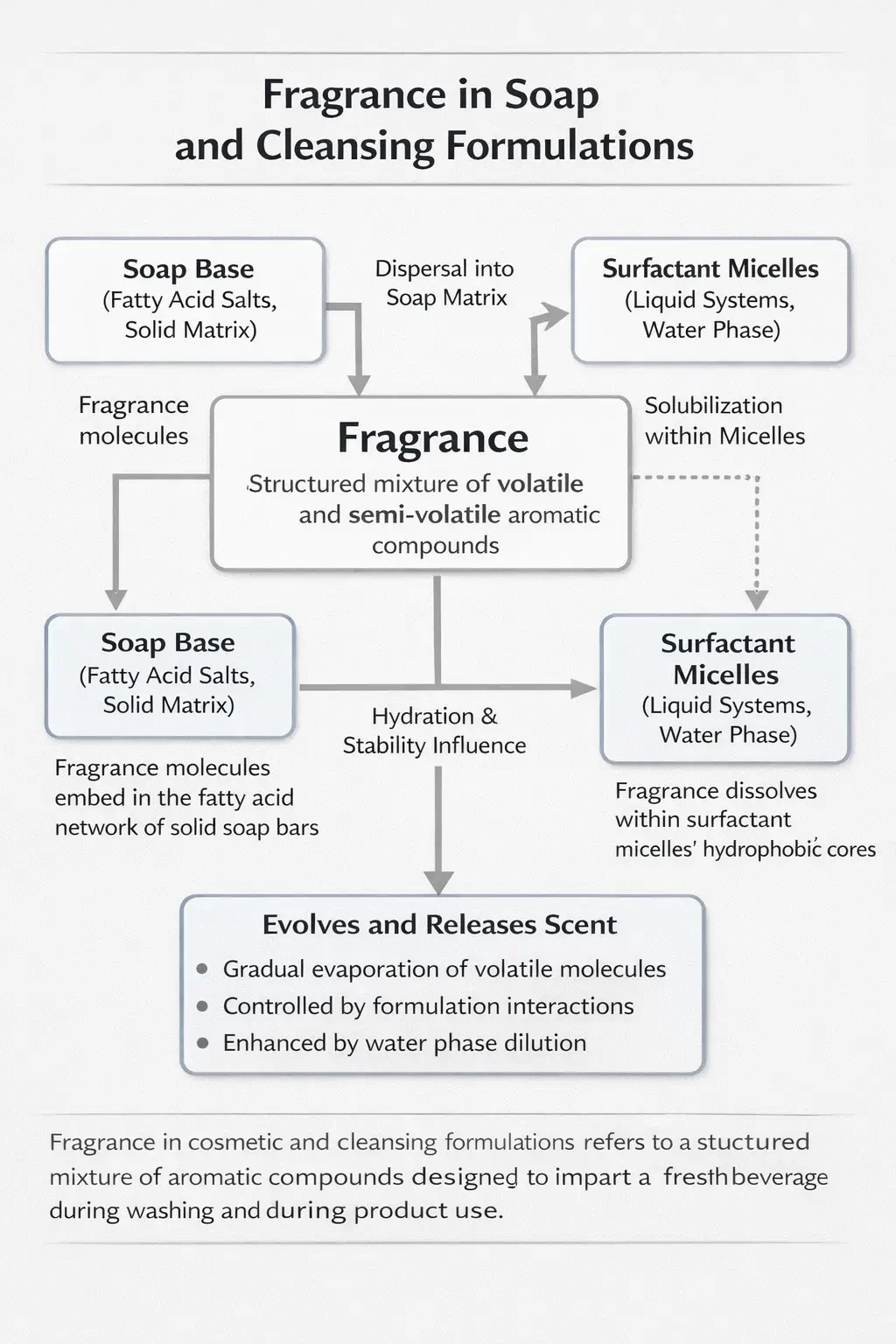
Fragrance in cosmetic and cleansing formulations refers to a structured mixture of aromatic compounds designed to impart a defined scent profile to the final product. In soap systems and other cleansing formulations, fragrance functions as a sensory component rather than a cleansing agent. The material typically consists of multiple volatile and semi volatile molecules blended to create a stable olfactory character that remains perceptible during product use.
Chemically, fragrance mixtures belong to a broad class of organic aromatic compounds that may include esters, aldehydes, alcohols, ketones and terpenoid derivatives. These molecules are selected and blended by fragrance chemists to achieve specific volatility behavior and scent progression. Within soap formulations the fragrance mixture must coexist with surfactants, water and structural components of the bar or liquid matrix without destabilizing the formulation.
Although fragrance does not participate directly in the cleansing mechanism, its presence affects the sensory perception of the product during washing. The volatile nature of many fragrance molecules allows them to evaporate gradually during use, creating the characteristic scent associated with the product.
This page belongs to the CleanFormulation Ingredient Library, a research project that analyzes how cosmetic ingredients behave inside real formulations rather than evaluating them as isolated substances.
Quick Facts
| Property | Description |
|---|---|
| Ingredient Type | Aromatic composition used for scent creation |
| Chemical Class | Mixture of aromatic organic compounds including esters, aldehydes, alcohols and terpenoids |
| Functional Role | Provides characteristic scent profile within cosmetic and cleansing products |
| Ionic Class | Typically non ionic organic molecules |
| Typical Use Context | Soap bars, liquid soaps, detergents, shampoos, lotions and other cosmetic products |
| Primary Formulation Purpose | Creates recognizable sensory identity through controlled release of aromatic compounds |
Ingredient Interaction Logic
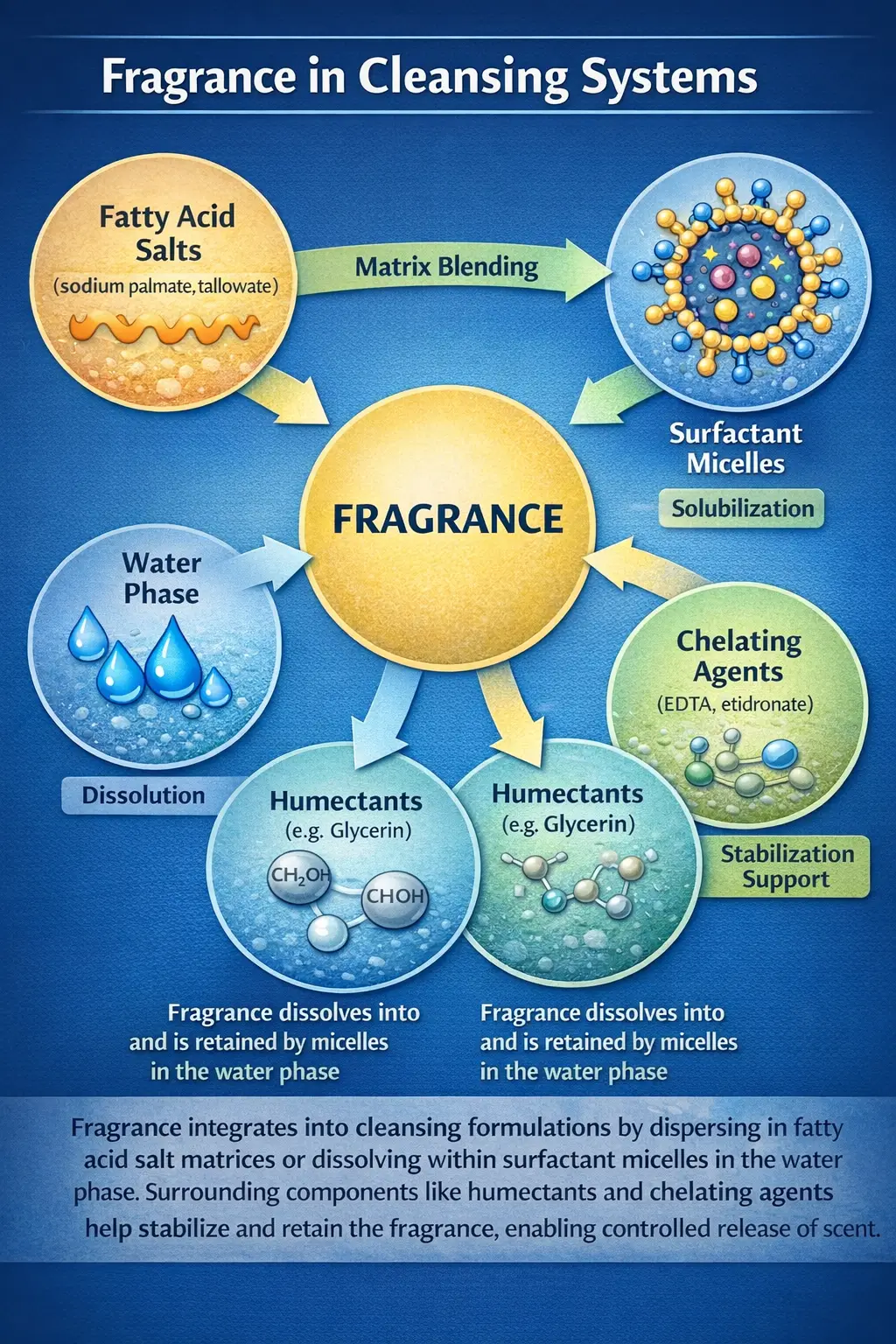
Fragrance interacts with multiple components inside a cleansing formulation. These interactions determine how the scent behaves during storage and during product use. In soap systems the most significant interactions occur with the surfactant matrix, the water phase and auxiliary formulation ingredients that influence solubility and volatility.
Soap base salts such as sodium palmitate or sodium cocoate form the structural framework of bar soaps. Fragrance molecules disperse throughout this structure and may associate with the hydrophobic regions of the fatty acid network. During washing the matrix gradually dissolves in water, releasing both soap molecules and small quantities of fragrance compounds.
In liquid cleansers the water phase plays a more direct role. Surfactant micelles create hydrophobic microenvironments capable of hosting fragrance molecules that would otherwise separate from water. Humectants such as glycerin can also influence the hydration structure of the solution, indirectly affecting how fragrance molecules diffuse through the formulation.
Additional formulation components such as chelating agents and preservatives generally interact only indirectly with fragrance materials. Their primary functions relate to mineral control and microbiological stability rather than scent behavior. However changes in ionic strength or solvent composition can still alter how fragrance molecules distribute within the system.
Why This Ingredient Appears On Cosmetic Labels
Fragrance appears on cosmetic ingredient labels because scent is considered part of the overall formulation composition of the product. Many cleansing products incorporate aromatic blends to create a consistent sensory experience during use. These fragrance mixtures may contain numerous individual molecules but are commonly declared on labels using a single INCI term such as fragrance or parfum.
From a formulation perspective, the inclusion of fragrance helps define the product identity. The scent profile often becomes associated with the product itself, allowing consumers to recognize a formulation through its characteristic aroma. For this reason fragrance compositions are typically added during manufacturing as a separate component after the main cleansing matrix has been created.
The presence of the term fragrance in an ingredient list therefore indicates that the formulation contains an aromatic blend designed to deliver a defined scent profile. The individual molecules within the mixture may vary depending on the fragrance design, but the labeling convention groups them under a single declaration term.
Chemical Identity And Classification
Unlike many cosmetic ingredients that represent a single defined molecule, fragrance is classified as a complex mixture of aromatic substances. These substances may originate from natural extracts, synthetic aromatic compounds or combinations of both. The mixture is designed according to fragrance chemistry principles in which different molecules contribute to top, middle and base scent notes.
From a chemical perspective the molecules commonly found within fragrance blends belong to several organic compound families. Esters often contribute sweet or fruity notes, aldehydes may produce bright or fresh scent characteristics and terpene derived molecules frequently provide citrus or herbal profiles. Alcohols and ketones can also appear within fragrance compositions depending on the intended olfactory design.
Most fragrance molecules are hydrophobic or only partially soluble in water. Because of this property they are often dispersed within cleansing formulations using the surfactant matrix itself. In soap bars the aromatic compounds become embedded within the solid fatty acid salt structure, while in liquid cleansers they are solubilized by surfactants and auxiliary solubilizing agents.
The mixture behaves chemically as a collection of volatile organic molecules with varying evaporation rates. This variation in volatility explains why certain scent notes become noticeable immediately during product use while others remain perceptible for a longer period.
Functional Role In Soap Systems
Within soap formulations fragrance operates as a sensory component integrated into the surfactant matrix rather than participating in the cleansing mechanism itself. Soap bars and liquid soaps derive their cleaning ability from fatty acid salts or surfactant blends. Fragrance is introduced primarily to create a recognizable scent profile that becomes part of the product identity during use.
In bar soap systems the aromatic mixture is typically incorporated after the saponification stage during milling or blending. At this stage the fragrance molecules become distributed within the crystalline soap matrix. Because many fragrance compounds are hydrophobic, they associate readily with the fatty acid structures present in the bar. This interaction allows the scent to remain embedded within the product while slowly releasing during washing.
In liquid cleansing systems the interaction occurs differently. Surfactants form micellar structures in the water phase, and fragrance molecules may become solubilized within the hydrophobic interior of these micelles. This behavior enables the fragrance to remain dispersed within the liquid formulation rather than separating as an oil phase.
Although fragrance does not influence the fundamental chemistry of cleansing, its presence can affect the perceived character of the product. Subtle changes in volatility and diffusion determine how the scent emerges during washing and how long it remains perceptible after rinsing.
Phase Behavior In Cleansing Formulations
Fragrance mixtures consist primarily of volatile organic compounds with limited solubility in water. Because of this property their distribution inside a cleansing formulation depends strongly on the surrounding formulation environment. In soap bars the fragrance becomes physically embedded within the solid fatty acid matrix formed during cooling and crystallization.
During use the soap bar gradually dissolves at the surface, releasing both surfactant molecules and small quantities of fragrance. This process allows scent molecules to evaporate into the surrounding air while the soap performs its cleansing function.
In liquid formulations the phase behavior is influenced by surfactant micelles. These micellar structures provide hydrophobic interiors capable of dissolving fragrance molecules that would otherwise separate from the aqueous phase. As the product is diluted with water during washing, micelle structure changes and fragrance molecules begin to volatilize.
Temperature can also influence fragrance behavior because volatility increases as temperature rises. Warm water during washing therefore accelerates the evaporation of certain fragrance components, contributing to the immediate scent perception experienced during product use.
Comparison With Related Aromatic Ingredients
Fragrance blends differ from single aroma chemicals used in some cosmetic formulations. Understanding this distinction helps clarify why fragrance is often declared as a mixture rather than as individual molecules. The table below compares fragrance mixtures with a commonly encountered single aroma compound used in cosmetics.
| Feature | Fragrance Blend | Linalool |
|---|---|---|
| Ingredient Type | Mixture of multiple aromatic compounds | Single terpene derived aroma compound |
| Chemical Composition | Combination of esters, aldehydes, alcohols and other aromatic molecules | Monoterpene alcohol molecule |
| Use In Formulations | Creates complex scent profiles | Provides a specific floral or citrus like aroma note |
| Label Declaration | Usually declared as fragrance or parfum | Declared individually when present above regulatory thresholds |
| Formulation Role | Overall scent architecture | Individual scent component within a fragrance system |
Regulatory Context
In cosmetic ingredient regulation fragrance is typically declared using the standardized INCI terms Fragrance or Parfum. These terms represent aromatic mixtures composed of multiple individual compounds that collectively form the scent profile of the finished product. Because fragrance blends may contain numerous components, labeling systems allow them to be listed under a single declaration term rather than requiring every constituent molecule to appear individually in the ingredient list.
Within the European Union cosmetic regulatory framework established by Regulation (EC) No 1223/2009, fragrance mixtures are permitted in cosmetic products provided that the finished formulation complies with applicable safety assessment and labeling requirements. Certain individual fragrance allergens identified by the regulation must be declared separately on ingredient labels when their concentrations exceed defined thresholds. This requirement ensures transparency regarding specific aromatic components that may be present within fragrance blends.
Regulatory databases such as the European Commission Cosmetic Ingredient Database maintain entries describing fragrance and related aromatic substances used in cosmetic formulations. These records identify fragrance primarily as a functional ingredient used to impart scent to cosmetic products.
Common Misunderstanding About Fragrance Ingredients
A frequent misunderstanding arises from the assumption that the term fragrance refers to a single defined chemical substance. In practice the term represents a composition that may contain dozens or sometimes hundreds of individual aromatic molecules blended to create a particular scent character.
Each molecule within the mixture contributes to the overall fragrance structure. Some compounds evaporate quickly and provide the initial scent impression, while others evaporate more slowly and remain detectable for a longer period. This layered volatility pattern is fundamental to fragrance chemistry and explains why fragrance blends are formulated as complex mixtures rather than as single compounds.
Because fragrance compositions function as integrated scent systems, their formulation often involves balancing volatility, solubility and compatibility with the base formulation. The single label declaration reflects the mixture as a unified formulation component rather than a single chemical identity.
Structural Limitations In Formulation Systems
Fragrance materials introduce certain formulation constraints because many aromatic molecules possess high volatility and limited water solubility. These characteristics influence how fragrance behaves within cleansing formulations and require careful formulation design to maintain stability.
One limitation relates to volatility. Fragrance compounds gradually evaporate during storage and product use, which means the scent profile may evolve over time. Formulators often address this by combining molecules with different evaporation rates so that the overall scent character remains perceptible throughout product use.
Another limitation involves solubility within aqueous systems. Many fragrance molecules are hydrophobic and require the presence of surfactants or solubilizing agents to remain dispersed in liquid cleansing formulations. Without these supporting structures the fragrance components may separate from the water phase.
Fragrance stability can also be influenced by environmental factors such as light exposure, oxygen and temperature. These factors may gradually alter the chemical composition of aromatic molecules within the formulation environment. For this reason fragrance compatibility is typically evaluated during formulation development and stability testing.
Formulation References Using This Ingredient
- Williams Sonoma Soap Dispensers & Pump Bottles
- Williams Sonoma Spiced Chestnut
- Aesop Mandarin Hand Soap
- Aesop Pumice Hand Soap
- Aesop Reverence Hand Wash
- Aesop Soap and Lotion Sets
- ABC Wash
- Homemade Laundry Soap
- Blighia Sapida Seed Oil Analysis
- Aesthetic Soap – Design, Dispensers & Bottles
- Alaffia Good Soap
- Shea Moisture Pink Himalayan Salt Bar Soap
- Aesop Face Wash
- Alaffia Face Wash
- Williams Sonoma Winter Forest
Summary of Findings
Fragrance in cosmetic and soap formulations represents a structured mixture of aromatic organic compounds designed to impart a characteristic scent profile to cleansing products. Unlike surfactants or structural ingredients, fragrance operates primarily as a sensory component integrated into the formulation matrix.
- Chemical Classification: Fragrance is a mixture of aromatic organic compounds including esters, aldehydes, alcohols and terpene derivatives.
- Functional Role: The ingredient provides the recognizable scent associated with a cosmetic or cleansing product.
- Interaction Logic: In soap bars fragrance disperses within the fatty acid salt matrix, while in liquid systems it becomes solubilized within surfactant micelles.
- Phase Behavior: Most fragrance molecules are volatile and partially hydrophobic, influencing how they distribute within aqueous formulations and how scent is released during washing.
- Formulation Boundaries: Volatility, solubility and environmental stability define the structural limits that formulators must consider when incorporating fragrance into cleansing systems.