Definition
Glycerin, also referred to as glycerol, is a small polyol molecule widely used in soap and cleansing formulations. Chemically it consists of a three carbon backbone with three hydroxyl functional groups. This structure gives glycerin strong affinity for water molecules and places it within the class of polyhydric alcohols commonly used as humectants in cosmetic systems.
In soap manufacturing and cleansing formulations, glycerin acts primarily as a moisture binding component that interacts with the water phase of the formulation. During traditional soap production it forms naturally as a byproduct of the saponification reaction when triglycerides react with alkaline materials. In other formulations it may also be introduced separately to modify hydration behavior and product texture.
Within soap systems glycerin influences how moisture is retained in the product matrix and can affect the transparency, softness, and dissolution behavior of certain soap types. Its interaction with water and other formulation ingredients plays a structural role in many glycerin soap base ingredients used in transparent or melt and pour soap systems.
This page belongs to the CleanFormulation Ingredient Library, a research project focused on analyzing how ingredients behave within real cleansing formulations rather than evaluating cosmetic marketing claims.
Quick Facts
| Property | Description |
|---|---|
| Ingredient Type | Humectant and formulation modifier |
| Chemical Class | Polyol alcohol |
| Chemical Formula | C3H8O3 |
| Functional Role | Moisture binding compound influencing hydration and texture |
| Ionic Class | Non ionic molecule |
| Typical Use Context | Soap bases, liquid cleansers, detergents and cosmetic formulations |
| Physical State | Clear viscous liquid |
Why This Ingredient Appears on Cosmetic Labels
Consumers often encounter glycerin in cosmetic ingredient lists because it is commonly used as a moisture regulating component within many formulations. Ingredient labels follow standardized naming conventions established by the International Nomenclature of Cosmetic Ingredients system, which identifies glycerin using its recognized INCI name.
In cleansing products glycerin is included because of its interaction with the water phase of the formulation. The molecule readily forms hydrogen bonds with water, which allows it to participate in moisture retention and hydration balance within the product system.
Glycerin may also appear on labels because it forms naturally during the production of traditional soaps. When fats or oils undergo saponification with alkaline compounds, glycerin separates from the triglyceride structure and remains present within the final soap mixture unless it is removed during manufacturing.
The presence of glycerin in an ingredient list therefore reflects either its natural formation during soap production or its deliberate inclusion to modify the behavior of the formulation matrix.
Chemical Identity and Classification
Glycerin, chemically known as glycerol, is a trihydroxy alcohol belonging to the broader family of polyols. The molecule contains three hydroxyl functional groups attached to a three carbon backbone, giving it strong polarity and high solubility in water. This structure allows glycerin to interact extensively with surrounding water molecules through hydrogen bonding.
The chemical formula of glycerin is C3H8O3, reflecting the presence of three oxygen atoms associated with hydroxyl groups. These groups enable the compound to attract and retain moisture within formulation environments. Because of this property, glycerin is commonly described in formulation science as a humectant rather than a surfactant or cleansing agent.
Within cosmetic ingredient classification systems, glycerin is categorized as a polyol solvent and humectant. Unlike ionic surfactants or soap salts, it does not carry an electrical charge in solution. Instead, its functional behavior arises from its ability to interact with polar solvents such as water and to participate in hydrogen bonding networks within the formulation.
Glycerin may originate from several production pathways. In soap manufacturing it appears naturally when triglycerides break apart during saponification reactions. Industrial production may also generate glycerin as a byproduct of biodiesel manufacturing or through synthetic chemical processes that produce purified glycerol suitable for cosmetic use.
Functional Role in Soap Systems
Within soap formulations glycerin primarily influences moisture behavior rather than directly participating in the cleansing mechanism. Soap itself performs the cleansing function through fatty acid salts that form micelles in water. Glycerin instead interacts with the water phase of the system, affecting how moisture is distributed and retained within the soap matrix.
In traditional cold process soaps the glycerin formed during saponification remains present unless removed through industrial processing. This retained glycerin contributes to the internal moisture balance of the soap bar and influences how the product behaves during use. Soap bars containing naturally retained glycerin may exhibit slightly different hydration characteristics compared with formulations where glycerin has been extracted.
In certain soap formats, particularly transparent glycerin soap base ingredients used in melt and pour systems, glycerin becomes a structural component of the formulation. The presence of polyols such as glycerin modifies the crystallization behavior of soap salts and contributes to the optical clarity of transparent soap compositions.
Glycerin can also influence sensory characteristics of cleansing products. In liquid cleansers it contributes to viscosity and hydration balance, while in solid soaps it may affect how the bar interacts with ambient humidity during storage and use.
Ingredient Interaction Logic
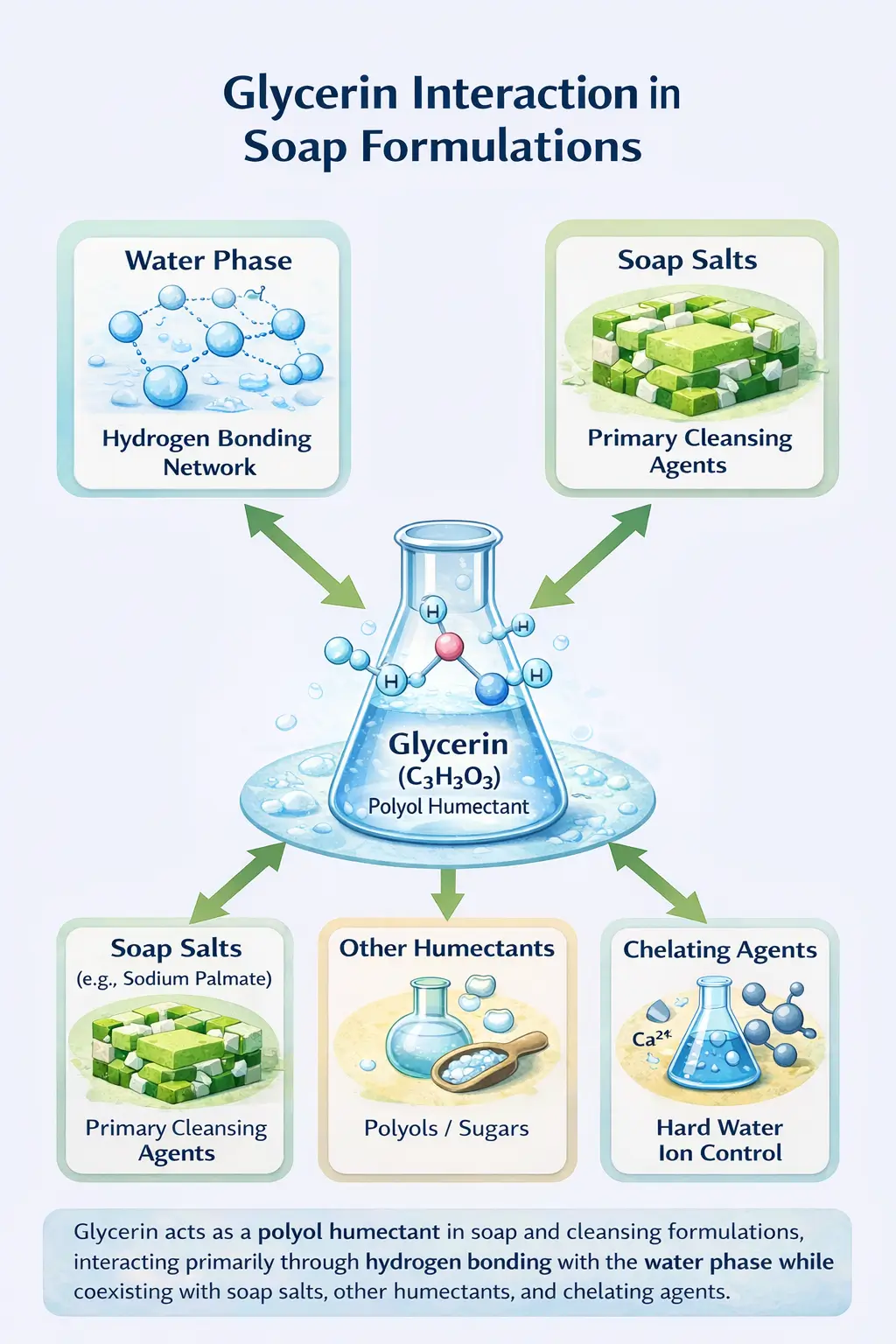
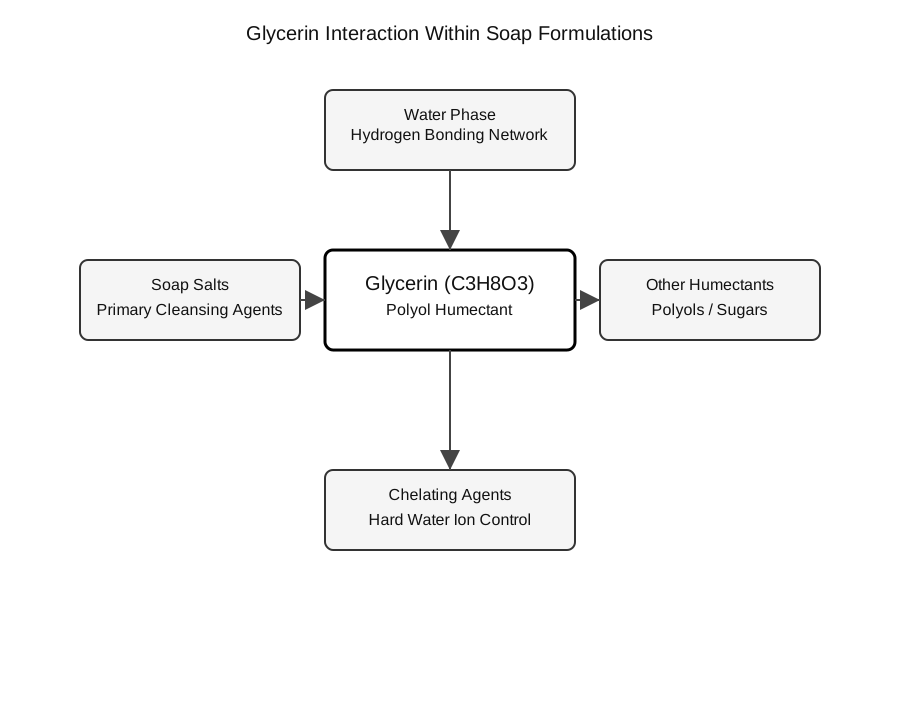
Glycerin interacts with multiple components present in cleansing formulations, primarily through hydrogen bonding and water phase interactions. Because the molecule contains several hydroxyl groups, it can form stable associations with surrounding water molecules. This interaction contributes to the moisture retaining behavior that characterizes glycerin containing formulations.
Soap salts such as sodium palmate or sodium palm kernelate operate as the active cleansing components within soap systems. Glycerin does not directly interact with oils or soil in the same way surfactants do. Instead it modifies the hydration environment surrounding these molecules, which may influence how the soap matrix behaves under different environmental conditions.
In formulations containing humectant blends, glycerin may work alongside other polyols or sugars that also bind water. These cooperative interactions influence the internal moisture equilibrium of the formulation and can affect product stability during storage.
Chelating agents present in certain cleansing formulations operate within the same aqueous environment. While glycerin does not bind mineral ions directly in the same way chelators do, the overall hydration state of the system may influence how these interactions occur within the formulation.
Phase Behavior in Soap and Cleansing Formulations
Glycerin behaves differently from many other cosmetic ingredients because it is highly miscible with water and participates directly in the hydration structure of aqueous formulations. When present in soap systems or liquid cleansers, glycerin does not form a separate phase. Instead it dissolves within the water phase and contributes to the overall solvent environment in which other formulation components operate.
The strong polarity of glycerin enables it to establish hydrogen bonding networks with surrounding water molecules. This interaction modifies how water is retained within the formulation matrix. In solid soap bars, this behavior influences the hydration state of the internal soap structure and can affect how the product responds to environmental humidity during storage.
In transparent glycerin soap compositions the presence of polyols disrupts the normal crystallization pattern of soap salts. This disruption allows light to pass through the structure rather than scattering at crystalline boundaries. The resulting structure produces the optical clarity associated with glycerin based transparent soaps.
Temperature and humidity can influence how glycerin interacts with the surrounding environment. Because glycerin readily binds water, soap bars containing high glycerin content may absorb moisture from humid air. This property contributes to the characteristic surface moisture sometimes observed on glycerin based soaps.
Regulatory Context
In cosmetic ingredient labeling systems glycerin is declared using its standardized International Nomenclature of Cosmetic Ingredients designation. Regulatory frameworks require ingredient lists to identify substances according to these standardized names so that formulation contents remain consistent and recognizable across international markets.
Within the European Union, cosmetic products must comply with Regulation (EC) No 1223 2009 on cosmetic products. This regulation requires manufacturers to disclose ingredient lists using recognized INCI terminology and to arrange ingredients according to their relative concentration within the finished product.
Regulatory ingredient databases such as the European Commission CosIng database classify glycerin primarily as a humectant and solvent. These classifications reflect the functional roles glycerin performs within cosmetic formulations rather than assigning it a cleansing or surfactant function.
Common Misunderstanding
A frequent misunderstanding surrounding glycerin soap base ingredients relates to the assumption that glycerin itself performs the cleansing action in soap products. In reality the cleansing function is provided by soap salts produced during saponification, such as sodium palmate or sodium cocoate. These surfactant molecules form micelles in water and remove oils or particulate matter during washing.
Glycerin does not perform this surfactant role. Instead it modifies the moisture environment of the formulation and interacts with the water phase. Its contribution lies in hydration behavior and formulation structure rather than direct cleansing action.
This distinction explains why glycerin soap composition includes both soap salts and polyols. The soap salts provide cleansing capability, while glycerin participates in moisture balance and structural characteristics of the soap matrix.
Structural Limitations
Although glycerin provides useful hydration interactions within cleansing formulations, its behavior introduces certain formulation constraints. One limitation arises from its strong affinity for water. Because glycerin readily attracts moisture from surrounding air, products containing high glycerin content may absorb humidity during storage in environments with elevated moisture levels.
This property can influence the surface appearance of certain glycerin soap formulations. Transparent soaps in particular may exhibit condensation like surface moisture when exposed to humid air because glycerin interacts with atmospheric water vapor.
Another formulation consideration relates to viscosity and solvent balance. High concentrations of glycerin alter the physical characteristics of aqueous systems and may affect flow behavior in liquid formulations. Formulators therefore balance glycerin levels with water and other solvents to achieve the desired structural properties.
Product Formulation References Using This Ingredient
Product Formulation References Using This Ingredient
- Nurture Soap Mica
- What Is Pacha Soap Made Of?
- What Is Castile Soap?
- Method Gel Hand Soap
- Method Men Soap
- Buff City Soap Ingredients Analysis
- Dr Squatch Soap Ingredients Analysis
- Can You Make Soap Without Lye
- Method Foaming Hand Soap Refills
- Method Hand Soap
- Why Ingredient Names Sound Chemical On Product Labels
Summary of Findings
Glycerin is a polyol compound widely used in soap and cleansing formulations due to its strong interaction with water molecules. Chemically it is a trihydric alcohol with the molecular formula C3H8O3. Its role in formulation systems differs from surfactant ingredients because it primarily modifies hydration behavior rather than performing the cleansing action itself.
- Chemical Classification: Glycerin is a polyol alcohol characterized by three hydroxyl functional groups.
- Functional Role: Within soap systems glycerin functions mainly as a moisture interacting component rather than a cleansing surfactant.
- Interaction Logic: Hydrogen bonding between glycerin and water influences hydration balance and formulation structure.
- Formulation Context: Glycerin appears naturally during saponification and may also be added to modify soap texture and transparency.
- System Boundaries: Its strong affinity for water introduces considerations related to humidity interaction and formulation balance.