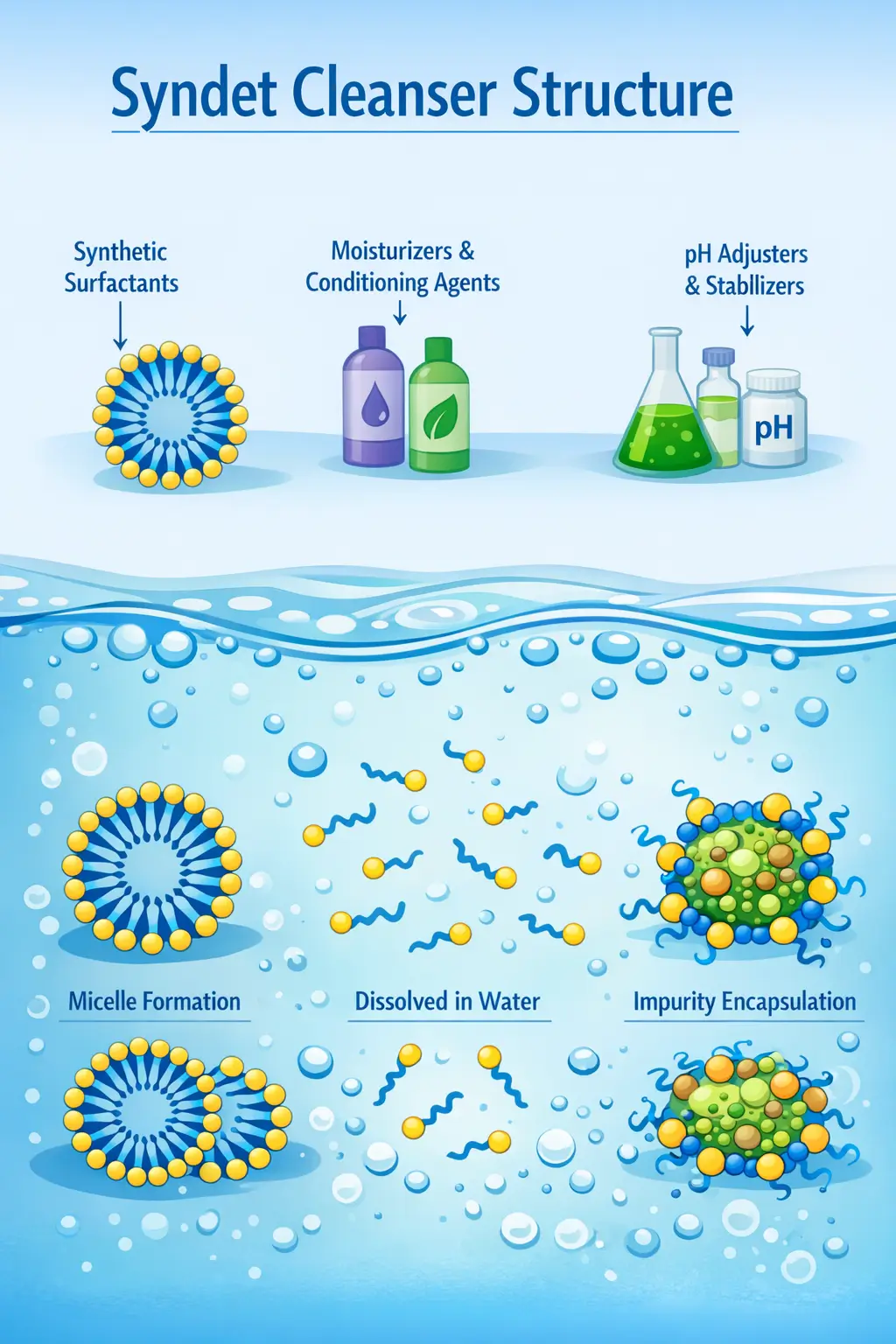
What Defines A Syndet Cleanser
The term syndet refers to synthetic detergent systems that perform cleansing without relying on soap chemistry. In formulation terms, this means the primary cleansing agents are surfactants such as sodium cocoyl isethionate, sodium laureth sulfate, sodium lauroyl sarcosinate, or alkyl polyglucosides, rather than sodium or potassium fatty acid surfactants formed through saponification.
This distinction is frequently misunderstood. Many consumers assume that a solid bar must be soap, or that liquid cleansers are inherently detergent-based. In practice, physical form does not define formulation logic. Syndet systems can exist as liquids, gels, or solid bars depending on how surfactants are structured and supported within the formulation matrix.
Historically, syndet systems gained traction when formulators sought greater control over pH behavior, mineral sensitivity, and consistency across varied water conditions. These goals were difficult to achieve using soap alone, particularly in regions with high water hardness or fluctuating supply quality.
Surfactant Systems In Syndet Cleansers
At the core of every syndet cleanser is a surfactant system designed to remain functional across a broader chemical range than soap. Synthetic surfactants are not dependent on alkaline conditions to stay soluble, which allows syndet cleansers to operate across mildly acidic to neutral pH environments.
This pH flexibility is not incidental. Many commonly used surfactants, including isethionates and sulfonates, retain surface activity without converting into insoluble salts when exposed to calcium or magnesium ions. As a result, syndet systems typically show lower sensitivity to hard water than traditional soap systems.
Most syndet formulations rely on blended surfactant systems rather than a single cleansing agent. Anionic surfactants provide primary soil removal, while amphoteric or nonionic surfactants modify foam structure, reduce irritation potential, and stabilize performance under dilution. The balance between these components shapes how the cleanser feels, rinses, and behaves during repeated use.
| System Characteristic | Soap-Based Systems | Syndet-Based Systems |
|---|---|---|
| Primary Cleansing Agent | Fatty acid salts | Synthetic surfactants |
| pH Dependence | Alkaline-dependent | Broad pH tolerance |
| Hard Water Interaction | Forms insoluble salts | Typically remains soluble |
| Structural Flexibility | Limited by crystallization | Highly tunable |
These differences explain why syndet cleansers are often selected for applications where consistent behavior across regions, temperatures, and water qualities is required. However, this flexibility introduces its own formulation trade-offs, including increased system complexity and reliance on supporting ingredients to maintain stability.
How Syndet Cleansers Maintain Structure Without Soap Crystals
Unlike soap bars, syndet cleansers do not form rigid crystalline networks through fatty acid salt alignment. This creates a structural challenge, particularly for solid formats. To remain stable, syndet systems rely on alternative structural supports such as fatty alcohols, waxy binders, polymers, or compressed surfactant matrices.
In solid syndet bars, ingredients such as cetyl alcohol or stearyl alcohol may contribute physical rigidity without participating in cleansing. Their role is mechanical rather than chemical. This distinction is often misunderstood, with non-cleansing components incorrectly assumed to be inactive fillers rather than necessary structural elements.
Liquid syndet cleansers address structure differently. Viscosity and phase stability are typically managed through polymeric thickeners, electrolyte balance, or surfactant packing behavior. These systems remain sensitive to temperature shifts and long-term storage, though less so than soap systems under comparable conditions.
Dilution And Rinsing Behavior In Syndet Systems
Dilution is an active phase in syndet cleanser performance, not a passive endpoint. As water is introduced, surfactant aggregates reorganize, altering foam texture, cleansing efficiency, and rinse feel. Because synthetic surfactants remain soluble across a wider concentration range, syndet systems tend to show smoother transitions during dilution than soap.
This behavior explains why syndet cleansers often maintain lather and slip even at low concentrations. The absence of insoluble salt formation allows surfactant micelles to persist rather than collapse. However, excessive dilution can still reduce performance, particularly when co-surfactant balance is disrupted.
| Dilution Phase | System Response | Common Observation |
|---|---|---|
| Initial Contact | High surfactant concentration | Dense foam, strong slip |
| Active Rinsing | Micelle reorganization | Stable lather, gradual thinning |
| Extended Dilution | Reduced surfactant density | Lower foam, clean rinse |
These dynamics contribute to the perception that syndet cleansers rinse more easily or leave fewer deposits. In reality, the system is redistributing rather than precipitating its components.
Boundary Conditions Where Syndet Behavior Changes
Despite their flexibility, syndet systems are not behaviorally uniform across all environments. Extremely cold water can slow surfactant dispersion, while high electrolyte loads may destabilize viscosity or foam structure. Storage temperature also influences long-term stability, particularly in refill formats common across European households.
Another boundary condition arises when surfactant systems are simplified for cost or labeling constraints. Reduced surfactant diversity can narrow the operational range, making the system more sensitive to water quality or user behavior.
These limits are often invisible during short-term use but emerge over time, leading to assumptions of inconsistency or formulation changes where none exist.
Why Syndet Cleansers Are Not Universal Replacements For Soap
Syndet systems offer control and flexibility, but they also introduce formulation complexity. Maintaining stability, sensory consistency, and performance requires careful surfactant selection and system balancing. This contrasts with soap systems, where structure and cleansing are inherently linked.
From a system perspective, neither approach is categorically superior. Each reflects different design priorities shaped by chemistry, environment, and usage context. Misunderstanding this leads to oversimplified narratives that frame syndets as improvements rather than alternatives.
Summary Of Syndet System Behavior Under Common Conditions
Syndet cleanser behavior is often interpreted through surface impressions such as foam volume or rinse feel. The table below summarizes how syndet systems typically respond to common environmental and usage conditions, highlighting why outcomes may differ from soap-based systems without implying superiority or suitability.
| Condition | Primary System Response | Common Misinterpretation |
|---|---|---|
| Hard Water | Surfactants remain soluble | Assumed to be "stronger" cleansing |
| Low Temperature | Slower dispersion, stable chemistry | Perceived reduction in effectiveness |
| High Dilution | Gradual micelle breakdown | Confused with over-rinsing |
| Extended Storage | Possible viscosity drift | Assumed formulation inconsistency |
| Solid Syndet Format | Binder-dependent structural stability | Misidentified as traditional soap |
These behaviors reflect system design rather than user error or formulation failure. Differences emerge from how surfactants interact with water, structure, and supporting materials over time.
Summary of Findings
- System Definition: Syndet cleansers rely on synthetic surfactants rather than fatty acid salts.
- Structural Logic: Physical structure is achieved through binders and polymers, not soap crystallization.
- Dilution Behavior: Solubility across concentration ranges prevents precipitation during rinsing.
- Boundary Limits: Temperature, electrolyte load, and storage conditions still influence behavior.
- Design Trade-Offs: Syndets offer flexibility at the cost of increased formulation complexity.
References
- Rosen, M. J. Surfactants and Interfacial Phenomena. Wiley-Interscience.
- Schramm, L. L. Surfactants Fundamentals and Applications. Cambridge University Press.
- OECD SIDS Reports on Synthetic Surfactants.
- European Commission Consumer Product Formulation Guidance.