Sunflower Oil Definition And Role In Formulation Systems
Sunflower oil is a plant-derived triglyceride oil classified as a non-ionic lipid ingredient, primarily used as an emollient and structural oil component in soap and cosmetic formulations.
It is composed mainly of unsaturated fatty acids, particularly linoleic acid and oleic acid, which influence how it behaves during saponification and in emulsion-based systems.
In soap systems, it functions as a precursor to fatty-acid salts, contributing to conditioning characteristics rather than structural hardness.
In cosmetic formulations such as lotions, creams and cleansing gels, it acts as a lipid phase component that modifies spreadability, viscosity and surface interaction.
This page is part of the CleanFormulation Ingredient Library, a research-based system that analyzes how ingredients behave within real formulation environments rather than evaluating them in isolation.
Quick Facts
| Property | Description |
|---|---|
| INCI Name | Helianthus Annuus (Sunflower) Seed Oil |
| CAS Number | 8001-21-6 |
| Molecular Structure | Glycerol backbone esterified with C16–C18 fatty acids |
| Fatty Acid Profile | Linoleic acid (≈55–70%), Oleic acid (≈20–35%), Palmitic acid (≈4–7%), Stearic acid (≈2–6%) |
| Iodine Value | 110–145 (indicates high unsaturation level) |
| Saponification Value | 188–194 mg KOH/g |
| Melting Point | -17°C to -19°C (remains liquid at room temperature) |
| Density | ~0.91–0.93 g/cm³ at 25°C |
| Viscosity | Moderate; contributes to light, non-greasy texture |
| Comedogenic Rating | 0–2 (generally low pore-clogging tendency) |
| Oxidative Stability | Moderate to low; prone to oxidation due to high linoleic content |
| Shelf Life | 6–12 months (can extend with antioxidants like tocopherol) |
| Unsaponifiable Matter | ~1–2% (contains phytosterols and tocopherols) |
| HLB Requirement | ~7 (for emulsification in oil-in-water systems) |
| Soap Hardness Contribution | Produces soft to moderately firm soap bars |
| Cleansing Value (SoapCalc) | ~0 (does not contribute significantly to cleansing strength) |
| Conditioning Value (SoapCalc) | ~60–70 (high skin-conditioning effect) |
| INS Value | ~61–69 (indicates softer soap profile) |
| Foam Profile | Low, creamy lather rather than bubbly foam |
| Recommended Usage Rate | 5–100% depending on formulation (typically 10–30% in soap blends) |
| Formulation Notes | Often balanced with harder oils (e.g., coconut, palm) to improve bar hardness and lather stability |
Why Sunflower Oil Appears On Ingredient Labels
Sunflower oil appears on ingredient lists because it functions as a primary lipid component in many formulations, either as a direct oil phase ingredient or as a precursor to soap formation through reaction with alkaline agents such as sodium hydroxide.
In finished products, its presence reflects either unreacted oil remaining in the system or its contribution to the overall fatty acid composition that defines cleansing behavior and texture.
Its listing does not indicate a single function, as the same ingredient may participate in different formulation roles depending on whether the system is a soap bar, liquid cleanser or emulsion-based cosmetic product.
Chemical Identity And Classification
Sunflower oil is typically declared under its INCI name Helianthus Annuus Seed Oil. It belongs to the triglyceride class of lipids, consisting of glycerol esterified with long-chain fatty acids.
The dominant fatty acids are linoleic acid and oleic acid, with smaller contributions from palmitic and stearic acids. The relative ratio depends on the cultivar and processing method.
From a formulation perspective, it is a non-ionic, hydrophobic ingredient that does not participate directly in charge-based interactions but contributes to system structure through its lipid nature.
Its behavior is governed by fatty acid composition rather than the oil identity itself, which means different sunflower oil variants may produce different outcomes in soap and cosmetic systems.
Functional Role In Soap Systems
In soap formulations, sunflower oil acts as a precursor to fatty-acid salts when reacted with alkaline agents such as alkaline agents. The resulting soap molecules are primarily derived from its unsaturated fatty acid profile.
Compared to more saturated oils, it contributes less to structural rigidity and more to conditioning characteristics within the soap matrix.
This results in a system where bar hardness is reduced and the soap tends to be softer unless balanced with higher saturated fat inputs.
The lather produced from sunflower-derived soap salts is generally lighter and less dense, reflecting the influence of unsaturated fatty acid chains.
In practical terms, formulations with higher proportions of this oil tend to produce bars that feel smoother during use but may wear down faster during repeated exposure to water.
Ingredient Interaction Logic Within Formulation Systems
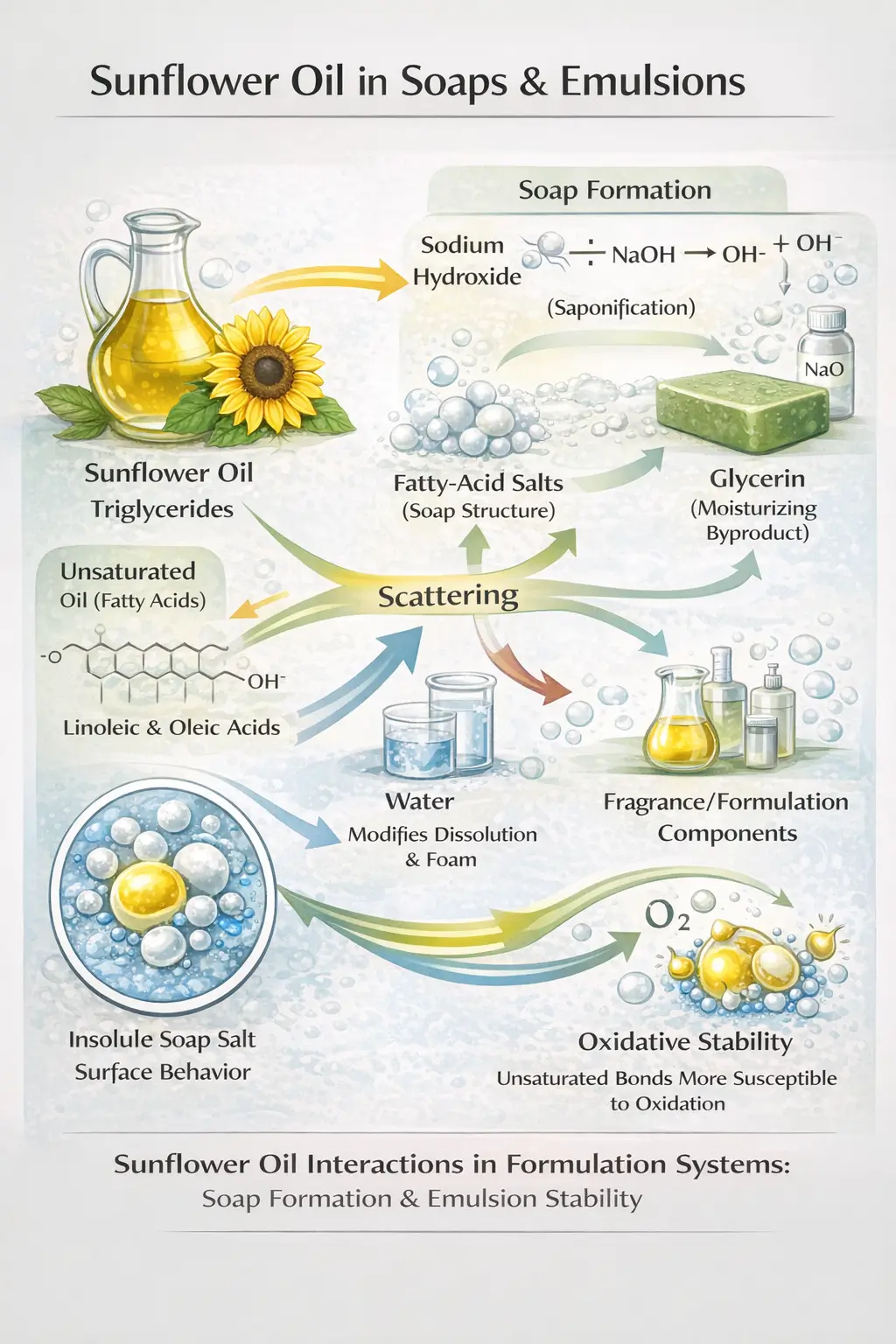
Sunflower oil interacts with alkaline components such as sodium hydroxide during saponification, converting triglycerides into fatty-acid salts and glycerin.
Within the soap matrix, the resulting soap salts coexist with water and residual glycerin, influencing hydration behavior and surface interaction.
When combined with more saturated fats such as tallow, the formulation achieves a balance between structural integrity and conditioning properties.
In emulsion-based systems like creams and lotions, sunflower oil forms part of the oil phase and interacts with emulsifiers to create stable oil-in-water structures.
It also interacts indirectly with fragrance systems by acting as a solvent medium for lipophilic aromatic compounds, affecting distribution and release characteristics.
The overall behavior of the formulation depends not on sunflower oil alone, but on how its fatty acid profile integrates with the rest of the ingredient system.
Phase Behavior And Physical Characteristics
Sunflower oil is insoluble in water and forms a separate hydrophobic phase in formulations. In emulsified systems, it is dispersed as droplets within the continuous phase.
During saponification, its liquid triglyceride structure is transformed into solid or semi-solid soap salts depending on the cation used, such as sodium or potassium.
Its high degree of unsaturation leads to lower melting behavior compared to more saturated fats, which directly affects the firmness of the final soap structure.
It is also susceptible to oxidative changes over time due to the presence of unsaturated bonds, which can influence stability in formulations if not balanced with stabilizing components.
From a formulation perspective, this translates into softer physical systems and potential variability in long-term stability depending on storage conditions and formulation design.
Comparison With Related Oils
| Feature | Sunflower Oil | Coconut Oil |
|---|---|---|
| Fatty Acid Profile | High in unsaturated fatty acids | High in saturated fatty acids |
| Soap Hardness Contribution | Low | High |
| Lather Character | Light and less dense | Dense and voluminous |
| Solubility Behavior | Moderate | High |
| Formulation Role | Conditioning and softening | Cleansing and structural support |
Regulatory Context
Sunflower oil is listed under the INCI name Helianthus Annuus Seed Oil and is included in ingredient declarations according to cosmetic labeling regulations.
Within the European Union framework, it is classified as a cosmetic ingredient without restriction when used in standard formulation contexts, provided the final product complies with general safety and labeling requirements.
It is not categorized as an active ingredient or functional additive requiring specific concentration disclosure, and therefore appears in ingredient lists based on relative concentration order.
Its regulatory role is therefore descriptive rather than functional, indicating composition rather than performance claims.
For broader context on how ingredients are declared and ordered, see ingredient list interpretation.
Common Misunderstanding
A common assumption is that sunflower oil behaves the same in all product types simply because it originates from a plant source.
In formulation reality, its behavior changes significantly depending on whether it is used as an unreacted oil in an emulsion system or converted into soap salts through reaction with sodium hydroxide.
This means that the ingredient name alone does not define its role. The formulation context determines whether it acts as a lipid phase component, a structural soap precursor, or a conditioning contributor within the system.
Structural Limitations In Formulation
One of the primary limitations of sunflower oil is its high unsaturation level, which reduces its ability to contribute to rigid structural frameworks in soap systems.
This leads to softer bar structures that may require balancing with more saturated fats to maintain physical integrity.
It is also susceptible to oxidative changes due to double bonds present in its fatty acid chains, which can influence formulation stability over time.
In addition, its contribution to lather structure is limited compared to oils with higher saturated fatty acid content, making it less suitable as a sole structural oil in soap formulations.
These limitations do not prevent its use, but they define the boundaries within which it can be effectively incorporated into formulation systems.
Formulation References Using This Ingredient
Summary of Findings
- Classification: Sunflower oil is a non-ionic triglyceride lipid classified as a vegetable oil used in soap and cosmetic formulations.
- Functional Role: It acts as a soap precursor and emollient, contributing primarily to conditioning and system flexibility rather than structural hardness.
- Interaction Logic: Its behavior depends on interaction with alkaline agents, water phase components, and co-formulated lipids.
- Phase Behavior: It exists as a hydrophobic oil phase or converts into soap salts depending on formulation conditions.
- System Boundaries: Its high unsaturation limits structural contribution and introduces sensitivity to oxidative change.