Viscosity Modifiers
Viscosity modifiers are formulation ingredients designed to influence the flow behavior and thickness of liquid or semi liquid systems. In cleansing products such as shampoos, liquid soaps, and body washes these ingredients adjust how easily the formulation pours, spreads, and remains suspended within a container. The viscosity of a product determines whether it behaves like a thin liquid, a gel, or a thicker structured system.
In practical formulation work the viscosity modifiers definition refers to ingredients that alter rheological properties rather than contributing directly to cleansing chemistry. Their primary task is to control the physical structure of the formulation so that other ingredients such as surfactants, fragrances, and humectants remain evenly distributed in the product matrix.
The concept appears across many product categories. Viscosity modifiers in cosmetics are used in cleansers, lotions, gels, and serums where controlled flow behavior helps maintain product stability and consistent dosing. In cleansing systems such as shampoo the viscosity modifier determines whether the product dispenses smoothly or separates during storage.
This page is part of the CleanFormulation Ingredient Library, a research project focused on explaining ingredient behavior inside real formulations rather than interpreting marketing language.
Quick Facts
| Property | Description |
|---|---|
| Ingredient Type | Rheology modifier used to adjust thickness and flow behavior |
| Chemical Class | Polymers, natural gums, salts, fatty alcohols, or clay based thickeners |
| Functional Role | Controls viscosity, stabilizes suspensions, and improves formulation texture |
| Ionic Class | Can be anionic, cationic, or polymeric depending on structure |
| Typical Use Context | Cosmetics, shampoo, body wash, liquid soap, and other cleansing formulations |
| Typical Concentration Role | Low concentration structuring agents that influence flow and stability |
Why This Ingredient Appears On Labels
Consumers often encounter viscosity modifiers in cosmetics and cleansing products because these ingredients help maintain a consistent physical structure. Without viscosity control many formulations would remain extremely thin liquids that separate easily or deliver uneven amounts during use.
In products such as shampoo the viscosity modifier adjusts the thickness of the liquid so it can be dispensed easily from the bottle and spread across hair surfaces during washing. The presence of viscosity modifiers in shampoo also helps stabilize the surfactant mixture, preventing the product from separating into layers during storage.
Viscosity modifiers in cosmetics perform similar functions in other formulations. Cleansers, gels, and emulsions rely on controlled viscosity to keep suspended particles, fragrances, and surfactant systems evenly distributed. This structural role explains why viscosity modifiers appear on ingredient labels even though they do not participate directly in the cleansing reaction.
Chemical Identity And Classification
Viscosity modifiers represent a diverse group of ingredients rather than a single chemical compound. The classification depends on the molecular structure used to create thickening or flow control. Many viscosity modifiers examples belong to polymer families that form extended molecular chains capable of interacting with water molecules.
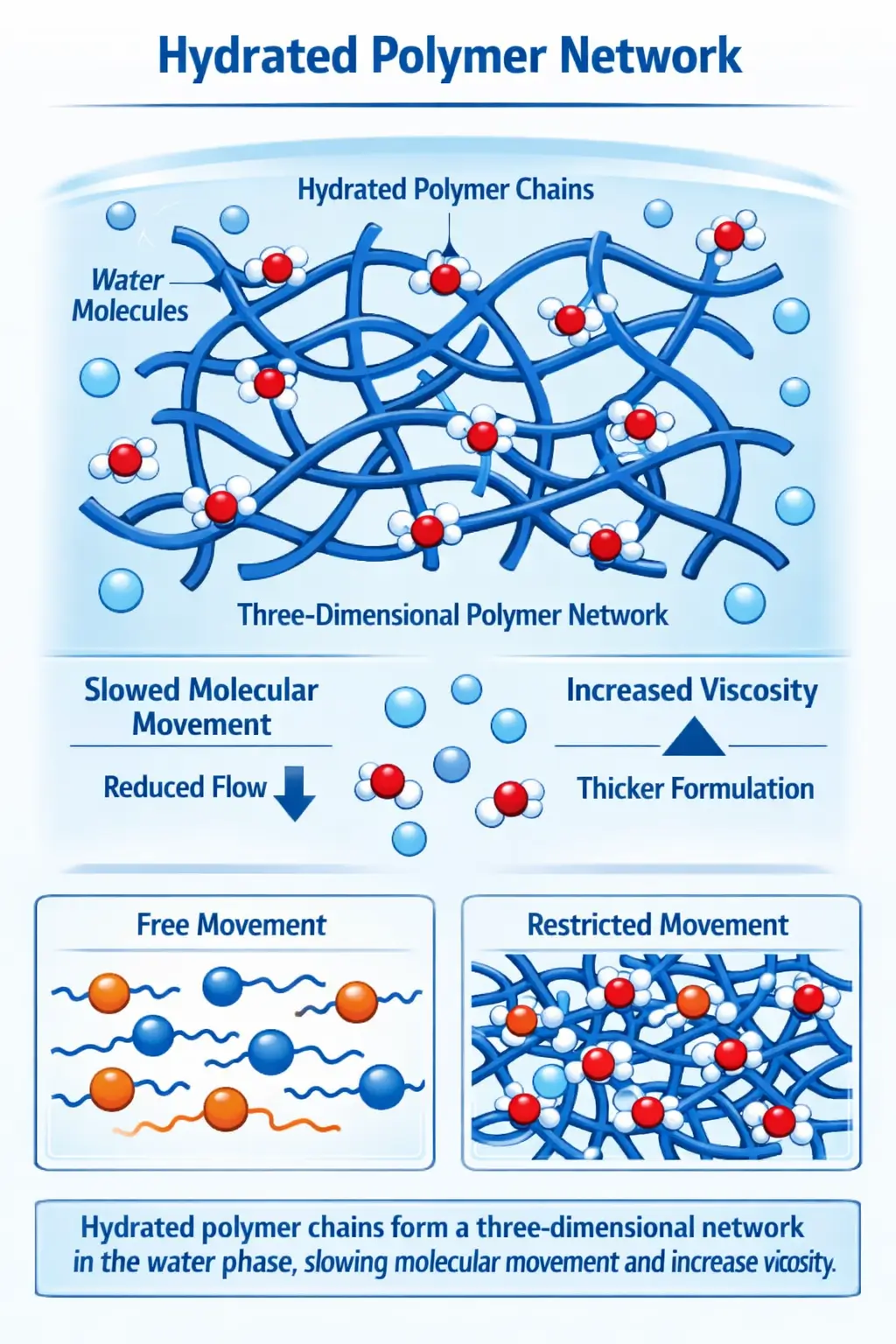
Common polymeric viscosity modifiers include carbomers, cellulose derivatives, and synthetic acrylate polymers. These molecules swell in water and form networks that slow the movement of liquid molecules, which increases viscosity. Natural gums such as xanthan gum or guar gum achieve similar effects through hydrated polysaccharide chains.
Some viscosity modifiers operate through different mechanisms. Electrolytes such as sodium chloride can increase viscosity in surfactant based systems by altering micelle interactions. Fatty alcohols and wax like ingredients may also structure emulsions by forming crystalline networks within the formulation.
Despite the variety of chemical structures involved, the shared purpose remains the same. Each viscosity modifier alters the physical arrangement of molecules within the formulation so that the final product maintains stable thickness and flow behavior during storage and use.
Functional Role In Cleansing Systems
Although viscosity modifiers do not function as cleansing agents themselves, they play an important structural role in cleansing formulations. Liquid cleansing products such as shampoos, body washes, and facial cleansers depend on a controlled viscosity range to remain stable and easy to use. Without viscosity modification, surfactant solutions would typically behave as thin liquids that pour rapidly and separate during storage.
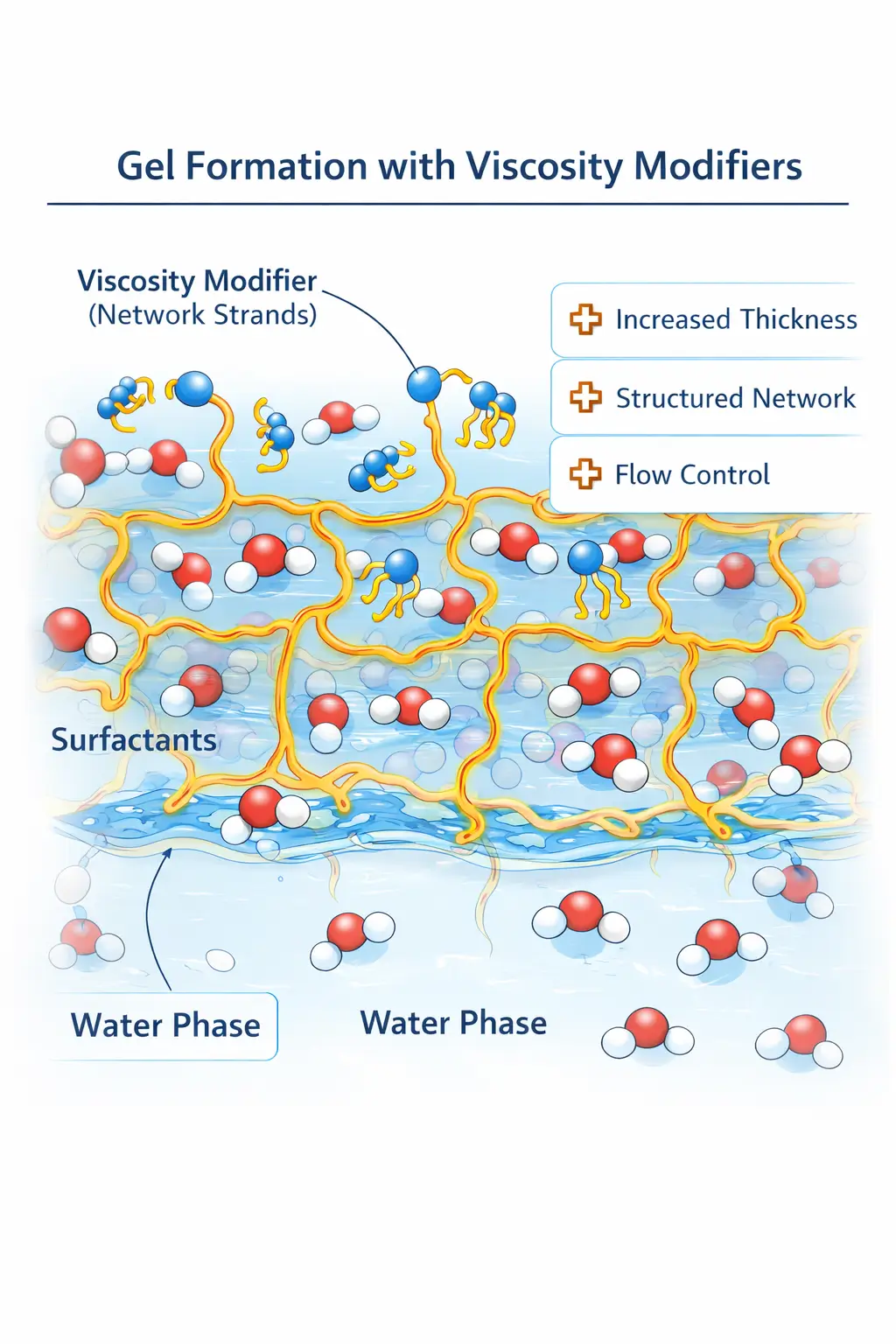
In formulations that contain surfactants, viscosity modifiers help organize the water phase and stabilize micellar structures formed by the surfactant system. When the viscosity of the surrounding medium increases, suspended particles, fragrance oils, and surfactant aggregates move more slowly. This reduced mobility improves product stability and prevents sedimentation or phase separation.
The presence of viscosity modifiers in shampoo is a clear example of this structural role. Shampoo formulations contain surfactant mixtures designed to remove oils from hair and scalp surfaces. If the viscosity remains too low, the surfactant solution may run off the hair quickly during use. By adjusting viscosity, the formulation remains in contact with the hair fibers long enough for the cleansing system to function effectively.
Viscosity modifiers also influence sensory perception. A thicker formulation spreads more gradually across surfaces and may appear richer during application. These physical characteristics arise from rheological behavior rather than from chemical cleansing activity.
Ingredient Interaction Logic
The behavior of viscosity modifiers depends strongly on how they interact with other components in the formulation. Water acts as the primary continuous phase in most cosmetic and cleansing products. When a polymeric thickener or gum is introduced into the water phase, its molecular chains hydrate and expand, occupying a larger volume within the liquid.
These hydrated polymer networks influence how other ingredients move through the formulation. Surfactant micelles, fragrance droplets, and suspended particles become trapped within the structured liquid environment created by the viscosity modifier. This interaction reduces the likelihood of separation and helps maintain a uniform product texture.
Humectants such as glycerin can influence this interaction further by altering the hydration environment around the polymer chains. Increased humectant content may change how quickly the viscosity modifier hydrates or how tightly its molecular network forms.
Fragrance materials also interact indirectly with viscosity modifiers. Many fragrance components dissolve poorly in water and rely on surfactant micelles or emulsified droplets to remain dispersed. A higher viscosity environment helps stabilize these dispersed droplets, reducing the chance of fragrance separation during storage.
Chelating agents present in the formulation can modify ionic conditions within the water phase. Because some viscosity modifiers respond to electrolyte concentration, the presence of mineral ions or chelating agents may influence the final viscosity of the product.
Phase Behavior
Viscosity modifiers influence the physical structure of a formulation by altering the spatial arrangement of molecules in the liquid phase. Many polymer based modifiers hydrate when dispersed in water. During hydration, the polymer chains absorb water molecules and expand into flexible networks that occupy a larger portion of the liquid environment.
As the polymer network develops, the movement of water molecules becomes restricted. This restriction slows the flow of the liquid and produces the thicker texture associated with gel like cosmetic formulations. The resulting system behaves as a structured liquid rather than a freely flowing solution.
Some viscosity modifiers form semi crystalline structures within emulsions or suspensions. Fatty alcohols, for example, can organize into ordered domains that reinforce the internal structure of an emulsion. This crystalline network increases resistance to flow and stabilizes dispersed oil droplets within the formulation.
Temperature and pH conditions can influence this phase behavior. Certain polymeric viscosity modifiers expand more effectively within a specific pH range, while elevated temperatures may temporarily reduce viscosity by increasing molecular mobility within the system.
Comparison With Related Structuring Ingredients
Viscosity modifiers belong to a broader group of formulation ingredients known as rheology modifiers. Comparing these ingredients with other formulation components highlights how they differ from surfactants and emulsifiers that serve different functional roles.
| Feature | Viscosity Modifiers | Surfactants |
|---|---|---|
| Primary Function | Control flow behavior and thickness | Remove oils and soils through micelle formation |
| Typical Chemical Types | Polymers, gums, clays, fatty alcohols | Anionic, nonionic, amphoteric or cationic molecules |
| Interaction With Water | Forms hydrated networks that slow molecular motion | Forms micelles that disperse hydrophobic materials |
| Typical Product Role | Structural stability and controlled flow | Cleansing and emulsification |
This comparison shows that viscosity modifiers and surfactants operate through entirely different mechanisms within a formulation. While surfactants focus on cleansing chemistry, viscosity modifiers focus on physical structure and product stability.
Regulatory Context
Viscosity modifiers used in cosmetic and cleansing formulations are regulated according to the product category in which they appear. In cosmetic products marketed within the European Union, ingredient disclosure follows the International Nomenclature of Cosmetic Ingredients system defined under Regulation (EC) No 1223/2009 on cosmetic products. Each viscosity modifying ingredient must be listed using its standardized INCI name so that the ingredient can be consistently identified across different products and manufacturers.
Examples of viscosity modifiers listed under INCI terminology include carbomer, xanthan gum, hydroxyethylcellulose, and acrylates copolymer. Although these ingredients differ chemically, they share the same functional classification as rheology modifiers that influence the physical structure of cosmetic formulations.
In detergent and household cleaning products the regulatory framework differs. Surfactant disclosure is governed by Regulation (EC) No 648/2004 on detergents, which focuses primarily on biodegradability and classification of surfactant categories. Viscosity modifiers present in detergent formulations may not always appear as a separate functional category because they are not responsible for the primary cleaning action.
Regulatory systems therefore treat viscosity modifiers primarily as structural ingredients rather than as active cleansing components. Their labeling ensures transparency of formulation composition while allowing manufacturers to use a wide range of polymeric or mineral based rheology modifiers.
Common Misunderstanding
A common misunderstanding is that viscosity modifiers change the chemical effectiveness of a cleansing formulation. In reality these ingredients primarily influence the physical structure of the product rather than the chemistry of the cleansing reaction. Surfactants remain responsible for oil removal and soil dispersion, while viscosity modifiers regulate how the liquid behaves during storage and application.
Another misconception is that thicker formulations always indicate a higher concentration of active ingredients. Thickness often results from rheological modification rather than increased cleansing agents. A formulation may contain the same surfactant concentration but display different viscosity depending on the presence or absence of a viscosity modifier.
Understanding this distinction helps clarify why viscosity modifiers appear frequently in ingredient lists even though their purpose is structural rather than functional in terms of cleansing chemistry.
Structural Limitations
Although viscosity modifiers improve formulation stability and usability, their performance depends on several formulation parameters. One limitation involves pH sensitivity. Certain polymer based viscosity modifiers expand effectively only within a specific pH range. If the formulation pH falls outside that range, the polymer network may not fully develop and the viscosity may remain lower than expected.
Electrolyte concentration can also influence viscosity behavior. Surfactant systems that contain dissolved salts may alter the hydration of polymer chains or the structure of micelles within the solution. These interactions can either increase or decrease the viscosity depending on the formulation design.
Temperature conditions represent another structural constraint. Elevated temperatures may temporarily reduce viscosity by increasing molecular mobility within the liquid. When the formulation cools again, the viscosity modifier network usually reforms and restores the original flow characteristics.
These limitations illustrate why rheology control requires careful balancing of formulation components rather than relying on a single thickening ingredient.
Formulation References Using This Ingredient
Summary of Findings
- Chemical Classification: Viscosity modifiers belong to a broad class of rheology modifying ingredients including polymers, gums, salts, and mineral thickeners.
- Functional Role: These ingredients regulate the thickness and flow behavior of cosmetic and cleansing formulations rather than participating directly in cleansing chemistry.
- Formulation Interaction: Viscosity modifiers interact with water, surfactant micelles, and other dissolved ingredients to create structured liquid networks.
- Phase Behavior: Many viscosity modifiers hydrate in water and form polymer networks that slow molecular movement and increase resistance to flow.
- System Boundaries: pH conditions, electrolyte concentration, and temperature influence the stability and effectiveness of rheology modifying systems.