Definition and Formulation Context
Tallow is a rendered animal-derived lipid composed primarily of triglycerides containing saturated and monounsaturated fatty acids. In formulation systems, it functions as a structural fat source rather than as a reactive additive. Within soap systems, tallow provides the fatty-acid backbone that, after reaction with an alkali, forms sodium or potassium salts responsible for cleansing behavior and bar integrity.
In applications such as tallow in soap, tallow face cream bases, and oil cleansing systems, the ingredient does not remain in its original triglyceride form when saponified. Instead, its fatty-acid profile defines how the final system behaves, influencing hardness, solubility, and interaction with water and surfactants.
This page is part of the CleanFormulation Ingredient Library, a research project examining how ingredients behave within real formulation systems rather than in isolation.
Quick Facts
| Property | Description |
|---|---|
| Ingredient Type | Animal-derived lipid |
| Chemical Class | Triglyceride (fat) |
| Functional Role | Fatty-acid source for soap formation and lipid phase structuring |
| Ionic Class | Non-ionic (pre-saponification) |
| Typical Use Context | Soap bars, lipid-based cleansers, emulsions, conditioning systems |
Why This Ingredient Appears on Labels
Tallow appears on cosmetic and cleansing product labels because it functions as a primary lipid source within formulation systems. In soap, it is listed either directly as tallow or indirectly through its reaction products such as sodium tallowate. In non-saponified systems like tallow face cream formulations or oil cleansers, it may appear as part of a lipid phase contributing to texture and structural balance.
Its inclusion reflects formulation design rather than positioning. Products that incorporate tallow rely on its fatty-acid composition to achieve specific physical properties such as bar density, controlled dissolution, or spreadability in emulsified systems.
Chemical Identity and Classification
Tallow consists primarily of triglycerides formed from glycerol esterified with fatty acids such as palmitic acid, stearic acid, and oleic acid. The exact composition varies depending on animal source and processing conditions, but it generally contains a higher proportion of saturated fatty acids compared to most plant oils.
In INCI terminology, tallow may appear as "Tallow" or through its derivatives such as sodium tallowate when saponified. The ingredient belongs to the broader category of animal fats within formulation chemistry, functioning as a lipid feedstock rather than a functional additive in isolation.
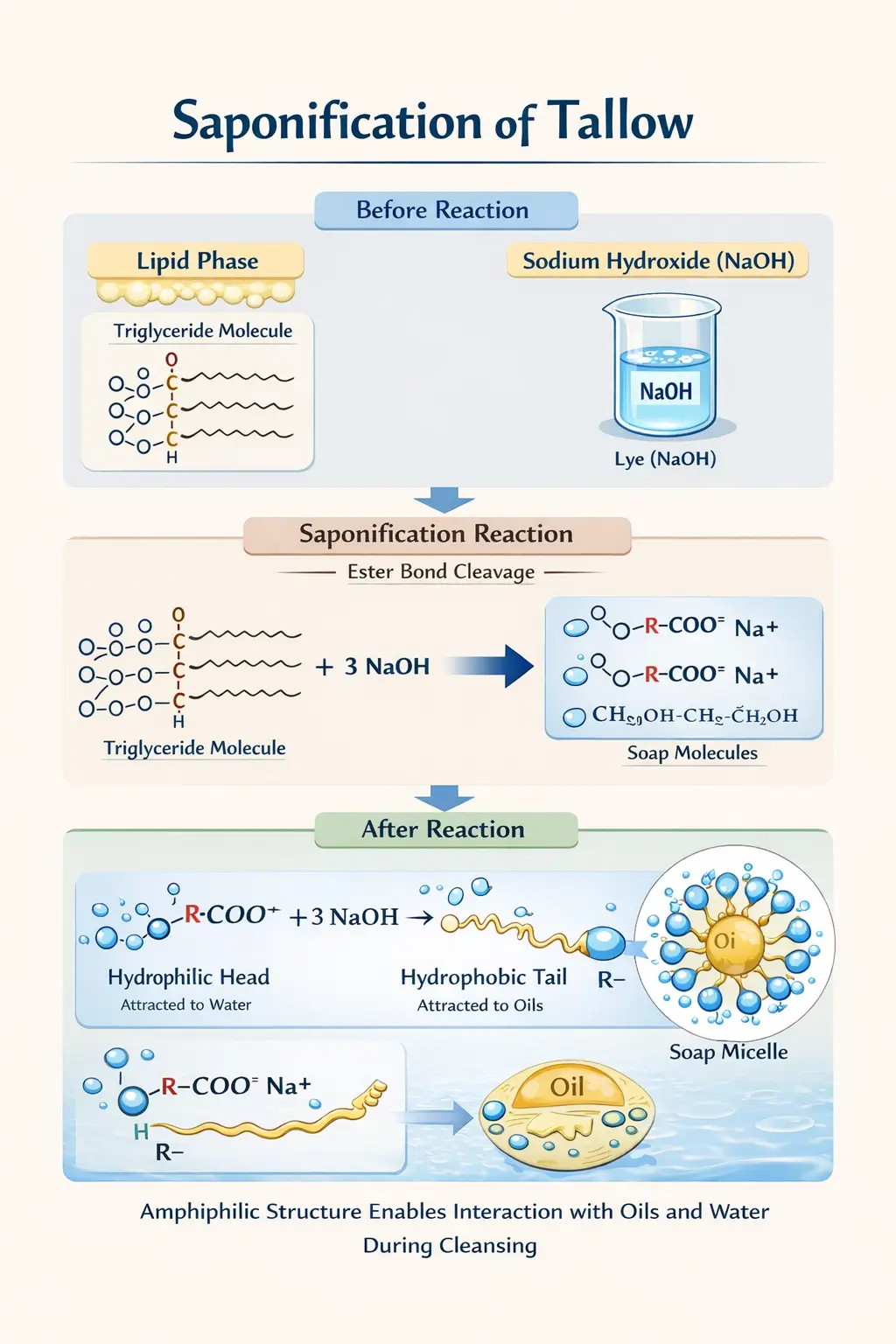
Before chemical transformation, tallow behaves as a non-polar, hydrophobic material. After saponification, its fatty acids become amphiphilic molecules capable of interacting with both oil and water phases.
Functional Role in Soap and Cleansing Systems
In soap systems, tallow contributes to the formation of dense, durable soap structures. When reacted with sodium hydroxide, the resulting sodium salts form a relatively hard bar with slower dissolution compared to high-unsaturated oil systems. This structural contribution is central to the use of tallow in soap formulations designed for longevity and controlled wear.
The fatty-acid composition influences multiple aspects of system behavior. High palmitic and stearic content increases bar hardness and reduces rapid erosion during use. Oleic fractions contribute flexibility and moderate solubility, preventing excessive brittleness.
In oil-based cleansing systems such as a tallow cleanser or tallow oil cleanser, the ingredient remains in triglyceride form. In this context, it functions as a lipid phase that interacts with surface oils and assists in the dispersion of hydrophobic materials during rinsing, especially when combined with emulsifiers.
In tallow cleanser for face formulations, its role is structural and compositional rather than reactive. It contributes to the lipid balance of the system, influencing spreadability and interaction with water during emulsification.
Ingredient Interaction Logic
Tallow does not function independently within a formulation. Its behavior is defined by how it interacts with alkali, water, and co-ingredients within the system. In soapmaking, the interaction begins with the reaction between triglycerides and an alkaline base, where ester bonds are cleaved and fatty-acid salts are formed. These salts then organize into structured networks that determine bar density and dissolution rate.
In mixed systems containing both tallow-derived soap salts and synthetic surfactants, interaction becomes more complex. Soap salts may contribute structure and baseline cleansing, while surfactants improve solubility and reduce sensitivity to water hardness. This hybrid behavior is commonly observed in industrial bar formulations.
When used in emulsified systems such as tallow face cream formulations, the ingredient interacts with emulsifiers and water phases to form semi-solid structures. The saturated fatty-acid content promotes thicker, more stable emulsions, while unsaturated fractions influence spreadability. Humectants such as glycerin may further modify how the lipid phase distributes across surfaces.
Fragrance components and lipid-soluble additives dissolve into the tallow phase, which can influence volatility and release behavior. This interaction is not chemical transformation but physical partitioning within the lipid matrix.
Phase Behavior and Physical Characteristics
Tallow exhibits temperature-dependent phase behavior due to its fatty-acid composition. At room temperature, it exists as a semi-solid lipid with a defined crystalline structure. This structure is governed by the ratio of saturated to unsaturated fatty acids, which determines melting range and hardness.
In soap systems, this crystalline behavior translates into bar firmness and resistance to deformation. During curing, the redistribution of water and crystallization of soap salts derived from tallow contribute to the final structural integrity of the bar.
In oil cleanser systems, tallow remains hydrophobic and does not dissolve in water. Instead, it forms a separate lipid phase that can be temporarily dispersed when emulsifiers are present. This behavior allows the system to transition from oil-rich to rinseable emulsion during use.
Thermal sensitivity is also relevant. At elevated temperatures, tallow softens and loses structural rigidity. Upon cooling, recrystallization occurs, though repeated heating cycles can alter texture due to changes in crystal size distribution.
Comparison With Related Lipid Ingredients
| Feature | Tallow | Lard | Olive Oil |
|---|---|---|---|
| Fatty-Acid Profile | High palmitic and stearic, moderate oleic | Higher oleic, lower stearic | High oleic, low saturated fats |
| Soap Hardness | High | Moderate | Low to moderate |
| Dissolution Rate | Slow | Moderate | Faster |
| Phase State | Semi-solid | Semi-solid | Liquid |
| Typical Use Context | Soap bars, lipid systems | Soap bars, emulsions | Soap, emulsions, liquid cleansers |
Regulatory Context and INCI Declaration
Within cosmetic labeling systems, tallow may be declared either in its raw form or as a reaction product depending on formulation type. In soap bars produced through saponification, the INCI name typically reflects the resulting fatty-acid salts, such as sodium tallowate. In non-reacted systems, it may be listed simply as tallow or incorporated within broader lipid phase declarations.
Under EU cosmetic regulation, ingredient labeling follows standardized nomenclature that prioritizes chemical identity rather than processing history. This means that the same raw material may appear differently depending on whether it has undergone chemical transformation.
Traceability requirements focus on origin and processing consistency rather than functional categorization. As a result, tallow is classified as a cosmetic ingredient based on its role in the formulation, not on its source alone.
Common Misunderstanding
A frequent misunderstanding is that tallow remains unchanged within soap products. In reality, when used in soapmaking, it is chemically transformed into fatty-acid salts and glycerol. The original triglyceride structure no longer exists in the final product.
This distinction matters because the functional behavior of the finished soap is governed by the properties of these salts rather than by the original fat. In contrast, in a tallow cleanser or oil-based formulation, the ingredient remains in its original lipid form and behaves differently within the system.
Structural Limitations in Formulation
One limitation of tallow in formulation systems is its dependence on fatty-acid balance. High saturated content contributes to hardness but can reduce solubility and slow dissolution rates in soap systems. This may result in reduced lather speed compared to formulations dominated by shorter-chain fatty acids.
In emulsified systems, its semi-solid nature requires careful balancing with liquid oils and emulsifiers to avoid excessive stiffness or poor spreadability. Without appropriate formulation adjustments, the resulting product may exhibit uneven texture or phase instability.
Oxidation stability is generally higher than in polyunsaturated oils, but prolonged exposure to heat and air can still lead to changes in odor and texture. These effects reflect lipid degradation rather than functional failure.
Formulation References Using This Ingredient
- Amish Soap Ingredients
- Homemade Laundry Soap Recipe
- Antibacterial Soap Ingredients
- Fels-Naptha Soap Ingredients
- Gold Dial Soap Ingredients
- Ivory Soap Ingredients
- Nurture Soap Fragrance Oils Ingredients
- Panoff Soap Ingredients
- Vegan Soap Ingredients
- Pacha Soap Ingredients
- Zote Soap Ingredients
- Castile Soap
- Lye Soap
- Sallyeander Soap
Summary of Findings
- Classification: Tallow is an animal-derived triglyceride lipid used as a fatty-acid source in formulation systems.
- Functional Role: In soap, it forms structural fatty-acid salts, while in cleansers and creams it acts as a lipid phase component.
- Interaction Logic: Its behavior depends on interaction with alkali, emulsifiers, and water phases rather than independent function.
- Phase Behavior: Semi-solid crystalline structure influences hardness, melting behavior, and system stability.
- System Boundaries: Performance is shaped by fatty-acid composition, requiring balance with other formulation components for optimal structure and usability.