Definition
Olive oil is a plant derived triglyceride oil obtained from the fruit of Olea europaea. In cleansing formulations it functions primarily as a lipid source that participates in soap formation or acts as a conditioning oil within surfactant based systems. When used in traditional soap production, olive oil undergoes alkaline hydrolysis to produce sodium or potassium oleate salts that contribute mild cleansing behavior and a dense, creamy lather structure.
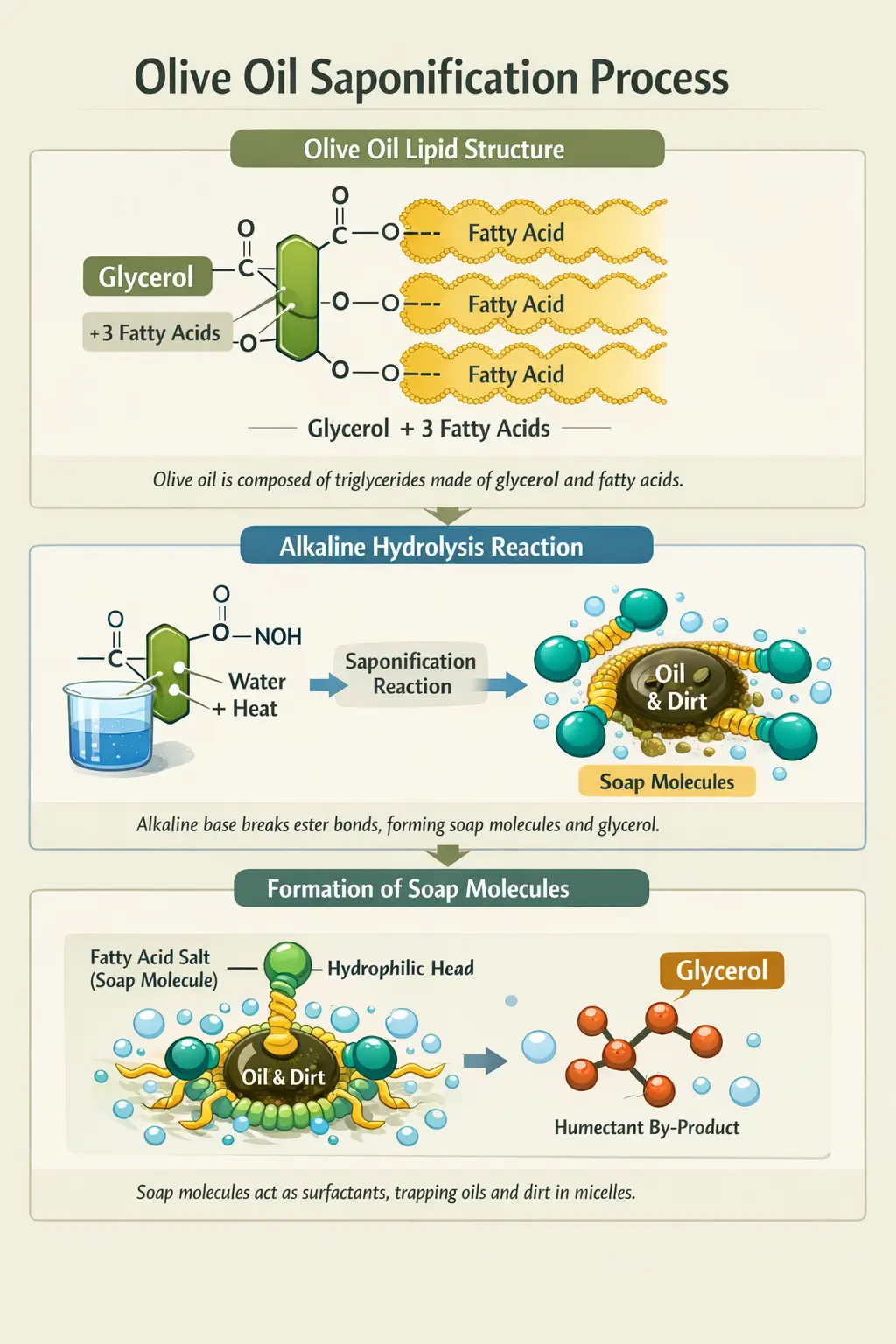
Within the context of olive oil in soap systems, the oil serves as a fatty acid reservoir dominated by oleic acid triglycerides. During saponification the ester bonds in these triglycerides react with an alkaline base, converting the oil into soap salts and glycerol. The resulting soap structure tends to produce stable foam with moderate cleansing strength and a relatively smooth bar texture compared with highly lauric oils.
Olive oil also appears in certain olive oil cleaning products and mild liquid cleansers where it may remain partially unsaponified or function as a lipid conditioning phase dispersed within a surfactant system. In formulations such as olive oil shampoo and conditioner bases, the oil is typically incorporated in small concentrations as part of the emollient phase rather than as the primary cleansing agent.
This page is part of the CleanFormulation Ingredient Library, a research project that analyzes ingredient behavior in real cleansing and cosmetic formulations rather than evaluating marketing claims or product performance narratives.
Quick Facts
| Property | Description |
|---|---|
| Ingredient Type | Vegetable oil used as lipid feedstock in soap production and as an emollient oil in cleansing formulations |
| Chemical Class | Triglyceride oil composed primarily of oleic acid esters |
| Primary Functional Role | Soap precursor in alkaline systems and conditioning lipid in surfactant formulations |
| Ionic Class | Nonionic lipid prior to saponification |
| Typical Use Context | Bar soap, liquid soap, olive oil cleaning products, conditioning phase in shampoo and conditioner formulations |
| Dominant Fatty Acid Component | Oleic acid triglycerides |
| Processing Pathway in Soap | Alkaline hydrolysis producing sodium or potassium oleate |
Functional Role in Soap Systems
Olive oil contributes to soap structure through its triglyceride composition, particularly its high proportion of oleic acid. When the oil undergoes alkaline hydrolysis during soap production, the triglycerides convert into sodium or potassium oleate salts. These soap salts form the cleansing phase responsible for removing oils and particulate residues from surfaces.
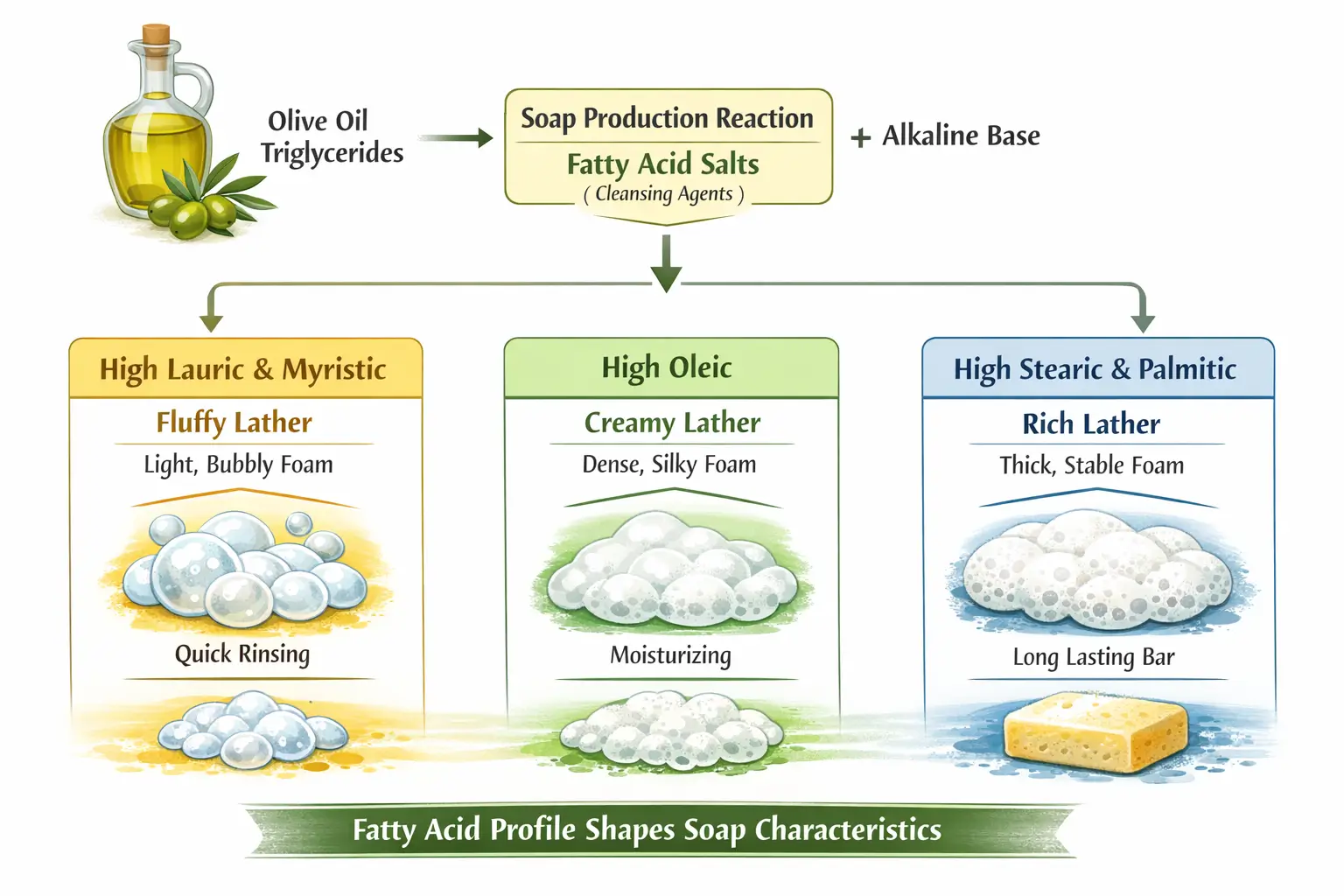
Compared with highly saturated oils that contain large amounts of lauric or myristic acid, olive oil generates soap structures with a different balance of cleansing strength and foam behavior. Oleate based soaps tend to produce a dense and creamy lather rather than large, rapidly forming bubbles. The foam structure forms more slowly but remains relatively stable once generated.
The fatty acid profile of olive oil also influences the mechanical properties of the soap bar. Oleic acid salts produce bars that are typically smoother in texture and less brittle than formulations dominated by saturated fatty acids. This characteristic is one reason olive oil is commonly used as a primary oil in certain traditional soap systems.
In liquid cleansing formulations such as olive oil shampoo and conditioner bases, the oil may appear in a different functional role. Instead of converting fully into soap salts, small concentrations of the oil can remain in the formulation as part of a dispersed lipid phase. In this context the oil modifies the sensory profile of the cleanser rather than acting as the primary surfactant component.
In broader olive oil cleaning products, the ingredient therefore performs two possible roles depending on formulation design. It may serve as a precursor to soap salts through saponification, or it may function as a lipid phase that interacts with surfactants and emulsifiers inside the formulation system.
Why This Ingredient Appears on Labels
Olive oil appears on ingredient labels because it functions as a lipid component within the formulation architecture of many cleansing products. In traditional soap making the oil is a direct precursor to soap salts. When the oil reacts with sodium hydroxide or potassium hydroxide during saponification, the triglyceride molecules break into glycerol and fatty acid salts that become the primary cleansing agents in the finished soap.
In other formulations the oil may remain partially intact and serve as a conditioning lipid dispersed within the surfactant system. In these cases olive oil does not function as the main cleansing agent but instead contributes to the sensory characteristics of the formulation by influencing lubrication and after feel. This explains why olive oil can appear in the ingredient lists of olive oil cleaning products, shampoo bases, and conditioning cleansers even when the primary cleansing agents are synthetic surfactants.
Ingredient lists therefore reflect formulation composition rather than marketing claims. The presence of olive oil on a label typically indicates that the formulation includes a triglyceride oil phase either as a soap precursor or as a supplementary lipid component interacting with surfactants, water, and stabilizing ingredients.
Phase Behavior in Cleansing Formulations
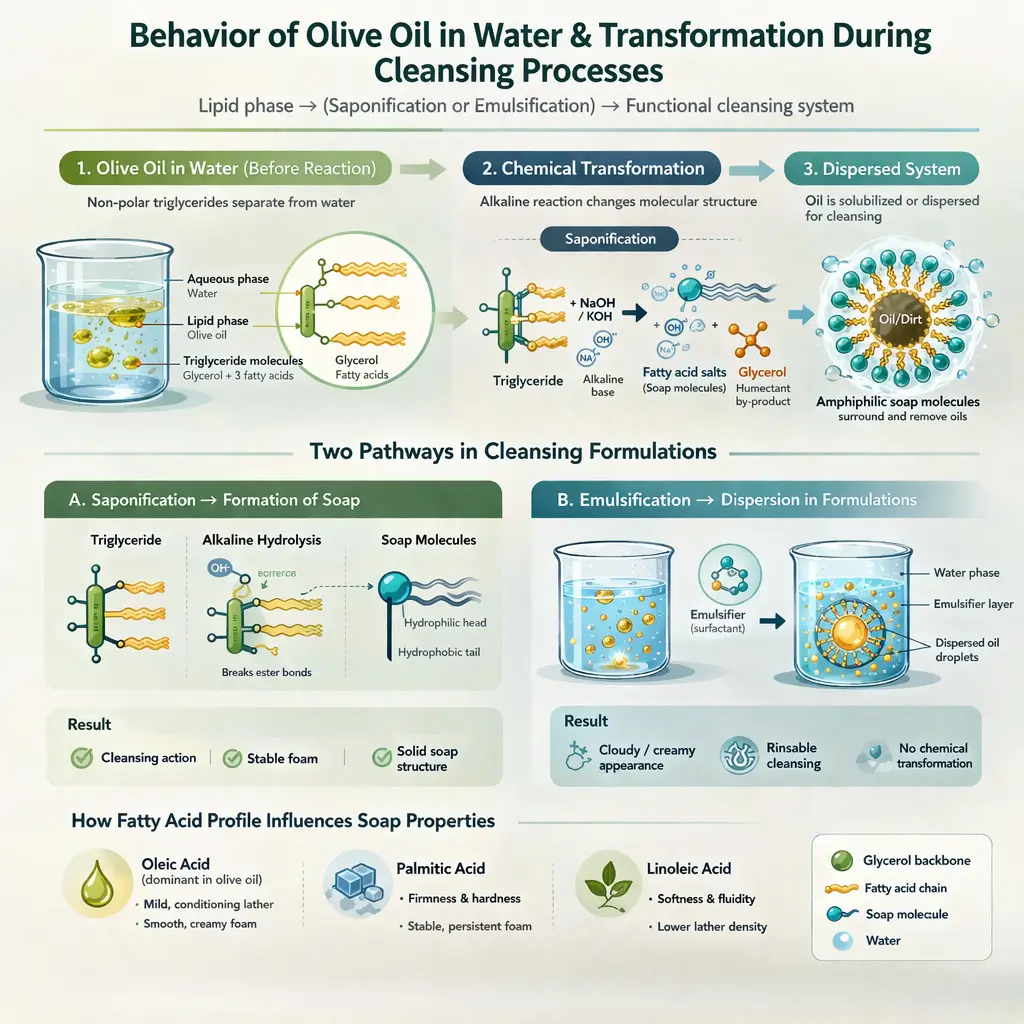
Olive oil exhibits typical hydrophobic behavior when introduced into aqueous cleansing systems. Because triglycerides do not dissolve in water, the oil forms a separate lipid phase unless it undergoes saponification or is stabilized through emulsification. This phase separation is a defining feature of how vegetable oils behave inside cleansing formulations.
In traditional soap production the phase behavior changes as the oil reacts with the alkaline base. Once the triglycerides convert into fatty acid salts, the resulting molecules become amphiphilic. This amphiphilic structure allows the soap molecules to interact with both water and oils, forming micellar structures responsible for cleansing activity.
In liquid cleansing systems where olive oil remains partially intact, emulsifiers or surfactant systems disperse the oil into small droplets throughout the aqueous phase. The stability of this dispersion depends on factors such as surfactant concentration, viscosity modifiers, and the overall ionic environment of the formulation.
Thermal conditions can also influence phase behavior. Vegetable oils generally remain liquid across a wide temperature range, but changes in temperature may affect viscosity and dispersion stability. Oxidation processes can gradually alter the chemical composition of the oil over extended storage periods, which can influence formulation stability if not controlled through formulation design.
Comparison With Related Vegetable Oils
Vegetable oils used in cleansing formulations vary widely in fatty acid composition. This composition determines how the resulting soap salts behave once the oil undergoes saponification. Oils rich in saturated fatty acids tend to produce stronger cleansing action and larger foam bubbles, while oils dominated by oleic acid create milder soap structures with denser lather.
| Feature | Olive Oil | Coconut Oil |
|---|---|---|
| Dominant Fatty Acid | Oleic acid | Lauric acid |
| Soap Salt Produced | Sodium or potassium oleate | Sodium or potassium laurate |
| Foam Structure | Dense creamy lather | Large rapidly forming bubbles |
| Typical Cleansing Strength | Moderate | Relatively strong |
| Typical Role in Formulation | Primary conditioning oil in soap systems | Cleansing and lather boosting oil |
This comparison illustrates how different fatty acid compositions shape the behavior of soap systems. Olive oil derived soaps are often combined with other oils in formulation design to balance cleansing performance, foam structure, and bar stability.
Chemical Identity and Classification
The INCI name used in cosmetic labeling is Olea Europaea Fruit Oil. Chemically, olive oil belongs to the triglyceride class of lipids, meaning the molecule consists of three fatty acids esterified to a glycerol backbone. The fatty acid distribution is dominated by oleic acid, typically representing the majority of the triglyceride composition, with smaller proportions of palmitic, linoleic, and stearic acids.
From a formulation chemistry perspective olive oil is categorized as a nonionic lipid prior to saponification. It does not carry a charge and therefore behaves differently from ionic surfactants commonly used in shampoo systems. Instead of reducing surface tension directly, the oil participates in soap formation or functions as a dispersed oil phase within emulsified cleansing systems.
The oil originates from mechanical extraction of the olive fruit and remains chemically composed of natural triglycerides, minor sterols, and trace unsaponifiable components. These minor fractions can influence oxidation stability and shelf life behavior in formulations but they do not change the primary classification of olive oil as a triglyceride lipid used in cleansing product formulation.
Ingredient Interaction Logic
Olive oil rarely functions in isolation inside a cleansing formulation. Instead it interacts with several other formulation components that determine how the ingredient behaves in the final product. The most important interaction occurs with alkaline bases during soap formation. Sodium hydroxide or potassium hydroxide breaks the ester bonds in the triglyceride structure, generating fatty acid salts and glycerol.
The resulting soap salts then interact with water to form the micellar structures responsible for cleansing behavior. These micelles surround oils and particulate material during washing, allowing them to be removed when the system is rinsed. The presence of glycerol produced during saponification can also influence the hydration behavior of the finished soap.
In formulations where olive oil remains partially unsaponified, the oil interacts differently with the system. Emulsifiers or surfactants help disperse the oil droplets throughout the aqueous phase of the formulation. Humectants may influence how the oil phase interacts with water retention in the finished product, while fragrances often partition into the lipid phase due to their hydrophobic nature.
Chelating agents also affect system behavior in certain cleansing formulations. Hard water ions such as calcium and magnesium can interact with soap salts to form insoluble deposits. Chelators reduce this interaction by binding metal ions, improving the stability of the cleansing system when soap salts derived from olive oil are present.
These interactions illustrate that the behavior of olive oil in cleansing products cannot be understood solely by examining the oil itself. Its role depends on how it participates in the broader formulation network that includes surfactants, water, stabilizers, and processing conditions.
Regulatory Context
In cosmetic ingredient labeling, olive oil is declared under the International Nomenclature of Cosmetic Ingredients system using the name Olea Europaea Fruit Oil. This naming convention is defined by the Personal Care Products Council and is used across cosmetic labeling frameworks in many regulatory jurisdictions. The INCI name identifies the botanical source and the type of ingredient present in the formulation.
Within the European Union cosmetic regulatory framework, olive oil is treated as a conventional cosmetic ingredient rather than a restricted chemical class. It appears in ingredient lists according to the labeling requirements of Regulation (EC) No 1223 2009 on cosmetic products. The regulation primarily governs labeling transparency, ingredient traceability, and consumer information rather than prescribing functional roles within formulations.
For soap and cleansing product manufacturers, the regulatory relevance of olive oil is primarily related to correct ingredient declaration and traceability of raw materials. When the oil undergoes saponification during soap manufacturing, the resulting soap salts may appear in labeling either as the original oil source or as the resulting sodium or potassium salts depending on the labeling approach used by the manufacturer.
This regulatory context explains why olive oil may appear on cosmetic labels even when the finished cleansing agent has undergone chemical transformation during soap production.
Common Misunderstanding
A common misunderstanding arises from the assumption that the presence of olive oil on an ingredient list means that the oil remains chemically unchanged in the finished soap. In traditional soap production this is often not the case. During saponification the triglyceride molecules that make up the oil react with an alkaline base and convert into soap salts and glycerol.
As a result, the original oil structure may no longer exist in its initial form once the soap is fully processed. What remains are fatty acid salts derived from the oil's triglyceride composition. These salts are responsible for the cleansing behavior of the finished soap.
In other cleansing formulations such as certain liquid cleansers or olive oil shampoo and conditioner products, the oil may remain partly intact because it is dispersed into the formulation rather than chemically converted. The difference between these two scenarios depends entirely on the formulation design and manufacturing process rather than on the ingredient name alone.
Structural Limitations in Formulation Systems
Despite its widespread use in cleansing formulations, olive oil has several structural limitations that influence formulation design. One limitation relates to the fatty acid profile dominated by oleic acid. Soap salts derived from oleic acid tend to produce softer bar structures compared with formulations dominated by saturated fatty acids such as lauric or palmitic acid.
This structural characteristic means that soaps composed primarily of olive oil may require longer curing periods or may be combined with other oils to improve bar firmness. The balance between different fatty acid profiles is a common consideration in soap formulation development.
Another limitation involves oxidative stability. Vegetable oils contain unsaturated fatty acids that can undergo oxidation during extended storage, particularly when exposed to heat, oxygen, or light. Formulation strategies sometimes include antioxidants or controlled storage conditions to reduce the impact of oxidation on product stability.
Finally, soaps derived from vegetable oils including olive oil may interact with minerals present in hard water. Calcium and magnesium ions can form insoluble salts with soap molecules, sometimes resulting in visible deposits during washing. Chelating agents or formulation adjustments are often used to reduce this interaction in certain cleansing systems.
Formulation References Using This Ingredient
Summary of Findings
Olive oil is a plant derived triglyceride lipid widely used in cleansing formulations as a precursor to soap salts or as a conditioning oil dispersed within surfactant systems. Its chemical composition is dominated by oleic acid triglycerides, which influence the structural characteristics of soap produced through alkaline hydrolysis.
- Ingredient Classification: Olive oil is a vegetable triglyceride oil declared on cosmetic labels as Olea Europaea Fruit Oil.
- Functional Role: In soap systems the oil undergoes saponification to form fatty acid salts that act as cleansing agents.
- Formulation Context: In liquid cleansing products the oil may remain partially intact as a dispersed lipid phase interacting with surfactants and emulsifiers.
- Interaction Logic: The ingredient interacts with alkaline bases, water phases, humectants, and chelating agents within cleansing formulations.
- System Boundaries: The fatty acid composition and oxidation sensitivity of the oil influence bar hardness, formulation stability, and interaction with minerals in hard water.