Definition and System Identity
Sodium silicate is an inorganic alkaline compound used in detergent and cleansing systems as a structural component that contributes to alkalinity, soil dispersion and formulation stability.
It belongs to the class of silicate salts, functioning primarily within alkaline environments where it supports cleaning efficiency rather than directly removing soils through surface activity.
In practical formulations, it operates alongside alkaline bases and detergent systems, influencing how soils are loosened and how the system maintains stability during washing.
This page is part of the ingredient library, a research system examining how ingredients behave inside real formulation environments rather than in isolation.
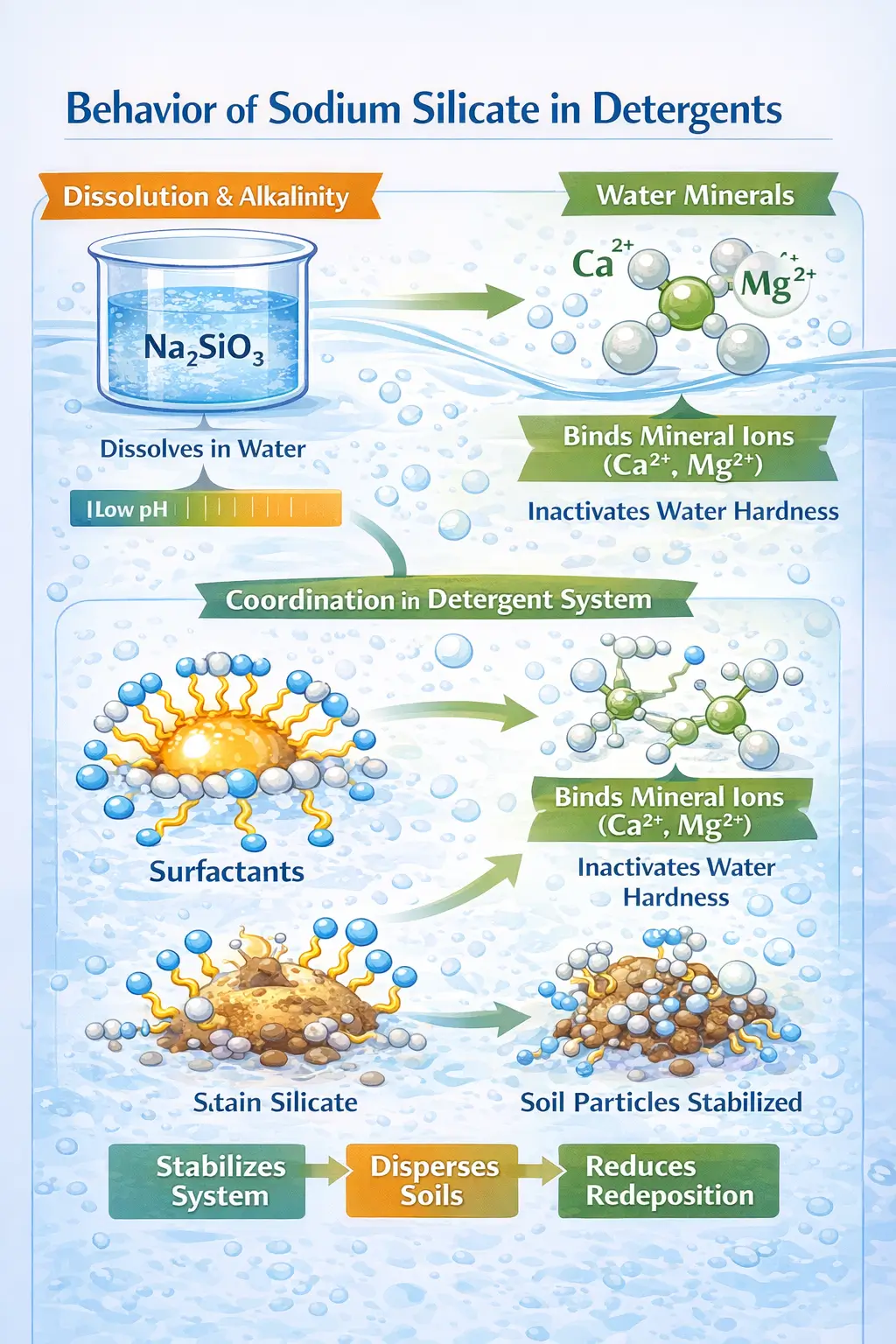
Quick Facts
| Property | Description |
|---|---|
| Ingredient Type | Alkaline agent and builder component |
| Chemical Class | Inorganic silicate salt |
| Functional Role | Alkalinity control, soil dispersion, corrosion inhibition |
| Ionic Nature | Anionic inorganic compound |
| Typical Use Context | Laundry detergents, industrial cleaners, soap systems |
| Physical Form | Solid or liquid aqueous solution |
| Alkalinity Contribution | Raises and buffers system pH in alkaline cleaning environments |
| Silicate Ratio (SiO₂:Na₂O) | Determines alkalinity strength, solubility, and functional behavior |
| Buffering Capacity | Maintains stable pH during washing cycles |
| Soil Dispersion Mechanism | Prevents redeposition by stabilizing dispersed soil particles |
| Corrosion Inhibition | Forms protective films on metal surfaces to reduce corrosion |
| Interaction with Surfactants | Enhances cleaning efficiency by maintaining alkaline conditions |
| Compatibility with Builders | Works alongside phosphates, carbonates, and other builders |
| Water Hardness Interaction | Helps manage mineral interference indirectly through dispersion |
| Solubility Behavior | Highly soluble in water; dependent on silicate ratio and form |
| Phase Behavior | Remains in aqueous phase; contributes to system stability |
| pH Range | Operates in strongly alkaline conditions |
| Film Formation | Can deposit thin silicate layers on surfaces under certain conditions |
| Formulation Limitation | Excess levels may lead to residue or film formation |
| System Role | Supports cleaning performance through alkalinity, dispersion, and protection rather than direct soil removal |
Why This Ingredient Appears on Labels
Sodium silicate appears on ingredient labels because it plays a functional role in maintaining the chemical environment required for effective cleaning.
Its inclusion indicates that the formulation contains an alkaline system designed to support soil removal, dispersion and structural stability during use.
Unlike primary cleaning agents such as surfactant systems, it does not directly interact with oils at the surface level but instead modifies the surrounding chemical conditions that enable cleaning to occur efficiently.
Ingredient listing practices follow standardized labeling frameworks explained in the ingredient list interpretation guide, where ingredients reflect formulation composition rather than performance ranking.
In observable terms, formulations containing sodium silicate may show more stable performance in hard water environments and improved consistency during washing cycles.
Chemical Identity and Classification
Sodium silicate is typically represented by a general formula involving sodium oxide and silica, where the ratio between these components determines its physical and chemical behavior in formulation systems.
It is commonly referred to as water glass in solution form, reflecting its ability to form viscous, alkaline aqueous systems that interact strongly with mineral surfaces and dissolved ions.
The compound exists in different grades defined by the silica to sodium oxide ratio, which influences solubility, alkalinity strength and structural behavior within the formulation matrix.
As an inorganic salt, it dissociates in water to form silicate species and sodium ions, contributing to the overall alkaline environment required for effective cleaning processes.
This classification places it within alkaline system components rather than surface-active ingredients such as anionic surfactants, which operate through interfacial mechanisms.
Functional Role in Soap and Detergent Systems
Sodium silicate contributes to multiple aspects of detergent performance, primarily through its ability to modify the chemical environment rather than directly removing soils.
Alkalinity Contribution
One of its primary roles is maintaining an alkaline pH, which enhances the breakdown of fatty soils and supports the activity of cleaning systems.
This alkaline environment complements the action of stronger alkali components, ensuring consistent system behavior during use.
Soil Dispersion and Anti-Redeposition
Sodium silicate helps disperse soil particles once they are detached from surfaces, reducing the tendency of dirt to redeposit during the washing process.
This function supports the overall efficiency of detergent formulations, where removal and suspension of soils must occur simultaneously.
Structural Stabilization
In some systems, it contributes to formulation stability by interacting with dissolved minerals and preventing undesirable precipitation reactions.
This stabilization effect helps maintain clarity or consistency in liquid systems and improves structural integrity in powdered formulations.
Corrosion Control
Sodium silicate can form protective layers on metal surfaces, reducing corrosion during washing processes in machines or industrial cleaning environments.
This role becomes particularly relevant in systems where prolonged exposure to alkaline solutions occurs.
In observable terms, these combined functions result in cleaning systems that show more stable performance, reduced residue formation and improved handling of mineral-rich water conditions.
Ingredient Interaction Logic
Sodium silicate operates within a network of interacting components, where its effectiveness depends on coordination with other ingredients in the formulation.
Interaction with Water Phase
Water enables dissolution and ionization, allowing silicate species to interact with dissolved minerals and suspended particles.
This interaction forms the basis for dispersion and stabilization mechanisms within the system.
Interaction with Surfactants
Surfactants are responsible for removing oils and reducing surface tension, while sodium silicate supports the surrounding chemical environment that allows this process to proceed efficiently.
Systems containing anionic surfactants or nonionic surfactants benefit from the alkaline conditions maintained by silicate components.
Interaction with Other Alkaline Agents
It works alongside other alkaline substances to maintain pH balance and ensure consistent system performance.
The broader role of such components is explained within the alkaline agent system, where multiple ingredients contribute to overall chemical conditions.
Interaction with Mineral Ions
Sodium silicate interacts with calcium and magnesium ions present in hard water, reducing their interference with cleaning processes.
This interaction helps prevent the formation of insoluble residues that can reduce cleaning efficiency.
Interaction with Organic Components
Organic additives such as fragrance systems may be influenced by the alkaline environment, which can affect their stability or perception during use.
These interactions are part of broader formulation considerations involving compatibility between inorganic and organic components.
Phase Behavior and Physical Characteristics
Sodium silicate can exist in both solid and liquid forms, with its behavior depending on concentration and water content within the formulation.
In solid detergent systems, it is incorporated as a stable component that dissolves upon contact with water during use.
In liquid systems, it exists as an aqueous solution commonly referred to as water glass, contributing to viscosity and structural stability.
Solubility and Dissolution
Upon dissolution, sodium silicate forms alkaline solutions containing silicate ions that interact with water, minerals and suspended particles.
This process enables dispersion and stabilization mechanisms within the cleaning system.
Temperature Influence
Temperature affects solubility and reaction dynamics, with higher temperatures generally enhancing dissolution and interaction with other formulation components.
However, its functional role remains consistent across typical washing conditions.
Stability in Storage
In dry formulations, sodium silicate remains stable under controlled conditions. In aqueous systems, stability depends on concentration and interaction with other components.
Proper formulation design ensures that precipitation or instability is minimized during storage.
Comparison With Other Alkaline Components
The role of sodium silicate becomes clearer when compared with other alkaline agents commonly used in detergent systems.
| Feature | Sodium Silicate | Sodium Carbonate | Sodium Hydroxide |
|---|---|---|---|
| Primary Function | Alkalinity + stabilization | Alkalinity + water softening | Strong alkalinity |
| Strength of Alkalinity | Moderate | Moderate | High |
| Additional Role | Dispersion, corrosion control | Builder function | pH adjustment |
| System Behavior | Stabilizing | Buffering | Reactive |
| Typical Use | Detergents, industrial cleaning | Detergents, laundry systems | Soap making, strong cleaners |
This comparison highlights how sodium silicate combines alkaline behavior with stabilization and dispersion functions, distinguishing it from purely pH-focused components.
Regulatory Context
Sodium silicate is regulated under general chemical and detergent frameworks, where its use is evaluated based on formulation context and environmental interaction.
It is not classified as a primary cleaning agent but as a supporting component within alkaline systems.
In product labeling, its presence reflects formulation design rather than consumer-facing functionality, as explained in the ingredient list interpretation guide.
Regulatory frameworks consider its behavior within complete formulations rather than as an isolated substance.
Common Misunderstanding
A common misconception is that sodium silicate directly removes dirt in the same way as surfactants.
In reality, it does not act on oils or reduce surface tension. Instead, it modifies the chemical environment that enables other components to function effectively.
Another misunderstanding is that alkalinity alone determines cleaning performance. In practice, cleaning results from coordinated interaction between surfactants, alkaline agents and additives.
This distinction is explored further in the cleansing mechanism explanation.
Structural and Formulation Limitations
Despite its advantages, sodium silicate introduces certain formulation challenges that must be considered.
- Dependence on system balance: effectiveness relies on interaction with other formulation components.
- Potential for precipitation: improper formulation may lead to instability or solid formation.
- Alkalinity control: excessive levels may affect system compatibility.
- Complex interaction behavior: interactions with minerals and other ingredients require careful formulation design.
These limitations highlight the importance of integrating sodium silicate into a balanced formulation system.
Formulation References Using This Ingredient
- What Is ACE Soap - Ingredients & Formulation
- Williams Sonoma Soap Dispensers & Pump Bottles – Materials & Refill Fit
- Lava Soap Ingredients Analysis
- Charlie’s Soap Ingredients Analysis
- Buff City Soap Ingredients Analysis
- Amway Soap Ingredients Analysis
- Vegan Soap Ingredients Analysis
- Arm & Hammer Laundry Soap Ingredients Analysis
Summary of Findings
- Classification: Sodium silicate is an alkaline agent and builder component.
- Functional Role: It contributes to alkalinity, dispersion and system stabilization.
- Interaction Logic: Its effectiveness depends on coordination with surfactants, water and mineral ions.
- System Behavior: It supports consistent cleaning performance and reduces redeposition.
- Limitations: Requires careful formulation to avoid instability and imbalance.