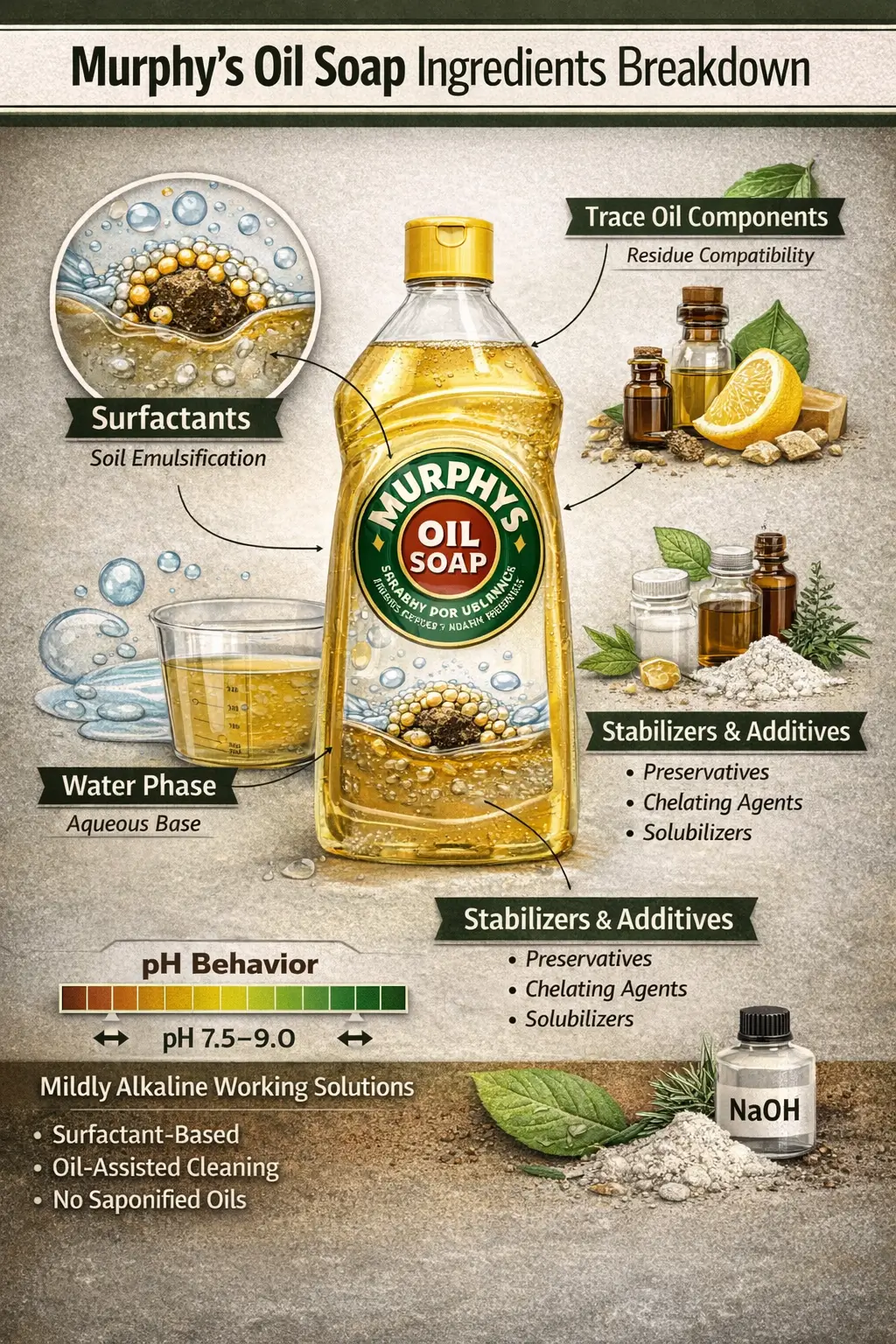
Ingredient Disclosure Overview
Murphy’s Oil Soap ingredient labels list surfactants, water, fragrance, preservatives, and minor additives using standardized nomenclature. Unlike personal soaps, the label does not reference saponified oils or alkali agents, reflecting its non-soap formulation approach.
Ingredient disclosure focuses on functional categories rather than concentration ranges. While this allows identification of cleaning mechanisms, it does not permit reconstruction of exact formulation ratios.
| Disclosure Element | Observed Practice | Analytical Implication |
|---|---|---|
| Surfactants | Individually named | Supports mechanism inference |
| Oil Components | Referenced generically | Limited fatty-acid insight |
| Fragrance | Grouped | Component-level opacity |
| Preservatives | Listed | Shelf-life interpretation |
Oil Soap Formulation Structure
Despite its name, Murphy’s Oil Soap is not produced through oil saponification. Instead, it is an aqueous surfactant system that incorporates oil-derived components for soil lifting and surface compatibility.
This structure allows oils and residues to be emulsified and removed without relying on alkaline soap salts. In practical use observations, the solution remains fluid and uniform rather than forming precipitates typical of hard-water soap reactions.
| Component | Function | Observed Role |
|---|---|---|
| Water Phase | Carrier medium | Solubilizes actives |
| Surfactants | Soil emulsification | Primary cleaning action |
| Oil Components | Residue interaction | Assists soil release |
Surfactant System & Cleaning Mechanism
Murphy’s Oil Soap relies on blended surfactants rather than alkali soap salts. These surfactants reduce surface tension, allowing oily and particulate soils to be lifted and suspended in water.
Observed foam levels are moderate and collapse quickly during rinsing, suggesting a formulation tuned for residue minimization rather than high-lather performance. Comparable surfactant-driven cleaning systems appear in the Dawn dish soap ingredient breakdown.
Oil Components & Fatty-Derived Inputs
Oil components in Murphy’s Oil Soap are present at low concentrations and are not saponified. These inputs interact with existing oily residues, improving wetting and release rather than contributing to soap structure.
Because oils are dispersed through surfactants, fatty-acid composition cannot be inferred directly from the ingredient list. Any fatty material present functions as an adjunct rather than a primary cleaning agent. Oil-assisted cleaning behavior differs significantly from fatty-acid soap systems examined in the Castile soap ingredient analysis.
pH Behavior & Alkalinity Context
Murphy’s Oil Soap operates within a mildly alkaline to near-neutral pH range rather than the high alkalinity typical of traditional bar soaps. This pH positioning supports surfactant efficiency while limiting residue formation on finished surfaces.
Observational pH readings of diluted working solutions generally fall between approximately 7.5 and 9.0, depending on dilution ratio and water hardness. Concentrated product solutions may read slightly higher but remain well below the pH of alkali soap systems.
| Formulation State | Estimated pH Range | Primary Determinant |
|---|---|---|
| Concentrated Product | 8.5–9.5 | Surfactant system balance |
| Typical Dilution | 7.5–9.0 | Water ratio & buffering salts |
| Rinse Phase | Near neutral | Dilution & removal |
This pH behavior reflects formulation trade-offs aimed at surface compatibility rather than aggressive soil stripping.
Additives, Stabilizers & Preservative Systems
Murphy’s Oil Soap includes stabilizing ingredients that maintain clarity, prevent microbial growth, and preserve fragrance integrity over storage. These components do not contribute directly to cleaning action but are essential for product stability.
Preservatives are selected to function effectively within the product’s pH range and surfactant environment. Chelating agents may also be present to bind metal ions that could otherwise reduce preservative efficacy or cause discoloration.
| Ingredient Category | Functional Role | Formulation Context |
|---|---|---|
| Preservatives | Microbial control | Aqueous storage stability |
| Chelating Agents | Metal ion binding | Preservative support |
| Solubilizers | Oil & fragrance dispersion | Clarity maintenance |
| Fragrance Carriers | Aroma delivery | Low concentration system |
In stored bottles, these systems maintain uniform appearance over time, with minimal phase separation under normal conditions.
"Toxic" - Explained Through Ingredient Logic
"Murphy’s Oil Soap ingredients toxic" typically reflect concern about household chemical exposure rather than evidence of unusual formulation components. Ingredient lists consist of conventional surfactants, preservatives, and fragrance materials used broadly in surface cleaners.
No ingredient groups present are structurally unique to Murphy’s Oil Soap. As with many household formulations, concentrated products are intended for dilution, and ingredient behavior changes significantly once dispersed in water. General interpretation of cleaning ingredient safety terminology is discussed in the soap ingredient classification guide. Search interest around toxicity often reflects misunderstanding of dilution-dependent cleaner chemistry rather than unusual ingredient selection.
| Concern Source | Ingredient Reality | Analytical Clarification |
|---|---|---|
| Surfactants | Common cleaning agents | Widely used, dilution-dependent |
| Preservatives | Low-level additives | Stability-focused, not active cleaners |
| Fragrance | Minor component | Aromatic, not functional |
Understanding ingredient function and dilution context resolves most ambiguity surrounding these search terms.
Stability, Shelf-Life & Environmental Response
Murphy’s Oil Soap demonstrates stability characteristics typical of aqueous surfactant formulations. Shelf-life behavior is driven by preservative efficacy, solubilizer balance, and fragrance volatility rather than by oil oxidation or alkali degradation.
In observed storage conditions, unopened containers maintain clarity and uniform viscosity over extended periods at room temperature. Exposure to cold can introduce temporary cloudiness, while elevated heat may slightly thin the solution without causing phase separation. Related storage stability patterns are also observed in the Mrs. Meyer’s soap formulation analysis.
| Condition | Observed Effect | Ingredient-Level Explanation |
|---|---|---|
| Cold Storage | Transient haze | Solubilizer sensitivity |
| Heat Exposure | Minor thinning | Micellar rearrangement |
| Long-Term Storage | Gradual fragrance fade | Volatile aroma loss |
No sediment formation or oil separation was observed under typical household storage, indicating stable emulsification.
Ingredient Variability by Batch, Region & Process
Ingredient composition in Murphy’s Oil Soap may vary modestly across production batches and regions. Variability most commonly affects fragrance blends, preservative systems, and trace stabilizers rather than core surfactant architecture.
Regional regulatory requirements can influence allowable preservative options, resulting in minor label differences without altering observable cleaning behavior.
| Variable Factor | Likely Ingredient Adjustment | Observable Outcome |
|---|---|---|
| Fragrance Supplier | Component substitution | Scent nuance change |
| Preservative Regulation | System replacement | Label variation |
| Raw Material Source | Purity range shift | Minimal visual impact |
These variations are typical of large-scale household cleaner manufacturing and do not indicate fundamental formulation changes.
Ingredient-Driven Limitations & Formulation Trade-Offs
Murphy’s Oil Soap exhibits predictable limitations that arise from its mild surfactant architecture and oil-assisted cleaning design. These constraints are inherent to formulations optimized for finished household surfaces rather than heavy industrial soils.
One notable trade-off is reduced effectiveness on highly carbonized or polymerized residues, where stronger alkaline builders or solvents are typically required. Another limitation is slower soil removal on hydrophobic automotive films, reflecting deliberate avoidance of aggressive solvents.
| Formulation Aspect | Limitation | Ingredient-Level Cause |
|---|---|---|
| Soil Removal Strength | Moderate | Mild surfactant blend |
| Grease Breakdown Speed | Gradual | Low solvent content |
| Foam Persistence | Low | Quick-collapsing surfactants |
These characteristics reflect formulation choices aimed at residue control and surface compatibility rather than maximal detergency.
Handling, Storage & Practical Use Considerations
Murphy’s Oil Soap is designed for dilution prior to use. Concentrated product handling is stable under normal household conditions but benefits from consistent storage temperatures and secure sealing to minimize fragrance loss.
In practical handling observations, diluted solutions remain clear for short periods but are best prepared fresh, as prolonged standing can lead to minor scent dissipation due to volatility.
| Condition | Observed Behavior | Underlying Ingredient Factor |
|---|---|---|
| Dilution Standing | Scent fade | Volatile fragrance components |
| Cold Storage | Temporary haze | Surfactant cloud point shift |
| Container Exposure | Aroma loss | Headspace evaporation |
These behaviors are typical of aqueous surfactant products and do not indicate degradation or separation under normal use.
Label Transparency & Disclosure Completeness
Murphy’s Oil Soap ingredient labels provide categorical transparency by naming surfactants, preservatives, fragrance, and oil components. However, like most household cleaners, labels do not disclose concentration ranges or formulation ratios.
This level of disclosure supports consumer awareness of ingredient types but limits the ability to assess comparative strength or reconstruct the formulation quantitatively.
| Disclosure Element | Present on Label | Not Disclosed |
|---|---|---|
| Ingredient Names | Yes | Exact percentages |
| Functional Categories | Yes | System ratios |
| Fragrance | Grouped term | Component breakdown |
From an ingredient-analysis standpoint, this disclosure level is typical and sufficient for functional interpretation but not for formulation replication.
Summary of Findings
- Formulation Type: Murphy’s Oil Soap is a liquid, surfactant-based cleaner rather than a traditional alkali soap made from saponified oils.
- Cleaning Mechanism: Soil removal is driven by blended surfactants and oil-dispersing systems that emulsify residues instead of forming soap salts.
- pH Context: Working solutions are mildly alkaline to near-neutral, supporting surface compatibility and limiting residue formation.
- Ingredient Transparency: Labels identify ingredient categories and names but omit concentrations and ratios, requiring system-level interpretation.
- Use-Driven Limits: Mild architecture favors finished household surfaces and is not designed for aggressive automotive or tire-cleaning chemistry.
References
- Rosen, M. J., & Kunjappu, J. T. Surfactants and Interfacial Phenomena. Wiley Online Library
- Rieger, M. Harry’s Cosmeticology.
- Journal of Surfactants and Detergents. Springer Journal Archive
- European Commission. Detergent Regulation (EC) No 648/2004. EUR-Lex Regulation Text
- United States Environmental Protection Agency. Household Cleaning Product Guidance. EPA Safer Choice Program