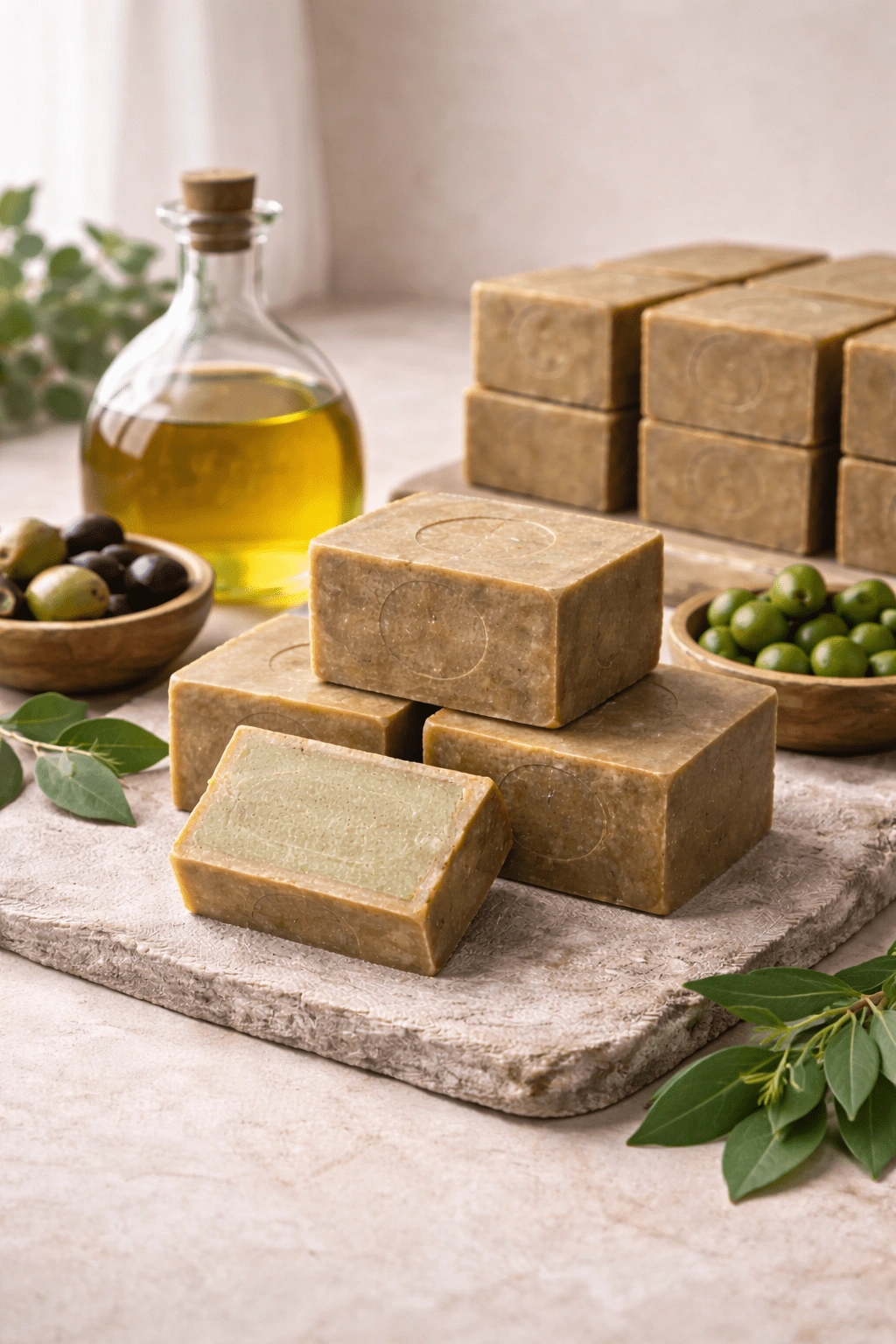
What Defines Original Ingredients
The term "original Aleppo soap ingredients" refers to a historically constrained formulation, as discussed in our broader soap ingredient guide not to a fixed recipe sheet. In its earliest documented forms, Aleppo soap relied on locally available oils, water, and an alkaline agent derived from plant ash or mineral sources.
What distinguishes original Aleppo soap is not novelty, but the absence of excess. Additives, fragrances, colorants, and functional enhancers were not part of the formula.
| Component | Role | Status In Original Formula |
|---|---|---|
| Olive Oil | Primary fatty input | Essential |
| Laurel Oil | Optional balancing oil | Conditional |
| Water | Reaction medium | Temporary |
| Alkaline Source | Saponification agent | Consumed |
A small observational insight: bars that adhere to this minimal ingredient set tend to age more predictably than complex formulations.
Ingredient Minimalism In Traditional Soap
Traditional Aleppo soap ingredients follow a philosophy of sufficiency. Each ingredient serves a structural role rather than a marketing function. This minimalism is often mistaken for simplicity, yet it requires careful control of ratios and processing.
Without secondary oils or buffers, the soap’s behavior depends heavily on oil quality, saponification completeness, and curing duration.
| Aspect | Minimal Formula Effect | User Perception |
|---|---|---|
| Transparency | Clear ingredient function | High trust |
| Customization | Limited | Less immediate appeal |
| Consistency | Process-dependent | Stable over time |
A practical limitation: minimal formulas leave little room to correct process errors after production.
Olive Oil As The Core Ingredient
Aleppo olive oil soap ingredients revolve around olive oil’s fatty acid structure, explored in greater depth in the Aleppo soap olive oil guide. Olive oil contributes a high proportion of oleic acid, which produces a mild, low-lather soap with gradual cleansing behavior. Fatty acid behavior in olive oil soaps is explained further in our Castile soap ingredient breakdown.
In traditional formulations, olive oil is not chosen for sensory luxury, but for availability, stability, and predictability during long curing periods.
| Property | Olive Oil Influence | Practical Outcome |
|---|---|---|
| Fatty Acid Profile | Oleic-dominant | Mild cleansing |
| Oxidative Stability | Moderate | Long shelf life when cured |
| Bar Longevity | High after curing | Slow wear |
A real-use observation: olive-oil–dominant Aleppo soaps often feel underwhelming early but improve noticeably with extended curing.
Traditional Aleppo Soap Ingredients vs Modern Variations
Traditional Aleppo soap ingredients reflect material constraint rather than innovation. The formula evolved around what could be sourced locally, stored safely, and processed at scale without degradation.
Modern Aleppo-style soaps often expand the ingredient list, introducing plant extracts, fragrance oils, or chelating agents. While these additions may alter sensory appeal, they shift the soap away from its original material logic.
| Aspect | Traditional Formula | Modern Variations |
|---|---|---|
| Oil Inputs | Olive oil ± laurel oil | Multiple Vegetable Oils |
| Additives | None | Extracts, fragrance, color |
| Ingredient Transparency | High | Variable |
A grounded observation: expanding the ingredient list often increases appeal but reduces predictability during curing and storage.
Laurel Oil As A Conditional Ingredient
Laurel oil is frequently associated with Aleppo soap, yet it is not universal to the original formula. Historically, laurel oil was incorporated when available to adjust cleansing strength rather than to define identity.
In ingredient terms, laurel oil introduces a higher proportion of lauric and myristic fatty acids, which increase lather and cleansing force. Chain-length differences are also examined in our cold process soap ingredient analysis.
| Laurel Oil Presence | Cleansing Effect | Trade-Off |
|---|---|---|
| 0–5% | Minimal change | Primarily olive oil behavior |
| 10–20% | Moderate cleansing boost | Reduced mildness |
| 30%+ | Strong cleansing | Higher dryness potential |
A practical limitation: laurel oil amplifies both cleansing and user error. Technique becomes more important as percentages rise.
Aleppo Olive Oil Soap Ingredients In Detail
Aleppo olive oil soap ingredients represent the most restrained expression of the tradition. When olive oil is the sole fatty input, every aspect of soap behavior traces back to its composition.
This formulation contains no balancing oils, making saponification completeness and curing discipline critical.
| Ingredient | Status After Cure | Functional Role |
|---|---|---|
| Olive Oil | Converted to soap salts | Cleansing matrix |
| Water | Evaporated | Reaction medium |
| Alkaline Agent | Consumed | Saponification driver |
A real-world observation: olive-only Aleppo soaps reward patience, often showing noticeable improvement in feel after extended storage.
Ingredient Purity, Grade & What Actually Matters
Ingredient purity is often framed in terms of oil grade, such as "extra virgin olive oil." In soapmaking, however, grade influences process behavior more than final sensory outcome.
Impurities, free fatty acids, and moisture content can affect saponification speed and curing consistency, but most aromatic and antioxidant compounds do not survive the reaction intact.
| Oil Characteristic | Process Impact | User-Visible Effect |
|---|---|---|
| Lower impurities | Smoother saponification | More uniform bar |
| Higher free acids | Faster reaction | Possible softness early |
| Aromatic compounds | Largely degraded | Minimal scent retention |
A measured judgement: curing duration outweighs oil grade in determining final soap quality.
Safety Notes & Handling Precautions Based On Ingredients
Safety in Aleppo soap is not defined by toxicity, but by how traditional ingredients behave when misused. Olive oil and laurel oil soaps are alkaline by nature, and their effects accumulate through frequency and contact time.
Ingredient-driven safety considerations therefore focus on moderation, similar to the framework outlined in Skin Safety 101. Most discomfort associated with Aleppo soap traces back to excessive exposure rather than to ingredient incompatibility.
| Ingredient Profile | Potential Issue | Practical Mitigation |
|---|---|---|
| Olive oil dominant | Gradual dryness with overuse | Short contact times |
| Moderate laurel content | Sharper cleansing feel | Limit frequency |
| High laurel content | Surface tightness | Targeted, brief use |
A recurring real-use observation: reducing frequency resolves most perceived "ingredient issues" without changing the soap.
Handling, Storage & Ingredient Stability
Aleppo soap continues to change after purchase. Its ingredients respond to airflow, humidity, and time, making storage a meaningful extension of formulation.
Olive-oil-heavy soaps benefit from drying between uses, while laurel-rich variants are more sensitive to prolonged moisture.
| Storage Practice | Ingredient Response | Outcome |
|---|---|---|
| Ventilated drying | Moisture loss | Harder, longer-lasting bar |
| Standing water | Oil matrix softening | Faster wear |
| Dry storage between uses | Continued curing | Improved feel over time |
A small experiential signal: olive-oil-dominant bars often feel milder after weeks of home storage, even when already cured.
Reading Ingredient Labels Without Over-Interpreting Claims
Understanding ingredient lists helps separate functional information from symbolic language, a distinction discussed more broadly in natural vs synthetic ingredient labels.
Traditional Aleppo soap ingredient lists are short. Length alone does not indicate quality, but unnecessary additions complicate behavior prediction. Interpretation challenges are further explained in our soap ingredients master guide.
| Label Term | What It Signals | What To Verify |
|---|---|---|
| "Original Formula" | Traditional positioning | Minimal ingredient list |
| "Traditional Ingredients" | Olive & laurel oils | Declared oil ratios |
| "Pure Olive Oil" | Single oil base | Absence of added oils |
A grounded judgement: ingredient lists with fewer surprises are easier to evaluate than poetic claims.
Ingredient-Driven Buyer Decision Framework
Selecting Aleppo soap based on ingredients is less about finding the "best" formula and more about matching ingredient balance to use context.
Users prioritizing predictability often favor olive-oil-dominant formulas, while those seeking stronger cleansing accept narrower tolerance windows. Modern commercial soaps such as Pears soap use similar fatty acid soap chemistry but combine it with additional formulation modifiers.
| User Priority | Recommended Ingredient Focus | Reasoning |
|---|---|---|
| Daily routine | High olive oil | Greater tolerance |
| Occasional deep cleanse | Moderate laurel | Stronger action |
| Long-term storage | Olive-dominant | Stability over time |
A closing observation for this section: ingredient restraint often produces the most adaptable soap.
Summary of Findings
- Ingredient Simplicity Is Intentional: Original and traditional Aleppo soap relies on a narrow ingredient set to ensure stability, predictability, and long curing compatibility.
- Olive Oil Is The Structural Core: In aleppo olive oil soap ingredients, olive oil defines cleansing pace, bar hardness over time, and tolerance for frequent use.
- Laurel Oil Is A Modifier, Not A Requirement: When present, laurel oil shifts cleansing intensity and lather speed but narrows the margin for misuse.
- Process & Curing Outweigh Oil Grade: Ingredient behavior after saponification is shaped more by curing duration than by cosmetic oil classifications.
- Fewer Ingredients Improve Transparency: Short, functionalingredient lists are easier to evaluate than expanded formulas with symbolic additions.
References
-
Journal of Surfactants and Detergents.
Fatty acid profiles and traditional soap performance.
Journal Homepage (Wiley) -
International Journal of Cosmetic Science.
Saponification behavior and curing dynamics.
Journal Homepage (Wiley) -
Barel, A.O., Paye, M., Maibach, H.
Handbook of Cosmetic Science and Technology.
CRC Press.
Publisher Reference -
European Commission.
CosIng Database – Ingredient Identity & Classification.
Official CosIng Portal -
Historical documentation on Levantine soapmaking traditions.
UNESCO Cultural Heritage Resources