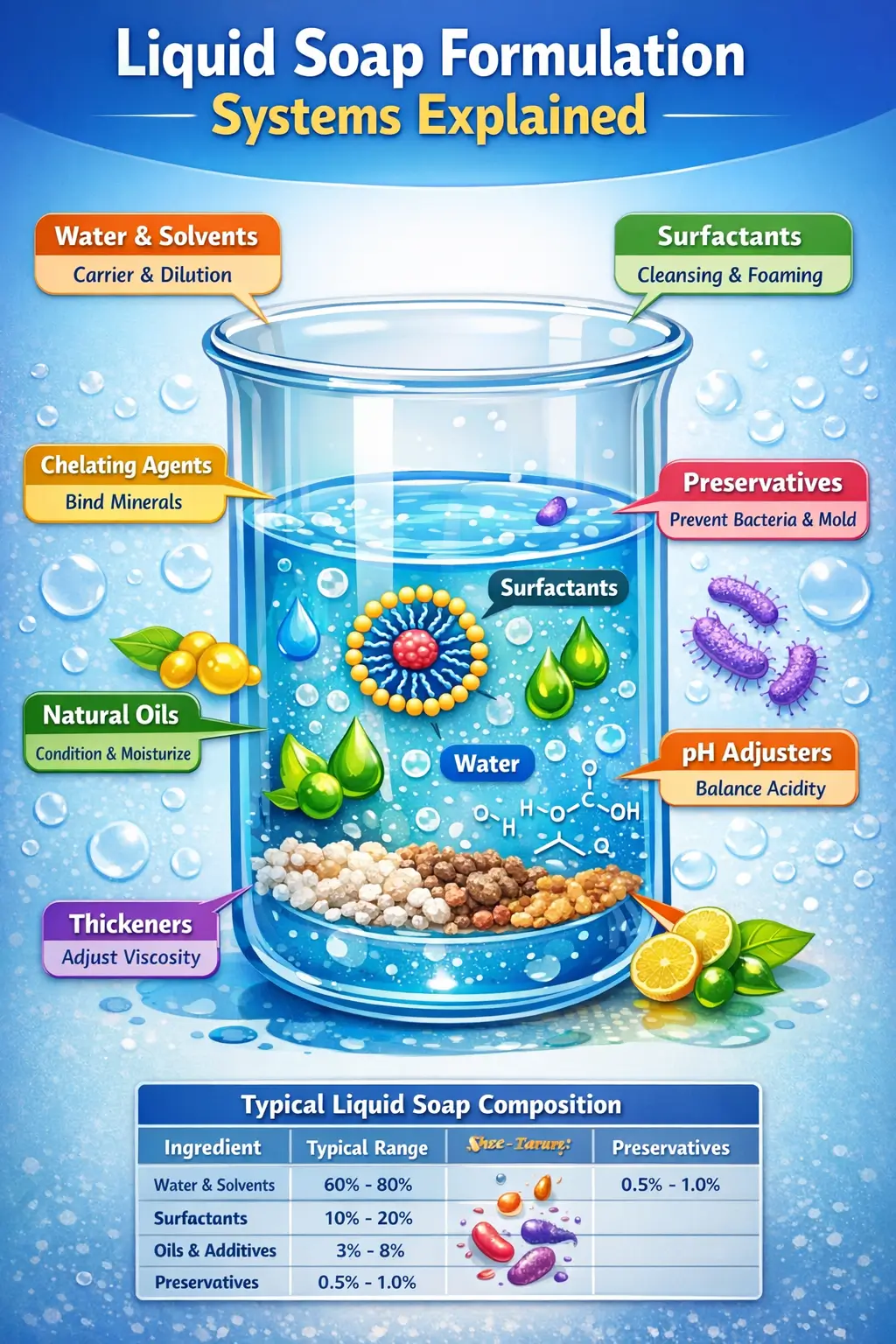
What Defines A Liquid Soap System
A liquid soap system is defined by surfactants dispersed and stabilized in water, forming a fluid cleansing medium rather than a solid matrix. Unlike bar soaps, which rely on crystalline fatty acid salt structures (soap-based surfactants), liquid systems remain fully solvated during storage and use.
This solvated state changes how cleansing occurs. Surfactant molecules organize into micelles or related assemblies that encapsulate soils and oils, allowing them to be rinsed away. The system remains dynamic, continuously responding to dilution, temperature, and water composition.
Liquid soap formulation systems include both true soaps produced through saponification and surfactant blends derived from non-soap chemistries. Physical form alone does not determine system type.
Chemical Foundations Of Liquid Soap Formulas
Liquid soap formula chemical structure depends on the nature of the primary surfactant. In true liquid soaps, fatty acid salts remain dissolved through the use of potassium-based counterions, maintaining fluidity instead of forming rigid crystals, a formulation pathway explained in detail in the Liquid Lye Soap Complete Guide.
In other liquid systems, surfactants are synthesized molecules designed to remain soluble across a wider pH and hardness range. These systems rely less on ionic exchange and more on engineered hydrophilic balance.
These chemical differences explain why some liquid soaps remain clear across temperatures while others become cloudy, thicken, or separate under identical storage conditions.
Roles Of Liquid Soap Formulation Ingredients
Liquid soap formulation ingredients serve distinct structural and functional roles. Water acts as the continuous phase, surfactants provide cleansing action, and secondary components influence viscosity, clarity, and stability.
Unlike bar soap systems, where ingredient roles are locked into a solid matrix, liquid systems allow continuous rearrangement. This flexibility increases design range while introducing sensitivity to dilution and environmental change.
These ingredient interactions underpin why hand wash liquid soap formulation, liquid body wash formulation, and dishwashing liquid soap require different system priorities despite similar visual appearance, particularly when delivery methods such as foaming dispensers are considered as outlined in the Foaming Hand Soap Method Guide, and when reuse-oriented formats like refill systems are evaluated, as examined in the Aesop Soap Refill Guide.
Why Some Liquid Soap Formulations Are Transparent
Transparent liquid soap formulation is often assumed to indicate purity or refinement. In practice, transparency reflects how completely surfactants remain dissolved and how uniformly light passes through the liquid phase.
In true soap systems, transparency depends on fatty acid composition, potassium salt solubility, and dilution balance. When these elements align, micellar structures remain small enough to avoid light scattering.
In surfactant-based systems, clarity is more predictable because molecular surfactants are engineered to remain soluble across a broader range of temperatures and concentrations. Cloudiness, when it appears, usually reflects system stress rather than contamination.
How Natural Liquid Soap Formulation Shapes System Behavior
Natural liquid soap formulation typically relies on plant-derived oils or surfactants with minimal structural modification. While the cleansing chemistry remains similar, the resulting systems exhibit greater variability in viscosity, clarity, and storage stability.
Fatty acid profile plays a central role. Oils rich in unsaturated components tend to produce softer, more fluid soaps that respond readily to temperature and dilution changes. Saturated profiles contribute greater structure but can reduce clarity.
This variability explains why natural liquid soap formulations often behave differently across households, even when used under similar conditions.
Why Multipurpose Liquid Soap Formulations Exist
Multipurpose liquid soap formulation aims to balance cleansing performance across multiple use contexts rather than optimizing for a single surface or soil type. This requires compromise at the system level.
Surfactant selection and concentration are adjusted to remain effective on both skin-contact and non-skin surfaces, while viscosity is tuned to remain usable across different dispensing methods.
These formulations often appear similar to hand wash or body wash products but behave differently during rinsing and soil removal due to their broader design constraints.
How Dishwashing Liquid Soap Systems Differ
Dishwashing liquid soap systems prioritize rapid soil emulsification and grease dispersion in the presence of food residues and hard water. This shifts the formulation focus toward higher surfactant efficiency and faster micelle formation.
Compared to liquid body wash formulation or hand wash liquid soap formulation, dishwashing systems typically tolerate wider pH ranges and higher dilution during use.
These differences explain why dishwashing liquids feel less viscous on the skin despite similar visual thickness in the bottle.
Industrial Liquid Soap Formulation As A Distinct System
Industrial liquid soap formulation operates under constraints distinct from household products. These systems are designed for controlled environments, repeatable dilution, and predictable soil profiles.
Stability under storage, resistance to microbial growth, and compatibility with automated dispensing systems often take precedence over tactile properties.
While chemically similar to other liquid soap systems, industrial formulations reflect a different set of priorities shaped by scale and usage context.
System Variability And Boundary Conditions
Liquid soap systems respond continuously to environmental conditions. Water hardness, temperature, and dilution rate can shift micelle behavior, viscosity, and perceived effectiveness without any change in formulation.
In colder water, surfactant mobility decreases, sometimes producing temporary cloudiness or reduced foaming. In warm conditions, viscosity may decrease as molecular motion increases.
These boundary effects explain why identical liquid soap formulations behave differently across European regions and seasonal conditions.
Liquid Soap Systems Compared At A Structural Level
Liquid soap systems that appear similar in the bottle often differ in chemical architecture and behavioral limits. The table below summarizes system-level distinctions across common liquid soap categories without implying performance ranking or usage guidance.
| System Context | Primary Surfactant Basis | Stability Driver | Typical Behavioral Sensitivity |
|---|---|---|---|
| Hand Wash Liquid Soap Formulation | Soap Or Surfactant Blends | Balanced Solubility And Viscosity | Dilution Rate And Water Temperature |
| Liquid Body Wash Formulation | Surfactant Blends | Micelle Stability In Dilute Use | Water Hardness And Rinse Dynamics |
| Transparent Liquid Soap Formulation | Highly Soluble Surfactants Or Potassium Soaps | Light Transmission And Phase Uniformity | Temperature And Concentration Shifts |
| Dishwashing Liquid Soap | High-Efficiency Surfactants | Rapid Soil Emulsification | Grease Load And Dilution Extremes |
| Multipurpose Liquid Soap Formulation | Mixed Surfactant Systems | Compromise Across Contexts | Surface Type And Contact Time |
| Industrial Liquid Soap Formulation | Engineered Surfactant Systems | Process Stability And Repeatability | Dispensing Method And Storage Conditions |
These distinctions highlight why formulation behavior should be interpreted as a system response rather than a fixed product attribute.
Design Trade-Offs In Liquid Soap Formulation Systems
Designing a liquid soap system involves trade-offs between clarity, viscosity, stability, and responsiveness to dilution. Increasing one attribute often introduces sensitivity elsewhere, particularly under variable household conditions.
For example, systems optimized for transparency may exhibit clouding at lower temperatures, while highly stable industrial systems can feel less responsive during brief contact. These outcomes reflect design priorities rather than formulation shortcomings.
Broader formulation methodology principles are outlined in the Data & Methodology documentation.
Limitations And Boundary Conditions
Liquid soap systems cannot fully decouple cleansing behavior from water composition and temperature. Hard water alters micelle efficiency, and rapid dilution can shift surfactant organization during use, contributing to residue behavior examined in the Soap Residue and Hard Water Interaction Guide.
Storage boundaries also matter. Extended exposure to heat or cold can change viscosity and appearance without altering the underlying chemistry. These effects are reversible in many cases but often misinterpreted as degradation.
Summary of Findings
- System Definition: Liquid soap formulations are solvated surfactant systems, not solid matrices.
- Chemical Diversity: Liquid soap formula chemical structure varies between true soaps and engineered surfactants.
- Context Matters: Body wash, hand wash, dishwashing, multipurpose, and industrial systems reflect different priorities.
- Transparency Is Structural: Clarity reflects solubility and phase uniformity, not formulation quality.
- Boundary Effects: Water hardness, temperature, and dilution shape observable behavior.
References
- Rosen, M. J. Surfactants And Interfacial Phenomena. Wiley Publication Page
- Schramm, L. L. Surfactants: Fundamentals And Applications. Cambridge University Press
- OECD SIDS Reports On Surfactants. OECD Chemical Safety Portal
- European Commission Consumer Product Databases. EU Cosmetics Regulation Portal