Fatty Acid Surfactants
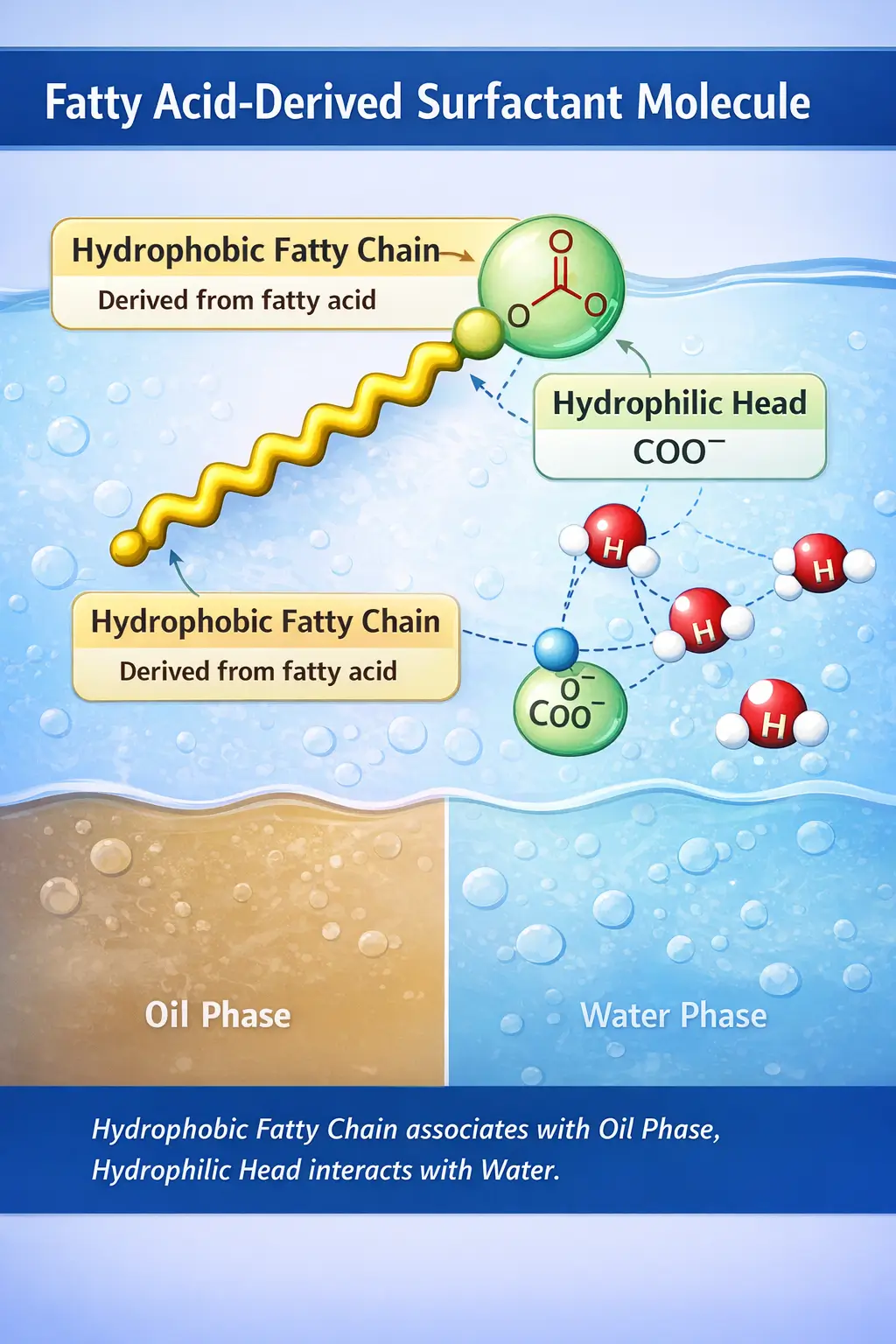
Fatty acid surfactants are surface active molecules produced from fatty acids obtained from natural lipids such as vegetable oils and animal fats. Their molecular structure contains a hydrophobic carbon chain derived from a fatty acid and a hydrophilic head group capable of interacting with water. This amphiphilic architecture allows the molecule to reduce surface tension and form micellar structures that disperse oils and soils in aqueous systems.
Within cleansing formulations these molecules frequently act as primary or supporting surfactants. Their behavior depends on how the fatty acid backbone has been chemically modified. Fatty acid based surfactants may appear as soap salts, ethoxylated alcohol derivatives, or other related molecular structures that maintain the same hydrophobic fatty chain origin.
Because fatty acids are widely available from plant oils, surfactants derived from fatty acids appear across many formulation categories including personal cleansing products, detergents, and industrial cleaning systems. Their functional behavior arises from the same amphiphilic design used by other surfactant classes, although the fatty acid backbone influences solubility, foam behavior, and interaction with other formulation components.
This page belongs to the CleanFormulation Ingredient Library, a research project analyzing ingredient behavior in real formulations rather than interpreting product marketing language.
Quick Facts
| Property | Description |
|---|---|
| Ingredient Type | Surface active molecules derived from fatty acid chains |
| Chemical Class | Fatty acid based surfactants including soaps, alcohol ethoxylates and related derivatives |
| Functional Role | Cleansing, emulsification and dispersion of oils within aqueous systems |
| Ionic Class | May be anionic, nonionic or amphoteric depending on chemical modification |
| Typical Use Context | Cosmetics, detergents, household cleaning systems and industrial formulations |
| Common Feedstocks | Coconut Oil, palm oil, tallow and other lipid sources |
Why This Ingredient Appears On Labels
Consumers encounter fatty acid surfactants in cosmetics and cleaning products because these ingredients form part of the cleansing system responsible for dispersing oils and residues in water. The hydrophobic fatty chain associates with oils or soils while the hydrophilic portion interacts with the water phase. This dual interaction allows the formulation to transport hydrophobic material away from surfaces during washing.
In personal care formulations fatty acid surfactants in cosmetics frequently appear in cleansers, shampoos, and body washes where they contribute to emulsification and lather formation. Depending on the formulation strategy they may serve as the primary surfactant or function alongside other surfactant classes to adjust foam texture and cleansing strength.
In household products fatty acid surfactants in detergents may participate in removing grease or particulate soils from fabrics and hard surfaces. The fatty acid chain length and chemical modification determine how effectively the surfactant interacts with oils during washing.
Many formulations include more than one surfactant type. Fatty acid based surfactants often work in combination with other surfactant classes to improve stability, soil dispersion, and compatibility with other formulation components.
Chemical Identity And Classification
The defining characteristic of fatty acid derived surfactants is the hydrophobic chain originating from a fatty acid molecule. Fatty acids contain long hydrocarbon chains typically ranging from eight to eighteen carbon atoms. When these molecules undergo chemical transformation such as saponification or ethoxylation they become surfactants capable of interacting with both oils and water.
Several fatty acid surfactants examples illustrate how these transformations occur. Soap salts represent one of the simplest forms. When fatty acids react with alkali they produce sodium or potassium salts that function as classic soap molecules. Other surfactants derived from fatty acids include alcohol ethoxylates where ethylene oxide units create a hydrophilic region attached to the fatty chain.
Despite structural differences, these molecules share the same hydrophobic fatty backbone. The length of this chain influences surfactant behavior by affecting solubility, foam formation, and interaction with oils. Shorter chains generally produce higher solubility, while longer chains often enhance oil association within micellar structures.
Because fatty acids originate from natural lipids, these surfactants can be produced from a wide range of feedstocks. Coconut oil and palm oil commonly provide medium chain fatty acids, while tallow and other fats yield longer chain variants. The choice of feedstock influences the final surfactant properties used in formulation design.
Functional Role In Soap Systems
Fatty acid surfactants occupy a central position in many cleansing systems because their structure closely resembles the classic soap molecule. The hydrophobic fatty chain associates readily with oils and hydrophobic residues, while the hydrophilic head group interacts with water. When these molecules accumulate above a threshold concentration they assemble into micelles that allow oils to become suspended in the wash solution.
In traditional soap bars the surfactant form is produced through saponification of fatty acids. The resulting sodium or potassium salts form the structural framework of the soap matrix. These salts influence bar hardness, lather generation, and dissolution rate when the soap is used with water. The fatty acid composition determines whether the foam becomes dense and creamy or light and rapidly expanding.
Liquid cleansing products use fatty acid derived surfactants somewhat differently. In shampoos or liquid soaps they may function as part of a mixed surfactant system rather than forming the entire cleansing base. In such systems the fatty acid backbone contributes to oil removal and foam formation while additional surfactants adjust viscosity and foam stability.
In detergent formulations the role shifts slightly toward soil dispersion. Fatty acid surfactants in detergents interact with oily residues released from fabrics or surfaces. Once micelles form, the hydrophobic interior of the micelle can trap grease or particulate matter and keep it suspended in the water phase until it is rinsed away.
These functional roles illustrate why fatty acid based surfactants remain common in both traditional soap systems and more complex synthetic detergent formulations.
Ingredient Interaction Logic
The behavior of fatty acid surfactants cannot be understood in isolation from the rest of the formulation. Cleansing systems contain several interacting components including water, auxiliary surfactants, humectants, fragrance materials, and sometimes chelating agents. Each component influences how the surfactant molecules assemble and function.
Water provides the continuous phase in which surfactant molecules disperse. The hydrophilic portion of the fatty acid surfactant remains hydrated while the hydrophobic chain aligns toward oil droplets or air interfaces. This orientation allows micelles to form and stabilizes the dispersion of hydrophobic substances within the aqueous solution.
When multiple surfactants are present, fatty acid surfactants may integrate into mixed micelles with other surfactant types. In such systems the fatty acid chain contributes to oil association while other surfactants modify micelle size or electrical charge. The result is a micellar structure that can accommodate a broader range of soil types and remain stable in different water conditions.
Humectants present in cosmetic cleansers influence the hydration environment surrounding surfactant molecules. Ingredients such as glycerin alter solvent structure and may change the spacing between micelles. These interactions affect viscosity and the tactile perception of the cleansing solution during use.
Fragrance materials provide another interaction pathway. Many fragrance compounds dissolve poorly in water but can partition into the hydrophobic interior of surfactant micelles. Fatty acid surfactants therefore help distribute these materials evenly throughout the formulation, preventing separation of oil based fragrance components.
Phase Behavior
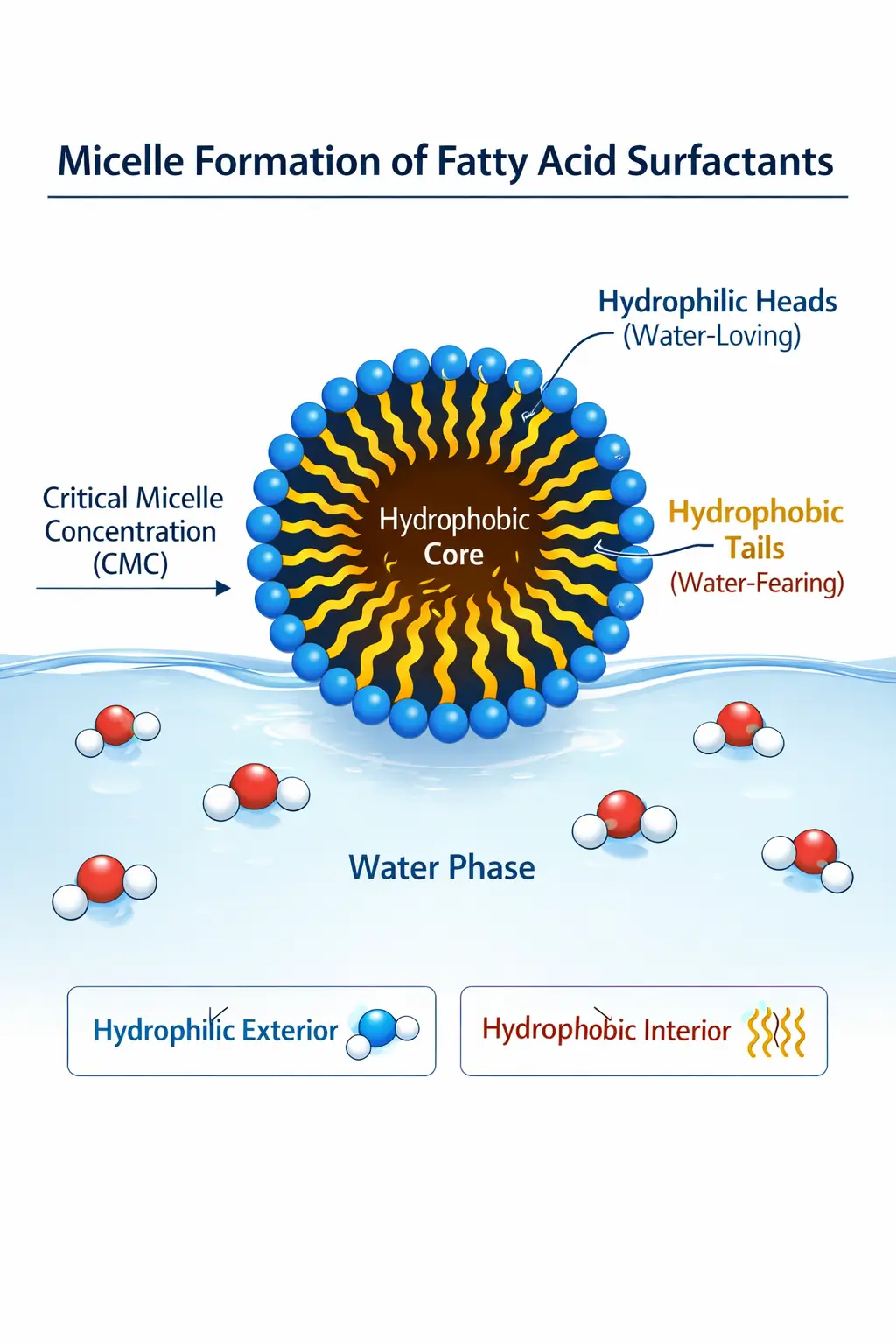
Fatty acid surfactants display characteristic phase behavior when dispersed in water. At very low concentrations the molecules remain separated within the aqueous phase. As concentration increases and reaches the critical micelle concentration, the molecules aggregate into micelles. This structural transition marks the point at which the surfactant system can effectively disperse hydrophobic materials.
Micelle formation involves the clustering of hydrophobic fatty chains toward the interior of the aggregate while the hydrophilic head groups remain exposed to the surrounding water. This arrangement creates a stable interface that can incorporate oils and other hydrophobic substances within the micelle core.
Temperature and ionic strength influence the stability of these structures. Elevated temperatures may increase molecular mobility and alter micelle size, while dissolved salts can modify electrostatic interactions between head groups in ionic surfactants. These effects determine how the surfactant behaves under different washing conditions.
In solid soap systems phase behavior occurs within a semi crystalline matrix. The soap salts arrange into ordered domains that dissolve gradually when the bar contacts water. This dissolution releases surfactant molecules into the wash solution where they form micelles and begin dispersing oils.
Comparison With Related Surfactant Types
Fatty acid derived surfactants share certain structural features with other surfactant classes yet differ in how their hydrophobic backbone influences behavior in water. Comparing them with synthetic surfactants helps clarify how fatty acid based systems function within broader cleansing formulations.
| Feature | Fatty Acid Surfactants | Synthetic Anionic Surfactants |
|---|---|---|
| Hydrophobic Backbone | Derived from natural fatty acid chains | Often derived from petrochemical or modified hydrocarbon sources |
| Typical Form | Soap salts or fatty alcohol derivatives | Sulfates or sulfonates |
| Foam Character | Creamy foam influenced by fatty chain length | Rapid and abundant foam formation |
| Typical Applications | Soap bars, cosmetic cleansers, mild detergents | Laundry detergents, dishwashing liquids, industrial cleaners |
This comparison highlights how surfactants derived from fatty acids occupy a middle ground between traditional soap chemistry and modern detergent formulations. Their behavior reflects the natural lipid origin of the hydrophobic chain while still functioning within contemporary surfactant systems.
Regulatory Context
Fatty acid surfactants appear in multiple product categories including personal care products, household cleaning systems, and certain industrial formulations. The regulatory framework that governs their labeling depends largely on the product classification rather than the surfactant chemistry itself.
Within cosmetic products marketed in the European Union, ingredients must be declared according to the International Nomenclature of Cosmetic Ingredients system. Under Regulation (EC) No 1223/2009 on cosmetic products, fatty acid surfactants used in cosmetic cleansers, shampoos, or body washes must appear in ingredient lists under their standardized INCI names. Examples may include sodium cocoate, potassium oleate, or other fatty acid derived salts depending on the formulation.
Household cleaning products follow a different regulatory pathway. In the European Union, detergents fall under Regulation (EC) No 648/2004 on detergents. This regulation focuses on biodegradability of surfactant systems and requires manufacturers to disclose surfactant categories on packaging. In many cases surfactants derived from fatty acids fall within the anionic or nonionic surfactant categories described by the regulation.
These regulatory frameworks aim to ensure consistent ingredient disclosure and environmental compatibility of surfactants used in cleaning systems while allowing manufacturers to formulate products using different surfactant chemistries.
Common Misunderstanding
A common misunderstanding is that all fatty acid surfactants are identical to traditional soap molecules. While soap salts represent one important member of this category, many fatty acid derived surfactants differ significantly in their chemical structure. Processes such as ethoxylation, esterification, or amidation can transform the fatty acid backbone into surfactants with different solubility and performance characteristics.
Because of these structural differences, formulations that contain fatty acid surfactants may behave very differently from classic soap systems. Some fatty acid based surfactants function as nonionic emulsifiers, while others behave as anionic detergents. The shared fatty chain origin does not automatically determine the overall behavior of the surfactant system.
Another misconception involves assuming that a fatty acid origin guarantees identical performance across all cleaning formulations. In practice, variations in chain length, head group structure, and formulation environment strongly influence how each surfactant interacts with oils, water, and other ingredients.
Structural Limitations
Although fatty acid surfactants provide effective cleansing and emulsification properties, their structure introduces certain formulation limitations. One commonly encountered limitation involves sensitivity to water hardness. In soap systems, calcium and magnesium ions present in hard water can react with fatty acid salts to form insoluble deposits. This interaction may reduce lather formation and leave residues on washed surfaces.
Solubility can also vary depending on the length of the fatty acid chain. Surfactants derived from longer chain fatty acids may exhibit lower solubility in cold water, which can influence dissolution rate and cleansing efficiency under certain conditions.
Oxidation stability represents another potential constraint. Because fatty acid chains originate from lipid molecules, they may undergo oxidative changes when exposed to air and light over extended periods. Formulations that include antioxidants or controlled storage conditions often address this limitation.
These structural characteristics illustrate why fatty acid surfactants are often used in combination with other surfactant classes in modern cleansing systems. The mixed surfactant approach helps maintain stable performance across different water conditions and usage environments.
Formulation References Using This Ingredient
Summary of Findings
- Chemical Classification: Fatty acid surfactants are surface active molecules derived from fatty acid chains obtained from lipid sources such as plant oils or animal fats.
- Functional Role: These surfactants contribute to cleansing, emulsification, and dispersion of oils within aqueous systems through micelle formation.
- Formulation Interaction: Their behavior depends on interactions with water, additional surfactants, humectants, fragrances, and other formulation components.
- Phase Behavior: In aqueous solutions they form micellar structures that allow hydrophobic substances to remain suspended within the wash solution.
- System Boundaries: Hard water sensitivity, solubility characteristics, and oxidation of fatty chains influence how these surfactants perform within different cleansing formulations.