Colorants In Cosmetic And Soap Formulations
Colorants used in cosmetic and cleansing formulations are substances added to create or modify the visible color of the finished product. In soap systems these materials do not participate in the chemical process of cleansing. Instead they serve a visual formulation role by introducing pigments or dyes that influence the appearance of the bar or liquid product.
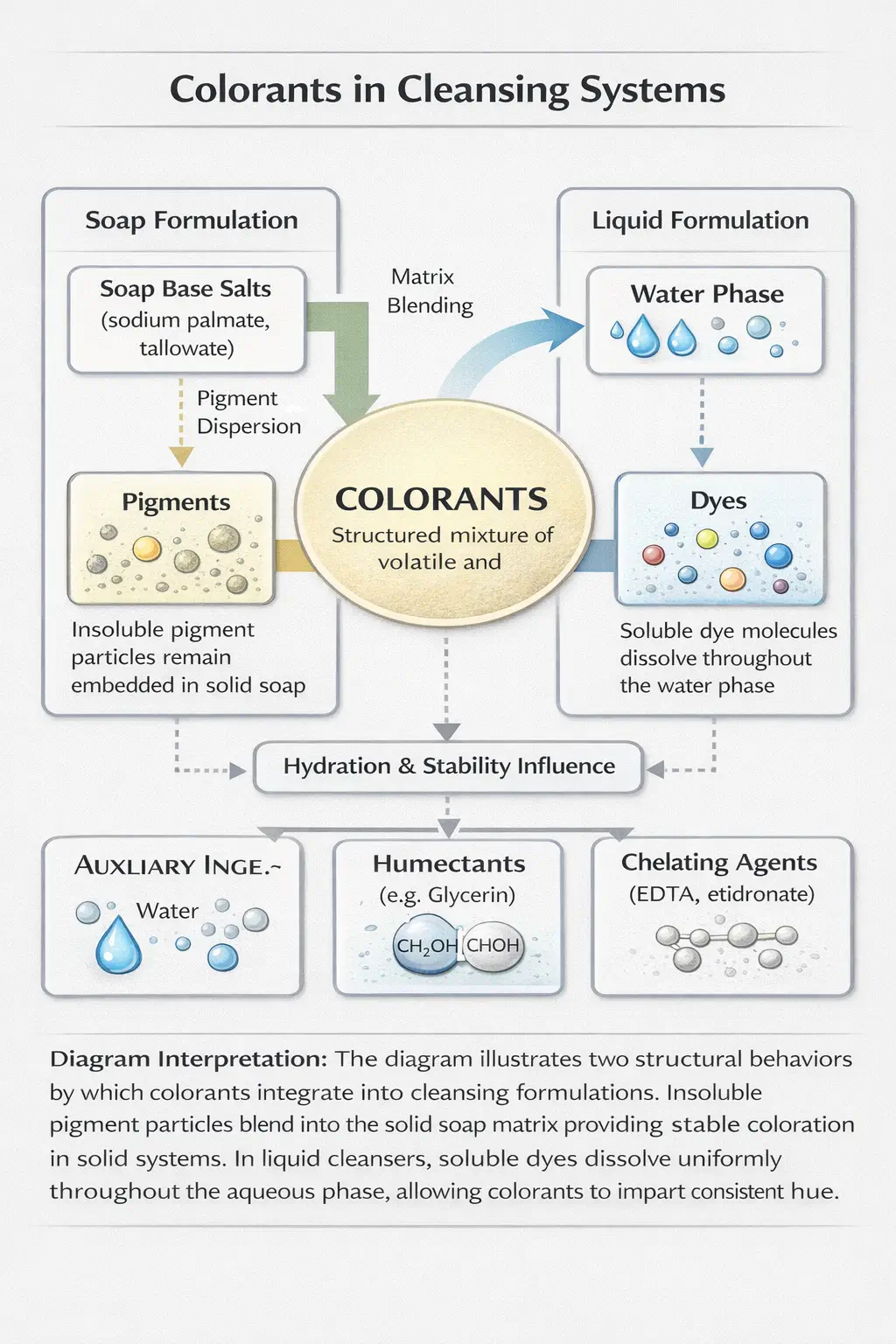
Colorants may exist as insoluble pigments dispersed within the formulation matrix or as soluble dyes that dissolve in the aqueous phase of the system. The selection of a specific colorant depends on the structure of the formulation, the stability of the coloring agent and the physical properties of the cleansing system in which it is used.
In soap bars colorants are typically distributed throughout the solid fatty acid salt structure created during saponification and cooling. In liquid cleansers the coloring material remains suspended or dissolved within the water and surfactant mixture. The result is a consistent visual identity that allows the product to be recognized through its appearance.
This page belongs to the CleanFormulation Ingredient Library, a research project examining how cosmetic ingredients behave within real formulations rather than evaluating them as isolated substances.
Quick Facts
| Property | Description |
|---|---|
| Ingredient Type | Color producing additive used to modify product appearance |
| Chemical Class | Pigments, dyes or mineral color compounds |
| Functional Role | Provides visible color to cosmetic and cleansing formulations |
| Ionic Class | Varies depending on colorant chemistry |
| Typical Use Context | Soap bars, liquid cleansers, cosmetics and personal care products |
| Primary Formulation Purpose | Creates recognizable visual appearance and product differentiation |
Ingredient Interaction Logic
Colorants interact with several components within cleansing formulations. The nature of these interactions depends largely on whether the coloring agent behaves as a dissolved dye or as a dispersed pigment particle. In both cases the surrounding formulation matrix determines how the colorant remains distributed within the system.
In soap bars the fatty acid salt matrix provides the structural environment in which pigment particles become physically embedded. Because these particles are insoluble, their distribution depends on mechanical mixing during manufacturing. Uniform dispersion ensures that the final bar exhibits consistent coloration throughout the structure.
In liquid formulations the water phase plays a central role. Water soluble dyes dissolve within the aqueous environment and remain distributed as individual molecules throughout the formulation. Surfactants present in the system may assist dispersion by modifying surface tension and preventing localized aggregation of colorant particles.
Other formulation components can also influence color stability. Chelating agents may reduce interactions between metal ions and certain colorant molecules. Fragrance materials and preservatives generally interact only indirectly, although changes in solvent composition or pH can influence how colorants behave within the system.
Why This Ingredient Appears On Cosmetic Labels
Colorants appear on cosmetic ingredient labels because they form part of the formulation composition of the product. The visual appearance of a cosmetic or cleansing product often depends on the presence of coloring materials that produce the characteristic hue of the formulation.
In ingredient lists these substances may be declared using Color Index numbers, commonly abbreviated as CI numbers. Each CI number corresponds to a specific approved coloring agent used within cosmetic formulations. For example certain pigments used in soaps or cosmetics may appear on labels using a CI identifier rather than a traditional chemical name.
The presence of a colorant in an ingredient list therefore indicates that the formulation contains a substance intended to influence the visual appearance of the product. These materials may function either as dissolved dyes or as dispersed pigments depending on the type of formulation and the physical properties of the coloring compound.
Chemical Identity And Classification
Colorants used in cosmetic formulations fall into several chemical categories. Some are organic dye molecules that dissolve in water or other solvents within the formulation. Others are inorganic pigments composed of mineral based compounds that remain suspended as microscopic particles within the product.
Organic dyes typically belong to families of aromatic molecules capable of absorbing specific wavelengths of visible light. Their molecular structure allows them to produce strong color intensity even at relatively low concentrations. Because they dissolve in the formulation medium, dyes are commonly used in transparent liquid products where uniform coloration is required.
Pigments differ structurally from dyes because they exist as solid particles rather than dissolved molecules. These particles reflect and scatter light to create visible color. Mineral pigments such as iron oxides and titanium dioxide are frequently used in cosmetic formulations where stable and opaque coloration is required.
From a formulation perspective the distinction between dyes and pigments determines how the colorant interacts with the surrounding formulation matrix. Dyes integrate into the liquid phase of the system, while pigments remain dispersed as fine particles throughout the product.
Functional Role In Soap Systems
In soap formulations colorants function as visual modifiers that influence the appearance of the finished product. The cleansing behavior of soap originates from fatty acid salts that interact with oils and water during washing. Colorants do not participate in this chemical process. Their role is limited to producing a defined visual identity for the formulation.
In bar soap manufacturing the coloring agent is usually incorporated during mixing or milling stages after saponification. At this point the soap mass has already formed a structured matrix composed primarily of sodium or potassium fatty acid salts. Pigment particles or dye molecules become distributed throughout this matrix, producing a uniform or patterned color depending on the formulation technique used.
Liquid soap and detergent systems incorporate colorants differently. Because these formulations contain a significant aqueous phase, soluble dyes may dissolve directly into the liquid medium. Pigments may also be used, although they require adequate dispersion to prevent sedimentation or uneven coloration.
Although colorants do not alter cleansing chemistry, they can influence the sensory perception of the product. Color may signal product identity, fragrance associations or formulation category. For this reason color selection often becomes part of the overall formulation design strategy.
Phase Behavior In Cleansing Formulations
Colorant phase behavior depends primarily on whether the ingredient is a dye or a pigment. Dyes typically dissolve in the aqueous phase of liquid formulations, forming a molecular solution that distributes color uniformly throughout the product. Because the molecules are dissolved, they move freely within the liquid environment and remain visually homogeneous.
Pigments exhibit a different type of phase behavior. These substances remain as solid particles that must be dispersed mechanically within the formulation. In bar soaps pigment particles become trapped within the crystalline soap matrix during cooling and solidification. In liquid systems they remain suspended as fine particles within the formulation.
Particle size plays an important role in pigment behavior. Very small particles disperse more easily and produce more uniform coloration, while larger particles may settle or produce uneven visual distribution if the formulation does not provide sufficient stabilization.
Temperature and pH can also influence color stability in some formulations. Certain dye molecules may change shade under different pH conditions, while pigments generally maintain color through light scattering rather than molecular absorption changes.
Comparison With Related Coloring Ingredients
Colorants used in cosmetics generally fall into two primary categories. Understanding the distinction between these categories helps explain how different coloring agents behave within cleansing formulations.
| Feature | Pigments | Dyes |
|---|---|---|
| Physical Form | Insoluble solid particles | Dissolved molecular species |
| Distribution In Formulation | Dispersed within the formulation matrix | Dissolved within the liquid phase |
| Typical Use Context | Opaque soaps, decorative Cosmetics | Transparent liquids and gels |
| Color Mechanism | Light scattering and reflection from particles | Selective absorption of visible light by molecules |
| Formulation Behavior | Requires mechanical dispersion | Forms homogeneous solution in compatible solvents |
Regulatory Context
Colorants used in cosmetic and cleansing formulations are regulated separately from many other cosmetic ingredients. Instead of appearing only under traditional chemical names, most approved colorants are identified using Color Index numbers, commonly abbreviated as CI numbers. These identifiers correspond to internationally recognized color substances catalogued in the Colour Index system.
Within the European Union cosmetic regulatory framework defined by Regulation (EC) No 1223/2009, colorants are listed in Annex IV of the regulation. Only substances included within this annex are permitted for use as coloring agents in cosmetic products marketed in the European Union. Each entry specifies the CI number, chemical description and any relevant conditions for use.
In ingredient labeling practices the colorant may therefore appear either as a CI number or as a recognized pigment name. This labeling structure allows regulatory authorities and formulation professionals to identify the exact coloring substance used within a cosmetic formulation.
Other regulatory systems, including those used in different global markets, may follow similar classification principles. Although naming conventions may vary slightly, the general objective remains consistent: ensuring that color additives used in cosmetic products are clearly identified through standardized nomenclature.
Common Misunderstanding About Cosmetic Colorants
One common misunderstanding is the assumption that colorants in cosmetics always behave as dissolved chemicals within the formulation. In reality many colorants used in soaps and other cosmetics exist as microscopic solid particles rather than dissolved molecules.
Pigment based colorants function by reflecting and scattering light rather than dissolving in the surrounding medium. Their behavior resembles that of extremely fine mineral particles distributed throughout the formulation matrix. Because of this structural property they may remain suspended within liquids or embedded within solid soap bars without dissolving in the formulation medium.
Dye based colorants follow a different mechanism because they dissolve within the liquid phase of the formulation. This distinction between particle pigments and dissolved dyes explains why different colorant types are selected depending on whether the formulation is opaque, transparent or structurally solid.
Structural Limitations In Formulation Systems
Colorants introduce several formulation considerations because their stability depends on environmental conditions within the formulation. One important limitation relates to dispersion stability. Pigment particles must remain evenly distributed within the formulation matrix. If dispersion is insufficient, particles may aggregate or settle, leading to uneven coloration.
Another limitation involves compatibility with the surrounding formulation chemistry. Certain dye molecules may change shade depending on the pH of the environment. Because soap systems are typically alkaline, color stability must be evaluated under these conditions to ensure the intended color remains visually consistent.
Light exposure can also influence the long term behavior of some colorants. Certain organic dye molecules gradually undergo chemical changes when exposed to ultraviolet radiation or oxygen over extended periods. These environmental interactions may influence the visual intensity of the color over time.
For this reason formulators often select colorants based on their compatibility with the intended formulation environment, including factors such as pH, temperature and light exposure conditions.
Formulation References Using This Ingredient
- Nudy Rudy Soap
- Nurture Soap Guide
- Nurture Soap Mica
- Is Dawn Dish Soap Toxic
- Method Laundry Detergent
- Lava Soap Ingredients Analysis
- Method Men Soap
- Buff City Soap Ingredients Analysis
- Caress Soap Ingredients Analysis
- Dr Squatch Soap Ingredients Analysis
- Irish Spring Soap Ingredients Analysis
- What Is Pacha Soap Made Of?
Summary of Findings
Colorants used in cosmetic and cleansing formulations function primarily as visual modifiers that define the appearance of the finished product. They exist in several chemical categories including organic dyes and inorganic pigments, each displaying different physical behavior within the formulation environment.
- Chemical Classification: Cosmetic colorants may consist of organic dye molecules or inorganic pigment particles identified using Color Index numbering.
- Functional Role: Their primary role is producing visible color within soap bars, liquid cleansers and other cosmetic formulations.
- Interaction Logic: Pigments disperse as microscopic particles within the formulation matrix, while dyes dissolve within the aqueous phase of liquid systems.
- Phase Behavior: Pigments remain suspended or embedded within the product structure, whereas dyes form homogeneous solutions within compatible solvents.
- System Boundaries: Color stability may depend on dispersion quality, formulation pH and environmental factors such as light exposure.