Definition
Aqua, commonly referred to as water, is the primary solvent used in many cosmetic and cleansing formulations. In chemical terms it is a small polar molecule composed of two hydrogen atoms bonded to one oxygen atom. Within soap systems and other cleansing products, aqua functions as the continuous phase that dissolves or disperses formulation ingredients, allowing surfactants, humectants, salts, and other components to interact effectively.
In soap manufacturing and cleansing formulations, water serves as a processing medium, a solvent, and a structural component influencing product texture and performance. It enables the dissolution of alkaline materials during soap production and later participates in hydration and micelle formation when the product is used during washing.
This page belongs to the CleanFormulation Ingredient Library, a research project focused on analyzing how ingredients behave within real cleansing formulations rather than evaluating cosmetic marketing claims.
Quick Facts
| Property | Description |
|---|---|
| Ingredient Type | Solvent and formulation medium |
| Chemical Class | Polar molecular solvent |
| Chemical Formula | H2O |
| Functional Role | Solvent, hydration medium, and transport phase for formulation ingredients |
| Ionic Class | Non ionic molecule |
| Typical Use Context | Liquid soaps, detergents, shampoos, emulsions, and cosmetic formulations |
| Physical State in Formulations | Continuous liquid phase |
Why This Ingredient Appears on Cosmetic Labels
Consumers frequently encounter the ingredient name aqua on cosmetic labels because it represents the standardized International Nomenclature of Cosmetic Ingredients term for water. Cosmetic labeling systems use Latin based naming conventions for many ingredients, which is why water is listed as aqua rather than using its common language equivalent.
In many cosmetic formulations, water functions as the primary solvent that allows other ingredients to dissolve, disperse, or remain evenly distributed throughout the product. Surfactants, humectants, salts, and fragrance compounds often require a water based medium in order to remain stable during storage and to perform their intended function during product use.
The presence of aqua in an ingredient list therefore reflects the role of water as the formulation environment within which other ingredients operate. In liquid cleansing products, water commonly forms the largest portion of the system and determines the physical flow characteristics of the final product.
Chemical Identity and Classification
The ingredient listed as aqua in cosmetic formulations corresponds to the molecular compound water. The molecule consists of two hydrogen atoms covalently bonded to a single oxygen atom, forming a bent molecular structure with strong polarity. This polarity allows water to dissolve a wide range of ionic and polar substances, which explains its extensive use as a solvent in cleansing systems.
From a chemical classification perspective, water belongs to the family of polar molecular solvents. Unlike surfactants or fatty acid salts, it does not function as an active cleansing agent. Instead, it provides the medium that allows active ingredients to move, interact, and organize into functional structures within the formulation.
Water molecules are capable of forming hydrogen bonds with neighboring molecules. This property gives water a relatively high heat capacity and strong cohesive behavior compared with many other solvents. Within cosmetic formulations these characteristics influence viscosity, ingredient solubility, and stability of dispersed phases.
In ingredient lists, the term aqua is used regardless of the purification method applied during manufacturing. Cosmetic grade water may undergo filtration, distillation, or deionization processes before entering production environments. These treatments are intended to remove dissolved minerals or contaminants that could otherwise affect formulation stability.
Functional Role in Soap Systems
Although soap itself is composed primarily of fatty acid salts, water plays an important supporting role in both manufacturing and use phases of soap systems. During soap production, water dissolves alkaline compounds such as sodium hydroxide and allows the saponification reaction with oils to proceed in a controlled environment.
In finished cleansing products, water influences the physical behavior of the formulation. Liquid soaps, body washes, and many cleansing solutions exist as aqueous systems in which surfactant molecules remain dissolved or dispersed in the water phase. The solvent environment allows these surfactants to organize into micelles that capture oily soil during washing.
Even in solid soap bars, water remains present within the internal structure. The soap matrix contains a small but significant amount of retained moisture that affects hardness, dissolution rate, and surface lather formation during use. Changes in moisture content can alter how quickly a soap bar dissolves when exposed to running water.
Water also affects the sensory properties of cleansing products. In liquid formulations it determines viscosity and flow characteristics, while in solid soap bars it contributes to the hydration state of the crystalline soap network.
Ingredient Interaction Logic
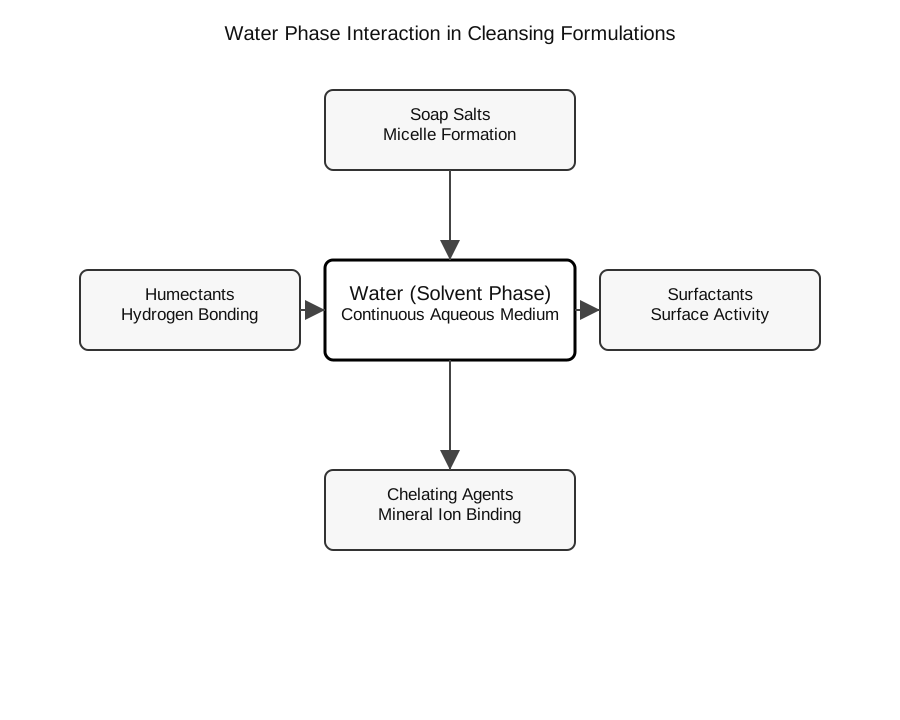
Water acts as the interaction medium for most ingredients present in cleansing formulations. Because many surfactants, salts, and humectants possess polar or ionic groups, they dissolve or disperse effectively in the aqueous phase. Once dissolved, these ingredients can interact with each other to form the structural networks responsible for cleansing behavior.
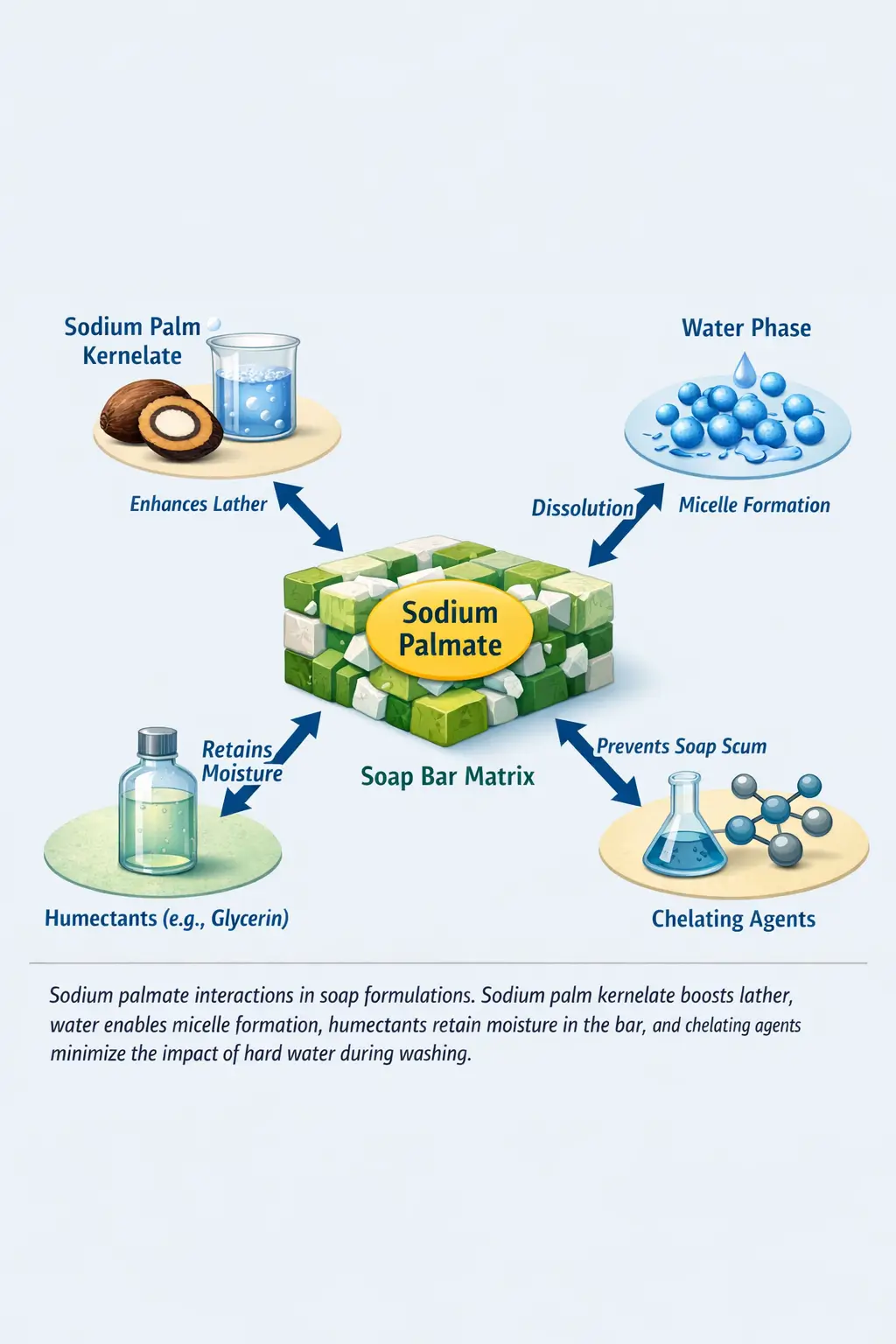
Soap salts such as sodium palmate or sodium palm kernelatesodium palm kernelate rely on the presence of water in order to form micellar structures. When soap molecules enter an aqueous environment, the hydrophilic carboxylate head groups orient toward the surrounding water while the hydrophobic fatty acid chains cluster inward. This arrangement allows oils and soil particles to become trapped within micellar aggregates during washing.
Humectants such as glycerin interact with water through hydrogen bonding. These interactions influence moisture retention within soap systems and can modify the hydration state of the formulation. In transparent soaps and glycerin based cleansing bars, the balance between water and polyols strongly affects optical clarity and structural stability.
Chelating agents present in some formulations also operate within the water phase. Their role is to bind mineral ions such as calcium or magnesium that may be present in hard water. By reducing mineral interactions with soap salts, these agents help maintain the availability of surfactant molecules during washing.
Phase Behavior in Cleansing Formulations
Water strongly influences the phase structure of cleansing formulations because it typically forms the continuous liquid phase of the system. Surfactants, salts, humectants, and other polar ingredients dissolve within this aqueous environment. When surfactant concentration reaches a sufficient level, molecules begin to assemble into micelles and other organized structures within the water phase.
These micellar structures are responsible for the fundamental cleansing mechanism of many washing products. The hydrophilic portions of surfactant molecules remain oriented toward the surrounding water, while hydrophobic regions cluster inward. This structural arrangement allows oily substances to become enclosed within micelles and carried away during rinsing.
Temperature and dissolved mineral content can alter the physical behavior of water within formulations. Higher temperatures generally increase solubility and molecular mobility, which may influence viscosity and surfactant activity. Dissolved minerals present in untreated water may also affect the stability of certain ingredients, which is why cosmetic manufacturers typically rely on purified water sources during production.
Regulatory Context
Within cosmetic ingredient labeling systems, water is declared using the International Nomenclature of Cosmetic Ingredients term aqua. This standardized naming convention ensures that ingredient lists remain consistent across international markets and regulatory jurisdictions.
In the European Union, cosmetic ingredient declarations follow the requirements established under Regulation (EC) No 1223 2009 on cosmetic products. According to this regulation, ingredients must be listed using their recognized INCI names and arranged in descending order of concentration when present above specified thresholds.
Regulatory ingredient databases such as CosIng classify aqua as a solvent and formulation vehicle rather than an active functional ingredient. This classification reflects its role as the medium within which other ingredients operate in cosmetic products.
Common Misunderstanding
A common misunderstanding arises from the assumption that the presence of aqua in a cosmetic ingredient list indicates the use of ordinary tap water within the formulation. In practice, cosmetic manufacturers typically rely on purified water systems designed to remove minerals, microbial contaminants, and dissolved impurities before the water enters the formulation process.
Purification methods may include filtration, reverse osmosis, or deionization systems depending on the manufacturing facility. These treatments produce a controlled water source suitable for consistent formulation behavior. The INCI designation aqua does not describe the purification method used, but rather identifies the ingredient as water within the finished cosmetic product.
Structural Limitations
Although water functions as a highly effective solvent for many cosmetic ingredients, its use within formulations introduces several practical limitations. One limitation relates to microbial growth potential in aqueous environments. Because water supports biological activity, cleansing products containing large water phases often require preservation systems to maintain stability during storage.
Another limitation arises from the interaction between dissolved minerals and surfactant systems. Calcium and magnesium ions commonly present in untreated water sources may interfere with certain cleansing ingredients, including soap salts. These interactions can influence foaming behavior or produce insoluble residues.
Water based formulations also require careful control of evaporation and viscosity characteristics. Excessive water loss during storage may alter the texture of liquid products, while variations in water content can affect the hardness of solid soap bars.
Product Formulation References Using This Ingredient
Summary of Findings
Aqua represents the standardized cosmetic ingredient name for water and functions primarily as the solvent phase within many cleansing formulations. Its molecular polarity enables the dissolution and interaction of surfactants, salts, humectants, and other formulation components. In both liquid and solid cleansing systems, water provides the environment in which cleansing mechanisms occur.
- Chemical Classification: Water is a polar molecular solvent with the chemical formula H2O.
- Functional Role: Within cleansing systems it acts as the continuous medium that allows surfactants and other ingredients to dissolve and interact.
- Interaction Logic: Soap salts, humectants, and chelating agents operate within the aqueous phase created by water.
- Phase Behavior: Water enables the formation of micelles and other surfactant structures responsible for cleansing performance.
- Formulation Boundaries: Microbial growth potential and mineral interactions represent important formulation considerations for water based systems.