Definition
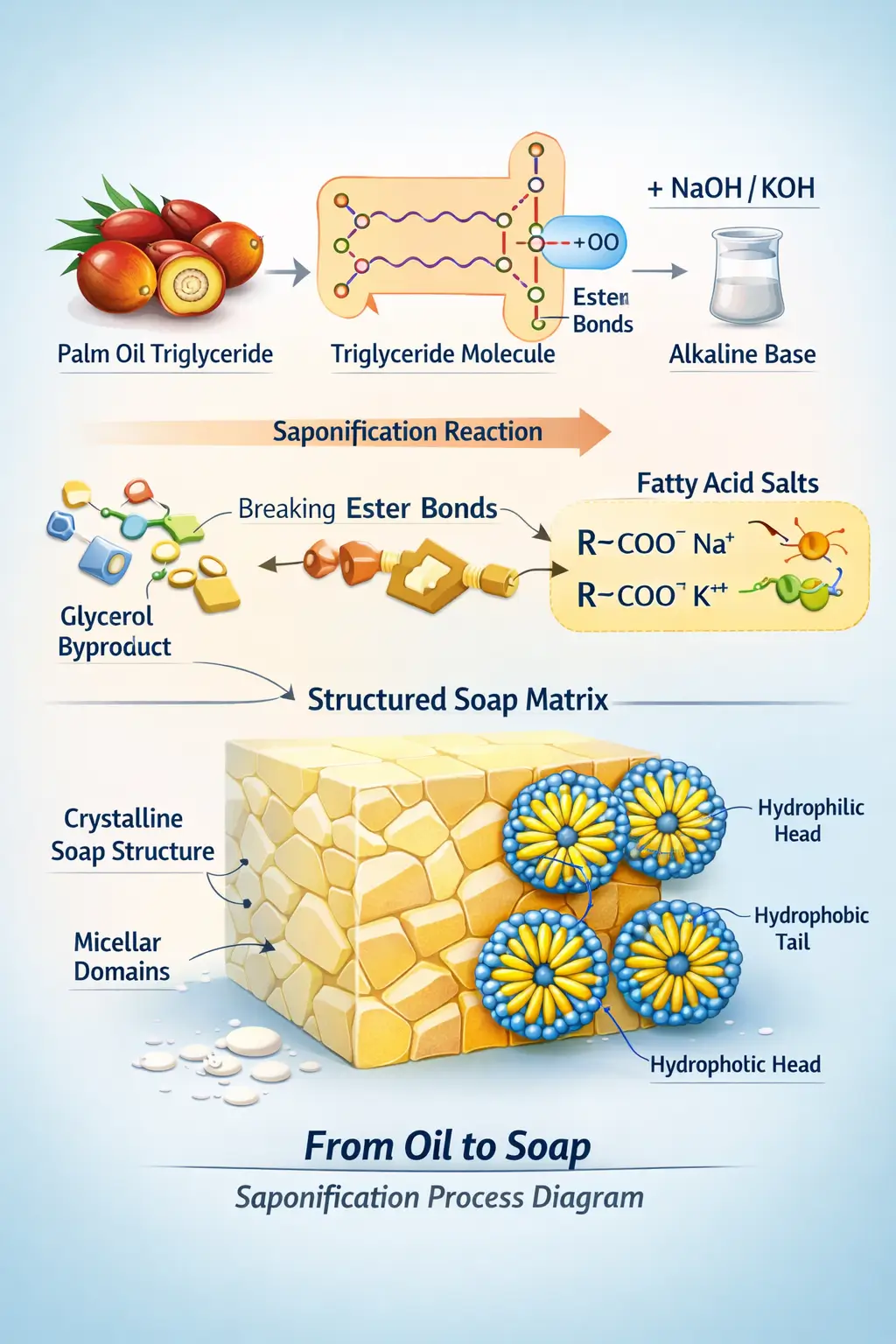
Palm oil is a triglyceride-based vegetable oil composed primarily of esterified fatty acids such as palmitic, oleic, and stearic acid, functioning in cleansing formulations as a source material that is chemically converted into soap salts through saponification.
It belongs to the lipid class of ingredients where fatty acids are bound to a glycerol backbone, forming a non-ionic, hydrophobic system that does not directly participate in cleansing until chemically transformed.
Within soap and detergent manufacturing, this material serves as an upstream structural input rather than an active cleansing agent, contributing indirectly by supplying the fatty acid chains that define the final soap matrix.
Its presence in formulation contexts is therefore transitional, moving from an oil phase component into a solid-phase soap structure after alkaline conversion, which ultimately influences bar hardness, lather density, and durability.
Quick Facts
| Property | Description |
|---|---|
| Ingredient Type | Vegetable Oil |
| Chemical Class | Triglyceride Lipid (Glycerol Ester of Fatty Acids) |
| Primary Components | Palmitic Acid, Oleic Acid, Stearic Acid (Esterified Form) |
| Functional Role | Source of fatty acids for soap salt formation during saponification |
| Ionic Nature | Non-ionic (prior to conversion) |
| Typical Use Context | Bar soap manufacturing, cleansing systems, cosmetic base formulations |
| Physical State | Semi-solid to solid lipid at room temperature |
| Phase Behavior | Oil phase component, insoluble in water, undergoes chemical conversion in alkaline conditions |
Why This Ingredient Appears on Labels
Palm oil appears on ingredient labels because it serves as a primary raw material used in the production of soap bases and other cleansing systems. In finished products, it may be listed directly in oil-based formulations or indirectly through its converted forms such as sodium salts of fatty acids.
In bar soaps, the original oil is typically not present in its triglyceride form after processing. Instead, it has been chemically transformed during saponification, but labeling conventions may still reference the source material depending on formulation and regulatory declaration practices.
In cosmetic systems such as creams or cleansers, it may remain partially unreacted or be used as an emollient phase component, contributing to texture and spreadability rather than cleansing action.
Chemical Identity and Classification
Palm oil is classified as a triglyceride, meaning it consists of three fatty acid chains esterified to a glycerol backbone. This structure defines it as a lipid rather than a surfactant or active cleansing agent.
The dominant fatty acids within this system include palmitic acid, which contributes to structural rigidity, oleic acid, which introduces fluidity, and smaller proportions of stearic acid and linoleic acid. These fatty acids remain chemically bound within the triglyceride until hydrolyzed under alkaline conditions.
From an ionic perspective, it is non-ionic and hydrophobic, meaning it does not dissolve in water and does not participate in micelle formation. Its behavior is governed by lipid-phase interactions rather than aqueous-phase chemistry.
Its typical origin is plant-based, extracted from the fruit of oil palm, but within formulation science, its origin is secondary to its structural role as a fatty acid carrier system.
Functional Role in Soap Systems
The primary role of palm oil in soap systems is indirect. It functions as a precursor that supplies fatty acids which are converted into soap salts during saponification.
During this conversion, the triglyceride structure is broken, releasing fatty acid chains that react with alkaline agents to form solid soap salts. These salts then define the cleansing properties of the final product.
The fatty acid profile of the oil influences key characteristics of the soap, including bar hardness, resistance to dissolution, and lather structure. A higher palmitic acid content contributes to a firmer and longer-lasting bar.
From an observable standpoint, formulations derived from this source tend to produce soaps with stable structure and moderate lather density rather than highly soluble or rapidly dissolving systems.
Ingredient Interaction Logic
Within a formulation system, palm oil interacts primarily during the processing stage rather than in the final product state. Its most critical interaction occurs with alkaline agents such as sodium hydroxide, which drive the saponification reaction.
It also interacts with water during processing, where hydrolysis facilitates the breakdown of triglyceride bonds. This interaction enables the transition from oil phase to soap matrix.
When combined with other oils, the fatty acid distribution shifts, allowing formulators to adjust properties such as solubility, foam behavior, and structural integrity.
In non-saponified systems such as creams, it interacts with emulsifiers and stabilizers to form part of the oil phase, influencing viscosity and spreadability without contributing to cleansing action.
Phase Behavior
Palm oil exists as a hydrophobic oil phase component that does not dissolve in water under standard conditions. Its behavior is governed by lipid-phase interactions and temperature-dependent structuring.
At room temperature, it exhibits semi-solid characteristics due to the presence of saturated fatty acids, leading to partial crystallization within the lipid matrix.
During saponification, it undergoes a chemical phase transformation rather than simple physical dispersion. The oil phase is converted into a solid soap matrix, which represents a structural reorganization rather than a reversible phase change.
This transformation defines the transition from a fluid lipid system to a rigid cleansing structure, directly impacting final product texture and durability.
Comparison With Related Ingredients
Palm oil is often evaluated alongside other vegetable oils used in cleansing systems. The differences arise from fatty acid distribution, which affects how each oil behaves after conversion into soap salts.
| Feature | Palm Oil | Coconut Oil |
|---|---|---|
| Dominant Fatty Acids | Palmitic, Oleic | Lauric, Myristic |
| Soap Structure | Firm, stable bar | Highly soluble, softer structure |
| Lather Behavior | Moderate, creamy | High, quick-forming foam |
| Dissolution Rate | Slower | Faster |
| Functional Role | Structural backbone provider | Cleansing and lather enhancer |
Regulatory Context
Palm oil is not regulated as an active functional ingredient but as a standard cosmetic raw material. Within ingredient labeling systems, it may appear under its common name or through derivatives depending on processing.
In the European Union framework, ingredients derived from this source are declared using their respective INCI names once chemically modified. For example, after saponification, the resulting compounds are listed as sodium salts of fatty acids rather than the original oil.
Its classification remains within the category of plant-derived lipids, and it does not fall under restricted or controlled substance groups when used within conventional formulation contexts.
Common Misunderstanding
A common misconception is that palm oil itself acts as the cleansing agent in soap. In reality, it does not perform cleansing in its original form.
The actual cleansing function arises only after the oil is chemically transformed into soap salts. The triglyceride structure cannot interact with water in a way that removes dirt or oils, which is why conversion into fatty acid salts is necessary.
This distinction is important for understandingingredient lists, where the source material and the functional output are not always clearly differentiated.
Structural Limitations
One limitation of palm oil in formulation systems is its dependence on chemical conversion for functionality. Without saponification, it does not contribute to cleansing behavior.
Its relatively high saturated fatty acid content also leads to reduced solubility after conversion, which can result in soaps that are less quick-rinsing compared to those derived from more soluble fatty acid profiles.
Additionally, its semi-solid nature can limit flexibility in liquid formulations unless modified or combined with other ingredients that improve fluidity and dispersion.
Formulation References Using This Ingredient
Summary of Findings
- Classification: Palm oil is a triglyceride-based vegetable oil composed of esterified fatty acids.
- Functional Role: It acts as a source material for fatty acids that are converted into soap salts during saponification.
- System Behavior: It transitions from a hydrophobic oil phase into a solid soap matrix through chemical transformation.
- Interaction Logic: Its primary interaction occurs with alkaline agents, enabling structural conversion rather than direct cleansing.
- Limitations: It requires conversion to become functional and contributes to lower solubility in final soap structures.