Definition
Sodium chloride is an inorganic ionic compound composed of sodium and chloride ions arranged in a crystalline lattice. In cosmetic and cleansing formulations it is commonly introduced as a dissolved salt within the water phase of the formulation. The compound belongs to the class of simple inorganic salts and is widely recognized by its chemical formula NaCl.
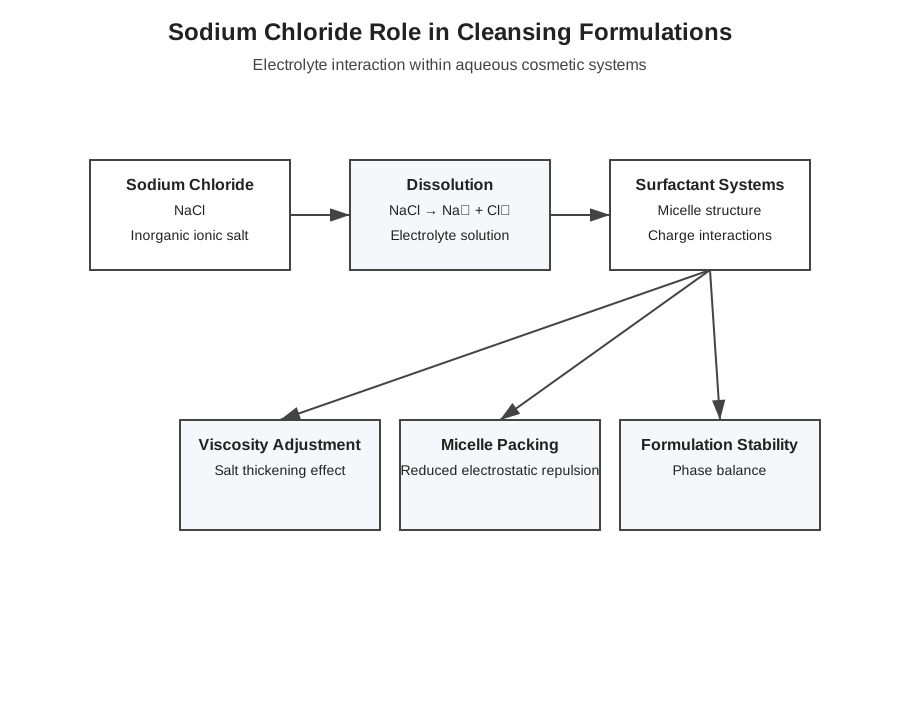
Within soap systems and surfactant based cleansers, sodium chloride does not function as a cleansing agent itself. Instead it operates as a formulation modifier that influences physical properties of the system. These properties include viscosity adjustment, phase balance within surfactant solutions, and stabilization of certain cleansing formulations.
In practical manufacturing environments sodium chloride may also affect how surfactant molecules interact with the surrounding solvent environment. Small adjustments in salt concentration can influence micelle structure, thickening behavior in liquid cleansers, and the separation behavior of soap systems during production.
This page belongs to the CleanFormulation Ingredient Library, a research project focused on analyzing how ingredients behave within real cleansing formulations rather than evaluating cosmetic marketing claims.
Quick Facts
| Property | Description |
|---|---|
| Ingredient Type | Inorganic salt and formulation modifier |
| Chemical Class | Ionic inorganic compound |
| Chemical Formula | NaCl |
| Functional Role | Viscosity modifier and phase behavior regulator in aqueous formulations |
| Ionic Class | Strong electrolyte composed of sodium and chloride ions |
| Typical Use Context | Liquid soaps, surfactant cleansers, shampoos and cosmetic formulations |
| Physical State | Crystalline solid that dissolves readily in water |
Why This Ingredient Appears on Cosmetic Labels
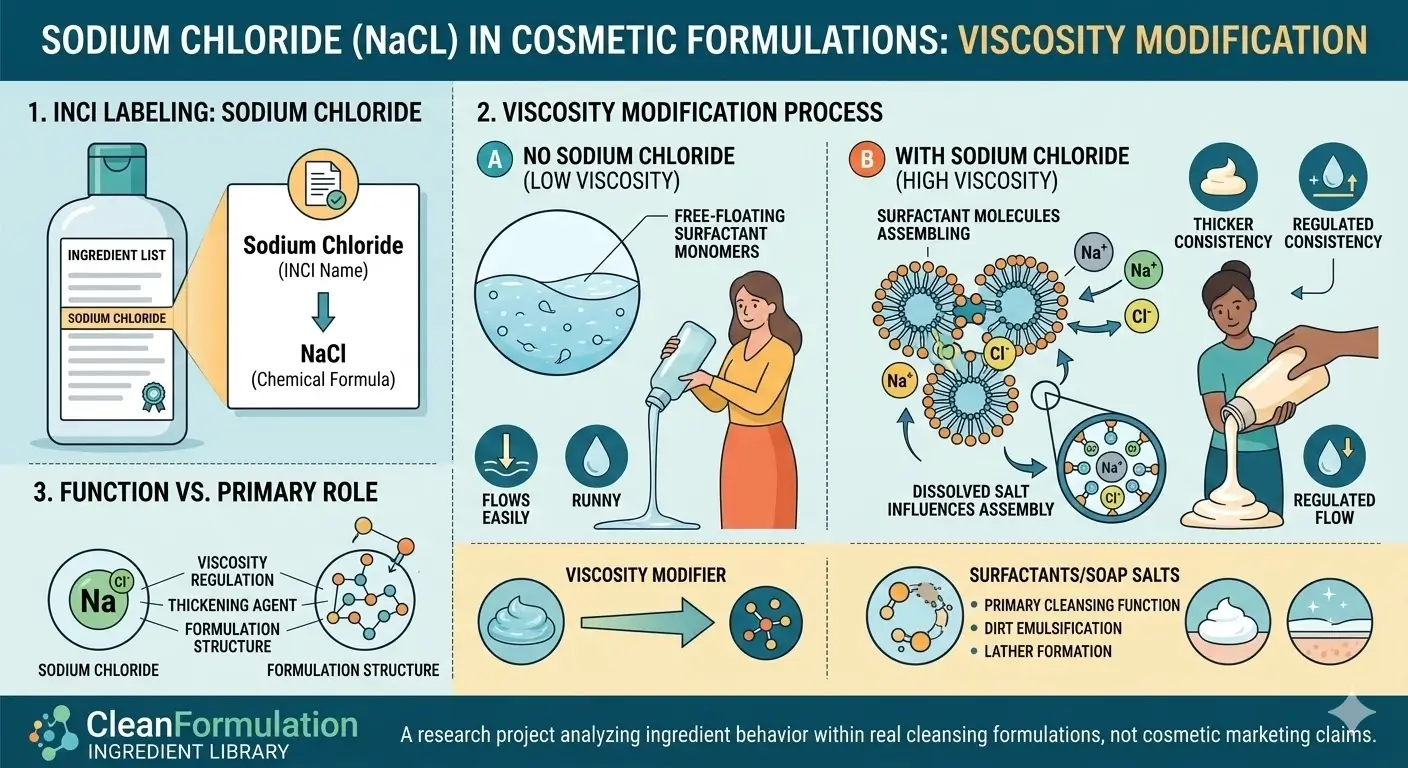
Consumers frequently encounter sodium chloride in cosmetic ingredient lists because the compound is widely used as a formulation component within aqueous cleansing systems. Ingredient declarations follow standardized naming conventions established by the International Nomenclature of Cosmetic Ingredients system. Under this system the compound appears under the name sodium chloride rather than its chemical formula.
In liquid cleansers and similar formulations sodium chloride often functions as a viscosity modifying ingredient. Small quantities of dissolved salt can influence how surfactant molecules assemble in the water phase, which in turn affects the thickness and flow characteristics of the final product.
The presence of sodium chloride on a label therefore reflects its role in adjusting the physical behavior of the formulation rather than acting as the primary cleansing ingredient. Surfactants or soap salts perform the cleansing function, while the salt participates in regulating the structure of the surrounding formulation system.
Chemical Identity & Classification
Sodium chloride is an inorganic ionic compound composed of positively charged sodium ions and negatively charged chloride ions arranged in a repeating crystal lattice. In cosmetic ingredient lists it appears under the International Nomenclature of Cosmetic Ingredients name sodium chloride. The compound belongs to the broader class of simple electrolytes that readily dissociate into ions when dissolved in water.
When sodium chloride dissolves in the aqueous phase of a formulation it separates into Na⁺ and Cl⁻ ions. These ions interact with surrounding water molecules through electrostatic forces, creating a highly conductive solution. This ionic behavior distinguishes sodium chloride from organic formulation ingredients such as humectants or surfactants.
Although widely recognized as a common salt, in formulation chemistry sodium chloride is better understood as an electrolyte that modifies interactions between other ingredients. Its primary influence occurs through the way dissolved ions alter the structure and behavior of surfactant systems present in liquid cleansers and similar products.
Because of its simple ionic structure sodium chloride does not participate in complex molecular reactions within cosmetic systems. Instead it affects formulation performance indirectly by changing the ionic strength of the solution and influencing how other ingredients organize within the solvent environment.
Functional Role in Soap Systems
In soap systems and surfactant based cleansers sodium chloride commonly functions as a viscosity modifying ingredient. When present in small quantities the dissolved ions influence how surfactant molecules organize into micelles within the water phase. Changes in micelle structure can alter the thickness and flow characteristics of the finished product.
Liquid soaps and shampoos often rely on this behavior when formulators adjust product texture. By introducing controlled amounts of sodium chloride, the ionic environment surrounding surfactant molecules changes and the solution can transition from a thin liquid to a thicker gel like consistency.
Sodium chloride may also influence separation behavior during traditional soap manufacturing. When salt is introduced into certain soap mixtures the ionic environment of the solution changes in a way that reduces the solubility of fatty acid soap salts. This phenomenon can cause the soap phase to separate from the aqueous phase, a process sometimes used in large scale soap production.
Despite these roles sodium chloride does not contribute directly to cleansing activity. The removal of oils and soil during washing remains the function of surfactant molecules or soap salts present within the formulation. The salt instead modifies the environment in which those cleansing molecules operate.
Ingredient Interaction Logic
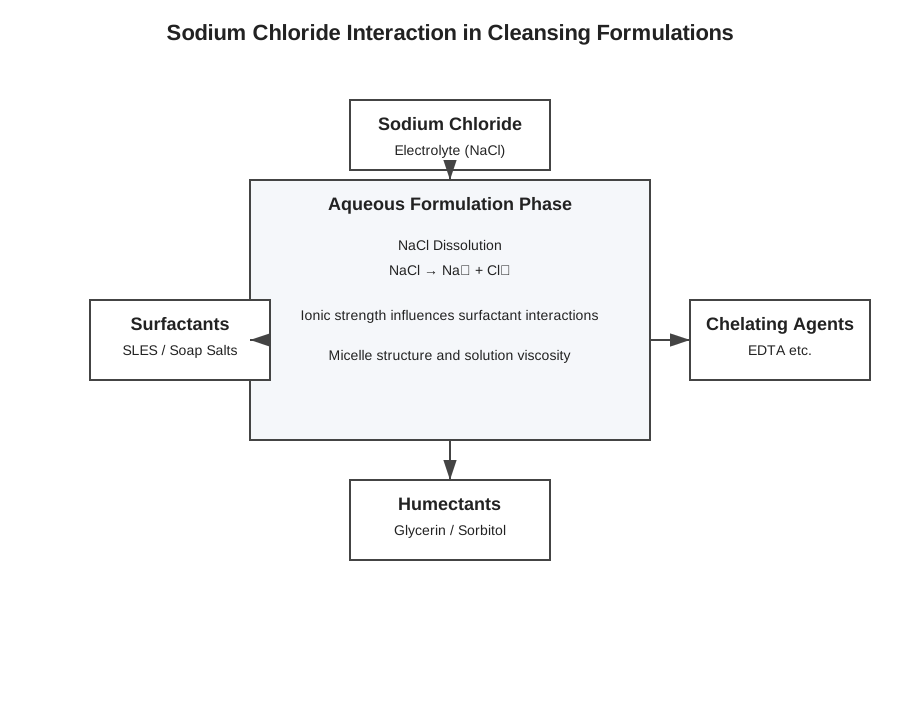
The functional behavior of sodium chloride in cleansing formulations arises from its interaction with the aqueous phase and with surfactant systems dissolved within that phase. Once dissolved, the sodium and chloride ions influence the electrical environment surrounding other charged molecules in the formulation.
Anionic surfactants such as Sodium Lauryl Sulfate or fatty acid soap salts carry negative charges on their hydrophilic head groups. When sodium chloride is introduced into the system, the presence of additional ions can partially shield these charges. This reduction in electrostatic repulsion allows surfactant molecules to pack more closely together within micellar structures.
As micelles become larger or more structured the overall viscosity of the solution can increase. This is one reason small adjustments in salt concentration can significantly alter the thickness of a liquid cleanser. However, excessive salt concentrations may disrupt this balance and cause the system to become thinner again, illustrating the sensitivity of surfactant systems to ionic strength.
Other formulation ingredients also interact indirectly with sodium chloride. Humectants such as glycerin influence water structure and solvent properties, while chelating agents may bind metal ions present in the water phase. These combined interactions determine the overall stability and physical behavior of the cleansing formulation.
Phase Behavior in Cleansing Formulations
Sodium chloride exists as a crystalline solid under normal storage conditions. When introduced into water it dissolves rapidly and dissociates into sodium and chloride ions. This dissolution process forms an electrolyte solution that can influence the physical behavior of other formulation ingredients present in the same aqueous environment.
Within liquid cleansers and surfactant systems the ionic strength created by dissolved sodium chloride alters how surfactant molecules organize in solution. Surfactants naturally assemble into micelles once their concentration exceeds a threshold known as the critical micelle concentration. The presence of dissolved ions can influence the size and arrangement of these micellar structures.
Changes in micelle size and packing affect the rheology of the solution. In many surfactant systems the addition of small quantities of sodium chloride causes micelles to elongate or interact more closely, producing an increase in viscosity. As salt concentration continues to rise the system may eventually reach a point where micelle structure becomes destabilized and the solution thins again.
Temperature and overall ingredient composition also influence this behavior. Variations in surfactant type, water purity and the presence of polyols or polymers can shift the concentration range at which sodium chloride modifies viscosity within the formulation.
Regulatory Context
Within cosmetic ingredient labeling systems sodium chloride is declared using its International Nomenclature of Cosmetic Ingredients name sodium chloride. Cosmetic regulations in many jurisdictions require ingredients to be listed using standardized nomenclature so that ingredient identities remain consistent across international markets.
In the European Union ingredient declarations follow the requirements established under Regulation (EC) No 1223 2009 on cosmetic products. Under this framework ingredients present in a formulation must be listed in descending order of concentration when above defined thresholds. Sodium chloride therefore appears within the ingredient list according to the quantity present in the final product.
Regulatory databases such as the European Commission CosIng database classify sodium chloride primarily as a bulking agent, viscosity controlling agent or formulation component within cosmetic products. These classifications reflect its role in influencing physical characteristics of formulations rather than acting as an active cleansing substance.
Common Misunderstanding
A common misunderstanding arises from the assumption that sodium chloride functions as a cleansing ingredient in soap or cosmetic products. While the compound is widely known as table salt in everyday contexts, within cosmetic formulations its role is primarily structural rather than functional in the cleansing sense.
Cleansing activity in soaps and liquid cleansers is performed by surfactant molecules or fatty acid soap salts that can interact with oils and soil particles. Sodium chloride does not possess the amphiphilic structure required for surfactant activity and therefore does not participate directly in the removal of oils during washing.
Instead the compound influences the physical environment surrounding these cleansing agents. By modifying ionic strength in the water phase it indirectly affects how surfactant molecules organize and how the overall formulation behaves.
Structural Limitations
Although sodium chloride can effectively modify viscosity and phase behavior in many cleansing formulations, its use introduces certain formulation limitations. One limitation relates to the narrow concentration range within which the compound produces thickening effects in surfactant systems. Small increases beyond this range can cause the formulation to thin rather than thicken.
Another limitation arises from interactions with minerals present in water sources. Hard water containing calcium or magnesium ions can influence the behavior of surfactants and soap salts. These additional ions may alter the ionic balance of the formulation and change how sodium chloride affects viscosity or micelle formation.
Formulators therefore treat sodium chloride as a fine tuning component rather than a structural backbone of the formulation. Its effectiveness depends on precise concentration control and compatibility with the surrounding ingredient system.
Formulation References Using This Ingredient
Summary of Findings
Sodium chloride is an inorganic ionic compound composed of sodium and chloride ions and identified by the chemical formula NaCl. Within cosmetic and cleansing formulations the compound functions primarily as an electrolyte that modifies the behavior of surfactant systems rather than acting as a cleansing agent itself.
- Chemical Classification: Sodium chloride is a simple inorganic salt composed of sodium and chloride ions.
- Functional Role: The ingredient operates mainly as a viscosity modifier and ionic strength regulator in aqueous cleansing formulations.
- Interaction Logic: Dissolved ions influence how surfactant molecules assemble into micelles within the water phase.
- Phase Behavior: The compound dissolves readily in water and alters the electrostatic environment of the formulation.
- Formulation Boundaries: Effective performance depends on precise concentration control and compatibility with the surrounding ingredient system.