Role in Formulation Systems
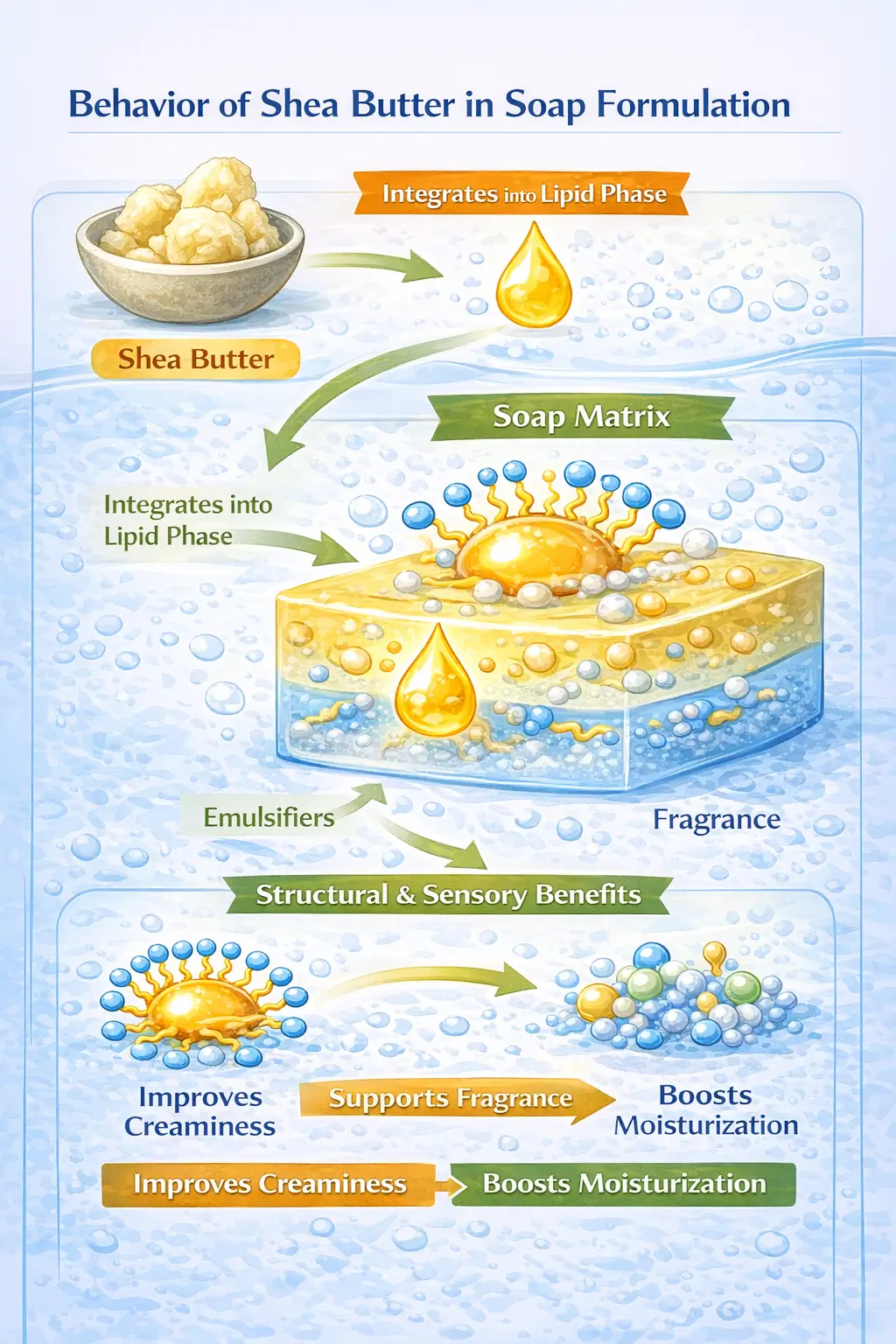
Shea Butter (Butyrospermum Parkii) is a vegetable triglyceride fat used in cosmetic and soap formulations as a structural and emollient component that influences texture, consistency and surface interaction.
It is chemically composed of fatty acid esters and differs from liquid oils by existing as a semi-solid material under ambient conditions.
Within formulation systems, it does not act as a cleansing agent but contributes to the physical structure and sensory behavior of the product matrix.
In observable terms, its inclusion typically results in a denser, smoother product feel and can reduce the perception of harshness in cleansing systems.
This page is part of the CleanFormulation Ingredient Library, a research-based system documenting how ingredients behave within real soap, detergent and cosmetic formulations.
Quick Formulation Facts
| Property | Description |
|---|---|
| Ingredient Type | Vegetable fat |
| Chemical Class | Triglyceride (fatty acid ester) |
| Functional Role | Structural lipid, emollient component |
| Ionic Character | Non-ionic |
| Typical Use Context | Soap bars, creams, lotions, cosmetic formulations |
| Physical State | Semi-solid at ambient temperature |
| Primary Phase | Oil phase (lipid phase component) |
| Water Solubility | Insoluble in water |
| Melting Behavior | Softens and melts over a defined temperature range |
| Dominant Fatty Acids | Stearic acid, oleic acid |
| Secondary Fatty Acids | Palmitic acid, linoleic acid |
| Chain Length Profile | Long-chain fatty acids (C16–C18 dominant) |
| Cleansing Contribution | Minimal; does not act as a primary cleansing agent |
| Foam Contribution | Low; may reduce foam intensity in soap systems |
| Structural Contribution | Increases firmness and density of formulation matrix |
| Emollient Behavior | Modifies surface feel and spreadability |
| Role in Soap Matrix | Contributes to bar hardness and longevity |
| Role in Emulsions | Functions within oil phase requiring emulsifiers for stability |
| Interaction with Alkali | Can undergo saponification to form soap salts |
| Compatibility with Surfactants | Non-interfering; complements cleansing systems structurally |
| Thermal Sensitivity | Physical consistency varies with temperature |
| Oxidation Stability | Moderate stability depending on formulation conditions |
| Formulation Function | Balances cleansing intensity and enhances texture |
| System Dependency | Requires integration with other ingredients for functional performance |
| Label Representation | Appears as Shea Butter or Butyrospermum Parkii Butter |
Why Shea Butter Appears on Ingredient Labels
Shea Butter appears on ingredient labels because it functions as a lipid component within formulation systems, contributing to texture, consistency and surface interaction.
In cosmetic formulations, it is used within the oil phase to modify spreadability and structural behavior. In soap systems, it contributes to the fatty acid composition that influences bar characteristics.
Ingredient labeling follows standardized naming conventions, where it may appear as Butyrospermum Parkii or as Shea Butter depending on the labeling format explained in the ingredient list interpretation guide.
Its presence on a label reflects formulation design choices rather than a direct indication of performance in isolation.
Chemical Identity and Classification
Shea Butter is identified in ingredient labeling systems as Butyrospermum Parkii Butter and belongs to the class of naturally derived triglyceride fats.
It consists of glycerol molecules esterified with a mixture of fatty acids, forming a non-ionic lipid structure that does not interact with water in its original form.
Unlike components used in surfactant systems, it does not reduce surface tension or participate directly in cleansing mechanisms.
Its role is therefore defined by its physical and structural contribution rather than chemical activity at interfaces.
Fatty Acid Composition and Structural Behavior
The behavior of Shea Butter in formulations is influenced by its fatty acid profile, which is dominated by longer-chain saturated and monounsaturated components.
| Fatty Acid | Contribution to Formulation Behavior |
|---|---|
| Stearic Acid | Contributes to firmness and structural integrity |
| Oleic Acid | Provides spreadability and softer texture |
| Palmitic Acid | Supports structural stability |
| Linoleic Acid | Influences fluidity within the lipid matrix |
This composition differs from oils such as Palm Kernel Oil, which are richer in shorter-chain fatty acids and behave differently in cleansing systems.
In observable terms, this composition leads to a denser and more stable product structure, with a smoother application profile compared to lighter oils.
Functional Role in Soap and Cosmetic Systems
Shea Butter contributes to formulation systems primarily through its structural and sensory effects rather than direct participation in cleansing.
Role in Soap Systems
When incorporated into soap formulations, it becomes part of the fatty acid matrix that defines bar hardness, longevity and overall structural integrity.
Its higher proportion of stearic acid contributes to a firmer bar structure and influences how the soap behaves during use.
Role in Cosmetic Systems
Within cosmetic formulations, it functions as an oil phase component that modifies texture and spreadability.
It contributes to the formation of stable emulsified systems when combined with water and emulsifying agents.
Effect on Sensory Characteristics
Its semi-solid nature influences the tactile properties of formulations, contributing to a thicker, more cohesive feel during application.
This can moderate the perception of cleansing intensity when used alongside active cleansing agents.
Non-Cleansing Nature
It does not act as a cleansing agent and does not replace the role of surfactants or soap salts within a formulation.
Ingredient Interaction Logic
Shea Butter operates within formulation systems through interactions with other structural and functional components.
Interaction with Soap Base
In soap systems, it integrates into the fatty acid composition that forms soap salts when reacted with sodium hydroxide.
This interaction influences the resulting balance between hardness and solubility in the final product.
Interaction with Water Phase
As a hydrophobic material, it does not dissolve in water and instead forms part of the dispersed oil phase in emulsified systems.
Its distribution within the formulation affects how evenly the product spreads and interacts with the skin surface.
Interaction with Emulsifiers
To form stable cosmetic systems, it requires the presence of emulsifying agents that enable mixing between oil and water phases.
These interactions determine the stability and consistency of creams and lotions.
Interaction with Fragrance Systems
Fragrance components are incorporated within the lipid matrix, influencing how scent is retained and released over time in the presence of fragrance systems.
Interaction with Other Oils
Shea Butter is often combined with oils such as Palm Oil or Palm Kernel Oil to create balanced formulations with controlled structural and cleansing properties.
Phase Behavior and Physical Characteristics
Shea Butter exists as a semi-solid material under typical ambient conditions due to its high proportion of saturated fatty acids.
This physical state influences how it behaves during formulation, particularly in processes involving heating, mixing and emulsification.
Melting and Solidification
It transitions between solid and liquid states over a defined temperature range, allowing it to be incorporated into formulations through controlled melting.
Upon cooling, it recrystallizes into a structured lipid matrix that contributes to product firmness.
Solubility Characteristics
Shea Butter is not water-soluble and remains confined to the oil phase in emulsified systems.
Its distribution within this phase affects texture and consistency rather than cleansing activity.
Storage Stability
The stability of Shea Butter depends on formulation conditions, including temperature and interaction with other lipid components.
Proper formulation design ensures consistent texture and prevents undesirable structural changes over time.
Comparison With Other Vegetable Oils
Shea Butter differs from other commonly used vegetable oils in both composition and formulation role.
| Feature | Shea Butter | Palm Oil | Palm Kernel Oil |
|---|---|---|---|
| Physical State | Semi-solid | Semi-solid | Semi-solid |
| Dominant Fatty Acids | Stearic, oleic | Palmitic, oleic | Lauric, myristic |
| Primary Role | Structure, emollient effect | Structure, stability | Cleansing, foam generation |
| Cleansing Contribution | Minimal | Moderate | High |
| Typical Use Context | Cosmetics, soap formulations | Soap, cosmetics | Soap, detergents |
This comparison illustrates how different vegetable oils contribute distinct functional roles within formulation systems, allowing formulators to combine them for balanced performance.
Regulatory Context
Shea Butter is regulated as a cosmetic ingredient within established frameworks governing formulation and labeling practices.
Its presence in a formulation is evaluated within the context of the final product rather than as an isolated substance.
Labeling conventions allow it to appear under its botanical name or common name, as described in the ingredient list interpretation guide.
Common Misunderstanding
A common misconception is that Shea Butter functions as a cleansing agent within soap or cosmetic formulations.
In reality, it does not contribute directly to cleansing. Instead, it modifies the structural and sensory characteristics of the formulation.
Another misunderstanding is that all vegetable oils behave similarly. In practice, differences in fatty acid composition result in distinct functional roles within formulation systems.
Formulation Considerations and Limitations
- Non-cleansing nature: does not replace surfactants or soap salts.
- Phase dependency: requires emulsification for incorporation into aqueous systems.
- Temperature sensitivity: physical consistency changes with temperature.
- System balance requirement: must be combined with other ingredients for optimal formulation performance.
These considerations highlight the importance of integrating Shea Butter within a balanced formulation system.
Formulation References Using This Ingredient
Summary of Findings
- Classification: Shea Butter is a vegetable triglyceride fat.
- Functional Role: It contributes to structure, texture and sensory behavior.
- Cleansing Role: It does not act as a primary cleansing agent.
- System Interaction: Functions within the oil phase of formulations.
- Comparison: Distinct from palm oil and palm kernel oil in formulation behavior.