Why The Natural And Synthetic Distinction Exists
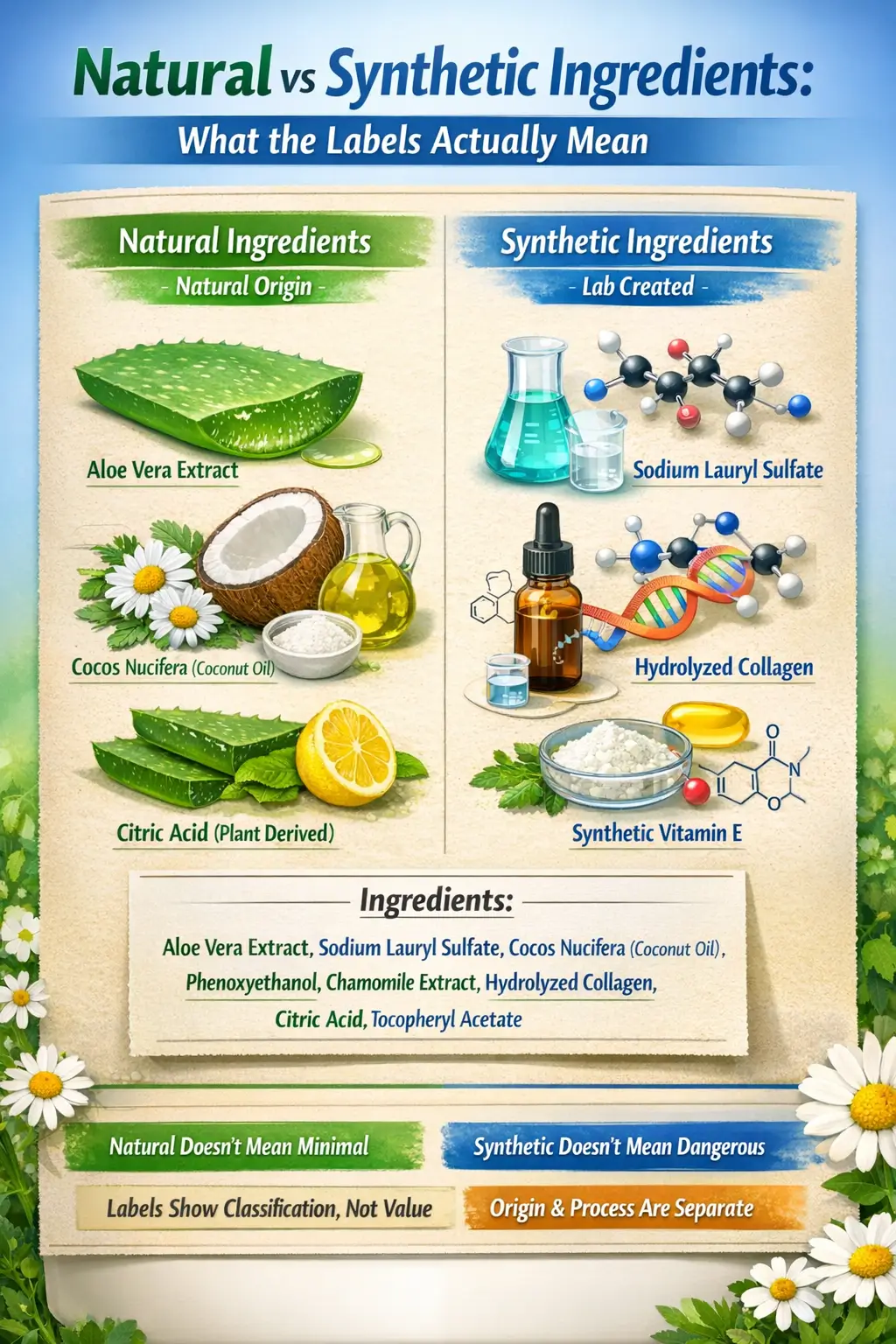
The distinction between natural and synthetic ingredients exists primarily for classification, not evaluation. Regulatory frameworks require ingredients to be described in consistent ways so that their identity and origin can be traced across supply chains, documentation, and markets.
Under Regulation (EC) No 1223/2009, Article 19 requires cosmetic products to list ingredients using standardized nomenclature (INCI) in descending order of weight. This obligation governs how ingredients are disclosed, but it does not classify them as superior, safer, or preferable based on origin. The regulation mandates identification, not evaluation.
In practice, this means ingredients are grouped based on how they are produced or modified, not on how familiar they feel to consumers. A substance that begins as a plant extract may still be processed extensively, while a substance produced synthetically may be chemically identical to one found in nature.
Labels do not attempt to reconcile these nuances. They record category placement, not interpretive meaning. Confusion often arises when readers assume these categories were designed to guide preference rather than documentation. In practice, this means ingredients are grouped based on how they are produced or modified, not on how familiar they feel to consumers, an approach explained in more detail in the soap ingredients guide.
How Natural Is Defined On Ingredient Labels
On European labels, natural typically refers to origin rather than simplicity. An ingredient described as natural usually begins with a biological or mineral source, but that description does not specify how much processing occurred afterward.
This can be counterintuitive. Many consumers associate natural with minimal transformation. In formulation contexts, however, even ingredients sourced from plants may be refined, stabilized, or altered to ensure consistency and shelf life.
As a result, natural on a label should be read as a statement about starting material, not as a summary of the ingredient’s final form or behavior within a product.
How Synthetic Is Defined On Ingredient Labels
Synthetic typically indicates that an ingredient was produced through controlled chemical processes rather than extracted directly from a natural source. This definition focuses on manufacturing method, not on novelty or risk.
In many cases, synthetic ingredients are used because they offer consistency, a consideration that also appears in discussions around plant-derived formulations such as those outlined in vegan soap ingredients. Variability in natural sources can make formulation unpredictable, particularly at scale. Synthetic production allows manufacturers to replicate specific molecular structures reliably.
This does not imply that synthetic ingredients are more complex or less familiar in use. The distinction remains administrative rather than experiential, even if the language suggests otherwise.
Why Natural And Synthetic Are Not Opposites In Practice
A common assumption is that natural and synthetic describe two opposing ends of a spectrum. In formulation reality, they often intersect. An ingredient can originate from a natural source and still be chemically modified, while a synthetic ingredient can be designed to mirror a structure that exists in nature.
Labels do not attempt to map this overlap. They record how an ingredient is classified, not how closely it resembles something familiar or traditional. This is one reason the natural versus synthetic distinction feels incomplete when read as a judgment rather than a category.
In everyday retail contexts, such as supermarket shelves or pharmacy packaging, these terms are often read as shorthand for quality or intent. On labels, they are closer to filing labels than evaluative statements.
How Ingredient Names Appear On Labels In Practice
| Label Name | Common Association | Classification Context | What The Name Actually Signals |
|---|---|---|---|
| Sodium Chloride | Salt | Mineral-derived compound | Standardized chemical naming for a widely familiar substance |
| Citric Acid | Citrus fruit | Plant-derived, often processed | Functional acid identified by molecular structure, not source narrative |
| Tocopherol | Vitamin E | Can be natural or synthetic | Unified naming used regardless of production method |
| Cocos Nucifera Oil | Coconut oil | Plant-derived lipid | Botanical identification rather than consumer-facing wording |
| Phenoxyethanol | Preservative | Synthetically produced | Chemical identity stated without performance or safety implication |
Tables like this illustrate why ingredient names often feel disconnected from everyday language. Labels prioritize consistency and traceability across markets, not familiarity or reassurance, which is why ingredient terminology often feels technical, as explored further in why ingredients sound chemical. As a result, substances with simple origins may appear technical, while production method is often invisible unless specifically required to be disclosed.
Where Labels Stop Explaining
Ingredient labels are intentionally limited in what they explain. Their role is to identify substances consistently, not to provide context about processing choices, sourcing trade-offs, or formulation constraints.
Explaining why an ingredient was synthesized rather than extracted would require space, interpretation, and assumptions about reader priorities. Regulatory labeling frameworks avoid this by design. They prioritize neutrality and verifiability over narrative clarity.
This creates a gap between what labels say and what readers want to know. That gap is not the result of omission or concealment, but of scope. Labels document compliance, not reasoning.
Common Assumptions Labels Do Not Correct
Many readers assume that natural implies gentler behavior, while synthetic implies artificiality or risk. Labels do not confirm or deny these assumptions. They simply list ingredients according to established naming and classification rules.
In addition, Regulation (EU) No 655/2013 establishes common criteria for cosmetic claims. Terms such as natural or synthetic, when used in marketing communication, must not mislead consumers regarding characteristics or benefits. However, the claims framework regulates promotional language, not ingredient classification itself.
Another frequent assumption is that fewer synthetic ingredients indicate a simpler or more transparent formulation. In practice, formulation simplicity is not visible from labels alone. Ingredient count and classification do not reveal how ingredients interact or why they were chosen.
These assumptions persist because labels are silent on interpretation. They are not designed to challenge or reinforce consumer narratives, even when those narratives are widely held.
What This Means When Reading Labels
- Classification, Not Judgment: Natural and synthetic describe how ingredients are categorized, not whether they are better or worse.
- Origin And Method Are Separate: Natural origin does not imply minimal processing, and synthetic production does not imply unfamiliar behavior.
- Labels Have Defined Limits: ingredient lists identify substances but do not explain formulation choices or trade-offs.
- Interpretation Requires Context: Understanding these terms depends on recognizing what labels are designed to communicate and what they intentionally leave out.
Regulatory References
| Legal Instrument | Authority | Relevance To This Article | Official Source |
|---|---|---|---|
| Regulation (EC) No 1223/2009 – Article 19 | European Parliament & Council | Establishes mandatory ingredient listing requirements using standardized nomenclature (INCI). | EUR-Lex (Consolidated) |
| Regulation (EU) No 655/2013 | European Commission | Defines common criteria for cosmetic claims and prohibits misleading interpretation of product characteristics. | EUR-Lex (Claims Regulation) |
| European Commission Technical Document on Cosmetic Claims | European Commission | Provides guidance on interpretation and substantiation of claims under Regulation 655/2013. | Official Guidance |