Definition and System Context
Sodium Carbonate is an inorganic alkaline salt classified as a pH-adjusting and builder agent, widely used in soap, detergents, and cleaning products to increase alkalinity and enhance cleaning efficiency.
It functions primarily by modifying the chemical environment of the formulation, allowing surfactants and soap salts to perform more effectively under alkaline conditions.
Within cleansing systems, it does not act as a primary cleanser but instead supports the overall formulation by influencing water chemistry, soil interaction, and residue behavior.
This page is part of the CleanFormulation Ingredient Library, a research-based system analyzing how ingredients behave within real formulation environments.
Quick Facts
| Property | Description |
|---|---|
| Ingredient Type | Alkaline agent / builder component |
| Chemical Name | Sodium Carbonate |
| Common Names | Washing soda, soda ash |
| Chemical Formula | Na₂CO₃ |
| Molecular Weight | 105.99 g/mol |
| Chemical Class | Inorganic carbonate salt |
| Functional Role | pH adjustment, alkalinity control, water softening, builder support |
| Ionic Nature | Strong electrolyte (fully dissociates into Na⁺ and CO₃²⁻ ions) |
| pH (1% Solution) | ~11–12 (strongly alkaline) |
| Solubility in Water | Highly soluble; rapidly dissociates in aqueous systems |
| Dissolution Behavior | Fast dissolution with immediate pH increase in water |
| Water Hardness Interaction | Reacts with calcium and magnesium ions to form insoluble carbonates |
| Builder Function | Reduces water hardness and enhances surfactant efficiency |
| Cleansing Contribution | Indirect; improves surfactant and soap performance under alkaline conditions |
| Foam Impact | Supports foam performance indirectly by reducing hardness interference |
| Grease Removal Role | Enhances emulsification efficiency in alkaline environments |
| Typical Use Context | Laundry detergents, dishwashing powders, cleaning products, soap systems |
| Use in Soap Systems | Improves alkalinity and supports fatty acid salt performance |
| Use in Detergents | Acts as builder and alkalinity source in powdered and liquid systems |
| Use in Cosmetics | Limited; used as pH adjuster in controlled systems |
| Physical Form | White crystalline powder or granules |
| Hygroscopic Nature | Moderately hygroscopic; absorbs moisture under humid conditions |
| Hydrated Forms | Can form sodium carbonate decahydrate (Na₂CO₃·10H₂O) |
| Thermal Stability | Stable under normal conditions; decomposes at high temperatures |
| Compatibility | Compatible with most surfactants and builders; reacts with acids |
| Incompatibility | Strong acids, moisture-sensitive systems, certain cationic compounds |
| pH Influence in System | Raises and stabilizes alkaline pH environment |
| Role in System Stability | Maintains consistent alkalinity during use |
| Residue Potential | Can form insoluble deposits if not balanced with dispersing agents |
| Storage Consideration | Store in dry conditions to prevent clumping and hydration |
| Environmental Behavior | Dissociates into ions; does not persist as intact compound |
| Regulatory Status | Approved for use in cleaning and cosmetic formulations (function-based use) |
| INCI Name | Sodium Carbonate |
Why This Ingredient Appears on Labels
Sodium carbonate appears in ingredient lists because it plays a functional role in controlling alkalinity and improving cleaning efficiency across formulation systems. It is commonly included in laundry detergents, dishwashing formulations, and multi-surface cleaning products where water hardness and soil removal performance are key variables.
For readers interpreting labels, its presence reflects formulation design rather than standalone activity. In many cases, it works alongside surfactants and other builders to support the overall cleaning mechanism rather than acting independently. Understanding this distinction becomes easier when reading ingredient lists through a structured lens, as explained in how to read ingredient list.
In broader formulation contexts, sodium carbonate may also appear in systems categorized under ingredient composition and application layers, where it contributes to performance rather than defining the product type.
Chemical Identity and Classification
Sodium carbonate is identified by the chemical formula Na₂CO₃ and is commonly referred to as washing soda. It belongs to the class of inorganic carbonate salts and is characterized by its strong alkaline nature when dissolved in water.
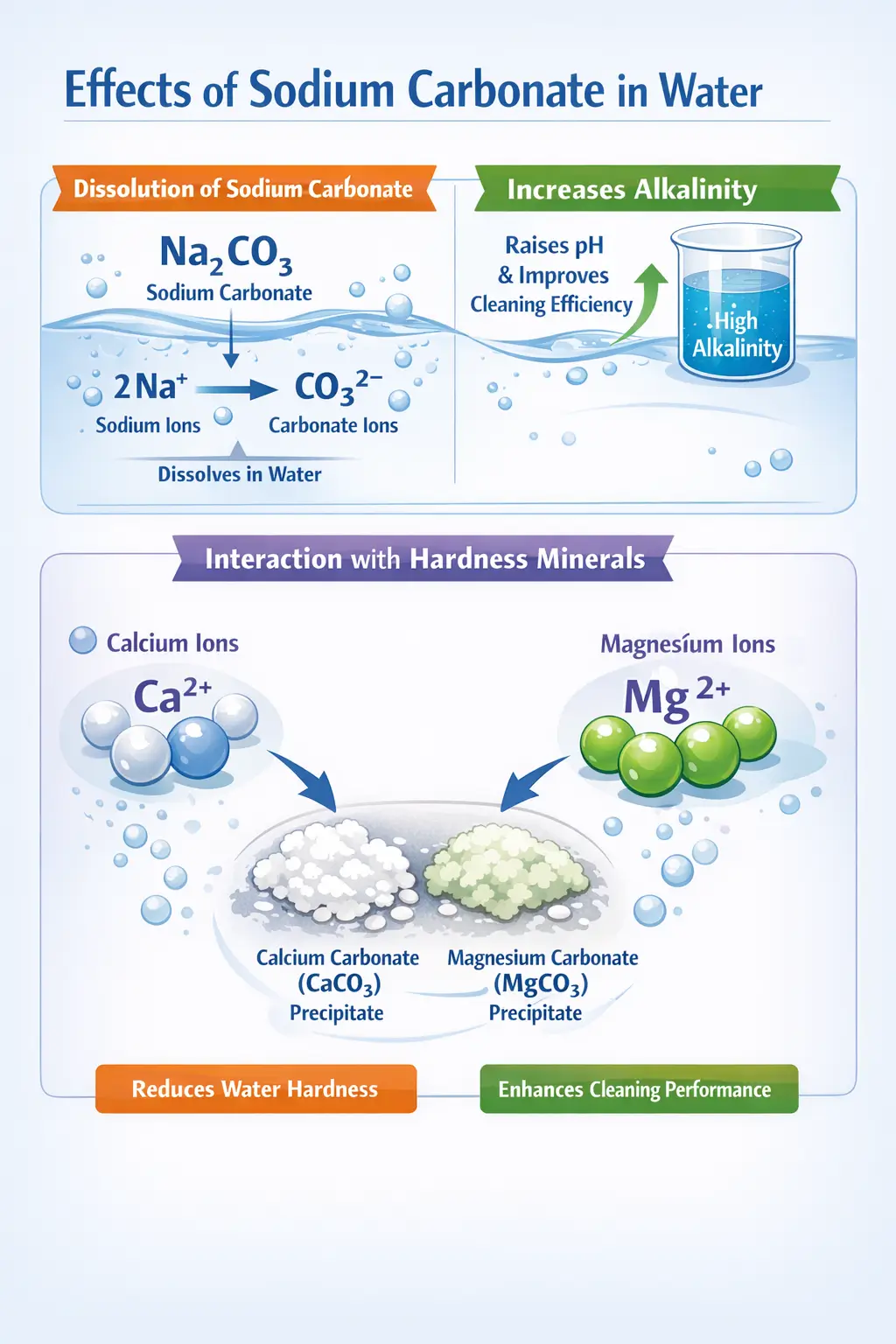
In aqueous systems, it dissociates into sodium ions and carbonate ions, which interact with water to increase pH through the formation of hydroxide ions. This behavior places it within the functional category of alkaline agents, where it contributes to the chemical environment rather than acting as a surface-active compound.
Unlike sodium hydroxide, which directly participates in saponification reactions, sodium carbonate operates post-formation, modifying system conditions rather than forming soap molecules.
Functional Role in Cleansing Systems
Sodium Carbonate operates as a system-level modifier rather than a primary cleansing agent. Its main function is to increase alkalinity, which directly influences how effectively surfactants and soap salts interact with soils and oils.
In traditional soap systems, higher alkalinity enhances the ionization of fatty acid salts, improving their ability to emulsify oily residues. This effect is particularly relevant in formulations where cleaning performance depends on maintaining a stable alkaline environment.
In detergent-based systems, it functions as a builder by reducing the impact of calcium and magnesium ions present in hard water. By reacting with these ions, it prevents them from interfering with surfactant performance, allowing the formulation to maintain consistent cleaning efficiency.
Within detergent formulation systems, this behavior translates into improved soil suspension and reduced redeposition, especially during laundry and dishwashing cycles.
From a formulation perspective, its presence can influence multiple system properties:
- Cleaning efficiency: Enhanced due to improved surfactant activity under alkaline conditions
- Residue behavior: Reduced mineral deposition in hard water environments
- System stability: Maintains consistent pH across use conditions
- Interaction with soils: Promotes breakdown of grease and particulate matter
In observable terms, this often results in more effective removal of oily films and less visible residue after rinsing, particularly in hard water conditions.
Ingredient Interaction Logic
Sodium carbonate does not act in isolation. Its behavior is defined by how it interacts with other formulation components within the system.
When combined with surfactants, it enhances their efficiency by maintaining an alkaline environment that favors grease breakdown and micelle formation. This interaction is particularly important in systems where surfactant performance is sensitive to water hardness.
In soap-based formulations, it interacts with fatty acid salts by shifting equilibrium toward more active ionized forms, indirectly strengthening cleansing performance without altering the core soap structure.
Its interaction with water is equally significant. Upon dissolution, it releases carbonate ions that react with hardness minerals, forming insoluble precipitates. This reduces interference from calcium and magnesium, a function that overlaps with certain chelating agents, although through a different chemical mechanism.
In multi-component systems, its interaction network typically includes:
- Surfactants: Supports micelle efficiency and grease removal
- Soap salts: Enhances ionization and cleansing activity
- Water phase: Modifies hardness and ionic balance
- Builders and additives: Works alongside other alkalinity contributors
These interactions define its role as a system stabilizer rather than a standalone active ingredient.
Phase Behavior and Solubility
Sodium carbonate exhibits high solubility in water, where it dissociates into sodium and carbonate ions. This dissolution is rapid and contributes to immediate pH elevation within the aqueous phase.
In solid formulations such as powders, it exists as a crystalline salt that dissolves upon contact with water. The rate of dissolution depends on particle size, temperature, and agitation conditions.
Its hydration behavior can influence storage stability. Under humid conditions, it may absorb moisture and form hydrated variants, which can alter flow properties in powdered systems.
In liquid systems, its solubility contributes to uniform distribution, but excessive concentration may lead to precipitation when interacting with hardness ions or other formulation components.
From a system perspective, this behavior translates into faster activation in water and consistent alkalinity throughout the cleaning process.
Comparison With Related Ingredients
| Feature | Sodium Carbonate | Sodium Hydroxide |
|---|---|---|
| Chemical Type | Carbonate salt | Strong alkali base |
| Primary Role | pH adjustment and builder | Saponification agent |
| Reactivity | Moderate | Highly reactive |
| Function in Soap | Supports cleaning environment | Forms soap from fats |
| Use Stage | Post-formulation or additive | Core reaction stage |
This comparison highlights that sodium carbonate modifies system conditions, whereas sodium hydroxide defines the foundational chemistry of soap formation.
Regulatory Context
Sodium carbonate is listed under its INCI name as Sodium Carbonate and is permitted for use in cosmetic and cleaning formulations without classification as an active cosmetic ingredient. Its function is typically categorized as a pH adjuster or buffering agent within formulation systems.
Under European Union cosmetic regulation frameworks, ingredients are declared based on their function and concentration hierarchy rather than perceived importance. This means sodium carbonate may appear at different positions in ingredient lists depending on formulation type and system concentration.
Its inclusion is generally aligned with formulation requirements rather than regulatory restriction thresholds. Understanding how ingredients are disclosed within these systems is further explained in soap regulatory classification systems and broader labeling differences across regions.
In detergent systems, regulatory classification may differ from cosmetic frameworks, particularly when products are intended for household cleaning rather than personal care. These differences influence labeling, terminology, and functional classification.
Common Misunderstanding
A common misunderstanding is that sodium carbonate acts as a primary cleaning agent in the same way as surfactants or soap molecules. In reality, it does not directly remove dirt or oil through surface activity.
Its role is indirect. It modifies the chemical environment to make other ingredients more effective. Without surfactants or soap salts present, sodium carbonate alone cannot deliver the same level of soil removal.
This distinction becomes important when interpreting ingredient lists or comparing formulations. Confusion often arises when alkaline components are assumed to be responsible for the entire cleaning effect, rather than part of a coordinated system. The difference between cleansing mechanisms and additive support is explored further in cleansing versus antimicrobial action.
Structural Limitations
Despite its functional benefits, sodium carbonate introduces several formulation constraints that must be managed carefully.
Its strong alkalinity can shift system pH beyond the optimal range for certain formulation types, particularly those designed for controlled or balanced pH environments. This limits its use in systems where lower pH stability is required.
In hard water conditions, while it reduces interference from calcium and magnesium, the resulting precipitates can contribute to residue formation if not properly managed within the formulation design.
In powdered systems, its tendency to absorb moisture can affect storage stability, leading to clumping or reduced flowability over time. This behavior becomes relevant in formulations exposed to humid environments.
Additionally, its compatibility with other ingredients must be considered, particularly in complex systems where multiple ionic interactions occur simultaneously.
From a formulation perspective, these limitations translate into the need for balance between alkalinity, solubility, and overall system stability.
Formulation References Using This Ingredient
Summary of Findings
Sodium Carbonate is an inorganic alkaline agent that plays a supporting role in cleansing formulations by modifying pH and improving system efficiency rather than acting as a primary cleanser.
- Classification: Inorganic carbonate salt within alkaline agents
- Functional Role: pH adjustment, water softening, and builder support
- Interaction Logic: Enhances surfactant and soap salt performance by modifying chemical environment
- Phase Behavior: Highly water-soluble, forms ions that influence system alkalinity and hardness interactions
- System Limitation: High alkalinity and residue potential require controlled formulation balance
Within formulation systems, its value lies in how it supports other ingredients, defining system behavior rather than acting independently.