Definition and System Role
Sodium Cocoyl Isethionate is a mild anionic surfactant derived from fatty acids and isethionic acid, widely used in solid and liquid cleansing systems.
It belongs to the class of synthetic detergent surfactants, often referred to as syndet components rather than traditional soap salts formed through saponification.
Within formulations, it functions primarily as a cleansing and foaming agent, contributing to controlled lather formation and reduced interaction intensity compared to high-alkaline soap systems.
Its presence shifts formulation behavior toward low-residue, stable foam systems, especially in syndet bars and hybrid cleansing bases.
This page is part of the CleanFormulation Ingredient Library, a research project focused on analyzing ingredient behavior within real formulation systems.
Quick Facts
| Property | Description |
|---|---|
| Ingredient Type | Primary surfactant |
| INCI Name | Sodium Cocoyl Isethionate |
| Source Material | Coconut fatty acids (C8–C18) reacted with isethionic acid |
| Molecular Structure | R–CO–O–CH₂–CH₂–SO₃⁻ Na⁺ |
| pH (10% Solution) | 5.0 – 7.0 |
| Solubility | Low in cold water; improves with حرارة (~40–60°C) |
| Critical Micelle Concentration (CMC) | ~0.1 – 0.3 g/L |
| Foaming Profile | Dense, creamy foam with fine bubble size |
| Foam Stability | High stability even in presence of oils |
| Cleansing Strength | Moderate; effective without aggressive lipid stripping |
| Skin Interaction | Low irritation potential; reduced protein denaturation |
| Hard Water Tolerance | Resistant to Ca²⁺/Mg²⁺ interference; no soap scum formation |
| Typical Usage Level | 20 – 60% in syndet bar systems |
| Processing Temperature | Typically processed at 60 – 80°C for proper binding |
| Active Matter Content | ~80 – 85% (commercial grades) |
| Biodegradability | Readily biodegradable under aerobic conditions |
| Compatibility | Compatible with amphoteric and nonionic surfactants |
Why This Ingredient Appears on Labels
Sodium Cocoyl Isethionate appears in ingredient lists because it functions as a primary cleansing component within synthetic surfactant systems. Unlike traditional soap bases, it is intentionally added as a discrete surfactant ingredient rather than formed during processing.
Its inclusion reflects formulation choices aimed at controlling foam texture, rinse behavior, and system stability. Label presence is governed by INCI naming conventions, which are explained in the ingredient list interpretation guide.
In many products, it replaces or complements traditional soap salts, contributing to formulations categorized under cosmetic cleansing systems rather than alkaline soap matrices.
Chemical Identity and Classification
Sodium Cocoyl Isethionate is the sodium salt of fatty acid esters derived from coconut oil and isethionic acid. The fatty acid portion typically contains a distribution of chain lengths, primarily in the C12 to C18 range, reflecting the composition of coconut-derived triglycerides.
Chemically, it belongs to the family of isethionate surfactants, which are characterized by an ester linkage between fatty acids and the isethionate group. This structure differs from traditional soap salts, which are simple sodium salts of fatty acids formed through reaction with sodium hydroxide.
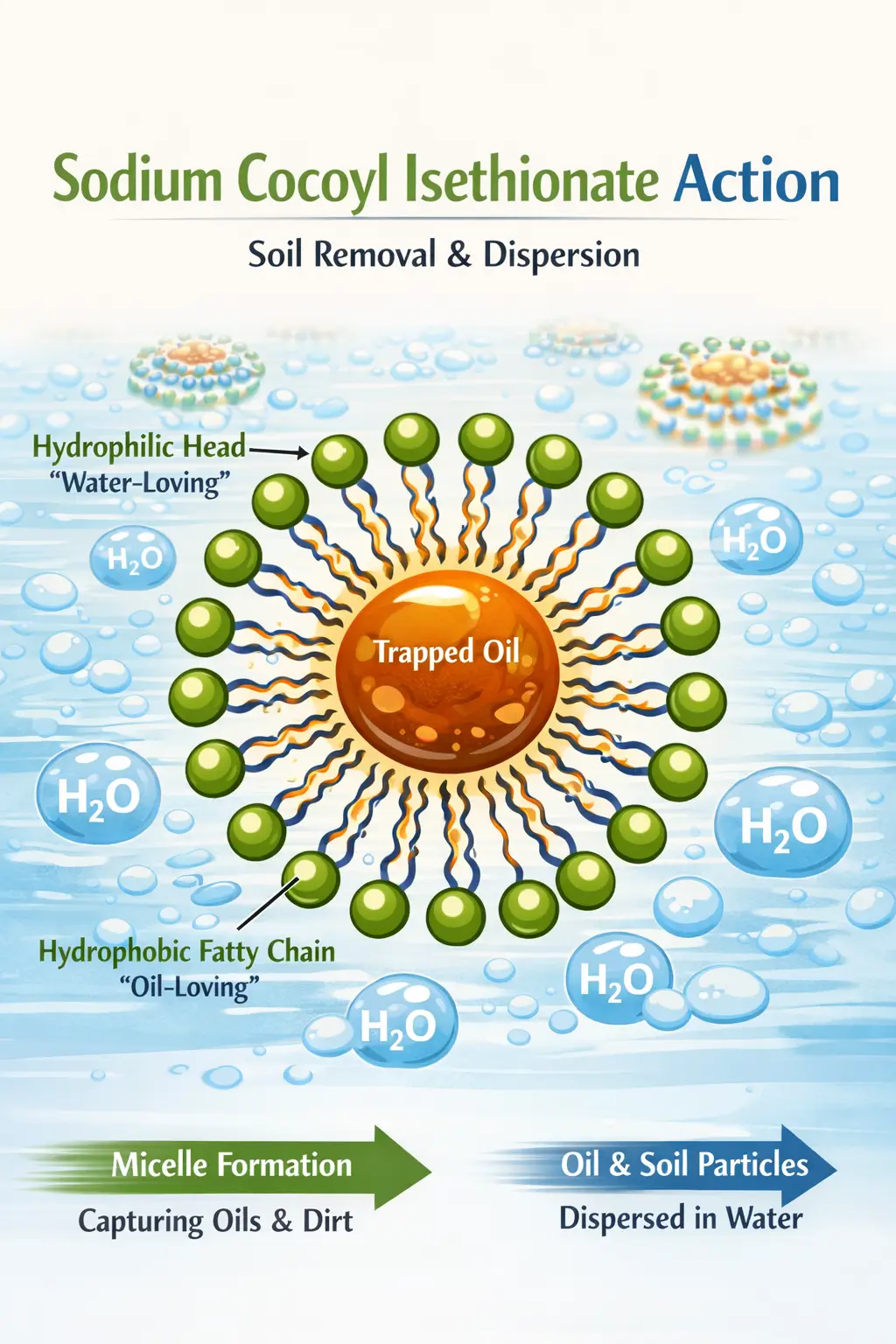
The molecule carries a negatively charged head group in aqueous environments, classifying it as an anionic surfactant. This charge enables interaction with water and oily residues simultaneously, forming micellar structures responsible for cleansing behavior.
Unlike classical soap systems built from fatty acids, Sodium Cocoyl Isethionate is synthesized through controlled esterification processes, allowing more predictable performance across a wider pH range.
Functional Role in Cleansing Systems
Within formulation systems, Sodium Cocoyl Isethionate acts as a primary surfactant responsible for soil removal, foam generation, and surface interaction control.
Its cleansing mechanism is based on micelle formation, where hydrophobic tails associate with oils while hydrophilic heads remain in the aqueous phase. This behavior aligns with general surfactant system principles described in soap formulation and ingredient role guide.
Compared to traditional soap bases, it produces a denser, creamier foam structure with smaller bubble size. This results in a more uniform lather distribution during use.
In solid syndet bars, it contributes to structural cohesion without relying on high alkalinity, enabling formulation of low pH cleansing systems. In liquid formats, it stabilizes foam while maintaining clarity and dispersion.
From a system perspective, its presence reduces the dependency on high levels of alkaline components, shifting formulation behavior away from classic soap chemistry toward controlled surfactant architectures.
Observable effect: formulations containing this surfactant typically produce stable, fine-textured foam and rinse with lower residue compared to high-fatty-acid soap bars.
Ingredient Interaction Logic
The behavior of Sodium Cocoyl Isethionate is strongly influenced by its interaction with other formulation components rather than acting in isolation.
Within multi-surfactant systems, it is often combined with amphoteric or nonionic surfactants to balance foam stability and reduce formulation harshness. This interaction modifies micelle size, charge density, and cleansing dynamics.
In the presence of water, it disperses into structured micellar networks that encapsulate oils and particulate matter. The efficiency of this system depends on overall formulation composition, including electrolyte concentration and co-surfactants.
Interaction with humectants such as glycerin influences hydration behavior and modifies the sensory feel of the cleansing system by affecting water retention at the interface.
Chelating agents such as tetrasodium EDTA improve system stability by binding metal ions that would otherwise interfere with surfactant performance in hard water environments.
Fragrance components are incorporated into the micellar phase, with their behavior governed by broader fragrance function in cosmetic formulation rather than direct chemical bonding with the surfactant.
This interaction network determines overall system behavior, including foam persistence, rinse characteristics, and clarity.
Phase Behavior and Physical Characteristics
Sodium Cocoyl Isethionate exhibits limited water solubility in its raw form, often appearing as a solid powder, flakes, or noodles. Upon dispersion, it forms structured surfactant phases rather than dissolving instantly.
This behavior is governed by its molecular structure, where the balance between hydrophobic fatty chains and hydrophilic head groups determines aggregation into micelles and lamellar phases.
In solid cleansing bars, it contributes to a compressed surfactant matrix, enabling the formation of syndet bars without requiring traditional saponified structures.
Temperature influences its processing behavior, as melting or softening is required for incorporation into solid systems. In liquid formulations, solubilization depends on co-surfactants and system composition.
Observable effect: this phase behavior results in stable foam formation and controlled rinse-off characteristics, especially in systems designed to minimize residue.
Comparison With Soap and Other Surfactants
| Feature | Sodium Cocoyl Isethionate | Traditional Soap (e.g. Sodium Cocoate) | SLS-Type Surfactants |
|---|---|---|---|
| Chemical Type | Anionic isethionate surfactant | Fatty acid sodium salt | Synthetic sulfate surfactant |
| pH Range | Neutral to mildly acidic systems possible | Alkaline | Neutral systems possible |
| Foam Structure | Dense, creamy foam | Variable, often larger bubbles | High, airy foam |
| Hard Water Behavior | Remains soluble | Forms insoluble residues | Remains soluble |
| System Type | Syndet (synthetic detergent) | True soap system | Synthetic surfactant system |
This comparison highlights that Sodium Cocoyl Isethionate operates within a fundamentally different system architecture than traditional soap salts, even when used in similar product formats such as bars.
Regulatory and Labeling Context
Sodium Cocoyl Isethionate is listed under standardized INCI naming conventions and is classified as a cosmetic ingredient in most cleansing formulations.
Its classification depends on product claims and intended use, as explained in the soap and cosmetic regulatory classification guide. Products containing this surfactant are typically categorized as cosmetic cleansers rather than traditional soap products.
Because it is added directly as a finished surfactant rather than formed during processing, it appears explicitly on ingredient labels rather than being represented indirectly through oil sources.
Common Misunderstanding
A common misconception is that Sodium Cocoyl Isethionate is a form of “soap” due to its use in solid cleansing bars. In reality, it belongs to a different class of surfactants known as syndets.
Unlike soap salts formed through saponification, this ingredient is synthesized through controlled chemical processes and does not rely on alkaline conversion of oils.
This distinction explains why products containing it can operate at lower pH levels and exhibit different interaction behavior compared to traditional soap systems.
Formulation Limitations
Despite its functional advantages, Sodium Cocoyl Isethionate presents certain formulation constraints that must be managed during product development.
- Processing Complexity: Requires controlled temperature and blending conditions for incorporation into solid systems
- Limited Solubility in Raw Form: Does not dissolve instantly in water without formulation support
- Dependence on Co-Surfactants: Often combined with other surfactants to optimize foam and cleansing balance
- Cost Considerations: Typically higher formulation cost compared to basic soap salts
These factors influence how the ingredient is positioned within formulations rather than limiting its functional capability.
Formulation References Using This Ingredient
Summary of Findings
- Classification: Sodium Cocoyl Isethionate is an anionic synthetic surfactant (syndet)
- Function: Provides cleansing, foam generation, and system stability
- Behavior: Produces dense, stable foam with controlled rinse characteristics
- System Type: Operates independently of traditional soap chemistry
- Interaction: Performance depends on co-surfactants, water phase, and additives