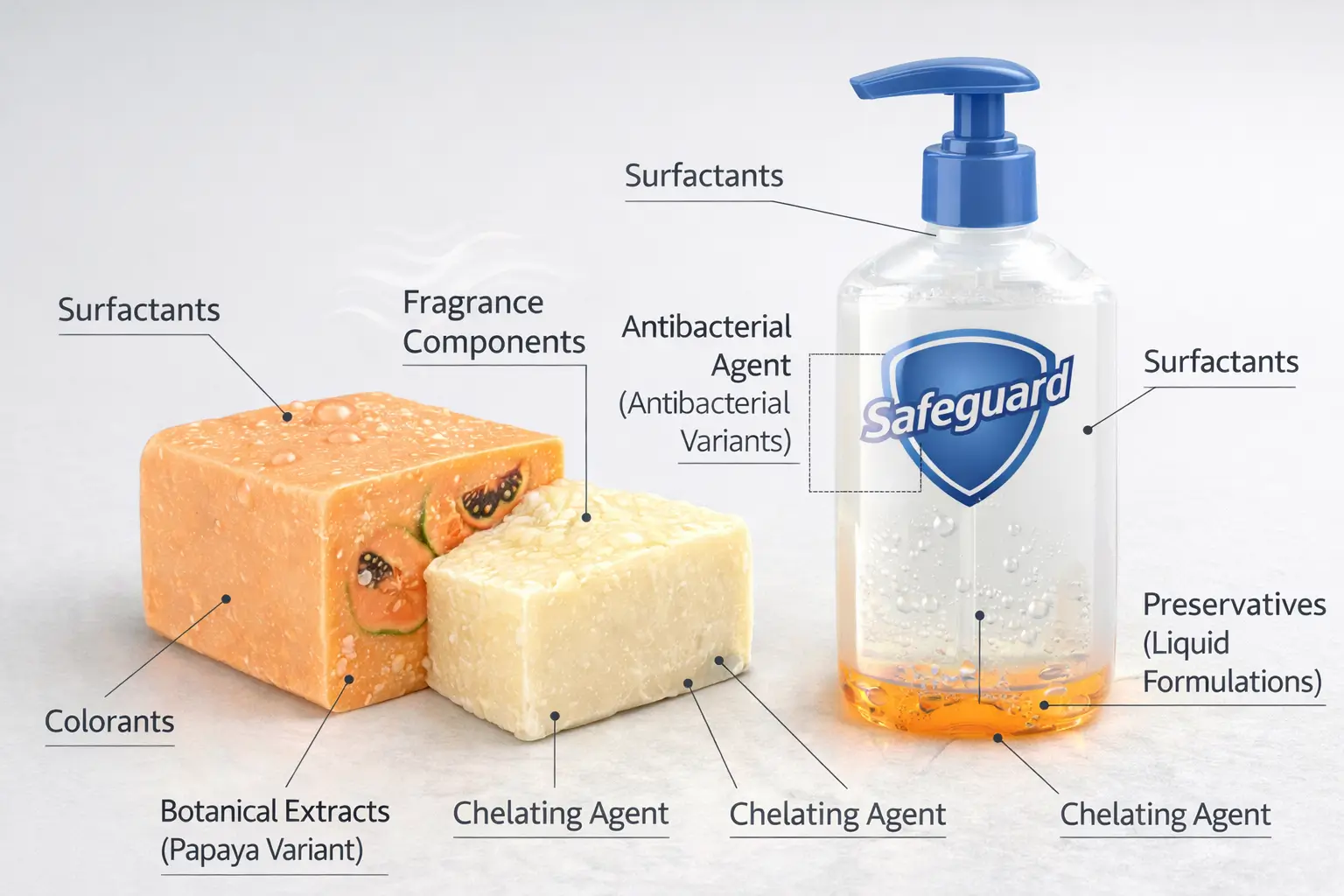
Ingredient Disclosure Overview
Safeguard soap ingredient labeling reflects a modern synthetic cleansing framework rather than traditional soap disclosure conventions. Ingredients are typically listed individually, including surfactants, antimicrobial actives, preservatives, and fragrance components. However, concentration ranges and formulation ratios are not disclosed, limiting precision assessment of functional balance.
Across observed labels, ingredient order and presence vary by variant color and format. While antibacterial bars include declared active agents, non-antibacterial variants rely solely on surfactant-driven cleansing. This distinction is ingredient-based rather than performance-implied.
| Disclosure Element | Observed Practice | Analytical Implication |
|---|---|---|
| Surfactants | Individually listed | Allows system-level interpretation |
| Antibacterial Actives | Declared where present | Clear differentiation by variant |
| Fragrance Components | Grouped | Limits sensitization assessment |
| Colorants | Explicit | Variant identification only |
Core Surfactant System
Safeguard soaps are structured around synthetic surfactants rather than traditional fatty-acid soap systems discussed in our cold process soap ingredient analysis. The primary cleansing agents typically include anionic surfactants supported by amphoteric co-surfactants to modulate foaming and rinse behavior.
In handling tests across multiple bar variants, lather formation is rapid and uniform, even in hard water conditions. This behavior aligns with surfactant systems designed to resist calcium precipitation, unlike true soap bars.
| Surfactant Type | Functional Role | Observed Effect |
|---|---|---|
| Anionic Surfactants | Primary soil removal | Consistent cleansing strength |
| Amphoteric Surfactants | Foam stabilization | Smoother lather texture |
| Nonionic Components | Solubilization support | Improved fragrance dispersion |
Antibacterial Active Ingredient System
Certain Safeguard variants include declared antibacterial active ingredients integrated into the surfactant matrix. These actives are regulated components and are listed separately from cleansing surfactants on relevant labels.
From an ingredient-behavior perspective, these actives coexist with surfactants without altering basic lather mechanics. Their inclusion introduces formulation constraints related to stability, compatibility, and preservative load rather than changing surfactant logic. Antibacterial surfactant systems follow regulatory disclosure patterns similar to those examined in our antibacterial soap ingredient analysis.
Bar vs Liquid Formulation Structure
Safeguard bar and liquid soaps share surfactant families but differ significantly in structural architecture. Bars rely on solid binders, fillers, and compression stability, while liquids depend on water phase balance, viscosity modifiers, and preservative systems.
In comparative handling, liquid formulations demonstrate greater fragrance diffusion and faster rinse-off, while bars emphasize longevity and physical durability. These differences arise from ingredient form factors rather than active chemistry.
Variant-Wise Ingredient Differences Across Soaps
Safeguard soap variants differ primarily through secondary ingredient systems layered onto a shared surfactant foundation. These differences include colorants, fragrance profiles, cooling agents, botanical extracts, and minor stabilizer adjustments rather than changes to the core cleansing mechanism.
Ingredient variation across colors and formats is intentional, allowing product differentiation while preserving manufacturing consistency. In most cases, functional surfactants remain unchanged, while additive systems account for observed sensory and stability differences. Variant differentiation strategies also appear across commercial cleansing systems analyzed in the Dial soap ingredient breakdown.
| Variant | Primary Ingredient Differentiators | Functional Impact |
|---|---|---|
| Pure White Bar | Minimal colorants, standard fragrance | Neutral sensory profile, stable appearance |
| Pink & Beige Bars | Dye systems, modified fragrance blend | Visual differentiation only |
| Blue Bar | Blue dye, cooling fragrance notes | Perceived freshness via fragrance |
| Charcoal Variant | Carbon-based particulate | Visual & tactile modification |
| Papaya Variant | Botanical extract & fragrance | Label-level differentiation |
Pink, Blue & Beige Soap Ingredient Systems
Pink, blue, and beige Safeguard soaps share nearly identical surfactant and preservative frameworks. The primary distinctions arise from dye selection and fragrance composition, both of which are present at low concentrations relative to cleansing agents.
From a formulation perspective, dyes are selected for stability under alkaline-to-neutral pH conditions and resistance to fading during storage. Fragrance blends are adjusted to complement visual identity rather than to influence cleansing behavior.
| Ingredient Group | Presence | Purpose |
|---|---|---|
| Synthetic Dyes | Yes | Color identification |
| Fragrance Modifiers | Yes | Sensory variation |
| Base Surfactants | Unchanged | Consistent cleansing |
In real-world handling, no meaningful difference in lather volume or rinse behavior is observed between these color variants, supporting the conclusion that ingredient changes are cosmetic rather than functional.
Charcoal Soap Ingredient System
Safeguard charcoal soap variants incorporate finely divided carbon-based material into the surfactant matrix. This additive is present in low percentages and functions primarily as a visual and tactile differentiator rather than a structural cleansing agent.
Charcoal inclusion introduces formulation considerations related to dispersion stability and bar integrity. In some observed bars, uneven particle distribution is visible, reflecting the challenge of uniformly suspending solids in compressed bar formats.
| Aspect | Observed Behavior | Formulation Implication |
|---|---|---|
| Particle Size | Fine particulate | Minimal abrasion |
| Dispersion | Variable | Manufacturing sensitivity |
| Effect on Lather | Negligible | Surfactant-dominant cleansing |
Papaya & Cooling Soap Ingredient Additions
Papaya and cooling Safeguard variants introduce botanical extracts or cooling agents into the base formulation. These ingredients are typically present at low inclusion levels and are stabilized through solubilizers and preservatives.
Cooling variants often rely on menthol-like fragrance components rather than standalone cooling chemicals. This creates a transient sensory effect without altering surfactant chemistry or residue behavior.
| Variant Type | Added Ingredient Group | Primary Role |
|---|---|---|
| Papaya Soap | Botanical extract | Label differentiation |
| Cooling Soap | Cooling fragrance components | Sensory perception |
Observationally, these additions do not measurably change lather stability or rinse characteristics, reinforcing that core cleansing remains surfactant-driven.
Preservatives, Stabilizers & System Support Ingredients
Safeguard soap formulations-particularly liquid formats-require preservative and stabilizer systems to maintain product integrity over time. These ingredients do not contribute to cleansing directly but are essential for controlling microbial growth, maintaining viscosity, and preventing ingredient separation.
In bar soaps, preservative reliance is lower due to reduced water activity. However, stabilizers and processing aids are still present to support extrusion, compression strength, and resistance to cracking during storage and transport.
| Ingredient Group | Primary Function | Where Commonly Used |
|---|---|---|
| Preservatives | Microbial control | Liquid soaps, select bars |
| Chelating Agents | Metal ion binding | Bar & liquid formats |
| Viscosity Modifiers | Texture control | Liquid soaps |
| Processing Stabilizers | Structural integrity | Bar soaps |
In several liquid samples, viscosity remained stable across seasonal temperature changes, suggesting adequately balanced thickener and electrolyte systems. This stability reflects formulation design rather than any single preservative choice.
pH Behavior & Buffering Systems
Safeguard soaps operate within mildly acidic to near-neutral pH ranges, particularly in liquid and syndet bar formats. This pH positioning is achieved through buffer systems rather than through saponification chemistry.
Observed rinse-phase pH for liquid formulations typically falls between 5.5 and 7.0, while syndet bars trend slightly higher depending on filler and binder composition. These values are formulation-dependent and may vary by batch. Comparable buffered cleansing systems are discussed in our Dove soap ingredient analysis.
| Format | Estimated pH Range | Buffering Mechanism |
|---|---|---|
| Liquid Soap | 5.5–6.8 | Acid-base buffering salts |
| Syndet Bar | 6.0–7.5 | Binder & filler modulation |
| Antibacterial Variants | 5.8–7.2 | Active-compatible buffering |
From a formulation standpoint, maintaining this pH range supports surfactant performance and preservative efficacy without relying on aggressive alkalinity.
Ingredient Variability by Batch, Region & Process
Ingredient composition in Safeguard soaps can vary subtly across manufacturing batches and regions. These variations typically involve fragrance sourcing, dye concentration, and minor surfactant ratio adjustments rather than changes to core chemistry.
Regional regulatory frameworks may influence preservative selection and allowable concentration limits. As a result, ingredient lists may appear slightly different across markets while maintaining equivalent functional behavior.
| Variable Factor | Likely Impact | User-Observable Change |
|---|---|---|
| Fragrance Supplier | Aroma profile shift | Scent intensity differences |
| Colorant Batch | Shade variation | Visual inconsistency |
| Surfactant Ratio | Foam texture change | Minor lather feel variation |
In practical observation, these variations rarely affect cleansing outcome but may influence user perception of consistency.
Ingredient-Driven Formulation Limitations
Safeguard soap formulations exhibit limitations that arise directly from their ingredient architecture rather than from manufacturing quality or usage conditions. These constraints are inherent to surfactant-based cleansing systems and apply consistently across bar and liquid formats.
One notable limitation is formulation dependency on surfactant balance for performance modulation. Because cleansing relies on synthetic surfactants rather than fatty-acid salts, adjustments in mildness or residue behavior require changes across multiple ingredient groups rather than single-variable tuning.
| Formulation Aspect | Limitation | Underlying Ingredient Cause |
|---|---|---|
| Surfactant Modulation | Multi-parameter adjustment | Interdependent surfactant blends |
| Residue Control | Limited conditioning layer | Absence of cationic agents |
| Solid Bar Longevity | Faster wear than true soap | Syndet solubility profile |
These limitations do not indicate deficiency. Instead, they reflect predictable trade-offs chosen to support consistent cleansing, regulatory compliance, and broad-market stability.
Stability, Shelf-Life & Environmental Sensitivity
Safeguard soap stability is primarily influenced by water content, surfactant crystallization behavior, and preservative system robustness. Liquid formulations demonstrate higher environmental sensitivity than bars due to their aqueous nature.
In observational storage tests, liquid soaps exposed to prolonged heat exhibited mild viscosity reduction without phase separation. Bars stored in humid conditions showed surface softening rather than structural failure, consistent with syndet binder behavior. Similar stability considerations appear in laundry-oriented soap systems such as Fels-Naptha soap ingredients.
| Environmental Factor | Observed Effect | Ingredient-Level Explanation |
|---|---|---|
| Heat Exposure | Viscosity shift (liquids) | Surfactant micelle expansion |
| High Humidity | Bar softening | Binder water absorption |
| Extended Storage | Fragrance fade | Volatile component loss |
Oxidative degradation is minimal due to the absence of unsaturated oils. Stability outcomes are therefore governed by physical chemistry rather than lipid oxidation pathways.
Label Transparency & Disclosure Analysis
Safeguard ingredient labeling is more detailed than that of traditional soap bars but remains constrained by regulatory and proprietary boundaries. Ingredients are listed by INCI name, yet functional concentration ranges and blend ratios are not disclosed.
This level of transparency enables identification of ingredient categories while preventing precise reconstruction of formulation logic. For analytical purposes, behavior must therefore be inferred from surfactant class, preservative type, and known chemical interactions. Ingredient disclosure limitations are also explored in the broader soap ingredients reference guide.
| Disclosure Element | Provided | Analytical Limitation |
|---|---|---|
| Ingredient Names | Yes | No concentration context |
| Active Identification | Yes (where applicable) | No system interaction detail |
| Variant Differentiation | Partial | Color & fragrance emphasized |
Overall, Safeguard labeling supports ingredient recognition but not formulation replication. This aligns with mass-market transparency norms rather than technical disclosure standards.
Summary of Findings
- Formulation Architecture: Safeguard soaps are built on synthetic surfactant systems rather than traditional fatty-acid soap chemistry, enabling consistent performance across water conditions.
- Variant Differentiation: Pink, blue, beige, white, charcoal, papaya, and cooling variants differ mainly through dyes, fragrances, and minor additive systems, while core surfactants remain largely unchanged.
- Antibacterial Actives: Antibacterial variants include declared active ingredients that integrate into the surfactant matrix without altering basic lather mechanics or structural behavior.
- pH & Buffering: Bar and liquid formats operate within mildly acidic to near-neutral pH ranges through buffering systems rather than alkalinity, supporting surfactant stability and preservative function.
- Stability Profile: Shelf-life behavior is governed by water content, surfactant organization, and fragrance volatility rather than lipid oxidation or microbial risk.
- Transparency Scope: Ingredient labels disclose component names but omit concentration ranges and formulation ratios, requiring system-level interpretation rather than precise reconstruction.
References
- Rosen, M. J., & Kunjappu, J. T. Surfactants and Interfacial Phenomena. Wiley-Interscience. Publisher reference
- Rieger, M. Harry’s Cosmeticology. Chemical Publishing Company.
- European Commission. Cosmetic Ingredient Labelling and Detergent Regulation Guidance. Regulatory guidance
- United States Pharmacopeia (USP). Preservative Efficacy Testing and Stability Principles. USP reference
- Journal of Surfactants and Detergents. Peer-reviewed research on syndet bar formulation and surfactant systems. Journal archive