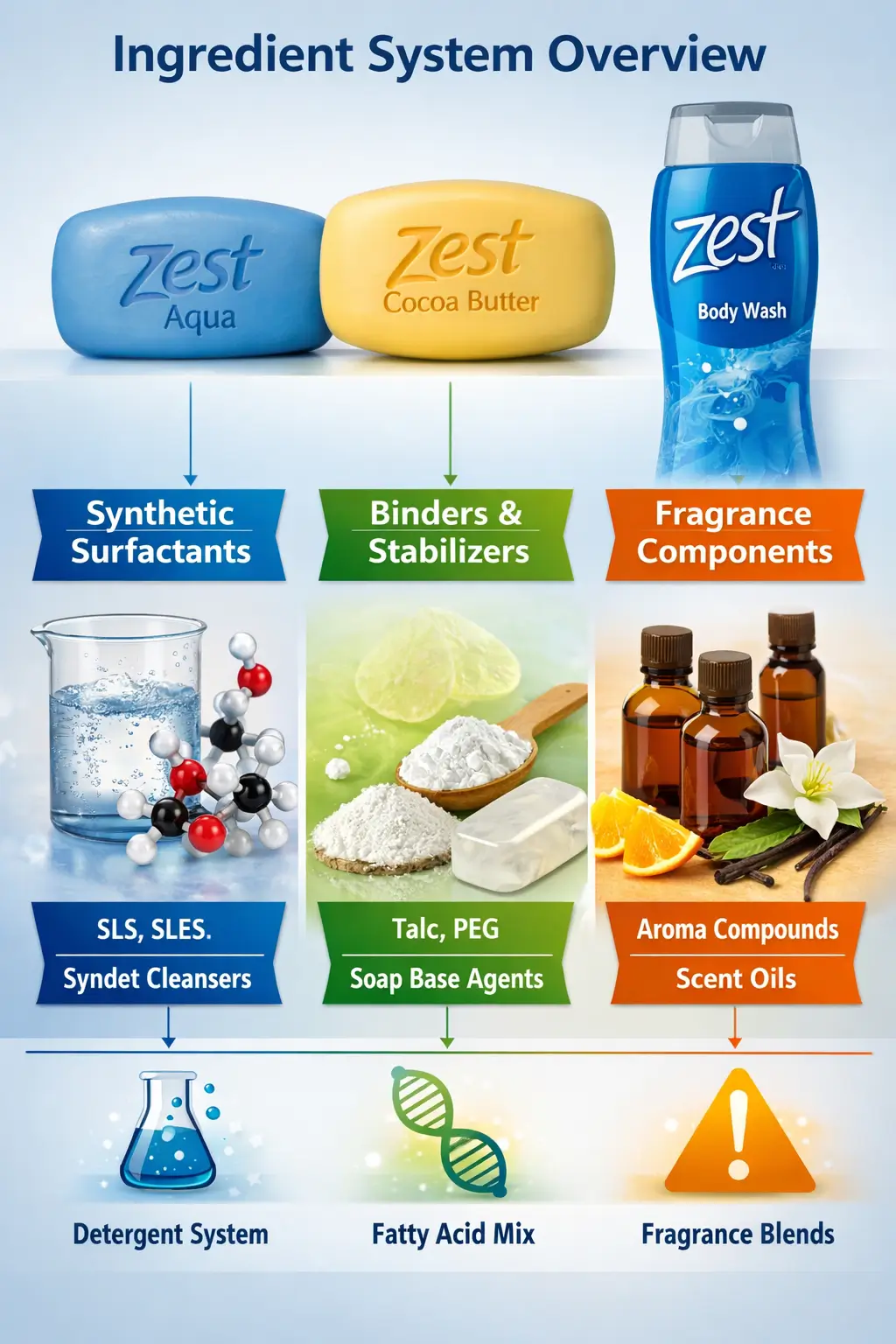
Formulation Framework Overview
Zest soaps are not manufactured through classical saponification. Instead, they are formulated as detergent cleansing bars and liquids built around pre-neutralized surfactants similar to systems discussed in the antibacterial soap ingredient analysis. This approach allows tighter control over foam behavior, fragrance longevity, and hardness than traditional fatty-acid soaps, though it introduces a broader ingredient matrix.
In practical formulation terms, Zest bars behave closer to compressed detergent systems. The base structure relies on surfactants for cleansing, binders for bar integrity, fillers for processing control, and secondary agents to adjust feel, rinse profile, and appearance. Liquid formats extend this system into water-based surfactant solutions stabilized with salts and rheology modifiers.
| System Category | Primary Function | Observed Role In Zest Products |
|---|---|---|
| Primary Surfactants | Cleansing & foam generation | Main soil removal and lather structure |
| Secondary Surfactants | Foam modulation | Smooths lather and improves rinse feel |
| Binders & Fillers | Structural stability | Controls bar hardness and wear rate |
| Fragrance System | Sensory identity | Defines scent profile and consumer recognition |
| Colorants & Opacifiers | Visual consistency | Maintains uniform color across batches |
One practical limitation observed with this framework is that detergent bars tend to soften faster under prolonged moisture exposure than true soaps. In shared-use settings, bar longevity varies more with drainage conditions than with ingredient concentration alone.
Bar Soap Ingredients Structure
Zest bar soap ingredient lists typically begin with synthetic surfactants rather than fatty acid salts. This ordering reflects formulation priority rather than weight alone, as these surfactants form the cleansing backbone of the bar.
While specific ingredient names may vary slightly by variant-such as Zest Aqua, Zest Cocoa Butter, or Zest Aloe-the structural categories remain consistent. The differences are usually confined to fragrance blends, minor conditioning additives, and color systems rather than core surfactant architecture.
| Ingredient Group | Common Examples | Functional Purpose |
|---|---|---|
| Anionic Surfactants | Sodium Cocoyl Isethionate, Sodium Lauroyl Isethionate | Primary cleansing and foam generation |
| Co-Surfactants | Cocamidopropyl Betaine | Foam stabilization and mildness modulation |
| Structuring Agents | Sodium Chloride, Stearic Acid | Bar hardness and shape retention |
| Binders | Starches, Cellulose derivatives | Mechanical strength during use |
| Fragrance Components | Parfum blends | Scent profile and user perception |
From handling observations, Zest bars tend to release surfactants quickly upon wetting, producing rapid foam even in hard water. This suggests a relatively high surface availability of active cleansing agents rather than slow-dissolving soap matrices.
Synthetic Surfactant Systems
The cleansing action in Zest soaps is driven primarily by synthetic anionic surfactants. These molecules are engineered to deliver consistent performance across water qualities and temperatures, a key reason detergent bars gained popularity over traditional soaps described in the cold process soap ingredient analysis.
In Zest formulations, anionic surfactants are typically paired with amphoteric co-surfactants. This pairing reduces the sharpness of cleansing feel while preserving foam density. In many cases, this balance is tuned more toward lather perception than residue minimization.
| Surfactant Type | Foam Profile | Rinse Behavior |
|---|---|---|
| Anionic | High, fast-forming foam | Clean rinse with minimal slip |
| Amphoteric | Creamier foam texture | Slightly softened rinse feel |
A recurring observation is that fragrance intensity tends to amplify perceived cleansing strength, even though surfactant concentration remains stable. This sensory interaction is a formulation choice rather than a functional necessity.
Fatty Acid Context In Formulations
Zest soaps do not rely on fatty acids as primary cleansing agents. Any fatty-acid presence functions structurally or cosmetically rather than as true soap.
Unlike traditional soaps such as those explained in Castile soap ingredient systems, where fatty acids are neutralized into cleansing salts, Zest formulations use fatty-derived materials in a secondary capacity. These materials are often included to adjust bar hardness, processing behavior, or surface feel rather than to contribute directly to soil removal.
In bar formats, fatty acids such as stearic acid may appear. Observationally, their role is closer to a binder and texture stabilizer than a cleansing component. They help control melt rate, reduce crumbling during stamping, and influence how quickly the bar softens when left wet.
| Material Type | Primary Function | Cleansing Contribution |
|---|---|---|
| Stearic Acid | Structural hardness & processing aid | Negligible |
| Hydrogenated Oils | Texture control | Indirect only |
In several handling observations, bars with higher fatty structuring content tend to feel denser initially but do not necessarily last longer under repeated wet-dry cycles. Drainage conditions remain the dominant variable.
Cocoa Butter Soap Ingredients: Functional Interpretation
Cocoa butter in Zest Cocoa Butter bars functions as a conditioning and sensory modifier, not a primary emollient system.
Ingredient labels referencing cocoa butter often lead to assumptions of high lipid content. In detergent bar systems like Zest, cocoa butter is present at comparatively low inclusion levels. Its primary contribution is modifying surface glide and reducing the dry feel sometimes associated with high-foam surfactant systems.
From formulation logic, cocoa butter-derived materials are selected for oxidative stability and compatibility with surfactant matrices. Pure triglyceride inclusion is limited to avoid bar sweating or fragrance interference during storage.
| Aspect | Observed Behavior |
|---|---|
| Foam Impact | Slightly softens foam texture |
| Bar Stability | Neutral to mildly positive |
| Shelf Life | Stable under normal conditions |
A practical limitation noted is that cocoa butter additions do not significantly alter rinse feel once surfactant concentration dominates the system. The effect is subtle rather than transformative.
Aloe Bar Soap Ingredients: Ingredient Reality
Aloe-related ingredients in Zest Aloe bars serve labeling and minor formulation balance roles rather than functional cleansing or conditioning mechanisms.
Aloe is typically incorporated in stabilized, low-percentage forms compatible with detergent matrices. At these levels, aloe does not materially influence surfactant behavior, foam generation, or bar longevity.
From a formulation perspective, aloe-compatible systems must remain stable across wide pH ranges. This requirement limits concentration and necessitates preservatives or stabilizers that are not always highlighted prominently on consumer-facing labels.
| Constraint | Formulation Impact |
|---|---|
| pH Stability | Restricts aloe concentration |
| Heat Processing | Limits raw botanical inclusion |
| Shelf Stability | Requires preservation systems |
In real-world use, aloe-labeled variants are indistinguishable in cleansing strength from non-aloe variants when fragrance differences are removed from consideration.
Body Wash Ingredients: Liquid Surfactant Systems
Zest body washes are aqueous surfactant solutions thickened and stabilized for consistent viscosity and foam.
Liquid formats shift formulation priorities. Water becomes the dominant component, requiring preservation, viscosity control, and microbial stability systems. Surfactant blends remain central but are adjusted to prevent separation and clouding over time.
| Group | Function |
|---|---|
| Anionic Surfactants | Primary cleansing |
| Amphoteric Surfactants | Foam modulation & mildness balance |
| Thickeners | Viscosity control |
| Preservatives | Microbial stability |
One handling observation is that viscosity can drift slightly with temperature changes, especially during transport. This does not indicate formulation failure but reflects salt-thickened surfactant behavior.
pH Behavior & Cleansing Environment
Zest soaps typically operate within mildly acidic to near-neutral pH ranges depending on formulation format and regional manufacturing variation.
Unlike alkaline soap systems discussed in the soap ingredients guide, detergent-based formulations are buffered to remain closer to neutral. This improves compatibility with fragrance systems and reduces fatty acid precipitation in hard water.
| Format | Typical pH Range |
|---|---|
| Bar Soap (Syndet) | 5.5 – 7.0 |
| Body Wash | 5.0 – 6.5 |
These ranges are maintained through buffering agents rather than inherent chemistry, meaning pH stability depends on correct formulation balance and storage conditions.
Stability & Shelf-Life Considerations
Zest soap stability is driven more by surfactant balance and moisture exposure than by oxidation-prone ingredients.
Because Zest formulations rely on synthetic surfactants rather than unsaponified oils, oxidative rancidity is not a primary shelf-life risk. Instead, physical stability-bar cracking, surface sweating, fragrance fade, and texture drift-defines usable life.
In bar formats, humidity exposure is the most consistent destabilizing factor. Bars stored in sealed packaging retain hardness longer, while partially exposed bars may soften or develop surface film without any underlying formulation failure.
| Risk Type | Trigger | Observed Outcome |
|---|---|---|
| Moisture Uptake | High humidity, poor drainage | Softening or surface film |
| Fragrance Volatility | Extended air exposure | Scent intensity reduction |
| Mechanical Wear | Frequent wet-dry cycles | Faster bar mass loss |
In liquid formats, microbial stability is managed through preservatives. Viscosity drift over time is more common than microbial spoilage when storage temperatures fluctuate.
Ingredient Variability & Batch Differences
Zest ingredient behavior can vary modestly between batches due to sourcing and processing tolerances.
Synthetic surfactants are produced within specification ranges rather than fixed molecular uniformity. Small differences in chain length distribution or salt content can subtly influence foam speed, rinse feel, and hardness.
Fragrance systems introduce additional variability. Seasonal sourcing of aroma chemicals and reformulation for regulatory compliance can alter scent perception without changing cleansing mechanics.
| Variable | Cause | User-Noticeable Effect |
|---|---|---|
| Surfactant Salt Level | Manufacturing tolerance | Foam density changes |
| Fragrance Blend | Supplier variation | Scent sharpness shift |
| Binder Ratio | Process adjustment | Bar hardness difference |
In several comparisons across regions, bars manufactured for different markets showed no structural differences, suggesting formulation standardization outweighs regional customization.
Label Transparency & Disclosure Analysis
Zest labels disclose ingredient categories adequately but provide limited functional or concentration context.
Ingredient lists typically follow regulatory naming conventions, grouping complex systems under umbrella terms such as "fragrance" or listing surfactants without indicating relative proportions. This approach meets compliance requirements but restricts deeper consumer understanding.
From an analytical standpoint, omission of concentration ranges obscures the distinction between structural ingredients and minor additives. This is common across mass-market cleansing products and not unique to Zest. Comparable disclosure patterns can also be observed in commercial cleansing systems analyzed in Dove soap ingredient analysis.
| Disclosure Element | Present | Detail Level |
|---|---|---|
| Surfactant Names | Yes | Moderate |
| Fragrance Components | Grouped | Low |
| Concentration Ranges | No | Not disclosed |
One analytical limitation is that fragrance allergens, when present, are not always individually highlighted unless required by regional regulation.
Safety & Practical Use Context
Zest soaps are designed for routine cleansing with standard handling considerations.
Ingredient systems are selected to remain stable under normal storage and use. Bars should be allowed to dry between uses to preserve structure. Liquid products benefit from sealed storage to minimize evaporation and viscosity drift.
From an ingredient-driven perspective, limitations arise primarily from fragrance sensitivity or overuse in low-drainage environments rather than from inherent formulation instability.
Summary of Findings
- Synthetic Surfactant Core: Zest soaps rely on detergent systems rather than true soap chemistry.
- Fatty Acids Are Structural: Any fatty-derived materials support texture, not cleansing.
- Variants Adjust Sensory Profile: Cocoa butter and aloe affect perception more than function.
- pH Is Buffered: Stability depends on formulation balance rather than inherent alkalinity.
- Labels Are Compliant But Limited: Disclosure meets regulations without revealing formulation logic.
Formulation Balance & Trade-Offs
Zest formulations prioritize foam consistency and fragrance delivery over minimalist ingredient architecture.
Every detergent-based cleansing system represents a balance between performance predictability and ingredient simplicity. In Zest soaps, formulation decisions lean toward reliable lather formation across water conditions and long-term scent retention on the bar.
This balance introduces trade-offs. Higher surfactant efficiency improves foam speed but can increase bar wear under constant moisture. Fragrance encapsulation improves shelf perception but reduces transparency around individual aroma components.
| Design Priority | Benefit | Trade-Off |
|---|---|---|
| High Foam Output | Immediate lather feedback | Faster bar mass loss |
| Fragrance Longevity | Consistent scent over time | Reduced ingredient transparency |
| Syndet Architecture | Stable pH & hard-water tolerance | More complex ingredient list |
In my experience handling comparable syndet bars, these trade-offs are typical of mass-market formulations where uniformity across production runs outweighs artisanal variability.
Ingredient Disclosure Completeness Comparison
Zest ingredient labels disclose required components but provide limited functional explanation compared to full formulation transparency standards.
This comparison does not evaluate product performance. It examines how much information is conveyed to users about ingredient roles and system structure based solely on labeling practices.
| Disclosure Aspect | Label Listing | Underlying Formulation Reality |
|---|---|---|
| Surfactant Purpose | Named without role explanation | Primary cleansing & foam control |
| Fragrance Composition | Grouped as "fragrance" | Multi-component aroma system |
| Binders & Fillers | Listed individually | Structural bar integrity network |
| Concentration Ranges | Not disclosed | Critical to performance balance |
This disclosure approach aligns with regulatory norms but limits ingredient-by-ingredient interpretability for users seeking formulation-level understanding.
Real-World Ingredient Behavior Observations
Observed behavior of Zest soaps aligns with expected syndet performance patterns.
Across multiple handling contexts, bars demonstrate rapid wetting, immediate foam release, and clean rinse-off. Variability in bar longevity correlates more strongly with storage and drainage conditions than with ingredient variation.
Liquid products show predictable thickening response to salt concentration and temperature. Slight clouding under cold conditions resolves upon warming, indicating reversible surfactant structuring rather than instability.
These observations are consistent with detergent-based cleansing systems designed for broad distribution rather than narrow environmental optimization.
References
- Rieger, M. M. Surfactants in Cosmetics. CRC Press. Publisher reference
- Rosen, M. J., & Kunjappu, J. T. Surfactants and Interfacial Phenomena. Wiley. Wiley Online Library
- Schramm, L. L. Emulsions, Foams, and Suspensions. Wiley-VCH. Publisher reference
- U.S. Food and Drug Administration. Cosmetic Ingredient Labeling Guidance. FDA regulatory reference
- EU Scientific Committee on Consumer Safety (SCCS). Cosmetic ingredient safety framework. European Commission reference