What Soap Scum Is In A Formulation System
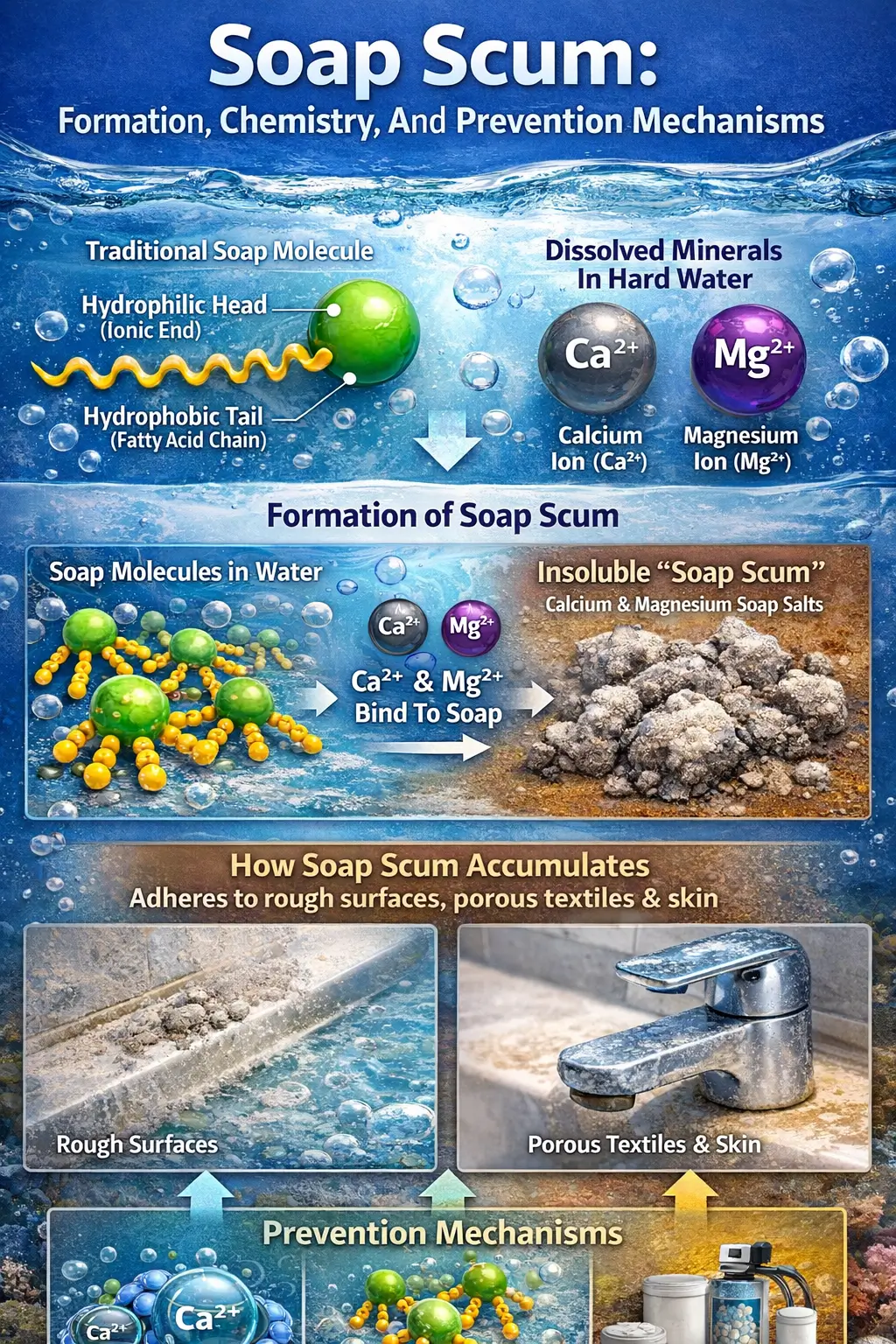
Soap scum is not leftover soap and it is not simply dirt redeposited on a surface. It is a distinct chemical byproduct formed when soap molecules react with dissolved metal ions present in hard water.
From a formulation perspective, soap scum represents a loss of system solubility. Once formed, it no longer participates in cleansing and instead behaves as an insoluble deposit that adheres to surfaces, fibers, or skin.
The term covers a range of related compounds rather than a single substance. Most commonly, soap scum consists of calcium and magnesium salts of fatty acids, sometimes incorporating oils, pigments, or particulate matter present during formation.
This distinction matters because soap scum formation is governed by chemistry rather than usage error, arising directly from the mineral interactions inherent to the soap and hard water system. It emerges predictably under certain water conditions regardless of technique or quantity.
The Chemical Foundation Of Soap Scum Formation
Traditional soap is composed of fatty acid surfactants (alkali metal salts of long chain fatty acids). Common examples include sodium palmitate, sodium cocoate, potassium oleate, and related compounds derived from plant or animal fats.
These molecules are water soluble only when paired with monovalent ions such as sodium or potassium. Their solubility depends on the balance between the hydrophilic ionic head and the hydrophobic hydrocarbon tail.
Hard water introduces divalent ions, primarily calcium (Ca²⁺) and magnesium (Mg²⁺). These ions carry a higher charge density and form stronger electrostatic associations with soap head groups.
When calcium or magnesium replaces sodium or potassium, the resulting metal soap becomes poorly soluble or completely insoluble. This change is abrupt rather than gradual.
| Soap Counterion | Water Solubility | System Role |
|---|---|---|
| Sodium | High | Primary cleansing dispersion |
| Potassium | Very high | Extended solubility window |
| Calcium | Low | Precipitate formation |
| Magnesium | Low | Precipitate formation |
Soap scum is therefore not an additive failure but a predictable outcome of ionic substitution within the soap system, leading directly to the residue behaviors examined in soap residue and hard water interaction.
Why Soap Scum Forms During Normal Use
Soap scum formation begins the moment soap contacts hard water. Calcium and magnesium ions compete with sodium or potassium for association with the soap molecule.
Because divalent ions can bind to more than one soap molecule at a time, they create cross-linked aggregates that collapse out of solution. These aggregates grow rapidly and settle onto nearby surfaces.
Mechanical action, temperature, or additional water do not prevent this reaction. At best, they delay visible accumulation by dispersing particles temporarily.
This mechanism explains why soap scum often appears most prominently after drying. Water evaporation concentrates minerals and completes precipitation that may have begun invisibly during washing.
Where Soap Scum Accumulates And Why Location Matters
Soap scum does not distribute evenly across all contacted surfaces. Its accumulation pattern reflects both chemical affinity and physical retention rather than simple exposure.
Surfaces with microscopic roughness, porosity, or surface energy heterogeneity provide nucleation points where precipitated metal soaps can anchor. Once initial attachment occurs, subsequent deposits adhere more readily to existing residue than to clean substrate.
In household contexts, this explains why matte tiles, grout lines, fabrics, and textured polymers often show buildup sooner than smooth glazed ceramics or polished metals.
On skin and hair, accumulation is influenced by lipid presence. Residual oils act as binding media, trapping insoluble soap particles that would otherwise rinse away more easily.
| Surface Category | Primary Retention Mechanism | Observed Persistence |
|---|---|---|
| Porous mineral surfaces | Physical anchoring | High |
| Smooth glazed surfaces | Weak adhesion | Low |
| Skin and hair | Lipid mediated binding | Variable |
| Textiles | Fiber entanglement | Moderate to high |
These patterns often lead to the mistaken belief that soap scum is selective or inconsistent, when in reality it is responding predictably to surface chemistry.
How Water Hardness And Dilution Shape Scum Formation
Water hardness determines the upper limit of soap compatibility before precipitation dominates system behavior. As mineral concentration increases, the margin for soluble soap dispersion narrows.
Dilution plays a critical role during rinsing. As soap concentration decreases while mineral concentration remains constant, the relative availability of calcium and magnesium ions increases, accelerating precipitation.
This dynamic explains why soap scum often appears after rinsing rather than during active washing. The system crosses a solubility threshold late in the process rather than at the start.
Regional water variability across Europe introduces additional complexity. Seasonal changes in supply blending can shift hardness enough to noticeably alter soap behavior without any change in formulation.
Temperature Effects And Temporal Delays
Temperature affects soap scum formation indirectly by influencing solubility and reaction kinetics. Warmer water increases molecular motion and can temporarily maintain soap dispersion.
This effect is time limited. As water cools or evaporates, mineral binding proceeds and insoluble salts form. Temperature therefore delays rather than prevents soap scum formation.
This delay contributes to a common interpretation error: the assumption that hot water eliminates soap scum risk. In practice, it shifts when and where deposits become visible.
How Formulation Design Influences Scum Expression
Soap Formulations vary in fatty acid composition, counterion selection, and secondary components. These differences influence how quickly scum forms, how dense it becomes, and how strongly it adheres.
Potassium soaps typically remain soluble slightly longer than sodium soaps, extending the dispersion phase before precipitation. Shorter chain fatty acids tend to form softer, less cohesive residues than longer saturated chains.
Some formulations incorporate chelating agents or dispersants that temporarily bind calcium and magnesium ions, an approach more fully engineered into modern detergent systems such as those described in high-efficiency laundry detergent design. These components modify system timing but do not eliminate the underlying incompatibility between soap and hard water.
From a system perspective, these design choices represent trade-offs between solubility window, sensory properties, and residue characteristics rather than absolute prevention.
Boundary Conditions And System Limits
Soap scum behavior changes under certain boundary conditions that fall outside typical household use patterns.
In very soft or demineralized water, soap scum formation may be negligible, as insufficient calcium and magnesium ions are present to drive precipitation.
Conversely, in extremely hard water, scum formation can occur almost instantaneously, limiting effective soap dispersion regardless of formulation nuances.
These boundaries illustrate that soap scum is not a binary outcome. It emerges along a gradient shaped by water chemistry, formulation design, and usage context.
Repeated Interpretation Errors In Soap Scum Assessment
A frequent misunderstanding is equating soap scum with poor rinsing alone. While rinsing influences visibility, the chemical formation of insoluble salts is independent of technique.
Another error is assuming that residue indicates excess soap usage. In hard water systems, increasing soap quantity often increases total precipitate mass without improving functional cleansing.
These interpretations persist because soft water experience is often generalized to all contexts. Soap scum highlights the limits of that generalization.
Summary of Findings
- Chemical origin: Soap scum forms through ionic substitution between soap and hard water minerals.
- Predictable behavior: Accumulation patterns reflect surface chemistry and water composition.
- Timing effects: Dilution and cooling often trigger visible residue after washing.
- Design trade-offs: Formulation choices shift scum characteristics but do not eliminate formation.
- System limits: Soap scum emerges along a continuum governed by hardness and context.
All interpretations align with the analytical framework described in our Ingredient Framework and Editorial Policy.
References
- McBain, J. W. Colloid Chemistry and Surface Phenomena.
- Myers, D. Surfactant Science and Technology. Publisher Page
- Rosen, M. J. Surfactants and Interfacial Phenomena. Publisher Page
- European Commission – Drinking Water Quality Reports. Official Resource