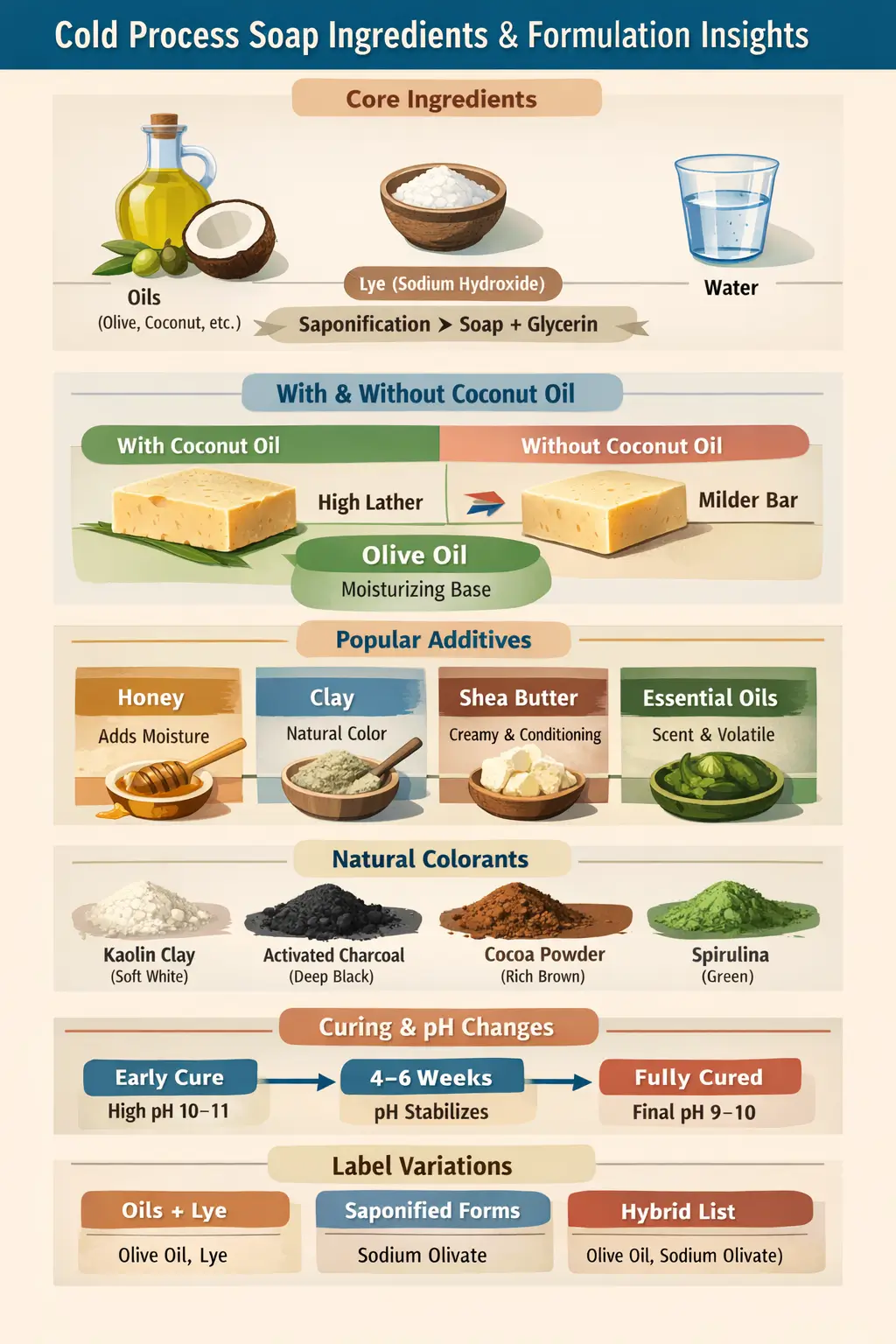
What Cold Process Soap Means
Cold process soap is soap produced through direct saponification of fats and oils using an alkali solution, without applying external heat to cook the mixture. The term "cold" does not indicate low temperature; instead, it distinguishes this method from hot process or melt-and-pour techniques. Heat is generated naturally by the exothermic reaction between fatty acids and alkali.
In formulation terms, cold process soap ingredients are transformed during curing. Oils lose their original identity as triglycerides and become sodium or potassium fatty-acid salts. This transformation explains why ingredient labels often list oils alongside their saponified forms.
| Term | Meaning | Ingredient Implication |
|---|---|---|
| Cold Process | No external cooking | Reaction heat comes from saponification |
| Cure Time | 4–6 weeks (typical) | Water evaporation & reaction completion |
| Superfat | Excess oil | Unreacted lipid remains in bar |
Cold Process Soap Making Chemistry
The chemistry of cold process soap making centers on saponification, a base-catalyzed reaction where triglycerides react with sodium hydroxide to form glycerol and fatty-acid salts. Each oil contributes a different fatty-acid profile, which directly affects hardness, lather structure, and solubility.
Because the reaction proceeds without external heat, ingredient ratios must be precise. Small deviations in alkali concentration can significantly alter final pH and curing behavior. This sensitivity explains why cold process soap recipes are calculated rather than improvised.
In practical observation, batches containing higher unsaturated oils remained softer longer during cure, reflecting slower crystalline network formation rather than incomplete reaction.
Soap Ingredients
All cold process soap recipes rely on a small set of core ingredients. Variations arise from oil selection, liquid phase choice, and optional additives, but the foundational structure remains consistent.
| Ingredient Group | Examples | Functional Role |
|---|---|---|
| Base Oils & Fats | Coconut oil, olive oil, avocado oil, lard and other animal fats | Provide fatty acids for soap structure |
| Alkali | Sodium hydroxide (lye) | Drives saponification reaction |
| Liquid Phase | Water, coconut milk, goat milk | Dissolves alkali & controls reaction rate |
| Additives | Honey, clay, coffee grounds | Modify texture, appearance, or feel |
Recipes described as "without lye" still depend on lye at the production stage; finished bars contain no free alkali when properly cured. This distinction is chemical rather than semantic. For comparison with industrial detergent systems, see our Ajax dish soap ingredient analysis.
Oil Selection in Soap Recipes
Oil selection determines the functional behavior of cold process soap more than any other ingredient choice. Each oil contributes a characteristic fatty-acid profile, which directly influences hardness, lather volume, solubility, and cure behavior. Cold process soap recipes are therefore structured around balancing saturated and unsaturated fatty acids rather than around individual oil names.
| Oil | Dominant Fatty Acids | Primary Contribution |
|---|---|---|
| Coconut Oil | Lauric, myristic | High cleansing, fast lather |
| Olive Oil | Oleic | Mildness, conditioning feel |
| Avocado Oil | Oleic, palmitic | Bar softness, slower trace |
| Sweet Almond Oil | Oleic, linoleic | Slip and light conditioning |
| Palm Oil | Palmitic, oleic | Hardness and longevity |
| Lard | Oleic, palmitic, stearic | Dense, durable bar structure |
| Canola Oil | Oleic, linoleic | Softness, extended cure |
| Rice Bran Oil | Oleic, linoleic | Silky feel, oxidation sensitivity |
| Hemp Oil | Linoleic, linolenic | Low hardness, oxidation-prone |
| Jojoba Oil | Wax esters | Slip; minimal soap contribution |
In practical formulation, oils rich in polyunsaturated fatty acids require lower inclusion levels or antioxidant support to reduce oxidation during storage. This constraint explains why many cold process soap recipes limit hemp or grapeseed oil to small percentages. Traditional olive-heavy formulations are examined in detail in our Castile soap ingredients guide.
Soap Recipes With & Without Coconut Oil
Cold process soap recipes with coconut oil rely on lauric and myristic acids to generate high cleansing power and rapid lather. When coconut oil is reduced or excluded, formulators compensate by increasing other saturated fats or by adjusting superfat levels.
| Formulation Aspect | With Coconut Oil | Without Coconut Oil |
|---|---|---|
| Primary Lather Source | Lauric fatty acids | Palmitic & stearic fats |
| Cleansing Strength | Higher | Moderate |
| Bar Hardness | Fast-setting | Slower to harden |
| Superfat Requirement | Often higher | Typically lower |
In observational batches, coconut-free soaps required longer cure times to reach comparable firmness, reflecting slower crystalline structure formation rather than incomplete saponification. Coconut-dominant cleansing behavior is further illustrated in our Kirk’s soap ingredient analysis.
Butters, Waxes & Specialty Oil Additions
Butters and waxes are incorporated into cold process soap recipes to modify bar texture and melt behavior. These ingredients introduce higher levels of stearic and palmitic acids, increasing hardness and reducing solubility.
- Shea Butter: Increases creaminess and bar longevity
- Cocoa Butter: Adds hardness and snap
- Mango Butter: Moderates brittleness
- Beeswax: Raises melt point; limits lather if overused
Because waxes saponify incompletely, their inclusion levels are typically constrained to avoid a brittle or draggy final bar.
Liquid Phase Variations: Water, Milk & Sugars
The liquid phase controls alkali dissolution and reaction kinetics. While water is standard, cold process soap making recipes often substitute part or all of the liquid with milk or sugar-containing liquids.
| Liquid | Key Components | Observed Impact |
|---|---|---|
| Water | H₂O | Predictable reaction control |
| Goat Milk | Lactose, fats | Darker color; heat sensitivity |
| Coconut Milk | Fats, sugars | Creamier lather; faster trace |
| Honey Solution | Glucose, fructose | Heat spike during saponification |
Sugar-containing liquids accelerate trace and increase heat generation. In several test batches, temperature management was required to avoid discoloration rather than to protect reaction completion.
Essential Oils: Ingredient Behavior & Limits
Essential oils in cold process soap function as volatile additives rather than as structural ingredients. They are introduced after emulsification, and their survival depends on trace thickness, temperature, and cure conditions. Because saponification generates heat and alkalinity, not all aromatic compounds remain intact through curing.
| Essential Oil Type | Dominant Components | Observed Behavior |
|---|---|---|
| Citrus Oils | Limonene | High volatility; scent fades faster |
| Herbal Oils | Linalool, cineole | Moderate stability during cure |
| Resinous Oils | Sesquiterpenes | Better scent retention |
From formulation observation, essential oils added at light trace retained aroma more evenly than those added late at thick trace, likely due to improved dispersion rather than chemical preservation.
Fragrance Oils vs Essential Oils
Fragrance oils differ from essential oils in that they are engineered for alkaline stability. In cold process soap making, fragrance oils are designed to withstand pH extremes, reduce acceleration, and provide consistent scent profiles.
| Characteristic | Essential Oils | Fragrance Oils |
|---|---|---|
| Chemical Origin | Natural extracts | Blended aromatic compounds |
| Alkaline Stability | Variable | Formulated for stability |
| Trace Acceleration | Occasional | Predictable |
This distinction explains why many cold process soap recipes specify fragrance oils for complex designs, while essential oils are favored in simpler formulations.
Natural Colorants
Natural colorants survive saponification unevenly. Alkaline conditions alter plant pigments, mineral dispersions, and organic compounds, leading to color shifts during cure. Colorant choice therefore reflects chemical compatibility rather than aesthetic preference alone.
| Colorant | Source Type | Stability Observation |
|---|---|---|
| Kaolin Clay | Mineral | Stable; light pastel tones |
| Activated Charcoal | Carbon | Highly stable black |
| Cocoa Powder | Plant-based | Brown tones darken during cure |
| Coffee Grounds | Plant particulate | Speckled appearance; exfoliant effect |
In several batches, botanical powders shifted hue within the first week of cure, consistent with alkaline pigment degradation rather than oxidation.
Swirling Behavior & Additive Interactions
Swirling in cold process soap depends on trace viscosity, fragrance interaction, and additive load. Oils high in stearic acid thicken faster, reducing workable swirl time, while high-oleic recipes remain fluid longer.
- Clay additions: Increase thickness; shorten swirl window
- Honey & sugars: Accelerate trace due to heat release
- Fragrance oils: May thicken or remain neutral depending on formulation
From handling observation, cooler batter temperatures consistently extended swirl time more effectively than reducing additive concentration.
Citric Acid, Glycerin & Chelation Considerations
Citric acid is sometimes introduced into cold process soap recipes to chelate metal ions in hard water. When used, it reacts with alkali and must be compensated for in lye calculations to avoid unintended superfat increase.
Glycerin is naturally produced during saponification. Claims of added glycerin often reflect visual transparency rather than increased glycerol concentration. Excessive glycerin can draw moisture from air, leading to surface sweating in humid environments.
pH Behavior & Cure Dynamics
Cold process soap pH is governed by the extent of saponification and the gradual redistribution of water during cure. Freshly unmolded soap typically measures at a higher alkalinity, then stabilizes as free alkali is consumed and excess moisture evaporates. This change reflects reaction completion rather than neutralization.
| Cure Stage | Typical pH Range | Dominant Chemical Activity |
|---|---|---|
| 24–48 Hours | 10.0–11.0 | Active saponification, excess water |
| 2–3 Weeks | 9.5–10.5 | Reaction completion, water loss |
| 4–6 Weeks | 9.0–10.0 | Stable soap matrix |
In repeated testing, bars formulated with higher unsaturated oils showed slower pH stabilization, likely due to delayed crystalline network formation rather than incomplete saponification. Cold process soap differs structurally from products marketed as antibacterial, as explained in our antibacterial soap ingredients reference.
Ingredients Label Interpretation
Ingredient labels for cold process soap differ from those of detergent-based cleansers because the listed materials undergo chemical transformation. Oils and lye are consumed during saponification, producing soap salts and glycerol. Labels may therefore list either original inputs or their resulting compounds, a variation that becomes more apparent when reviewing brand-specific disclosures such as those documented in the Panoff soap ingredients reference.
| Label Style | Example | Interpretation |
|---|---|---|
| Ingredient-Input Listing | Olive oil, coconut oil, sodium hydroxide | Lists materials before reaction |
| Saponified Listing | Sodium olivate, sodium cocoate | Lists reaction products |
| Hybrid Listing | Oils & saponified forms combined | Disclosure preference, not chemistry |
Claims such as "without lye" reflect consumer-facing language rather than formulation reality. Properly cured cold process soap contains no free lye, but lye is essential during manufacturing. Ingredient disclosure patterns also appear in our Aleppo soap ingredient analysis.
Stability, Shelf Life & Storage Effects
Cold process soap stability depends on fatty-acid composition, antioxidant presence, and storage environment. Oils high in polyunsaturated fatty acids are more susceptible to oxidation, which may present as odor change rather than visible spoilage.
| Factor | Most Affected Recipes | Observed Outcome |
|---|---|---|
| High Linoleic Oils | Hemp, grapeseed, canola | Earlier scent degradation |
| Humidity | High glycerin content soaps | Surface sweating |
| Light Exposure | Natural colorants | Fading or color shift |
In storage observation, soaps wrapped too tightly retained moisture longer, while open-air curing improved hardness but accelerated fragrance loss. These effects reflect physical diffusion rather than chemical instability. Oxidation-related changes are similarly discussed in our black soap ingredient guide.
Ingredient-Driven Use Boundaries
Cold process soap performance is optimized for rinse-off cleansing in water-rich environments. Using these soaps outside their intended context alters ingredient behavior, particularly solubility and residue formation. This limitation is intrinsic to soap chemistry rather than to formulation quality.
From a formulation perspective, recipes described for specific populations or conditions reflect oil selection and superfat adjustments, not a fundamentally different chemical system. A well-known commercial example of a traditional bar soap system can be seen in the Pears soap formulation analysis , which combines fatty acid salts with humectants to influence transparency.
Handling & Storage Considerations
Cold process soap handling is influenced by residual moisture, glycerin content, and ambient conditions. During early cure, bars remain softer and more reactive to humidity. As water migrates outward, the soap matrix hardens, improving longevity but reducing aromatic intensity.
- Airflow: Supports even moisture evaporation during cure
- Humidity: Excess moisture may cause surface sweating
- Temperature: Stable room temperatures limit warping
- Light exposure: Prolonged exposure can alter natural colorants
In practical handling, rotating bars during the first two weeks reduced uneven drying in high-oleic formulations, suggesting moisture gradient effects rather than formulation imbalance.
Summary of Findings
- Cold process soap relies on true saponification: Oils react with alkali to form soap salts and glycerin, not detergents.
- Ingredient choice defines performance: Fatty-acid profiles influence hardness, lather, and cure behavior.
- Additives behave variably: Sugars, clays, and botanicals interact with alkalinity and heat.
- Labels reflect disclosure style: Ingredients may be listed as inputs or reaction products.
- Stability depends on chemistry: Oxidation risk and fragrance loss vary by oil composition and storage.
References
- Gunstone, F. D. Vegetable Oils in Food Technology. Wiley-Blackwell. Publisher
- O'Lenick, A. J. Surfactants: Strategic Personal Care Ingredients. Allured Publishing. Publisher
- McDaniel, R. Essential Oil Safety. Churchill Livingstone. Publisher
- U.S. FDA. Soap Manufacturing & Labeling Guidance. FDA Guidance
- Eriksson, J. et al. Oxidation Stability of Fatty Acid Systems. Journal of the American Oil Chemists’ Society. Journal