Definition
Coconut oil is a plant-derived lipid composed primarily of triglycerides rich in medium-chain fatty acids, particularly lauric acid, myristic acid, and caprylic derivatives. Within soap and cleansing formulations, it functions as a structural and reactive oil phase that contributes to the formation of sodium or potassium fatty acid salts during saponification. These fatty acid profiles influence cleansing strength, lather generation, and overall formulation balance in both bar and liquid systems.
As a non-ionic lipid prior to reaction, coconut oil does not exhibit surfactant behavior in its native state. However, once converted into soap salts or incorporated into emulsified cleansing systems, it plays a central role in defining how the system interacts with water, oils, and particulate matter. The relatively high proportion of shorter-chain fatty acids differentiates it from longer-chain vegetable oils, resulting in distinct functional outcomes within cleansing formulations.
In practical formulation terms, coconut oil contributes to faster lather formation, increased cleansing interaction with sebum-like materials, and a more immediate rinsing response. These effects are directly linked to its fatty acid distribution rather than its origin or marketing classification.
Quick Facts
| Property | Description |
|---|---|
| Ingredient Type | Vegetable-derived lipid |
| Chemical Class | Triglyceride mixture of saturated fatty acids |
| Functional Role | Soap precursor, lather contributor, cleansing structure modifier |
| Ionic Class | Non-ionic (before saponification) |
| Typical Use Context | Bar soaps, liquid soaps, surfactant systems, emulsified cleansers |
Why This Ingredient Appears on Labels
Coconut oil appears on ingredient labels because it functions as a foundational lipid source used to generate or modify cleansing structures within a formulation. In traditional soap systems, it is not the oil itself that performs the cleansing action, but the fatty acid salts produced from it during saponification. These resulting soap molecules interact with water and oils, enabling removal of hydrophobic residues.
In non-saponified systems, coconut oil may also be present as part of an emollient phase or as a precursor to derived surfactants such as sodium cocoate or cocamidopropyl compounds. Its inclusion signals the presence of a lipid-derived component that contributes to formulation structure rather than acting as a standalone cleansing agent.
From a label-reading perspective, its presence indicates that part of the formulation’s cleansing or structural behavior originates from a triglyceride source rather than exclusively from synthetic surfactant systems.
Chemical Identity and Classification
Coconut oil is identified in ingredient declarations under the INCI name Cocos Nucifera Oil. It belongs to the triglyceride class of lipids, composed of glycerol esterified with a mixture of saturated fatty acids. The dominant components include lauric acid, typically forming the largest fraction, followed by myristic, caprylic, capric, and smaller amounts of palmitic and stearic acids.
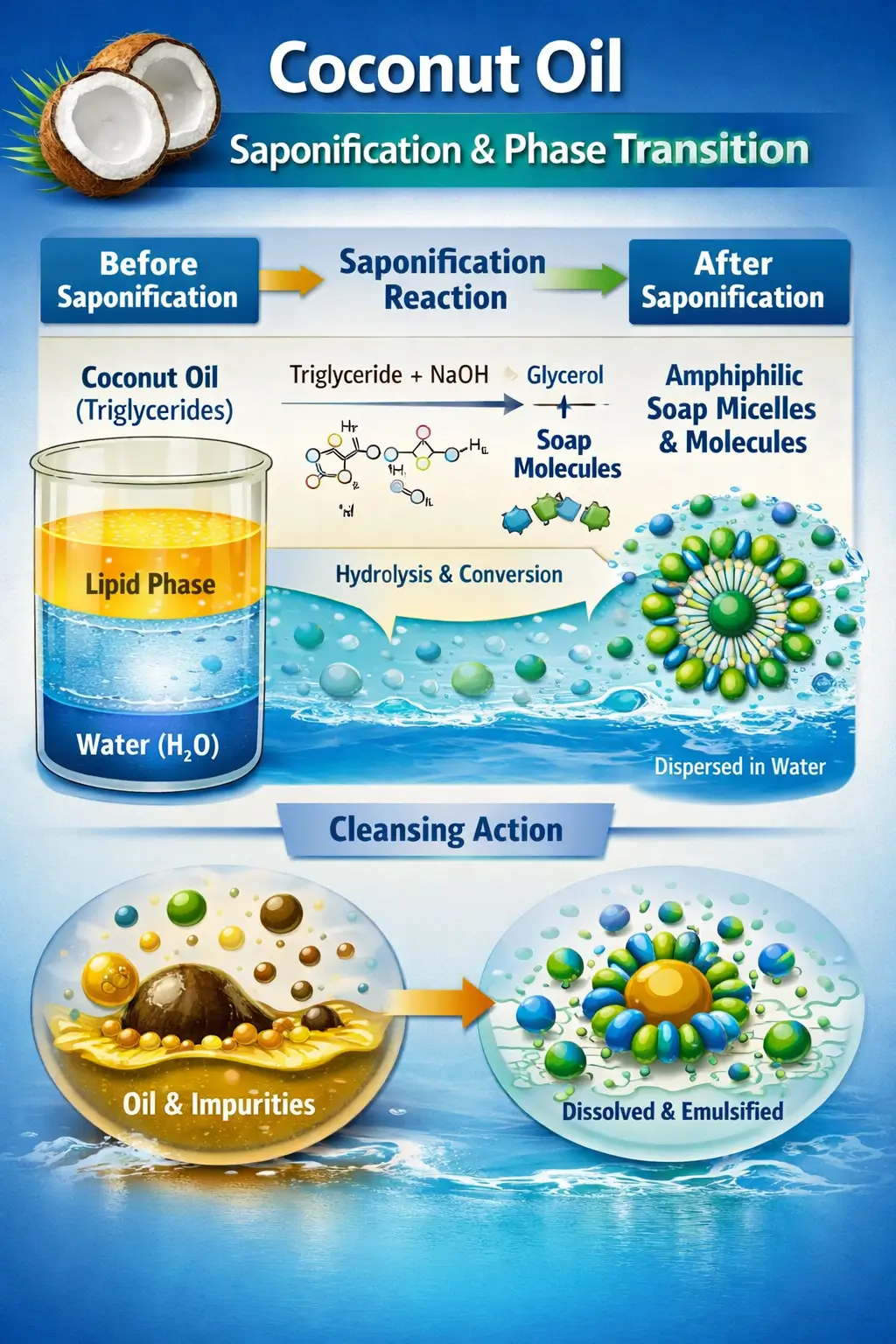
Unlike surfactants, coconut oil in its native form does not carry an ionic charge and does not exhibit amphiphilic behavior. Its transformation into a functional cleansing component occurs only after chemical modification, most commonly through alkaline hydrolysis during soap production. This process cleaves triglycerides into free fatty acids and subsequently converts them into their corresponding sodium or potassium salts.
From a molecular classification perspective, coconut oil sits within the broader category of saturated plant lipids with a relatively narrow chain length distribution. This distinguishes it from oils with higher proportions of long-chain unsaturated fatty acids, leading to differences in reactivity and end-product structure.
In practical formulation terms, this composition results in faster-reacting oil during saponification and the formation of soap salts that are more soluble in water compared to those derived from longer-chain fatty acids.
Functional Role in Soap Systems
Coconut oil plays a central role in shaping the cleansing and structural behavior of soap systems due to its fatty acid profile. When converted into soap salts, the resulting molecules exhibit relatively high water solubility and rapid surface activity. This contributes to immediate lather formation and efficient interaction with oily residues.
In bar soap formulations, coconut-derived fatty acid salts contribute to hardness and structural integrity, particularly when combined with longer-chain fatty acids from other oils. However, their higher solubility also means they dissolve more readily during use, influencing the rate at which the bar is consumed.
In liquid soap systems, the same properties translate into clearer solutions and more pronounced foaming behavior. The shorter and medium-chain fatty acid salts reduce the tendency for precipitation, allowing for stable aqueous systems under appropriate formulation conditions.
The influence of coconut oil extends beyond cleansing. It also affects sensory perception during use. Systems containing a higher proportion of coconut-derived soap salts tend to produce quicker foam generation and a more immediate rinsing response. This is not a standalone property of the oil itself, but a result of the molecular characteristics of its converted fatty acids.
From a formulation perspective, coconut oil is rarely used in isolation. It is typically balanced with other lipid sources to moderate solubility, adjust lather density, and control the rate of dissolution in water-based environments.
Ingredient Interaction Logic
Coconut oil does not operate independently within a formulation. Its behavior emerges through interaction with alkaline agents, water, and other formulation components. During saponification, triglycerides react with sodium or potassium hydroxide to form fatty acid salts, which then interact dynamically with the aqueous phase to create cleansing structures.
Within multi-oil systems, coconut-derived fatty acid salts are often combined with longer-chain fatty acid salts from oils such as olive or palm. This combination modifies solubility and structural behavior. Coconut-derived components increase solubility and foam initiation, while longer-chain counterparts contribute to persistence and structural cohesion.
Interaction with humectants such as glycerin influences hydration behavior. Glycerin retains water within the soap matrix, which can moderate the rapid dissolution associated with coconut-derived soap salts. This interaction helps maintain structural balance during use.
Chelating agents, when present, can influence how coconut-derived soap salts behave in hard water. By binding divalent ions such as calcium and magnesium, chelators reduce the formation of insoluble soap residues that would otherwise alter performance.
Fragrance components and lipid additives also interact with the system, but their effect is secondary compared to the primary interaction between fatty acid salts and the aqueous phase. The overall system behavior is therefore a result of multiple interacting components rather than a single ingredient acting in isolation.
Phase Behavior and Physical Characteristics
Coconut oil exists as a semi-solid lipid at room temperature, transitioning to a liquid phase as temperature increases. This behavior is linked to its relatively high proportion of saturated fatty acids with moderate chain lengths. In its native form, it is immiscible with water and forms a separate lipid phase.
During saponification, this phase separation is disrupted as triglycerides are converted into amphiphilic molecules. These molecules possess both hydrophilic and hydrophobic regions, enabling them to interact with water and form structured cleansing systems such as micelles or lamellar phases.
The resulting soap salts derived from coconut oil exhibit higher solubility compared to those formed from longer-chain fatty acids. This contributes to faster hydration and dissolution when exposed to water. In bar systems, this manifests as quicker surface softening during use. In liquid systems, it contributes to clarity and reduced precipitation under controlled conditions.
Thermal stability is relatively high in comparison to unsaturated oils, as the saturated fatty acid profile reduces susceptibility to oxidation. However, repeated heating or prolonged exposure to environmental factors can still influence structural integrity over time.
Comparison With Related Lipid Ingredients
Coconut oil is often evaluated alongside other vegetable oils used in soap formulations. Differences in fatty acid composition lead to distinct functional outcomes within the final system.
| Feature | Coconut Oil | Olive Oil |
|---|---|---|
| Dominant Fatty Acids | Lauric, myristic (medium-chain, saturated) | Oleic (long-chain, monounsaturated) |
| Solubility of Soap Salts | Higher | Lower |
| Lather Formation | Rapid, high initial foam | Slower, more stable lather |
| Bar Structure | Hard but faster dissolving | Softer but longer lasting |
| System Behavior | Quick interaction with water and oils | Gradual interaction and slower hydration |
This comparison illustrates how coconut oil contributes to immediate system activity, while oils with higher proportions of long-chain fatty acids influence longevity and structural persistence. Formulators typically combine these oils to achieve a balance between responsiveness and durability.
Regulatory Context
Coconut oil is declared under the INCI name Cocos Nucifera Oil in cosmetic ingredient listings. Within the European Union cosmetic framework, it is classified as a non-restricted ingredient when used in its conventional form, meaning it does not appear in annex lists that impose specific concentration limits or prohibitions.
Its function within a formulation does not change its labeling identity, even when it is used as a precursor to soap salts or as part of a modified derivative system. However, once chemically transformed into fatty acid salts or surfactant derivatives, the resulting substances are declared under their respective INCI names rather than as coconut oil.
From a regulatory perspective, coconut oil is treated as a raw material input rather than a finished functional agent when used in saponified systems. This distinction is relevant for understanding why ingredient lists may include both the original oil and its derived components depending on formulation design and labeling conventions.
Common Misunderstanding
A frequent misunderstanding is that coconut oil itself performs the cleansing function in soap products. In practice, the oil in its native triglyceride form does not act as a surfactant and does not remove oils or residues on its own. The cleansing action emerges only after chemical conversion into fatty acid salts during saponification.
This distinction is important when interpreting ingredient lists. The presence of coconut oil does not indicate direct cleansing activity by the oil itself, but rather signals its role as a precursor in the formation of active cleansing molecules within the system.
Structural Limitations
The same properties that enable coconut-derived soap salts to dissolve readily in water also contribute to faster material loss during use. In bar soap systems, this can result in increased wear rate compared to formulations dominated by longer-chain fatty acids. Managing this behavior typically requires blending with other lipid sources to balance dissolution characteristics.
Another limitation arises in hard water conditions. Coconut-derived soap salts can interact with calcium and magnesium ions to form insoluble residues, which may alter system performance and reduce effective lather formation. This behavior is not unique to coconut oil but is more pronounced due to the higher solubility and reactivity of its fatty acid salts.
Additionally, while the saturated fatty acid profile provides relative resistance to oxidation, it also limits flexibility in modifying sensory characteristics without introducing additional formulation components.
Formulation References Using This Ingredient
- Alaffia Good Soap
- Cold Process Dish Soap & Detergent Systems
- Nudy Rudy Soap
- How To Read Cosmetic Ingredient Lists (INCI Guide)
- Homemade Laundry Soap Recipe
- Zote Soap Ingredients Analysis
- What Is Castile Soap
- Goat Milk Cold Process Soap
- Lye Soap for Poison Ivy
- Method Men Soap
- Buff City Soap Ingredients Analysis
- Dr Squatch Soap Ingredients Analysis
- What Is Pacha Soap Made Of
Summary of Findings
- Classification: Coconut oil is a triglyceride-based vegetable lipid composed primarily of saturated medium-chain fatty acids.
- Functional Role: It acts as a precursor to soap salts that drive cleansing behavior, lather formation, and solubility in aqueous systems.
- Interaction Logic: Its behavior is defined by interaction with alkaline agents, water, and co-formulated lipids, rather than acting independently.
- System Behavior: It contributes to rapid lather formation, higher solubility, and faster dissolution in comparison to longer-chain lipid sources.
- Limitations: Increased dissolution rate and interaction with hard water ions require formulation balancing to maintain structural stability.