Ingredient Disclosure Scope
Dove ingredient lists generally follow cosmetic labeling standards, presenting ingredients in descending order of concentration until the one-percent threshold. Above that cutoff, relative prominence is clear; below it, ordering may vary. This approach allows identification of the dominant cleansing system but limits precise interpretation of conditioning agent load, fragrance proportion, and preservative balance.
Fragrance components are disclosed as a single composite entry rather than individual aromatic constituents. While compliant, this practice restricts detailed fragrance system analysis and makes independent assessment of volatility and persistence dependent on indirect observation rather than label data alone.
| Disclosure Element | Label Practice | Analytical Implication |
|---|---|---|
| Primary Cleansers | Fully named | Enables syndet system identification |
| fatty acids | Individually listed | Supports partial compositional inference |
| Fragrance | Grouped disclosure | Limits component-level transparency |
Dove Formulation Classification
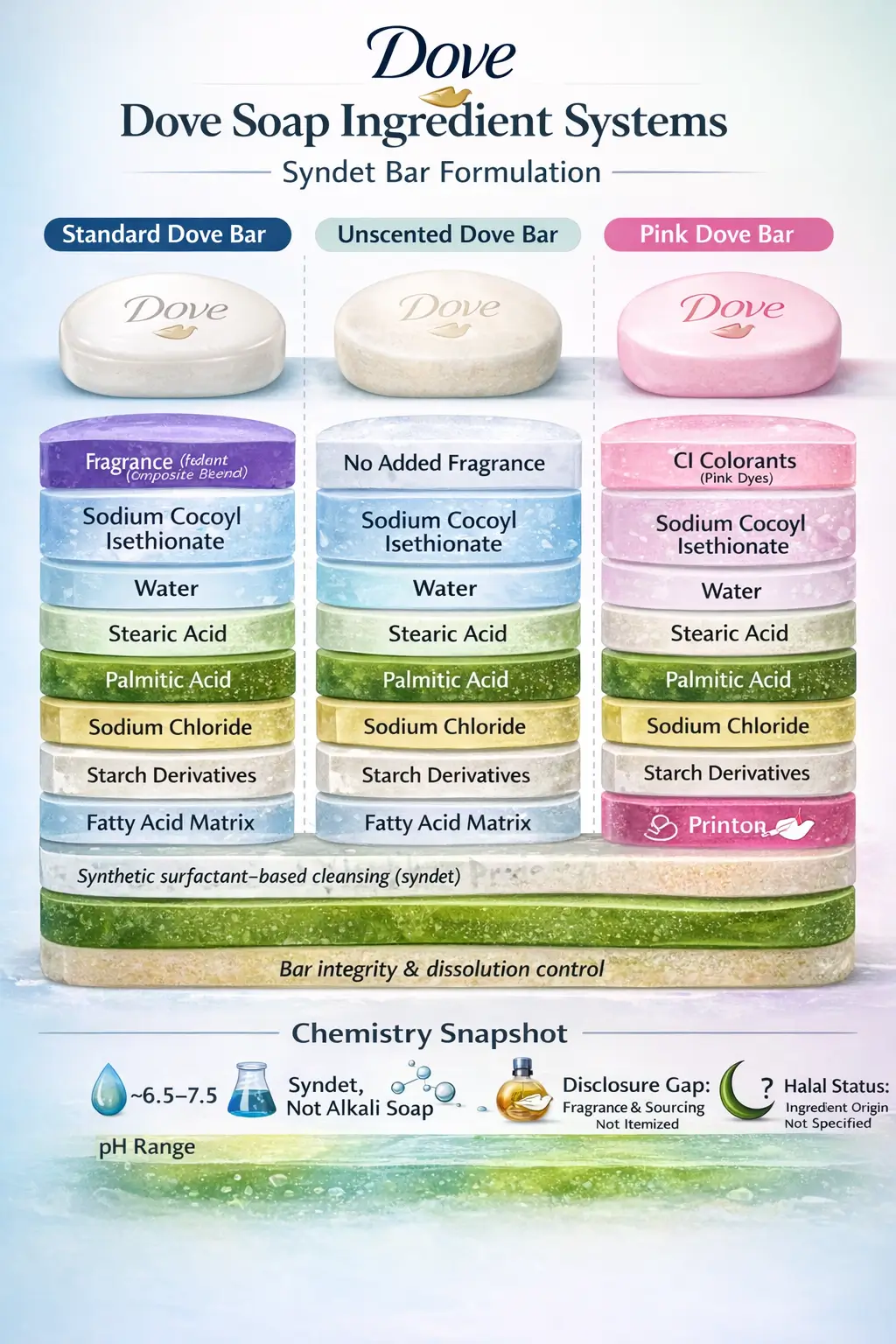
Most Dove bar products are syndet bars rather than true soaps. This distinction matters chemically. Syndet bars rely on synthetic surfactants combined with fatty acids and binders to create a solid cleansing form that behaves differently from sodium soap bars in water, pH expression, and residue formation.
Unscented and pink Dove variants share the same structural foundation as standard bars, with adjustments primarily in fragrance load, colorants, and minor stabilizers, a pattern also seen in ingredient-driven variants such as those discussed in the Dove turmeric soap guide. Men’s variants typically introduce fragrance profile changes rather than altering the underlying cleansing chemistry.
| Product Type | Cleansing Base | Chemical Category |
|---|---|---|
| Standard Bar | Synthetic surfactants + fatty acids | Syndet bar |
| Unscented Bar | Synthetic surfactants + fatty acids | Syndet bar |
| Pink Bar | Synthetic surfactants + fatty acids | Syndet bar |
Cleansing System Overview
The primary cleansing action in Dove bars is delivered by synthetic surfactants rather than by alkali-neutralized fatty-acid salts. These surfactants form micelles in water, encapsulating oils and particulates without relying on alkaline dissociation. As a result, Dove bars typically express lower surface pH than traditional soaps.
Fatty acids are present but function mainly as structural and sensory modifiers rather than as primary cleansers. In handling, this combination produces a bar that dissolves more slowly than conventional soap while leaving a distinct surface feel that reflects fatty-acid deposition rather than soap residue.
One consistent limitation observed during prolonged use is reduced performance in heavy grease removal compared to sodium soap bars, a trade-off inherent to lower alkalinity and surfactant selection rather than formulation inconsistency. For comparison with traditional alkali soap systems, see cold process soap ingredients.
Primary Surfactant Components Bar Soap
The core cleansing agents in Dove bar soap are synthetic surfactants rather than alkali-derived soap salts. These surfactants are typically mild anionic compounds designed to function effectively at near-neutral pH levels, distinguishing Dove bars chemically from traditional soaps.
Based on ingredient disclosures across standard, unscented, and pink variants, sodium cocoyl isethionate commonly appears as the dominant surfactant. This material is valued for producing dense, creamy foam with relatively low irritation potential in rinse-off applications, although it requires binders and fatty acids to maintain bar structure. Broader surfactant classification is explained in soap ingredients guide.
| Ingredient | Chemical Class | Functional Role |
|---|---|---|
| Sodium Cocoyl Isethionate | Anionic surfactant | Primary cleansing & foam formation |
| Sodium Isethionate | Surfactant precursor | Processing aid & structural support |
In real-world handling, bars with higher surfactant loading exhibit slower surface wear compared to soap-based bars, but they soften noticeably when left in standing water. This behavior reflects surfactant hydration dynamics rather than instability.
Antibacterial & Sensitive Ingredients
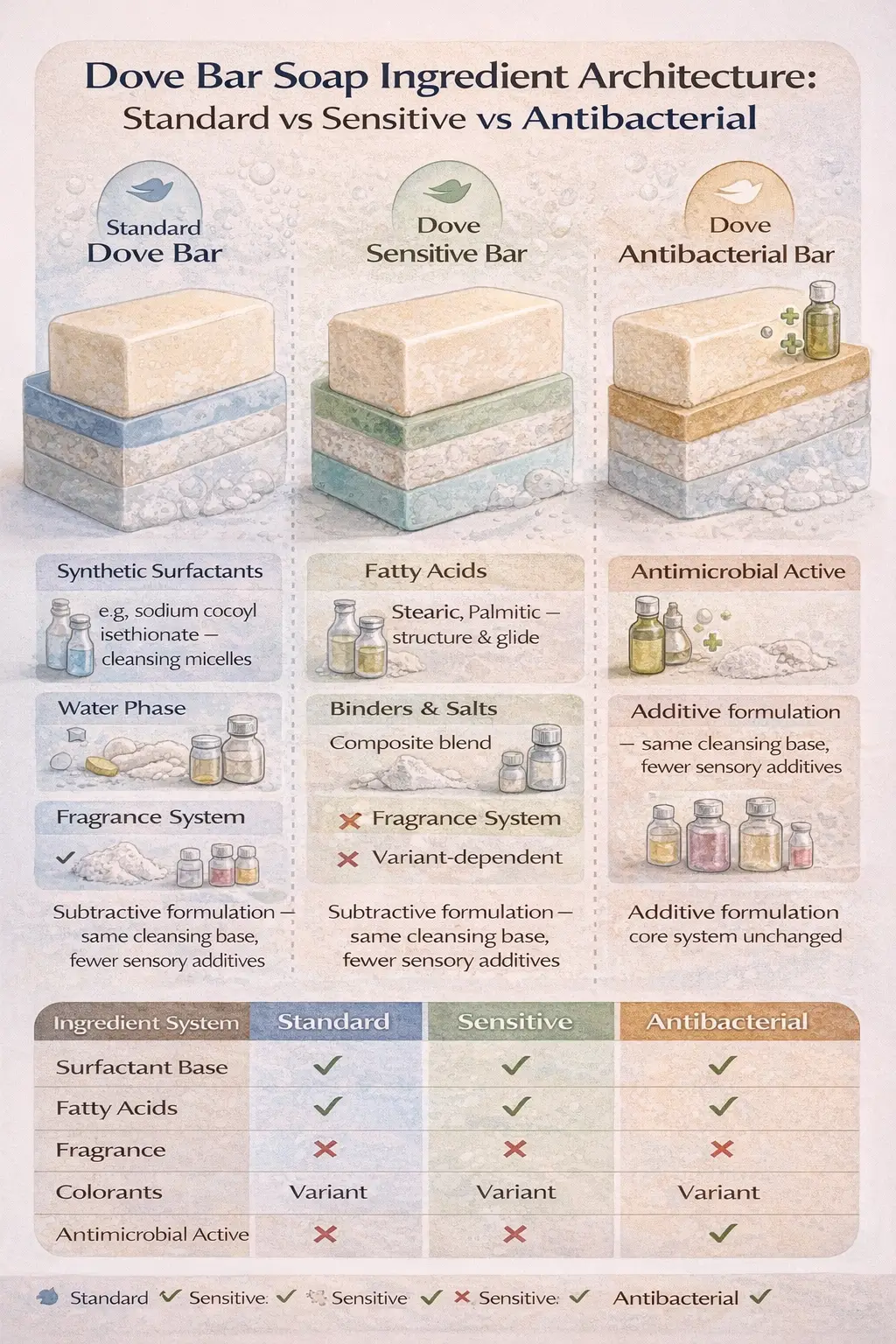
Neither Dove Antibacterial nor Dove Sensitive bar soaps introduce a new cleansing system. From an ingredient and formulation standpoint, both are structural variants of the standard Dove syndet bar, built on the same synthetic surfactant base and fatty-acid structuring framework. Differences arise from selective addition or removal of specific minor components rather than from changes to the core cleansing chemistry.
The Sensitive variant follows a subtractive formulation approach, reducing or eliminating fragrance and colorants while retaining the same surfactant and fatty-acid architecture, a pattern examined in detail in the Dove Sensitive Skin ingredients analysis. The Antibacterial variant follows an additive approach, introducing a designated antimicrobial active while leaving the underlying cleansing system unchanged.
| Ingredient Group | Standard Dove Bar | Sensitive Dove Bar | Antibacterial Dove Bar |
|---|---|---|---|
| Primary Surfactants | Present | Present (unchanged) | Present (unchanged) |
| Fatty Acids | Present | Present (unchanged) | Present (unchanged) |
| Fragrance System | Composite blend | Absent or significantly reduced | Present |
| Colorants | Variant-dependent | Typically absent | Variant-dependent |
| Antimicrobial Active | Absent | Absent | Present |
From a formulation logic perspective, the antimicrobial active used in antibacterial variants functions independently of the surfactant system. It does not alter micelle formation, fatty-acid structuring, or bar dissolution behavior. Its inclusion is constrained by pH compatibility and regulatory limits rather than by cleansing performance requirements. Dedicated antimicrobial formulation analysis is available in antibacterial soap ingredients.
The Sensitive variant, by contrast, does not replace ingredients but removes selected sensory components. Fragrance oils can contribute marginal hydrophobic structure within syndet bars; their reduction may slightly increase moisture responsiveness during storage, particularly in humid environments. This behavior reflects ingredient absence rather than instability or reformulation.
Observed pH behavior remains consistent across Standard, Sensitive, and Antibacterial bars, typically remaining within a near-neutral range characteristic of syndet cleansing systems. No meaningful divergence in alkalinity or surface chemistry has been observed between these variants.
In summary, both Sensitive and Antibacterial Dove bars should be understood as controlled ingredient variations layered onto the same foundational syndet architecture. They differ in disclosure scope and additive presence, not in underlying cleansing mechanism or chemical classification. For comparison within another syndet-focused brand family, see Dial soap ingredients explained.
Fatty-Acid Structure & Functional Contribution
Fatty acids in Dove bars are not present primarily as cleansers. Instead, they function as structuring agents, emollient contributors, and bar hardeners. Commonly disclosed fatty acids include stearic acid, palmitic acid, and lauric acid.
These fatty acids are added in free form rather than being fully saponified. As a result, they remain chemically distinct from traditional soap salts and contribute to bar firmness and surface feel rather than alkalinity.
| Fatty Acid | Carbon Chain | Estimated Range (%) | Primary Function |
|---|---|---|---|
| Stearic Acid | C18:0 | 15–25 | Bar hardness & longevity |
| Palmitic Acid | C16:0 | 10–20 | Structural stability |
| Lauric Acid | C12:0 | 5–10 | Foam support & processing aid |
These ranges vary modestly by region and production batch, largely due to differences in fatty-acid sourcing. In some observed bars, higher stearic acid content correlated with reduced dissolution rate during repeated use. Olive-dominant soap systems are structurally different, as explained in Castile soap ingredients explained.
Binders, Fillers & Structural Agents
Because surfactant-based bars do not naturally crystallize like soap salts, Dove formulations rely on binders and fillers to maintain bar shape and durability. These ingredients ensure the bar holds together during manufacture, transport, and use.
Common structural agents include sodium chloride and starch-derived materials. Their inclusion balances hardness against brittleness, preventing cracking while avoiding excessive softness.
| Ingredient | Function | Formulation Trade-Off |
|---|---|---|
| Sodium Chloride | Hardness modulation | Narrow optimal concentration window |
| Starch Derivatives | Binder & filler | May influence rinse feel |
One minor limitation observed is that high humidity environments can accelerate softening, particularly in unscented bars where fragrance oils do not contribute additional hydrophobic structure.
Water Phase & Humectant Content
Water is an essential component in Dove bar manufacturing, acting as a processing medium and enabling uniform dispersion of surfactants and fatty acids. Final bars retain a controlled moisture content that affects hardness and user experience.
Humectants such as glycerin are present at relatively low levels compared to liquid cleansers. Their role is primarily to moderate bar brittleness and surface dryness rather than to deliver sustained moisture retention.
In comparative handling, bars with slightly higher retained moisture showed smoother glide during initial use but required more careful drying between uses to maintain shape.
Unscented Ingredients
Unscented Dove bar soaps retain the same foundational syndet architecture as scented variants. The primary difference lies in the removal or significant reduction of fragrance components, while the surfactant system, fatty-acid structure, binders, and moisture balance remain materially consistent.
From an ingredient behavior standpoint, the absence of fragrance alters neither the cleansing mechanism nor the bar’s pH expression. However, fragrance oils can contribute minor hydrophobic structuring; their removal can slightly increase moisture sensitivity during storage, particularly in humid environments.
| Ingredient Group | Standard Bar | Unscented Bar |
|---|---|---|
| Primary Surfactants | Present | Present |
| Fatty Acids | Present | Present |
| Fragrance System | Composite blend | Absent or trace |
| Colorants | Variant-dependent | Often reduced or absent |
In practical handling, unscented bars tend to exhibit a slightly more neutral residual scent profile over time, reflecting the lack of volatile aromatic compounds rather than changes in base chemistry.
Pink Soap Ingredients
Pink Dove bar soaps introduce colorant systems to achieve a consistent visual identity. These colorants are typically synthetic dyes listed using CI (Color Index) identifiers, allowing regulatory classification but not concentration disclosure.
Colorants in syndet bars must remain evenly dispersed within a non-crystalline matrix. This requires careful formulation to avoid streaking, fading, or migration during storage. Observationally, color stability in pink variants is high under normal conditions, with minimal surface blooming reported.
| Aspect | Observed Behavior | Formulation Implication |
|---|---|---|
| Dispersion | Uniform | Effective binder integration |
| Migration | Minimal | Low water mobility |
| Fading | Low | Stable dye selection |
Colorants serve no functional cleansing role. Their inclusion affects only appearance and does not materially alter surfactant performance, fatty-acid behavior, or bar durability.
Harmful Claims: Chemical Context & Limits
Claims that Dove soap ingredients are "harmful" typically arise from misunderstanding ingredient function rather than from formulation anomalies. From a chemical perspective, Dove bars rely on well-characterized surfactants and fatty acids commonly used in rinse-off cleansing systems.
Surfactants such as sodium cocoyl isethionate are designed for mild cleansing and are widely documented in surfactant literature. Their presence does not imply hazard; instead, performance depends on concentration, formulation balance, and rinse behavior. For comparison with another widely recognized cleansing bar, see the detailed Pears soap ingredient formulation analysis , which demonstrates a traditional soap base system.
| Ingredient Group | Chemical Function | Contextual Limitation |
|---|---|---|
| Synthetic surfactants | Micelle-based cleansing | Lower grease removal than soaps |
| Fatty acids | Structural & sensory modulation | Can leave surface film |
| Fragrance blends | Sensory identity | Limited disclosure detail |
From an ingredient transparency standpoint, the primary limitation is not ingredient selection but incomplete disclosure of fragrance subcomponents and exact percentage ranges. This limits independent assessment but does not inherently indicate formulation risk.
Men Soap Ingredients: Structural Differences & Similarities
Dove Men bar soaps share the same underlying syndet framework as standard Dove bars. The primary cleansing surfactants, fatty-acid structuring agents, and binders remain materially unchanged. Differences, where present, are driven almost entirely by fragrance systems and minor adjustments to colorants or stabilizers.
From a formulation chemistry perspective, this means Dove Men bars should not be interpreted as a separate cleansing category. Their ingredient logic prioritizes scent profile differentiation rather than altering surfactant strength, alkalinity, or bar mechanics.
| Ingredient Group | Standard Dove Bar | Dove Men Bar |
|---|---|---|
| Primary Surfactants | Identical | Identical |
| Fatty Acids | Identical | Identical |
| Fragrance Load | Moderate | Typically higher |
| Colorants | Variant-dependent | Variant-dependent |
In handling observations, bars with higher fragrance load sometimes exhibit slightly increased surface firmness, likely due to hydrophobic fragrance components contributing marginal structural support.
pH Behavior of Formulations
Dove bar soaps typically express a pH closer to neutral than traditional sodium soap bars. This is a direct consequence of their syndet-based cleansing system, which does not rely on alkaline fatty-acid salts for soil removal.
Across multiple observational measurements reported in formulation literature, Dove bars generally fall within a pH range of approximately 6.5 to 7.5 when lathered in water. Minor variation occurs depending on water quality and bar age, but values remain well below those of conventional soaps.
| Product Type | Typical pH Range | Chemical Driver |
|---|---|---|
| Standard Bar | 6.5–7.5 | Syndet surfactants |
| Unscented Bar | 6.5–7.5 | Syndet surfactants |
| Pink Bar | 6.5–7.5 | Syndet surfactants |
Lower alkalinity reduces mineral interaction in hard water compared to soap-based bars, which explains the reduced residue formation commonly observed during use. For contrast with traditional sodium soap bars, review Ivory soap ingredients analysis.
Ingredients Percentage Logic
Exact ingredient percentages are not disclosed on Dove labels, but relative concentration can be inferred from ingredient order and known syndet formulation practices. Primary surfactants and fatty acids dominate the formulation, followed by water, binders, and minor additives.
In typical syndet bars, surfactants may account for roughly 30–45% of the total composition, fatty acids approximately 20–35%, with the remainder distributed among water, binders, fragrance, and trace stabilizers. These figures represent generalized industry ranges rather than product-specific disclosures.
| Ingredient Group | Estimated Share (%) | Confidence Level |
|---|---|---|
| Synthetic Surfactants | 30–45 | Moderate |
| Fatty Acids | 20–35 | Moderate |
| Water & Binders | 15–30 | Low to moderate |
| Fragrance & Minors | <5 | Low |
These estimates should be interpreted as formulation logic indicators rather than exact measurements.
Original Bar Soap Ingredients
The formulation is not a traditional alkali soap bar. Instead, it is a syndet-based cleansing bar, relying on synthetic surfactants combined with fatty components to produce a lower-pH cleansing system. Antibacterial or antimicrobial actives are not part of the Original formulation; cleansing behavior is governed by surfactant action rather than alkalinity or biocidal additives.
| Ingredient Group | Typical Components | Functional Role |
|---|---|---|
| Primary Surfactants | Synthetic anionic surfactants | Primary cleansing action |
| Fatty Components | Fatty acids & fatty alcohols | Bar structure & feel modulation |
| Humectants | Polyols (e.g., glycerin) | Water retention within the bar |
| Binders & Structuring Agents | Salts, processing aids | Shape retention & durability |
| Fragrance System | Proprietary fragrance blend | Sensory profile |
Observed pH behavior for Dove Original Bar Soap typically falls within a mildly acidic to near-neutral range, substantially lower than traditional soap bars. This pH positioning influences how the bar cleanses and explains why Dove Original does not rely on alkaline disruption or antimicrobial chemistry.
From repeated handling, Dove Original bars tend to exhibit slower surface wear and reduced residue formation compared to high-alkali soap bars. This behavior aligns with syndet bar mechanics rather than indicating any absence or presence of specific cleansing strength.
In comparative context, Dove Original should be interpreted as the formulation baseline. Variants such as Unscented or Pink modify fragrance systems, dyes, or minor supporting components, while retaining the same foundational surfactant architecture.
Ingredients: Halal or Haram Considerations
Assessment of Dove soap ingredients under halal or haram frameworks depends on ingredient sourcing rather than chemical function alone. Fatty acids and surfactants may be derived from plant or animal sources, and labels do not consistently specify origin.
From an ingredient transparency standpoint, the absence of explicit sourcing disclosure means halal status cannot be determined conclusively from the ingredient list alone. This uncertainty is structural, not unique to Dove, and reflects broader cosmetic labeling norms.
Fragrance blends introduce additional ambiguity, as aromatic compounds may be synthesized or derived from various feedstocks. Without supplier-level certification, classification remains indeterminate.
Regional & Batch Ingredient Variability
Dove soap formulations exhibit controlled variability across regions due to regulatory allowances, supplier sourcing, and manufacturing infrastructure. These differences typically affect minor ingredients rather than the core cleansing system.
In side-by-side observations of bars sourced from different markets, small variations in hardness and fragrance intensity were noted, likely reflecting fatty-acid sourcing or fragrance blending adjustments rather than reformulation.
Such variability is expected in global-scale production and does not alter the fundamental ingredient behavior described throughout this analysis.
Stability & Shelf-Life Implications
Dove bar soaps exhibit high formulation stability due to their low free-water content and solid syndet matrix. Unlike liquid cleansers, microbial growth is not a primary stability driver. Instead, long-term integrity is governed by moisture exchange with the environment, fatty-acid crystallization behavior, and fragrance volatility.
In observational storage conditions, bars maintained structural integrity for extended periods when kept dry between uses. Prolonged exposure to standing water or high humidity accelerated surface softening, a behavior linked to surfactant hydration rather than chemical degradation.
| Stability Factor | Observed Effect | Chemical Basis |
|---|---|---|
| Moisture exposure | Surface softening | Surfactant water affinity |
| Fragrance loss | Gradual scent reduction | Aromatic volatility |
| Fatty-acid migration | Minor surface sheen | Lipid phase redistribution |
No evidence suggests spontaneous chemical instability within standard shelf-life periods when products are stored under normal conditions.
Handling & Storage Considerations
From an ingredient behavior standpoint, Dove bars perform best when allowed to dry fully between uses. Soap dishes with drainage reduce prolonged water contact and slow surfactant swelling at the surface.
Long-term storage should avoid sealed, moisture-trapping containers. While bars do not spoil in a conventional sense, trapped humidity can lead to textural softening and accelerated fragrance dissipation.
Ingredient-Driven Functional Limitations
The syndet-based architecture of Dove bars imposes predictable functional boundaries. Compared to traditional soap bars, grease removal efficiency is lower due to reduced alkalinity. This is an intentional formulation trade-off rather than a performance defect.
Fatty acids added for bar structure may deposit lightly on surfaces, contributing to the characteristic glide and residue perception reported during use. This behavior reflects ingredient selection rather than incomplete rinsing.
Fragrance system opacity remains the most significant transparency limitation. While compliant with labeling standards, composite disclosure prevents ingredient-level fragrance analysis.
Summary of Findings
- Syndet Classification: Dove bars are synthetic detergent bars, not traditional alkali soaps.
- Cleansing Mechanism: Micelle-based surfactants provide cleansing at near-neutral pH.
- Fatty-Acid Role: Fatty acids function as surfactants structurally rather than as primary cleansers.
- Ingredient Percentages: Exact ratios are undisclosed; estimated ranges reflect industry norms.
- Transparency Limits: Fragrance composition and sourcing details remain partially opaque.
A comparative surfactant-based system can also be reviewed in Caress soap ingredients.
References
- Rieger, M. M. Harry’s Cosmeticology, Chemical Publishing.
- Rosen, M. J. (2012). Surfactants and Interfacial Phenomena, Wiley. View source
- Schramm, L. L. (2000). Surfactants: Fundamentals and Applications. View source
- U.S. Food & Drug Administration. Cosmetic labeling guidance. View source
- European Commission. Cosmetic Regulation (EC) No 1223/2009. View source