What are Anionic Surfactants
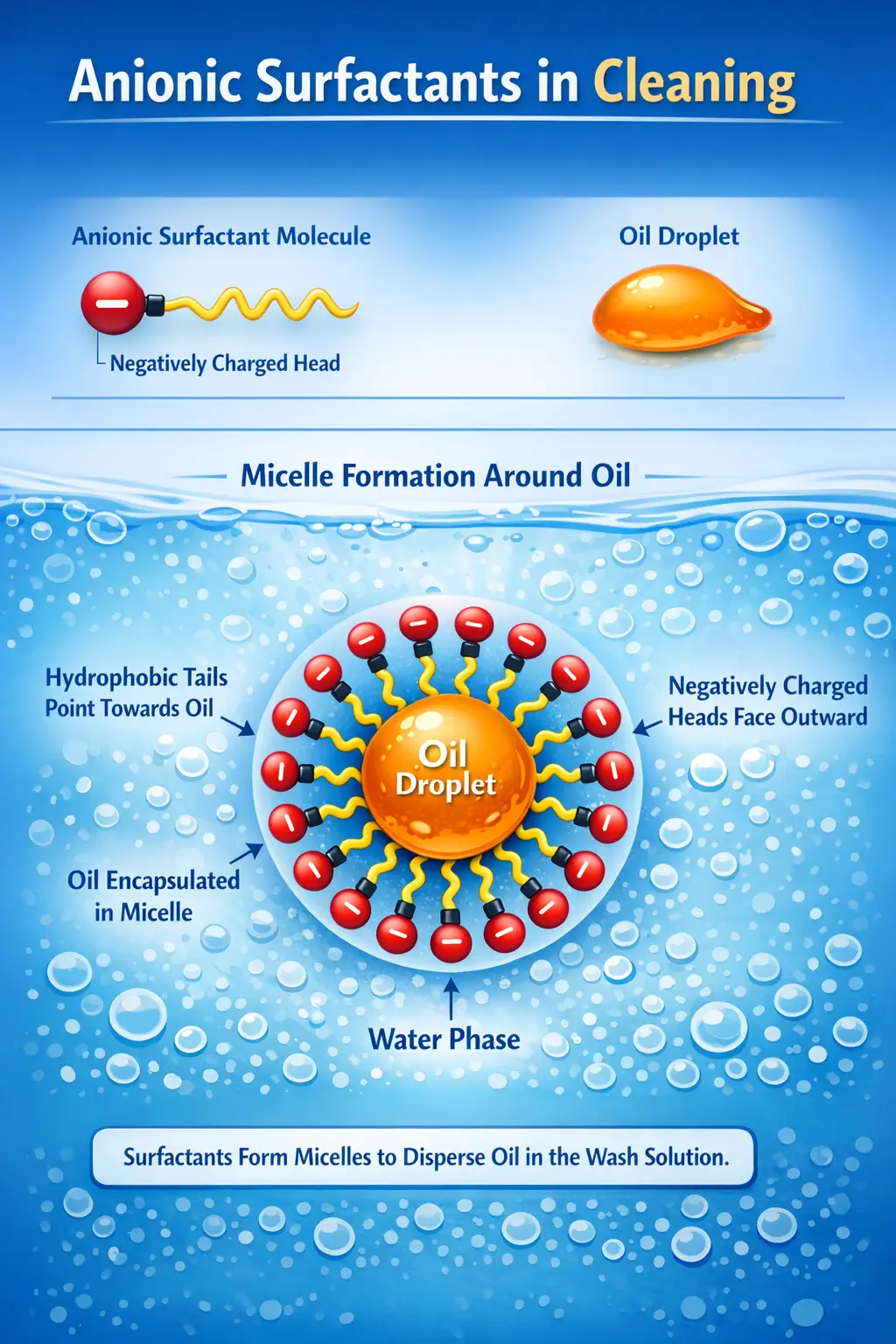
Anionic surfactants are a class of surface active molecules characterized by a negatively charged hydrophilic head group attached to a hydrophobic hydrocarbon chain. Within cleansing formulations they function as primary detergents, enabling oils, soils, and particulate matter to disperse into water. Their amphiphilic structure allows them to organize at oil water interfaces and form micelles that transport hydrophobic contaminants away from surfaces during rinsing.
In practical formulation contexts these materials appear across a wide range of cleansing systems including soap substitutes, dishwashing liquids, laundry detergents, shampoos, and various cosmetic cleansing products. The behavior of anionic surfactants in cleaning products is defined less by a single molecule and more by the structural family to which the surfactant belongs. Members of this family share a similar charge behavior but differ in carbon chain length, sulfate or sulfonate functionality, and molecular architecture.
The present page belongs to the CleanFormulation Ingredient Library, a research project that analyzes ingredient behavior inside real cleansing formulations rather than evaluating marketing claims or consumer positioning.
Quick Facts
| Property | Description |
|---|---|
| Ingredient Type | Surface active detergent molecules |
| Chemical Class | Sulfates, sulfonates, carboxylates and related anionic amphiphiles |
| Functional Role | Primary cleansing agents responsible for soil removal and dispersion |
| Ionic Class | Anionic, negatively charged in aqueous environments |
| Typical Use Context | Laundry detergents, shampoos, dishwashing liquids, cosmetic cleansers |
| Key Structural Feature | Hydrophobic carbon chain attached to a negatively charged head group |
Why This Ingredient Appears On Labels
Consumers often encounter the term anionic surfactants in detergents or see individual representatives of this class listed on product labels. These ingredients appear because they provide the primary mechanism through which many cleansing products remove oils and suspended soils. When a formulation requires strong wetting, rapid foam formation, or effective soil suspension, anionic surfactants are commonly selected as the foundational detergent system.
For example, anionic surfactants in shampoo formulations create rapid lather and distribute cleansing molecules across hair fibers and scalp surfaces. In dishwashing liquids the same structural class helps disperse cooking oils into the wash solution so they can be rinsed away. In laundry detergents these surfactants interact with soil particles released from fabrics and keep them suspended in the wash water rather than redepositing on textile surfaces.
Ingredient labeling therefore reflects the functional architecture of the formulation rather than a marketing classification. When a product requires strong oil removal under water based conditions, the formulation frequently relies on an anionic surfactant system to achieve that outcome.
Chemical Identity And Classification
The defining feature of anionic surfactants is the presence of a negatively charged functional group attached to a hydrophobic carbon chain. The negative charge is typically introduced through sulfate, sulfonate, or carboxylate groups. When dissolved in water these groups dissociate, leaving the surfactant molecule carrying a negative charge that interacts with surrounding ions and water molecules.
The hydrophobic region of the molecule is usually a linear or branched alkyl chain derived from fatty alcohols or petrochemical intermediates. The length of this chain influences solubility, foaming behavior, and the stability of micelle formation. Chains that are too short may dissolve without forming effective micelles, while excessively long chains reduce solubility and limit dispersion in aqueous systems.
A simplified representation of the anionic surfactants formula can be described as a hydrophobic tail connected to a hydrophilic ionic head group. Although individual molecules vary, the structural principle remains consistent across the entire class. This arrangement explains the behavior of anionic surfactants structure in water based formulations where the molecule simultaneously interacts with both oil and water phases.
Within modern cleaning formulations several families of anionic surfactants appear frequently. Sulfate based molecules are common in personal cleansing products, while sulfonate derivatives appear widely in laundry detergents due to their stability across different water hardness conditions. The underlying chemistry remains consistent across these families even though the molecular backbone and head group may differ slightly.
Functional Role In Soap Systems
Within cleansing formulations, anionic surfactants act as the primary detergency drivers. Their amphiphilic structure allows them to position themselves at the interface between water and hydrophobic substances such as oils, skin lipids, or environmental residues. When dispersed in water above a specific concentration threshold, these molecules organize into micellar structures that trap hydrophobic materials inside a core formed by the hydrocarbon chains.
This mechanism explains why anionic surfactants in cleaning products are widely used in formulations designed for soil removal. Once micelles form, the surfactant system can encapsulate oils, pigments, and particulate matter, allowing the wash water to transport them away from the cleaned surface. The negatively charged head groups also create electrostatic repulsion between micelles, preventing aggregated soil from redepositing onto fabrics or surfaces.
In formulations such as shampoos, these surfactants contribute both cleansing and lather characteristics. The rapid formation of foam results from air incorporation into surfactant stabilized films during agitation. In this context, anionic surfactants in shampoo systems typically generate fast, voluminous lather that distributes the cleansing solution across hair fibers and scalp surfaces.
In dishwashing liquids the functional emphasis shifts slightly. Here the primary objective is efficient removal of cooking oils and food residues from hard surfaces. Anionic surfactants in dishwashing liquid formulations reduce surface tension and disperse lipid residues into micelles that remain suspended in the wash solution. This process ensures that oils remain in the rinse water rather than adhering to the cleaned surface.
Laundry formulations introduce additional complexity. Anionic surfactants in laundry detergent systems must maintain cleaning efficiency under variable water hardness, temperature fluctuations, and mechanical agitation. In these environments they operate alongside builders and auxiliary surfactants to stabilize soil particles released from textile fibers during washing.
Ingredient Interaction Logic
The behavior of anionic surfactants rarely depends on a single ingredient acting independently. Instead, these molecules function within a broader formulation system composed of water, auxiliary surfactants, chelating agents, fragrances, and structural additives. Each component influences the performance of the surfactant system.
Water acts as the continuous phase that allows the ionic head group to remain hydrated and mobile. Without adequate hydration the surfactant cannot form micelles effectively. The presence of electrolytes in the water phase also influences the packing behavior of micelles and may alter foam structure or viscosity.
In many cosmetic cleansers and detergents, formulators combine anionic surfactants with nonionic or amphoteric surfactants. This blending approach moderates foam stability and adjusts the interaction between surfactant molecules. The combination often improves overall formulation stability and modifies the sensory characteristics of the final product.
Chelating agents influence the system by binding metal ions present in hard water. Calcium and magnesium ions can interfere with surfactant activity by forming insoluble salts. When chelators remove these ions from the solution, the surfactant molecules remain free to perform their cleansing function.
Fragrance systems interact primarily with the hydrophobic region of the surfactant micelles. Many fragrance components are poorly soluble in water but dissolve more readily within micellar cores. As a result, the surfactant system helps disperse aromatic molecules throughout the formulation and influences how scent is released during use.
Phase Behavior
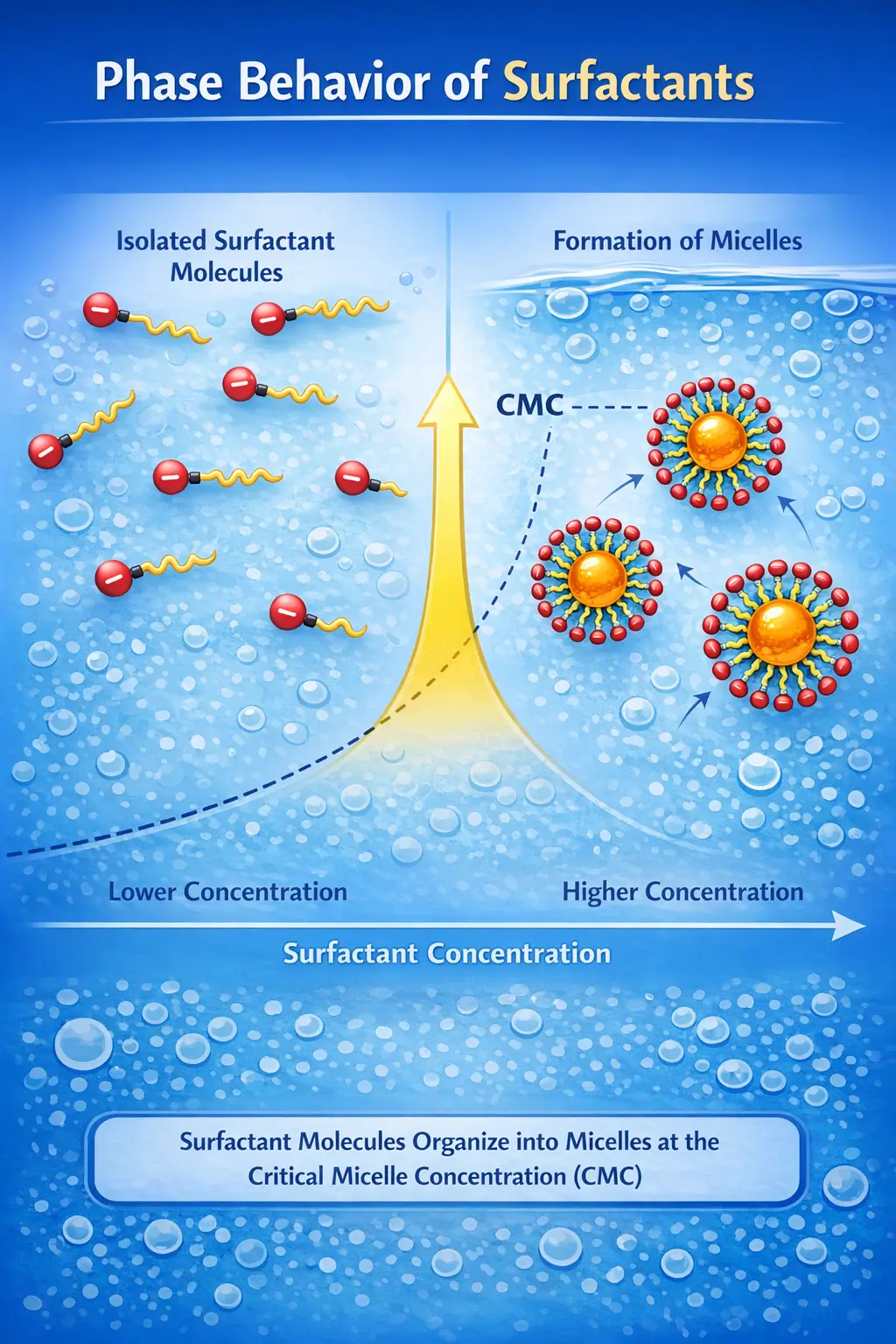
Anionic surfactants display characteristic phase behavior when dissolved in water. At low concentrations individual molecules remain dispersed throughout the aqueous phase. As concentration increases and reaches the critical micelle concentration, the molecules begin to aggregate into micelles. This transition represents a key functional threshold in cleansing systems because micelles provide the structural environment required for oil solubilization.
Micelle formation also influences viscosity and transparency in liquid cleansers. When the concentration of surfactant continues to increase, micelles may reorganize into larger structures such as elongated aggregates or layered phases. These structural changes are often used intentionally in formulation design to control thickness without introducing additional polymers.
Temperature and ionic strength influence these phase transitions. Elevated temperatures can reduce micelle stability in some surfactant systems, while dissolved salts may compress the electrical repulsion between head groups. Both factors alter how micelles form and how effectively they interact with oils during cleaning.
These phase transitions explain why anionic surfactants structure plays a central role in formulation design. The balance between hydrophobic chain length and ionic head group determines how easily micelles form and how stable those micelles remain under real washing conditions.
Comparison With Related Surfactant Classes
To understand the functional role of anionic surfactants, it is useful to compare them with other surfactant categories used in cleansing formulations. Each class interacts with water and oils differently due to differences in charge and molecular structure.
| Feature | Anionic Surfactants | Nonionic Surfactants | Amphoteric Surfactants |
|---|---|---|---|
| Electrical Charge | Negative in aqueous solution | No net charge | Charge varies with pH |
| Primary Use | High efficiency detergency and soil removal | Grease solubilization and stabilization | Foam modification and formulation balance |
| Typical Applications | Laundry detergents, shampoos, dishwashing liquids | Cosmetic cleansers and emulsions | Mixed surfactant systems in personal cleansers |
| Foam Behavior | Rapid foam generation | Moderate foam formation | Stabilizes or moderates foam |
Regulatory Context
Anionic surfactants appear across several regulatory categories depending on the product type in which they are used. In cosmetic formulations such as shampoos, body washes, and facial cleansers, these materials are declared according to the International Nomenclature of Cosmetic Ingredients system. This standardized naming framework ensures that individual surfactant molecules are listed by their recognized INCI designation on ingredient labels.
Within the European Union, cosmetic ingredients are regulated under Regulation (EC) No 1223/2009. This framework requires ingredient disclosure using the INCI name and establishes requirements for ingredient traceability, manufacturing standards, and product safety documentation. Surfactant ingredients used in cosmetics must also appear within the European Commission CosIng database, which provides reference information about cosmetic ingredient classification and permitted functions.
Detergent products such as laundry cleaners and dishwashing liquids fall under a separate regulatory structure in the EU. Regulation (EC) No 648/2004 on detergents requires disclosure of surfactant classes on packaging and specifies biodegradability requirements for surfactant systems used in household cleaning products. As a result, anionic surfactants in detergents are commonly identified by class level descriptors such as anionic surfactants rather than by complete molecular identity.
In practice, this regulatory distinction explains why ingredient labels for cosmetic cleansers often list individual surfactant names while household detergents frequently provide broader functional categories. Both approaches refer to the same underlying chemical families but follow different disclosure conventions depending on product classification.
Common Misunderstanding
A frequent misunderstanding arises from the assumption that all anionic surfactants represent a single ingredient. In reality the term describes an entire structural category of molecules rather than a specific compound. Each member of this class shares the defining characteristic of a negatively charged hydrophilic head group, but the hydrocarbon chain length, branching pattern, and functional group may vary considerably.
This distinction becomes particularly relevant when interpreting ingredient lists. A shampoo, detergent, or cosmetic cleanser may contain several different surfactants that all belong to the anionic class but differ in molecular architecture. The formulation behavior of these materials depends on their structural differences and how they interact with other components in the system.
Another misconception involves the interpretation of foam production. Because anionic surfactants often generate visible foam, the presence of foam is sometimes assumed to indicate cleaning strength. In formulation science foam volume and soil removal efficiency are related but not identical phenomena. Foam primarily reflects the stability of air films stabilized by surfactant molecules rather than the actual removal of oils or particulate matter.
Structural Limitations
Although anionic surfactants provide effective detergency across many applications, their structural characteristics introduce certain formulation constraints. One of the most widely recognized limitations involves interaction with dissolved minerals present in hard water. Calcium and magnesium ions can associate with negatively charged surfactant head groups, forming less soluble salts that reduce the efficiency of the surfactant system.
Formulators often address this limitation by introducing builder compounds or chelating agents that bind hardness ions before they interact with the surfactant molecules. By removing these ions from solution the formulation preserves the availability of the surfactant molecules needed for micelle formation.
Another constraint arises from electrostatic repulsion between the negatively charged head groups of neighboring surfactant molecules. While this repulsion stabilizes micelles and prevents aggregation of soil particles, it can also limit how tightly surfactant molecules pack together at interfaces. As a result the concentration range in which optimal micelle formation occurs must be carefully controlled during formulation design.
Temperature also influences surfactant behavior. In certain formulations elevated temperatures may alter micelle stability or change the solubility profile of the surfactant. These shifts can influence viscosity, foam stability, or the dispersion of fragrance oils within the product.
Formulation References Using This Ingredient
- Method Laundry Detergent
- Amway Soap Ingredients Analysis
- Buff City Soap Ingredients Analysis
- Dermakleen Antiseptic & Antibacterial Soap
- Dial Himalayan Salt Hand Soap
- Method Hand Soap
- Aesop Dish Detergent
- Dial Antimicrobial Soap Ingredients Analysis
- Dove Shea Butter Soap Ingredients Analysis
- Irish Spring Soap Ingredients Analysis
Summary of Findings
- Chemical Classification: Anionic surfactants represent a family of negatively charged surface active molecules characterized by hydrophobic carbon chains and ionic head groups.
- Functional Role: These molecules serve as primary detergents in cleansing systems, enabling oils and soils to disperse into water through micelle formation.
- Formulation Interaction: Their behavior depends on interactions with water, auxiliary surfactants, chelating agents, and fragrance components present in the formulation.
- Structural Behavior: Micelle formation, solubility limits, and ionic interactions determine how effectively these surfactants perform within cleansing systems.
- System Boundaries: Hard water interactions, ionic strength, and temperature variations influence how anionic surfactants behave in practical formulations.