Definition
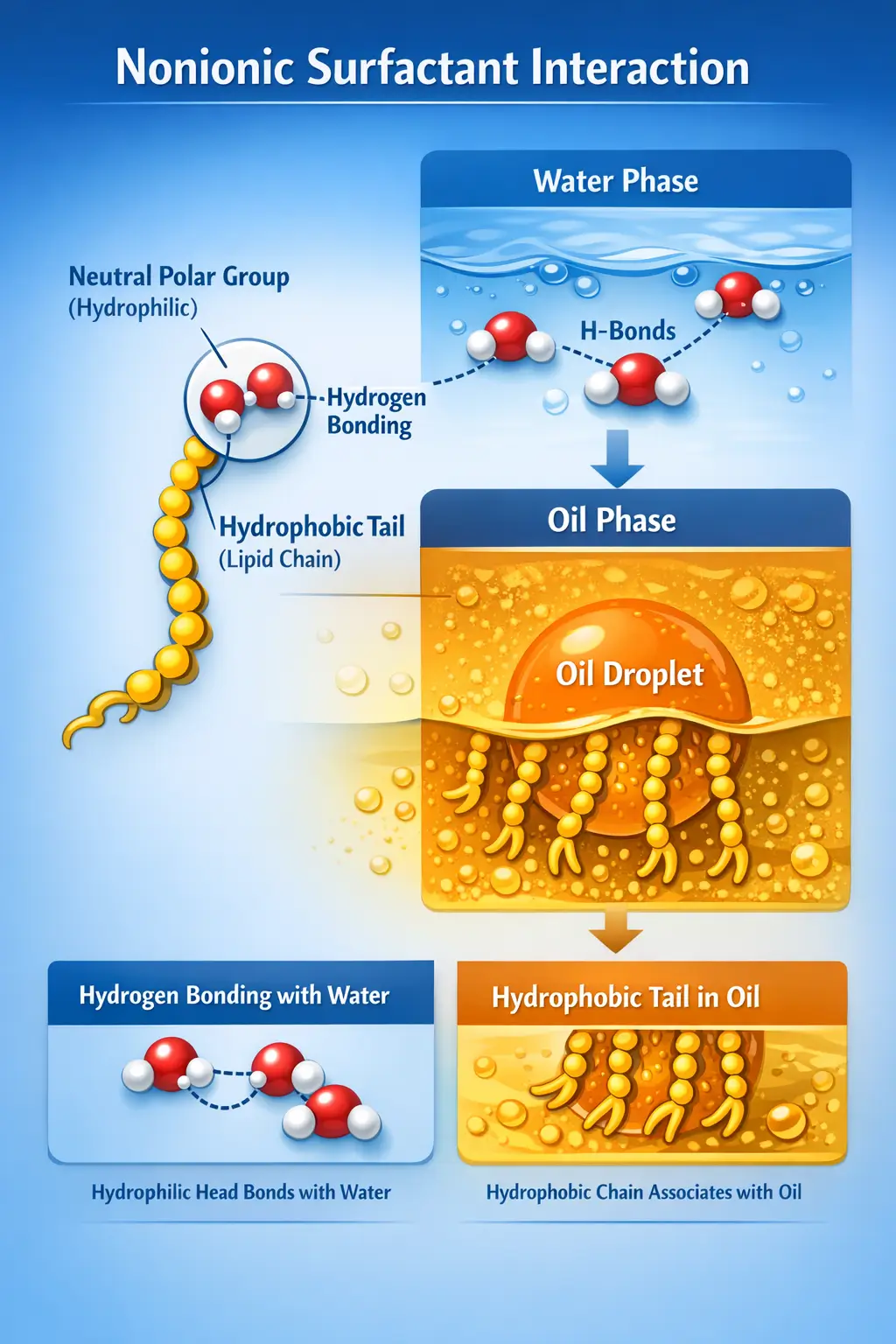
Nonionic surfactants are surface active molecules that reduce surface tension in water without carrying a permanent electrical charge in their hydrophilic head group. Their structure typically consists of a hydrophobic carbon chain attached to a neutral polar group that interacts with water through hydrogen bonding rather than ionic attraction. Because they lack an electrical charge, these molecules behave differently from anionic or amphoteric surfactants inside cleansing formulations.
In practical formulation systems, nonionic surfactants act as emulsifiers, solubilizers, and detergency modifiers. They are commonly used alongside other surfactant classes to stabilize mixtures of oils and water, disperse hydrophobic substances, and improve compatibility between ingredients. This behavior explains why nonionic surfactants in detergents and personal cleansing products frequently appear as supporting components within mixed surfactant systems.
The nonionic surfactants meaning therefore refers to a category defined by electrical neutrality in aqueous solution rather than by a single molecular structure. Many different chemical families fall into this classification, each designed to interact with oils, soils, and water in slightly different ways depending on the formulation requirements.
This page belongs to the CleanFormulation Ingredient Library, a research project examining how ingredients behave within real formulations rather than interpreting marketing descriptions or consumer claims.
Quick Facts
| Property | Description |
|---|---|
| Ingredient Type | Surface active agents used as emulsifiers, detergency modifiers and solubilizers |
| Chemical Class | Nonionic surfactants with neutral hydrophilic groups |
| Functional Role | Oil dispersion, emulsification, stability improvement in mixed surfactant systems |
| Ionic Class | Nonionic, no permanent electrical charge in aqueous solution |
| Typical Use Context | Detergents, cosmetics, agricultural formulations and aqueous cleaning systems |
| Representative Families | Alcohol ethoxylates, alkyl polyglucosides, fatty alcohol ethoxylates |
Why This Ingredient Appears On Labels
Consumers encounter nonionic surfactants in cosmetics and cleaning products because these molecules help stabilize mixtures of water, oils, and fragrance components. Many formulations contain ingredients that do not naturally dissolve in water. Nonionic surfactants create an environment where these hydrophobic substances can remain dispersed within the liquid phase.
For example, nonionic surfactants in cosmetics often help distribute oils or fragrance compounds evenly throughout a cleanser or lotion. Their neutral charge allows them to remain compatible with a wide variety of ingredients that might otherwise react with charged surfactants.
In cleaning systems the role may involve supporting primary detergents. Nonionic surfactants in detergents frequently work alongside anionic surfactants to enhance oil removal and maintain stability in the presence of hard water minerals. Their lack of electrical charge allows them to function in conditions where ionic surfactants may behave differently.
Outside personal care formulations these ingredients also appear in agricultural applications. Non ionic surfactants in agriculture are often used to improve wetting and spreading behavior of spray solutions on plant surfaces. The same fundamental surfactant properties that support cleaning systems also enable improved contact between liquids and hydrophobic surfaces.
Chemical Identity And Classification
Nonionic surfactants belong to a broad molecular family defined by the absence of a permanent ionic charge. Their hydrophilic region usually consists of ether, hydroxyl, or sugar derived groups that interact with water through hydrogen bonding rather than electrostatic attraction.
Several nonionic surfactants examples illustrate this structural pattern. Alcohol ethoxylates contain a hydrophobic alkyl chain linked to a series of ethylene oxide units that create a water compatible region. Alkyl polyglucosides use a sugar based hydrophilic group derived from glucose molecules. Despite structural differences, both categories remain electrically neutral when dissolved in water.
This neutrality influences how the molecules behave inside aqueous solutions. Because they do not carry a charge, nonionic surfactants do not interact strongly with dissolved ions in the water phase. This characteristic contributes to their stability in formulations where mineral content or electrolyte concentration might otherwise interfere with surfactant behavior.
The chemical classification therefore reflects a structural feature rather than a single compound identity. Many molecules share the same neutral hydrophilic design while differing in chain length or hydrophilic group size. These variations allow formulators to select surfactants suited to different applications ranging from cosmetic cleansers to agricultural spray systems.
Functional Role In Soap Systems
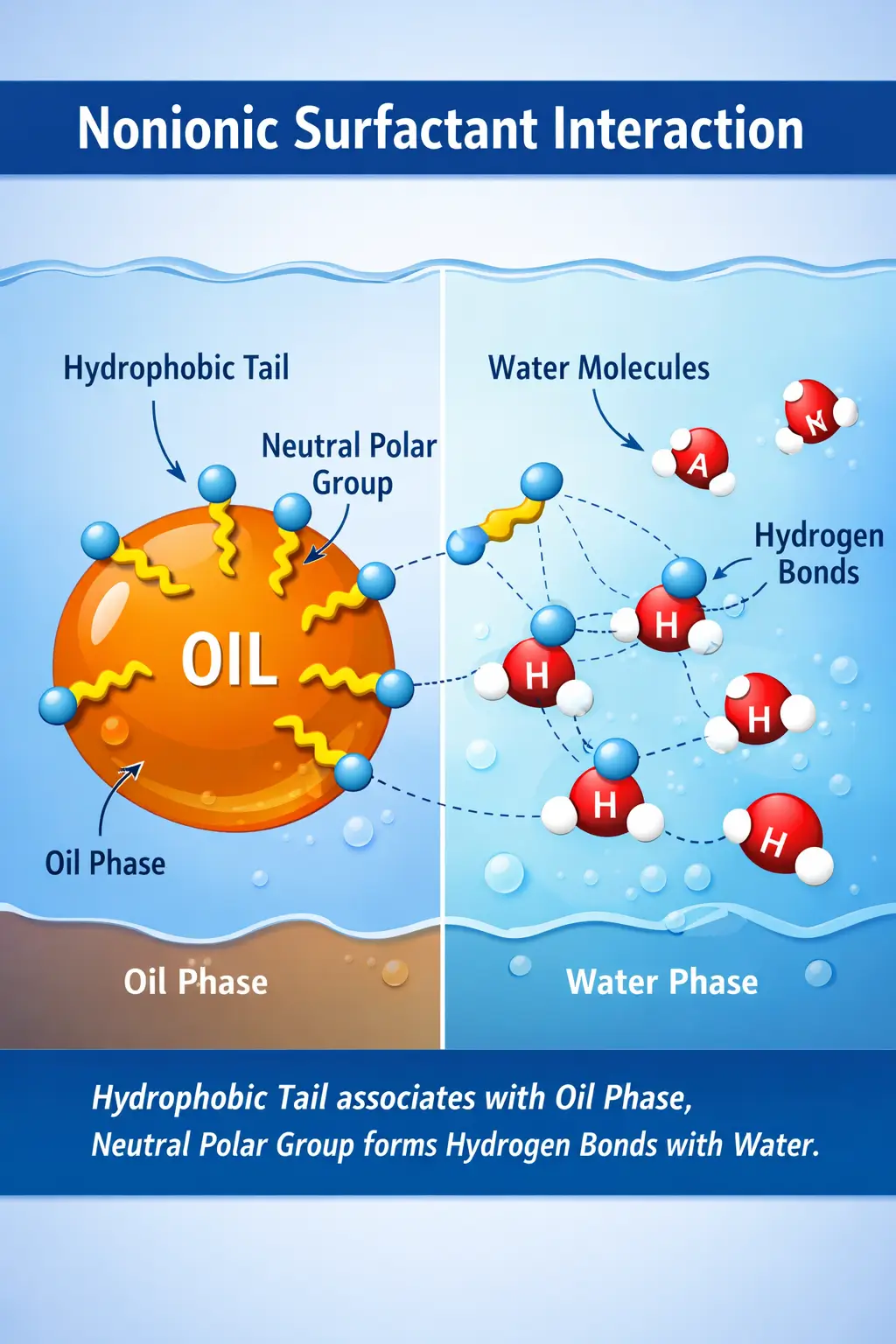
In cleansing formulations, nonionic surfactants usually act as secondary or supporting surfactants rather than as the sole detergency drivers. Their primary function is to improve the dispersion of oils and hydrophobic soils within water based systems. Because the molecules do not carry an electrical charge, they interact with oils primarily through hydrophobic association while remaining compatible with the aqueous phase through hydrogen bonding with water molecules.
This behavior explains why nonionic surfactants in detergents are often paired with anionic surfactants. The anionic molecules provide strong soil removal and foam generation, while the nonionic surfactants improve oil solubilization and stabilize the micelle structures that hold dispersed oils in suspension. The result is a mixed surfactant system capable of cleaning a broader range of soil types.
In cosmetic cleansers the functional emphasis shifts slightly. Nonionic surfactants in cosmetics are frequently used to stabilize fragrance oils, botanical extracts, and other hydrophobic ingredients that would otherwise separate from the aqueous phase. Because they remain electrically neutral, they maintain compatibility with both ionic and nonionic formulation components.
Another contribution involves foam texture and rinsing characteristics. Nonionic surfactants typically produce less foam than strongly anionic surfactants, yet they influence how foam films behave once formed. Their presence can modify foam density and reduce rapid collapse during washing. This property helps create more uniform foam structures in mixed surfactant systems such as shampoos or liquid cleansers.
In water treatment and industrial cleaning applications, the role may involve improving wetting behavior. A non ionic surfactant in water can lower surface tension and allow liquids to spread more evenly across surfaces that might otherwise repel water. This spreading behavior is also one reason similar molecules appear in agricultural spray formulations.
Ingredient Interaction Logic
Nonionic surfactants operate within complex formulation environments where multiple ingredients influence system behavior. Their performance depends not only on their own molecular structure but also on how they interact with water, ionic surfactants, humectants, and other formulation components.
Water forms the continuous phase in most cleansing products. The hydrophilic portion of the nonionic surfactant interacts with surrounding water molecules through hydrogen bonding. This interaction allows the molecule to remain dispersed in the aqueous phase while its hydrophobic tail associates with oils, soils, or air interfaces.
When combined with anionic surfactants, nonionic molecules may integrate into mixed micelles. These micelles consist of aggregated surfactant molecules that trap oils within their hydrophobic interior. Because the nonionic surfactant lacks an electrical charge, it can insert into these structures without introducing additional electrostatic repulsion between neighboring molecules. This often leads to more stable micellar assemblies.
Humectants present in cosmetic cleansers influence the hydration environment surrounding surfactant molecules. Compounds such as glycerin alter the solvent structure of the aqueous phase and can affect how surfactant aggregates form. Nonionic surfactants remain compatible with these ingredients because their hydrophilic groups rely on hydrogen bonding rather than ionic attraction.
Chelating agents present in detergent systems influence surfactant behavior by binding mineral ions that might otherwise disrupt surfactant aggregation. While nonionic surfactants are less sensitive to hard water minerals than ionic surfactants, the removal of calcium and magnesium ions still improves overall formulation stability.
Fragrance components represent another interaction pathway. Many fragrance molecules are hydrophobic and dissolve poorly in water. Nonionic surfactants can incorporate these materials into micelles, allowing them to remain dispersed throughout the formulation. This process helps maintain uniform scent distribution in liquid cleansing products.
Phase Behavior
Like other surfactant classes, nonionic surfactants exhibit characteristic phase behavior in aqueous solutions. At low concentrations the molecules remain dispersed individually throughout the water phase. As concentration increases and reaches the critical micelle concentration, the surfactant molecules begin forming organized structures known as micelles.
Micelles form when hydrophobic tails aggregate toward the center of the structure while hydrophilic groups remain in contact with water. In this arrangement oils and other hydrophobic substances can be trapped within the micelle interior. This process allows cleaning formulations to disperse substances that would otherwise remain insoluble in water.
Temperature influences the phase behavior of many nonionic surfactants. Some structures display a phenomenon known as cloud point behavior. As temperature increases, the hydration of the hydrophilic group may decrease, leading to phase separation of the surfactant solution. Formulators consider this property when selecting surfactants for products that must remain stable under varying storage conditions.
Electrolyte concentration can also influence phase behavior, although nonionic surfactants generally tolerate dissolved salts better than ionic surfactants. Because the molecules lack a permanent charge, they experience less electrostatic interference from dissolved ions present in the water phase.
Comparison With Related Surfactant Classes
Understanding the role of nonionic surfactants becomes easier when they are compared with other surfactant categories commonly used in cleansing formulations. Each class differs in electrical charge, interaction with water, and functional behavior inside mixed surfactant systems.
| Feature | Nonionic Surfactants | Anionic Surfactants | Amphoteric Surfactants |
|---|---|---|---|
| Electrical Charge | No permanent charge | Negative charge in aqueous solution | Charge changes with pH |
| Primary Role | Emulsification and oil solubilization | Primary detergency and foam generation | Compatibility and foam stabilization |
| Sensitivity To Hard Water | Low sensitivity to mineral ions | More sensitive to calcium and magnesium ions | Moderate sensitivity depending on pH |
| Typical Applications | Detergents, cosmetics, agricultural sprays | Laundry detergents, dishwashing liquids | Shampoos, mixed surfactant systems |
This comparison illustrates why nonionic surfactants are often combined with other surfactant classes rather than used alone. Their compatibility with multiple formulation environments allows them to improve stability and performance across a wide range of cleansing and industrial systems.
Regulatory Context
Nonionic surfactants used in personal cleansing products and cosmetics are declared using the International Nomenclature of Cosmetic Ingredients system. The INCI naming framework standardizes ingredient disclosure so that the same chemical substance appears under the same name on product labels regardless of manufacturer. This ensures consistent identification across cosmetic products sold in regulated markets.
Within the European Union, cosmetic ingredients are governed by Regulation (EC) No 1223/2009. This regulation requires full ingredient disclosure, documentation of formulation composition, and traceability of raw materials used in cosmetic manufacturing. When nonionic surfactants appear in shampoos, facial cleansers, or body washes, they must therefore be listed individually using their INCI designations.
Cleaning products such as laundry detergents and household surface cleaners fall under a separate regulatory framework. In the EU these products are regulated by Regulation (EC) No 648/2004 on detergents. This regulation focuses primarily on biodegradability and environmental performance of surfactants. Manufacturers must declare surfactant categories on product packaging and ensure that the surfactant system meets biodegradability requirements established by the regulation.
The difference between cosmetic and detergent regulations explains why ingredient disclosure may vary across product types. Cosmetic labels typically list individual surfactant names, whereas detergent labels sometimes identify surfactant classes such as nonionic surfactants in detergents without naming every molecule in the formulation.
Common Misunderstanding
A frequent misunderstanding arises from assuming that nonionic surfactants represent a single chemical ingredient. In practice the term refers to a structural category of surfactants rather than to one specific molecule. Many different chemical families fall within this classification, including alcohol ethoxylates, alkyl polyglucosides, and other neutral surfactant structures.
Because the classification describes a molecular behavior rather than a single compound, two formulations that both contain nonionic surfactants may use entirely different chemical substances. The shared characteristic is the absence of a permanent electrical charge in the hydrophilic head group when the molecule is dissolved in water.
Another misconception involves the assumption that electrical neutrality automatically means weak cleaning ability. In reality nonionic surfactants often excel at dispersing oily substances because their neutral head groups interact differently with hydrophobic materials. Their cleaning behavior therefore complements the detergency provided by ionic surfactants rather than replacing it.
Structural Limitations
Although nonionic surfactants provide valuable emulsification and compatibility within cleansing formulations, their structure introduces certain formulation constraints. One limitation involves temperature sensitivity. Many nonionic surfactants display cloud point behavior, where increased temperature reduces hydration of the hydrophilic group and causes phase separation of the surfactant solution.
Another limitation relates to foam production. Nonionic surfactants generally produce less foam than strongly anionic detergents. While this property can be advantageous in some formulations, it also means that nonionic molecules are often combined with ionic surfactants when significant foam generation is desired.
Solubility characteristics may also vary depending on the length of the hydrophobic chain and the size of the hydrophilic group. These structural parameters determine how readily the molecule dissolves in water and how effectively it participates in micelle formation. Formulators therefore select specific nonionic surfactants depending on the intended balance between emulsification, detergency, and stability.
These structural constraints do not limit the usefulness of nonionic surfactants but highlight that they function most effectively as part of a carefully balanced surfactant system rather than as the sole active ingredient.
Formulation References Using This Ingredient
- Ajax Dish Soap Ingredients Analysis
- ACE Soap
- Nivea Ingredients Analysis
- Method Laundry Detergent
- Amway Soap Ingredients Analysis
- Buff City Soap Ingredients Analysis
- Charlie’s Soap Ingredients Analysis
- Panoff Soap Ingredients Analysis
- Dial Antimicrobial Soap Ingredients Analysis
- Dove Shea Butter Soap Ingredients Analysis
- Method Laundry Products
- Mrs. Meyer’s Soap Ingredients Analysis
Summary of Findings
- Chemical Classification: Nonionic surfactants are surface active molecules whose hydrophilic groups remain electrically neutral in aqueous solution.
- Functional Role: They act primarily as emulsifiers and compatibility modifiers within mixed surfactant systems used in detergents, cosmetics, and cleaning formulations.
- Interaction Logic: Nonionic surfactants integrate into micelles with other surfactant classes and help disperse oils, fragrances, and hydrophobic materials in water based systems.
- Phase Behavior: Their aggregation behavior includes micelle formation and temperature dependent cloud point phenomena that influence formulation stability.
- System Boundaries: Foam generation, solubility characteristics, and temperature sensitivity determine how these surfactants are used within multi ingredient cleansing systems.