Definition and Functional Identity
Palmitic Acid is a saturated fatty acid belonging to the long-chain fatty acid group, widely used in soap and cleansing formulations as a structural and stability-contributing component.
It is commonly present within triglyceride oils such as palm oil and animal fats, and becomes functionally active in cleansing systems after conversion into soap salts through alkaline reaction.
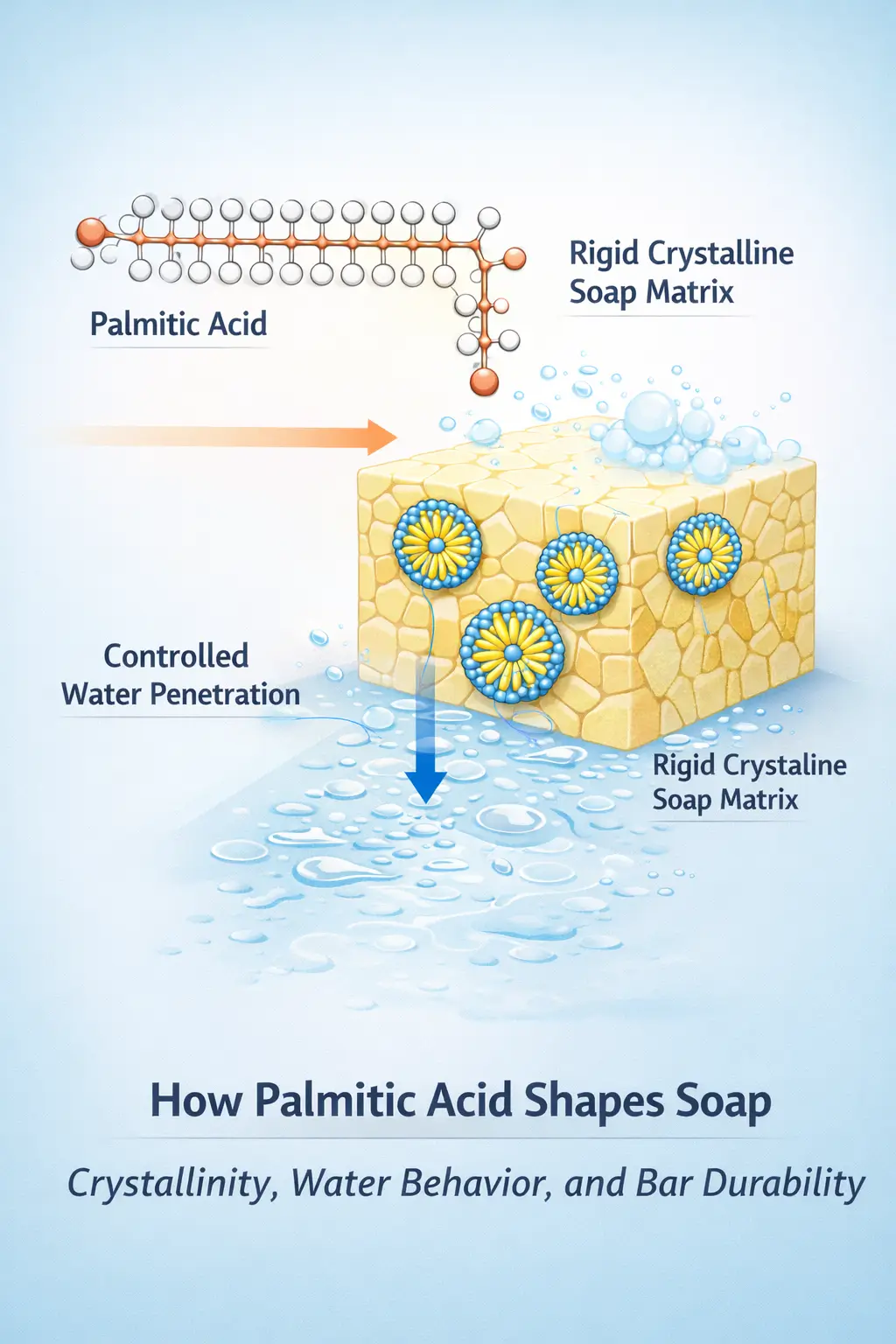
Within formulation design, it contributes to bar rigidity, influences dissolution rate, and supports the development of a stable, persistent lather structure.
In practical terms, formulations containing it tend to produce firmer bars with slower wear during use and a more controlled foam profile compared to systems dominated by shorter-chain fatty acids.
This page is part of the CleanFormulation Ingredient Library, a research-focused project analyzing how ingredients behave within real cleansing formulations.
Quick Facts
| Property | Description |
|---|---|
| Ingredient Type | Fatty acid component |
| Chemical Class | Saturated long-chain fatty acid (C16:0) |
| Functional Role | Matrix structuring agent, bar hardness contributor, formulation stability modifier |
| Ionic Class | Non-ionic in free acid form, converts to anionic palmitate salts after saponification |
| Solubility Profile | Low water solubility, forms crystalline domains in solid systems |
| Typical Use Context | Bar soap matrices, cleansing bases, cosmetic emulsions, structured formulations |
Why This Ingredient Appears on Cosmetic Labels
Palmitic Acid appears on ingredient labels because it serves as a structural component within many cleansing and cosmetic formulations, either as a deliberately added fatty acid or as part of naturally derived oil compositions.
In soap systems, it is often present through oils such as palm oil, where it exists within triglyceride structures and becomes active after chemical conversion into soap salts.
When listed explicitly, it typically indicates that the formulation has been adjusted to achieve specific physical characteristics such as increased hardness, reduced solubility, or enhanced stability of the cleansing matrix.
Its presence on labels reflects formulation design choices related to system structure and performance rather than functioning as an isolated additive.
Chemical Identity and Classification
Palmitic Acid is identified by its INCI name Palmitic Acid and belongs to the class of saturated long-chain fatty acids with a 16-carbon backbone.
It is part of a molecular group that includes other structurally related fatty acids such as stearic and palmitoleic variants, with chain length and saturation level defining its behavior within formulation systems.
In its free acid form, it is non-ionic. Upon reaction with alkaline agents during saponification, it converts into a soap salt, becoming part of an anionic surfactant matrix.
It is commonly derived from plant and animal lipid sources, particularly palm oil, where it exists as a major fatty acid within triglyceride structures. Processing isolates or concentrates it for controlled formulation use.
From a formulation perspective, it functions as a rigidity-enhancing component positioned toward the structural end of the fatty acid spectrum.
Functional Role in Soap Systems
Within soap formulations, Palmitic Acid contributes primarily to structural integrity, bar hardness, and controlled dissolution behavior.
When converted into its sodium or potassium salt, it participates in the surfactant system, contributing to cleansing through aggregation structures that enable oil and particulate removal.
Its lower solubility compared to medium-chain fatty acids results in slower bar wear during repeated use. This makes it a key component in formulations designed for durability.
In lather behavior, it supports the formation of stable foam rather than rapid expansion. The foam produced tends to be less airy and more persistent, contributing to a consistent cleansing experience.
It also enhances the stability of the soap matrix by reinforcing the internal structure, reducing deformation during storage and use.
In observable terms, increasing its proportion leads to a firmer bar, slower dissolution in water, and a more stable but less voluminous foam profile.
Ingredient Interaction Logic
Palmitic Acid functions as part of a multi-component fatty acid system, where its behavior is defined through interaction with other ingredients rather than acting independently.
When combined with shorter-chain fatty acids such as lauric acid, it balances high solubility and rapid foam formation by introducing structural resistance and reducing excessive dissolution.
In combination with longer-chain fatty acids such as stearic acid, it contributes to a more workable balance between rigidity and usability, preventing overly brittle or slow-dissolving structures.
Its interaction with water is characterized by gradual hydration, allowing the soap matrix to maintain integrity while still enabling controlled release of surfactant molecules.
In systems containing humectants such as glycerin, it helps stabilize the internal structure while accommodating moisture retention within the matrix.
It also influences fragrance behavior, as denser soap structures can slow the release of volatile components, resulting in more gradual scent diffusion during use.
Overall, it operates as a structural moderator within fatty acid blends, shaping how the system responds to water exposure and mechanical action.
Phase Behavior and Physical Characteristics
Palmitic Acid exhibits solid-phase behavior at room temperature due to its long-chain saturated structure, forming a relatively stable crystalline arrangement.
Within soap systems, this crystalline contribution supports the formation of a rigid matrix, which influences both mechanical strength and dissolution dynamics.
During saponification, it transitions into a salt form that integrates into the aqueous phase while retaining its influence on structural organization.
Its low solubility compared to shorter-chain fatty acids results in slower hydration and controlled erosion of the soap matrix during use.
Thermally, it remains stable under typical manufacturing conditions, but its crystallization pattern can affect texture depending on cooling rate and formulation composition.
From a user-observable standpoint, this behavior translates into a soap that maintains shape, resists rapid softening, and provides consistent performance across repeated use cycles.
Comparison With Related Fatty Acids
Palmitic Acid occupies a structural position between medium-chain fatty acids and higher molecular weight saturated or unsaturated variants. Comparing it with closely related fatty acids helps clarify how chain length and saturation influence formulation behavior.
| Feature | Palmitic Acid (C16) | Stearic Acid (C18) | Palmitoleic Acid (C16:1) |
|---|---|---|---|
| Chain Structure | Saturated | Saturated | Monounsaturated |
| Solubility | Low | Lower | Higher relative to saturated C16 |
| Bar Hardness Contribution | High | Very high | Lower structural contribution |
| Lather Behavior | Stable and persistent | Low foam contribution | More fluid system influence |
| Dissolution Rate | Controlled | Slow | Faster relative dissolution |
| Formulation Role | Structural balance and stability | Rigidity and reinforcement | Fluidity and flexibility modifier |
Comparative behavior with lauric acid and structurally heavier fatty acids helps define how chain length influences solubility and rigidity within cleansing systems.
This comparison highlights how saturation and chain length together determine whether a fatty acid contributes more toward rigidity, flexibility, or solubility within a cleansing system.
Regulatory Context
Palmitic Acid is listed under its INCI name without specific restriction in major cosmetic regulatory frameworks, including EU Cosmetic Regulation (EC) No 1223/2009.
It is not classified as a restricted ingredient in standard cosmetic use and is permitted in a wide range of formulation types including soaps, cleansers, creams and emulsified systems.
When present as part of natural oil compositions, it may not be listed individually if incorporated within triglyceride structures. However, when used as a defined ingredient, it must be declared according to INCI labeling rules.
It is categorized as a general formulation component rather than being assigned to functional regulatory classes such as preservatives or colorants.
Common Misunderstanding
A common misconception is that Palmitic Acid directly enhances cleansing strength. In formulation practice, its role is primarily structural rather than performance-driven in terms of soil removal.
Although it becomes part of the surfactant system after conversion into soap salts, it does not significantly increase cleansing intensity compared to more soluble fatty acids or synthetic surfactants.
Its main contribution lies in modifying how the system behaves during use, particularly in terms of durability, stability and foam persistence.
Understanding this distinction helps interpretingredient lists more accurately, where its presence reflects structural design choices rather than cleansing strength.
Structural Limitations in Formulation
Palmitic Acid introduces formulation constraints primarily related to its low solubility and high structural contribution.
Excessive concentrations can lead to reduced lather initiation, especially if not balanced with more soluble fatty acids. This may result in slower foam development during initial use.
In hard water environments, soap salts derived from it can contribute to the formation of insoluble residues, affecting rinse characteristics and surface feel.
Its rigidity can also limit flexibility in formulations where softer textures or higher spreadability are required, particularly in emulsified cosmetic systems.
For these reasons, it is typically used as part of a balanced fatty acid system rather than as a dominant standalone component.
Formulation References Using This Ingredient
Summary of Findings
Palmitic Acid is a saturated long-chain fatty acid that functions as a structural and stability-enhancing component within soap and cleansing formulations.
- Classification: Saturated C16 fatty acid contributing to structural integrity.
- Functional Role: Enhances bar hardness, stabilizes foam, and controls dissolution rate.
- Interaction Logic: Works with other fatty acids to balance solubility, durability and usability.
- System Behavior: Influences water interaction and structural cohesion within the soap matrix.
- Limitations: Requires balancing to prevent reduced lather initiation and excessive rigidity.