Opening Definition
Fatty Alcohols are long-chain aliphatic alcohols derived from fatty acids, functioning primarily as rheology modifiers and structural agents within soap, detergent, and cosmetic formulations.
Unlike short-chain alcohols, these materials are non-volatile and wax-like in nature, typically consisting of carbon chains ranging from C12 to C22. This structural length gives them low water solubility and a strong tendency to organize within formulation matrices.
In cleansing systems, their role is not centered on soil removal but on modifying texture, stabilizing emulsions, and supporting surfactant structures. They influence how a product flows, spreads, and maintains internal consistency over time.
In practical use, their presence is associated with thicker textures, creamier foam profiles, and improved structural stability across both liquid and semi-solid systems.
Quick Facts
| Property | Description |
|---|---|
| Ingredient Type | Rheology modifier and co-structuring agent |
| Chemical Class | Long-chain aliphatic alcohols |
| Functional Role | Viscosity control, emulsion stabilization, foam support |
| Ionic Class | Non-ionic |
| Typical Use Context | Cream cleansers, lotions, emulsions, syndet bars |
| Carbon Chain Range | Typically C12 to C22 (e.g., cetyl C16, stearyl C18) |
| Physical Form | Waxy solid flakes, pellets, or pastilles |
| Water Solubility | Very low, forms structured phases rather than dissolving |
| Melting Range | ~45°C to 65°C depending on chain length |
| Primary Function in System | Controls flow behavior and internal structural stability |
| General Molecular Formula | R–OH where R = long hydrocarbon chain (CₙH₂ₙ₊₁) |
| Typical Molecular Weight Range | ~186 to 326 g/mol depending on chain length |
| Hydrophobic Chain Contribution | Accounts for ~85 to 95 percent of molecular structure |
| Hydroxyl Functional Group | Single polar –OH group enabling limited hydrogen bonding |
| Critical Packing Behavior | Favors lamellar and gel phase organization in emulsions |
| Viscosity Impact Range | Can increase system viscosity by 2x to 10x depending on concentration (1–5%) |
| Typical Usage Concentration | ~0.5% to 5% in emulsions, up to ~10% in structured systems |
| Emulsion Stabilization Mechanism | Forms semi-crystalline interfacial film reducing droplet coalescence |
| Foam Stabilization Effect | Increases foam film thickness, reducing bubble collapse rate |
| Foam Persistence Increase | Can extend foam stability duration by ~20 to 50 percent in surfactant systems |
| Shear Response Behavior | Exhibits shear-thinning behavior in structured emulsions |
| Thermal Phase Transition | Solid to liquid transition influences viscosity during cooling cycles |
| Crystalline Structure Type | Semi-crystalline lamellar domains within continuous phase |
| Compatibility with Surfactants | Integrates into micellar or lamellar structures without disrupting charge balance |
| Water Activity Influence | Reduces free water mobility by structuring aqueous phase |
| Spreadability Control | Increases resistance to flow, improving controlled application |
| Phase Separation Resistance | Improves emulsion stability by increasing internal structural cohesion |
| Interaction with Oils | Associates with lipid phase, improving uniform dispersion |
| Oxidation Sensitivity | Generally low due to saturated hydrocarbon chains |
| System Rigidity Threshold | Above ~5 to 8% may lead to overly stiff or waxy textures |
| Rinse Behavior Impact | May contribute to slight residual film depending on formulation balance |
| Long-Term Stability Contribution | Supports structural consistency over extended storage periods |
Why This Ingredient Appears on Labels
Fatty alcohols appear on ingredient lists because they are used to control the physical structure of a formulation, rather than to perform the primary cleansing action. They are commonly listed under specific names such as cetyl alcohol, stearyl alcohol, or cetearyl alcohol.
In label interpretation, these ingredients reflect the presence of a structured emulsion or thickened system, where internal organization is required to maintain consistency and stability. Their inclusion often indicates that the formulation is designed to resist separation and maintain uniform texture.
According to conventions explained in ingredient list interpretation guide, ingredients are declared using standardized INCI names, which can make structurally simple materials appear more complex than their functional role suggests.
From an observable standpoint, products containing these components tend to exhibit smoother texture, reduced phase separation, and more controlled dispensing behavior compared to systems without structural modifiers.
Chemical Identity And Classification
Fatty alcohols are a class of organic compounds characterized by a long hydrocarbon chain attached to a terminal hydroxyl group. In cosmetic and cleansing formulations, they are typically represented by materials such as cetyl alcohol (C16), stearyl alcohol (C18), and their mixtures.
From a classification standpoint, they belong to the broader group of aliphatic alcohols, but differ significantly from short-chain alcohols due to their high molecular weight and low volatility. Their structure is dominated by a hydrophobic chain, with only a single polar functional group.
These materials are non-ionic and do not dissociate in water. As a result, their behavior is not governed by charge interactions but by physical organization within the formulation matrix.
They are commonly derived from hydrogenated fatty acids obtained from plant oils or animal fats. Once converted into alcohol form, they exhibit distinct behavior compared to their fatty acid counterparts.
In formulation terms, this identity translates into a material that does not act as a primary active agent but instead contributes to structure formation and phase organization.
Functional Role In Cleansing And Cosmetic Systems
The primary function of fatty alcohols in formulations is to modify rheological properties, meaning they control how a product flows, spreads, and maintains its shape under stress.
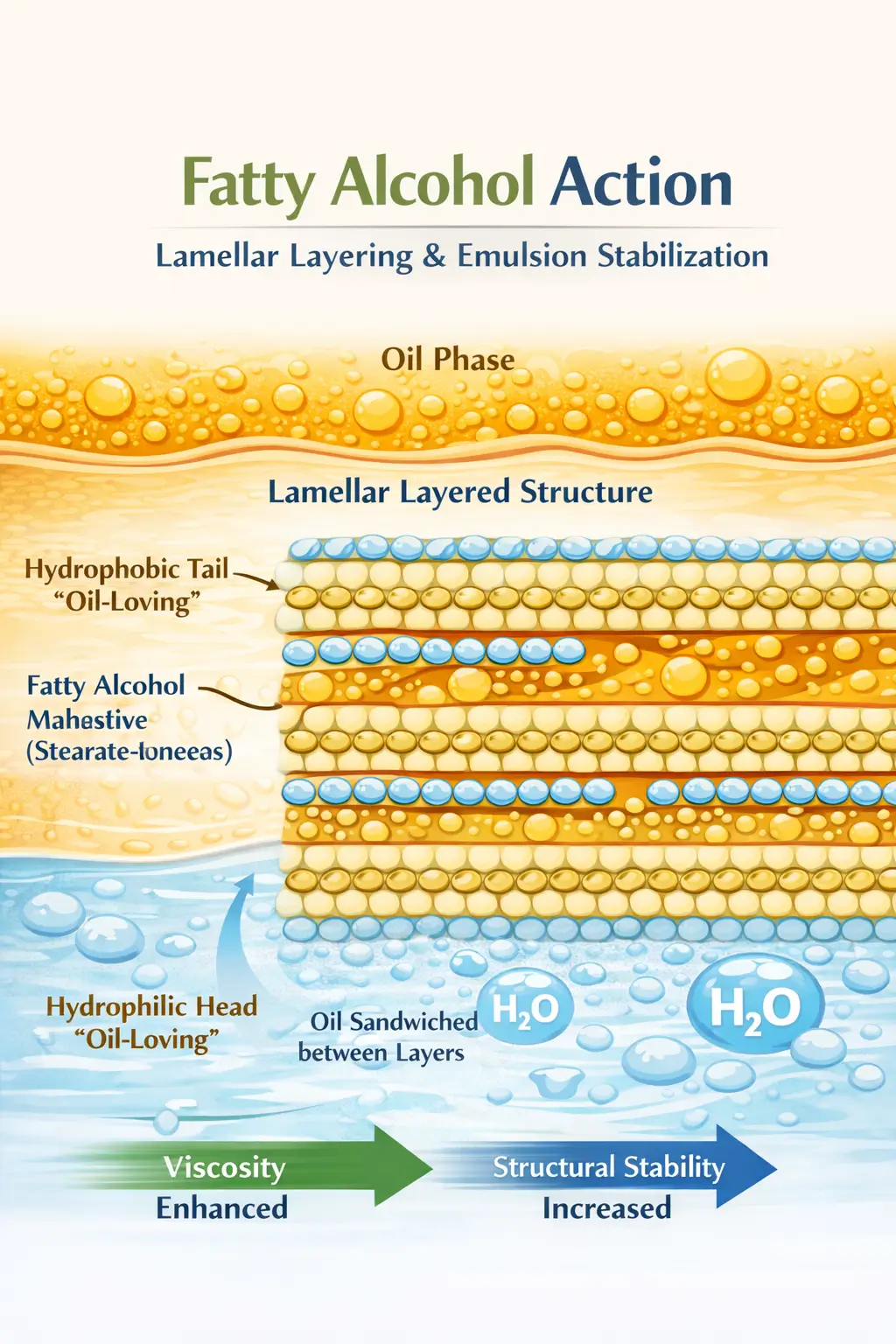
Within emulsified systems, they act as co-structuring agents, forming semi-crystalline networks that stabilize the interface between oil and water phases. This reduces the likelihood of phase separation over time.
They also influence foam characteristics when present alongside surfactants. While they do not generate foam independently, they can produce a denser and more stable foam structure by reinforcing the liquid films surrounding air bubbles.
In cleansing systems, their contribution is indirect. They adjust how surfactants are organized in solution, which can affect lather consistency and rinse behavior without altering the core cleansing mechanism described in soap cleansing mechanism explanation.
From a user-observable perspective, this results in formulations that feel more cohesive, less watery, and more controlled during application, particularly in creams and lotion-based cleansers.
Ingredient Interaction Logic
Fatty alcohols operate within a network of interactions rather than acting independently. Their behavior depends heavily on how they integrate with other formulation components.
In systems containing surfactants, they interact with micellar structures, often inserting themselves into organized assemblies and altering the packing density. This can modify viscosity and foam stability without directly contributing to surface activity.
When combined with emulsifiers, they reinforce the interfacial film between oil and water phases. This interaction enhances mechanical stability and reduces coalescence of dispersed droplets.
In the presence of water, they do not dissolve fully but instead participate in forming structured phases, including lamellar or gel-like arrangements. These phases influence how the formulation behaves under shear and during application.
Interaction with humectants such as glycerin can further modify system behavior. Increased water retention may soften the internal structure, leading to a shift in viscosity over time.
They also interact with fatty acid soap systems indirectly. In soap-based formulations derived using sodium hydroxide, fatty alcohols can influence the crystalline organization of the soap matrix, although they are not part of the saponification reaction itself.
These interactions collectively determine whether a product remains stable, separates over time, or changes texture during storage and use.
Phase Behavior And Structural Organization
Fatty alcohols exhibit distinct phase behavior due to their long hydrophobic chains and limited water compatibility. Rather than dissolving, they tend to organize into ordered structures within the formulation.
At temperatures above their melting range, they exist in a molten state and can be dispersed uniformly. As the system cools, they crystallize into structured domains that contribute to viscosity and stability.
In emulsions, they often form lamellar phases, where alternating layers of hydrophobic and hydrophilic components create a semi-ordered arrangement. These structures act as a backbone for the formulation.
The formation of these phases depends on concentration, temperature, and the presence of surfactants or emulsifiers. Small changes in these variables can shift the system from fluid to semi-solid.
Unlike fully soluble ingredients, fatty alcohols maintain a persistent structural presence within the formulation. This stability allows them to support long-term consistency but also limits their flexibility in highly dynamic systems.
In observable terms, this behavior explains why products containing these materials maintain uniform thickness, resist separation, and retain texture across repeated use.
Comparison With Related Ingredients
Fatty alcohols are often compared with fatty acids due to their similar chain length and origin. However, their behavior in formulations differs significantly because of their functional group and interaction with water systems.
| Feature | Fatty Alcohols | Fatty Acids |
|---|---|---|
| Functional Group | Alcohol (–OH) | Carboxylic acid (–COOH) |
| Primary Role | Structure and viscosity control | Soap formation and surfactant base |
| Water Interaction | Forms structured phases | Can form soluble salts after neutralization |
| Surface Activity | Low | High after saponification |
| System Contribution | Stabilizes emulsions and texture | Defines cleansing mechanism |
| Typical Usage Context | Emulsions, creams, structured cleansers | Soap bars, surfactant systems |
This comparison highlights that fatty alcohols contribute primarily to physical structure, while fatty acids participate directly in chemical transformation and cleansing behavior.
Regulatory Context
Fatty alcohols are listed under their specific INCI names, such as cetyl alcohol or stearyl alcohol, rather than as a group. This reflects standardized naming conventions used in cosmetic labeling frameworks.
Within the European regulatory system, ingredients are declared according to INCI rules that define naming, order, and classification. These conventions are explained in soap regulatory framework explanation.
Their classification typically falls under cosmetic ingredients used for structural or formulation purposes. They are not categorized as active agents unless combined with additional functional claims.
From a labeling perspective, their presence indicates the formulation includes a structured phase system, which can influence texture and stability rather than primary cleansing action.
Common Misunderstanding
A common misunderstanding is that fatty alcohols behave similarly to short-chain alcohols used as solvents. In reality, they are chemically and physically distinct due to their long hydrocarbon chains and low volatility.
This confusion often arises from naming conventions, where the term “alcohol” is interpreted without considering molecular structure. The naming system is discussed in why ingredient names sound chemical.
Unlike volatile alcohols, fatty alcohols do not evaporate quickly and instead remain within the formulation, contributing to structure and consistency.
Understanding this distinction helps explain why their inclusion is associated with thicker textures and more stable systems rather than rapid evaporation or solvent effects.
Structural Limitations
Despite their stabilizing role, fatty alcohols introduce certain formulation constraints that must be considered during system design.
One limitation is their low water solubility, which restricts their use in highly dilute or fully aqueous systems. They require appropriate emulsification or dispersion to function effectively.
Their crystalline behavior can also lead to phase rigidity. While beneficial for stability, excessive structuring may result in formulations that are difficult to spread or dispense.
Temperature sensitivity is another factor. Changes in temperature can alter crystalline organization, potentially affecting viscosity and texture over time.
Additionally, their interaction with other structuring agents must be carefully balanced. Overlapping structural networks can create instability or unpredictable rheological behavior.
In practical terms, these limitations explain why fatty alcohols are used in controlled concentrations and are typically combined with complementary ingredients to achieve balanced performance.
Formulation References Using This Ingredient
- Williams Sonoma Spiced Chestnut – Fragrance Structure & Cross
- Williams Sonoma Soap & Lotion Sets
- Mrs. Meyer’s Soap Ingredients Analysis
- Zest Soap Ingredients Analysis
- Williams Sonoma Hand & Body Lotions – Formulation & Performance Analysis
- Method Laundry Products
- ECOS Soap Ingredients Analysis
- Cetaphil Cleansing Formulations Analysis
Summary of Findings
- Classification: Fatty alcohols are long-chain aliphatic alcohols used as non-ionic structural components.
- Functional Role: They control viscosity, stabilize emulsions, and support foam structure rather than performing primary cleansing.
- Interaction Logic: Their behavior depends on integration with surfactants, emulsifiers, and water phase systems.
- Phase Behavior: They form semi-crystalline and lamellar structures that define formulation stability.
- System Boundaries: Low solubility, temperature sensitivity, and structural rigidity limit their use in certain formulations.