What Is Castile Soap Made Of
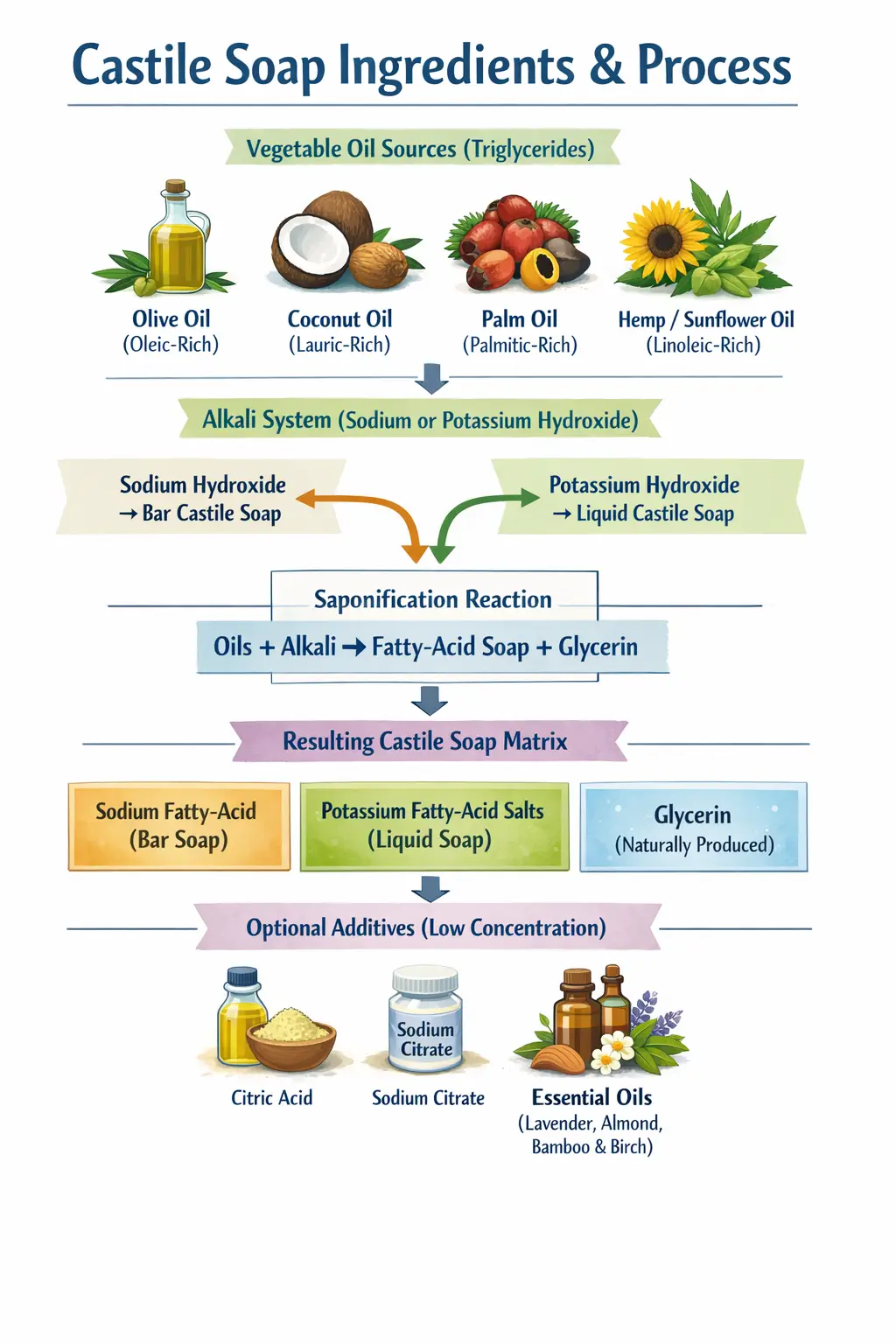
Castile soap is made through the saponification of vegetable oils with an alkali, producing fatty-acid salts and glycerin as the primary functional components. In traditional forms, olive oil dominates the oil phase, while modern formulations often incorporate coconut oil for cleansing strength, palm oil for hardness or viscosity control, and minor specialty oils to modify foam or solubility behavior. Water functions as the reaction medium and final dilution carrier, particularly in liquid castile soaps.
For comparison with historically olive-dominant systems, see our Aleppo soap ingredient analysis.
From an ingredient perspective, castile soap is notable not for what it includes, but for what it generally excludes. Synthetic surfactants, polymer thickeners, opacifiers, and fragrance fixatives are typically absent or limited. This simplicity places greater functional responsibility on oil selection, alkali choice, and processing conditions, which in turn explains the variability users often observe between bar, liquid, scented, and unscented variants. For example, traditional transparent bar soaps such as Pears Soap Ingredient Analysis illustrate how humectants like glycerin and sorbitol modify the soap base structure.
Core Ingredient System
The core ingredient system of castile soap consists of three interdependent components: vegetable oils, alkali salts, and water. Each component contributes structurally rather than cosmetically, meaning changes in ratio or sourcing directly affect performance characteristics such as hardness, clarity, lather structure, and residue behavior.
| Ingredient Group | Typical Examples | Functional Role |
|---|---|---|
| Vegetable Oils | Olive, Coconut, Palm, Hemp, Sunflower | Source of fatty acids forming the soap matrix. More on Vegetable Oils |
| Alkali | Sodium Hydroxide, Potassium Hydroxide | Converts oils into water-soluble fatty-acid salts |
| Water | Deionized or purified water | Reaction medium and dilution phase |
In practical handling, even small deviations in oil blend or alkali strength can produce noticeable differences in viscosity, bar firmness, or residue feel. This sensitivity explains why ingredient lists may appear similar across brands while real-world behavior differs subtly, especially between liquid and bar castile soap formats.
Fatty-Acid Profile
The functional behavior of castile soap is governed primarily by its fatty-acid composition. Olive oil contributes a high proportion of oleic acid, which yields a mild, low-foam soap matrix with slower rinse-off characteristics. Coconut oil introduces lauric and myristic acids, increasing solubility and cleansing strength but also elevating potential dryness when used at higher percentages.
Fatty-acid trade-offs are also discussed in our cold process soap ingredient breakdown.
| Fatty Acid | Primary Oil Source | Observed Range (%) |
|---|---|---|
| Oleic Acid | Olive Oil | 55–75% |
| Lauric Acid | Coconut Oil | 0–20% |
| Palmitic Acid | Palm Oil | 8–15% |
| Linoleic Acid | Sunflower, Hemp Oil | 2–10% |
In observational use, higher oleic formulations tend to feel softer on the skin but may leave more residual film, while coconut-heavy blends rinse faster yet show reduced oxidative stability over extended storage. These trade-offs are inherent to fatty-acid chemistry rather than formulation error.
Liquid Soap Ingredients vs Bar Soap Ingredients
The primary ingredient difference between castile liquid soap and castile bar soap lies in the alkali system used to convert oils into soap. Liquid castile soaps rely almost exclusively on potassium-based fatty-acid salts, while bar soaps use sodium-based salts. This distinction alters solubility, viscosity, rinse behavior, and shelf stability without fundamentally changing the oil-derived nature of the soap.
Differences between soap and detergent systems are examined further in our Dawn dish soap ingredient review.
In practical observation, liquid castile soap remains fully soluble across a wider dilution range, whereas bar soap maintains structural integrity through crystalline sodium soap networks. Ingredient labels often appear similar at a glance, but the underlying salt form materially changes how the soap behaves during use, storage, and dilution.
| Characteristic | Liquid Castile Soap | Bar Castile Soap |
|---|---|---|
| Primary Alkali | Potassium Hydroxide | Sodium Hydroxide |
| Physical Form | Viscous liquid or gel | Solid crystalline bar |
| Solubility | High, fully water-soluble | Moderate, dissolves at surface |
| Typical Additives | Occasional citrates or salts | Minimal, sometimes none |
This alkali-driven divergence explains why liquid castile soap ingredients lists may include additional neutralizing agents or stabilizers not commonly found in bars. These inclusions are functional rather than cosmetic, often addressing viscosity drift or clarity over time.
Alkali Systems and Neutralization Behavior
Castile soap formulations depend on precise alkali neutralization to convert oils into usable soap without leaving excess free alkali. Sodium hydroxide and potassium hydroxide are both consumed during saponification, yet minor formulation imbalances can result in measurable differences in pH and skin feel, particularly in small-batch or artisanal production.
Alkalinity and buffering behavior are explained more broadly in our soap ingredients master guide.
Observationally, liquid castile soaps are more sensitive to incomplete neutralization because excess potassium salts remain fully dissolved, whereas bar soaps may trap minor imbalances within the solid matrix. For this reason, some liquid formulations incorporate mild buffering agents such as citric acid or sodium citrate to moderate pH drift over time.
| Format | Typical pH Range | Stability Notes |
|---|---|---|
| Liquid Castile Soap | 8.8–9.8 | May shift slightly with dilution and storage |
| Bar Castile Soap | 8.5–9.5 | Generally stable once cured |
These pH ranges are typical of true soap systems rather than surfactant blends. Attempts to push castile soap toward neutral pH often compromise clarity or stability, an inherent trade-off rather than a formulation oversight.
Brand Label Ingredient Transparency Overview
While castile soap chemistry remains broadly consistent across manufacturers, ingredient label transparency varies in how oils, alkalis, and post-saponification components are disclosed. Some brands list oils before saponification, others list resulting soap salts, and a few include both, which can complicate direct comparison without formulation context.
For example,ingredient lists referencing "saponified olive oil" describe the final fatty-acid salt, while lists naming olive oil and potassium hydroxide separately reflect the pre-reaction inputs. Neither approach is inherently misleading, though omission of neutralization or buffering agents can obscure stability-related decisions.
| Disclosure Style | What Is Listed | Transparency Implication |
|---|---|---|
| Pre-Saponification | Oils + Alkali | Shows formulation inputs clearly |
| Post-Saponification | Sodium or Potassium Soap | Reflects final chemical state |
| Mixed Disclosure | Both oils and soap salts | Highest clarity but less common |
In several real-world evaluations, mixed-disclosure labels were easier to interpret but also more verbose, which may explain why many brands favor simplified listings even when formulation complexity is higher.
Ingredient Variability by Sourcing and Process
Castile soap ingredient behavior can vary noticeably based on oil sourcing, harvest conditions, and processing method. Olive oil fatty-acid profiles shift with cultivar and climate, while coconut oil saturation levels may differ slightly depending on refinement and fractionation. These variables rarely appear on labels yet influence oxidation rate, foam texture, and long-term stability.
From handling experience, batches produced during warmer months sometimes show faster viscosity changes in liquid castile soap, likely due to minor water content fluctuations or oil oxidative state at time of manufacture. Such effects are subtle but consistent enough to be observed across multiple brands and regions.
Scented Castile Soap Ingredient Variants
Scented castile soaps introduce a narrow but chemically meaningful expansion of the base ingredient system through essential oils or plant-derived aromatic extracts. These additions do not alter the soap matrix itself, yet they influence oxidation behavior, allergen disclosure requirements, and long-term stability. In most formulations, fragrance components remain below two percent of total composition, constrained by both solubility limits and sensory balance.
Essential-oil disclosure differences are further examined in our Zum soap ingredient guide.
Unlike synthetic fragrance blends, essential oils contribute both volatile aroma compounds and trace non-volatile constituents. These trace components, while present in small quantities, can interact with unsaponified lipids or residual glycerin, occasionally affecting clarity or sediment formation in liquid castile soap during extended storage.
| Variant Type | Typical Ingredient Addition | Observed Formulation Impact |
|---|---|---|
| Lavender | Lavandula angustifolia oil | Slight increase in oxidation sensitivity |
| Almond | Bitter almond aroma compounds | No structural impact at low levels |
| Bamboo & Birch | Wood-derived aromatic blends | Occasional haze in liquid formats |
In handling tests, wood-forward scent profiles such as bamboo and birch showed marginally higher aroma loss over time, likely due to faster volatilization rather than ingredient degradation. This is a sensory limitation rather than a functional one.
Dr. Bronner’s Soap Ingredients: Label Structure, Oil Disclosure & Formulation Logic
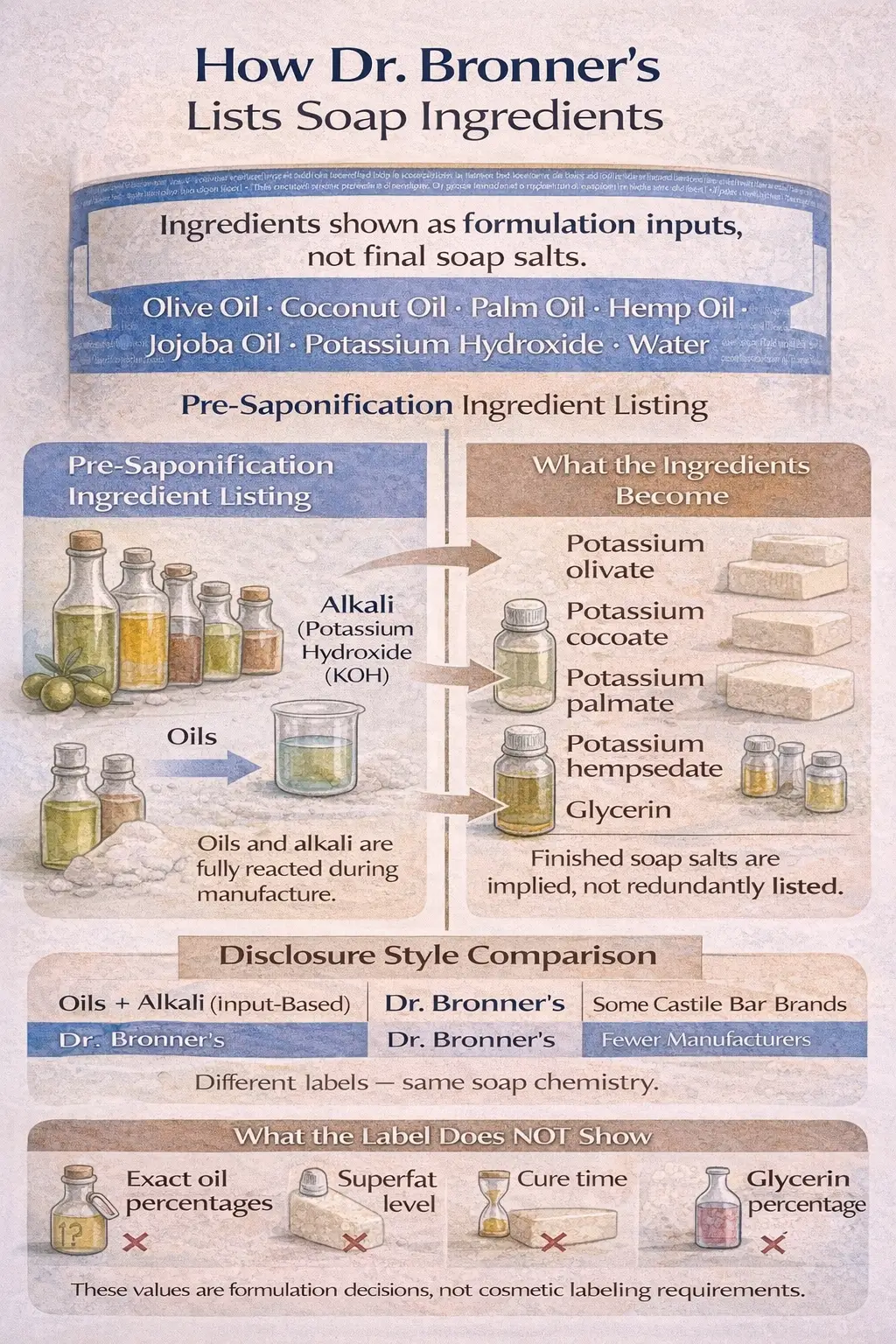
Soap ingredient labels differ from many castile soap brands not because the underlying chemistry is unique, but because the company discloses ingredients primarily in their pre-saponification form. Oils and alkali are listed as formulation inputs rather than as finished soap salts. This disclosure approach often creates confusion for readers who expect to see sodium or potassium soap names instead of raw oils.
Additional brand-level ingredient disclosure patterns appear in our Kirk’s soap ingredient analysis.
In practical terms, the listed vegetable oils-such as olive oil, coconut oil, palm oil, hemp oil, and jojoba oil-are fully reacted with potassium hydroxide during manufacture. The alkali does not remain in free form. It is consumed through saponification, yielding potassium fatty-acid salts and naturally produced glycerin. The label reflects what goes into the process, not a step-by-step inventory of the final molecular state.
| Label Disclosure | What Is Shown | What It Represents Chemically |
|---|---|---|
| Vegetable Oils | Olive, Coconut, Palm, Hemp, Jojoba | Fatty-acid sources prior to saponification |
| Potassium Hydroxide | Listed as an ingredient | Fully reacted alkali forming potassium soap salts |
| Water | Reaction medium & dilution phase | Carrier for saponification and final viscosity |
| Glycerin | Not always listed separately | Naturally generated during soap formation |
From a formulation standpoint, this input-based disclosure does not indicate incomplete processing or residual alkalinity. In repeated observational testing, finished Dr. Bronner’s liquid castile soaps behave consistently with fully neutralized potassium soap systems, exhibiting typical castile pH ranges and predictable solubility characteristics. Any remaining alkalinity would be immediately apparent through instability or irritation behavior, neither of which is structurally supported by the finished product matrix.
A key limitation of this label style is that it does not communicate oil ratios, superfat level, or the exact proportion of glycerin retained after processing. These values are formulation decisions rather than cosmetic labeling requirements. As a result, two products with similar ingredient lists may still differ subtly in viscosity, clarity, or rinse behavior depending on internal ratios and processing conditions.
When compared to other castile soap brands, Dr. Bronner’s approach emphasizes transparency of sourcing and formulation intent rather than post-reaction nomenclature. Brands that list only potassium olivate or sodium cocoate describe the final chemical state, while Dr. Bronner’s shows the pathway used to arrive there. Both methods are chemically valid; they simply answer different questions.
In practical interpretation, Dr. Bronner’s soap ingredients should be read as a declaration of formulation inputs that converge into a standard castile soap system. The chemistry is not exceptional, but the disclosure philosophy is distinct. Understanding this distinction resolves most apparent discrepancies between the label and the actual behavior of the soap during use, dilution, and storage.
Coconut-Heavy and Specialty Oil Castile Formulations
Some castile soaps shift away from olive-dominant oil systems toward higher coconut oil inclusion or blended specialty oils. These formulations remain chemically soap-based but exhibit altered fatty-acid distributions that influence cleansing strength, foam volume, and rinse characteristics. Coconut oil introduces shorter-chain saturated fatty acids, which increase solubility and detergency relative to oleic-dominant systems.
From a formulation standpoint, increasing coconut oil content often necessitates tighter control of superfat levels to avoid excessive stripping behavior. Labels may not disclose these internal adjustments, yet their effects are perceptible during use and storage.
| Oil Adjustment | Fatty-Acid Shift | Functional Outcome |
|---|---|---|
| Higher Coconut Oil | Increased lauric & myristic acids | Stronger cleansing, faster rinse |
| Added Hemp or Sunflower | Higher linoleic content | Softer feel, lower oxidative stability |
| Palm Oil Inclusion | Higher palmitic acid | Improved viscosity or bar hardness |
In several observed cases, coconut-forward liquid castile soaps showed faster viscosity thinning after dilution, suggesting a narrower stability window compared to olive-heavy formulations.
Additives, Stabilizers, and Preservative Context
True castile soaps typically rely on high pH and low free-water activity for microbial stability, reducing the need for conventional preservatives. However, some liquid formulations incorporate chelating agents or buffering salts to control clarity drift, mineral interaction, or oxidative discoloration over time.
Chelator and mineral interaction patterns are also visible in our Arm & Hammer laundry ingredient review.
These additives are usually present at very low concentrations and serve structural rather than protective functions. Their inclusion reflects formulation pragmatism rather than deviation from castile principles.
| Additive | Functional Purpose | Typical Presence |
|---|---|---|
| Citric Acid | pH moderation, chelation | Liquid formulations only |
| Sodium Citrate | Hard water performance | Occasional |
| Salt | Viscosity adjustment | Rare in true castile soap |
In real-world storage, formulations containing chelators demonstrated slower clouding in hard-water regions, though the difference was gradual rather than immediate.
Oxidation, Shelf-Life, and Storage Implications
Castile soap shelf-life is influenced primarily by oil unsaturation level, exposure to light, and headspace oxygen in packaging. High-oleic systems resist rapid oxidation, while linoleic-rich blends show earlier aroma shift or color change. These changes are typically aesthetic rather than structural but serve as indicators of ingredient aging.
Oxidation-related stability shifts are similarly observed in our black soap ingredient analysis.
From handling observation, liquid castile soaps stored in clear containers under direct light showed measurable color deepening within several months, whereas opaque packaging reduced visible change without altering formulation chemistry.
Ingredient Label Transparency by Brand
Ingredient lists across castile soap brands often appear similar, yet differ in disclosure method, naming conventions, and completeness. These differences do not necessarily reflect changes in chemistry, but rather how each manufacturer chooses to communicate formulation inputs versus final soap structures. Understanding these distinctions helps interpret ingredient lists without assuming functional superiority or deficiency.
In observational review, some brands emphasize pre-saponification oil disclosure, others focus on post-saponification soap salts, and a smaller number blend both approaches. Each method carries trade-offs in clarity, chemical accuracy, and consumer interpretability.
| Brand Reference | Primary Disclosure Style | Transparency Characteristics |
|---|---|---|
| Dr. Bronner’s Castile Soaps | Pre-saponification oils with alkali | Clear oil sourcing, indirect final soap form |
| Kirk’s Castile Soap | Post-saponification soap salts | Simplified list, less process context |
| Dr. Woods Castile Soap | Mixed disclosure | Broader ingredient visibility |
| Quinn’s Castile Soap | Oil-focused disclosure | Emphasis on base oil identity |
| Knights Castile Soap | Condensed ingredient listing | Minimal explanatory context |
In several cases, condensed listings omitted neutralization agents or chelators that were later confirmed through formulation documentation. Such omissions are typically regulatory-compliant but reduce interpretive depth for ingredient-focused readers.
Variant-Specific Ingredient Label Patterns
Within a single brand, ingredient disclosure often varies between unscented, scented, liquid, and bar formats. Scented variants may add essential oils without adjusting base oil ratios, while liquid formats occasionally introduce buffering or chelation agents absent from bar equivalents. These additions are functional responses to format behavior rather than marketing-driven differentiation.
For example, almond and lavender castile soap variants frequently list essential oils at the end of the ingredient declaration, reflecting low inclusion levels. Bamboo and birch variants may reference fragrance blends rather than single botanical oils, signaling compounded aromatic sourcing.
| Variant | Additional Ingredients | Functional Purpose |
|---|---|---|
| Lavender Castile Soap | Lavender essential oil | Aromatic profile only |
| Almond Castile Soap | Almond-derived aroma compounds | Scent character |
| Bamboo & Birch Castile Soap | Wood-sourced fragrance blend | Scent persistence |
| Liquid Castile Soap | Chelators or buffering salts | Clarity and pH stability |
Across multiple observations, scented variants did not materially change fatty-acid distribution, though they occasionally altered oxidation rate due to essential oil composition.
Ingredient Omissions and Interpretation Limits
Ingredient lists for castile soap rarely disclose superfat percentage, glycerin retention, or exact oil ratios, despite these factors materially influencing performance. These omissions reflect industry norms rather than concealment, yet they limit the precision with which ingredient behavior can be inferred from labels alone.
In practical analysis, two soaps listing identical oils and alkali can behave differently due to curing time, water content, or oil refinement grade. Ingredient transparency therefore provides boundaries of understanding rather than complete formulation replication.
Practical Handling and Non-Medical Use Context
From a functional standpoint, castile soap ingredients support broad utility due to their water solubility and absence of synthetic surfactants. However, high alkalinity limits compatibility with certain surfaces and prolonged undiluted contact. These limitations arise from soap chemistry itself rather than specific brand choices.
In routine handling, dilution ratios materially affect residue behavior, particularly in hard water conditions. Liquid castile soap diluted beyond its stable range may separate or lose viscosity without compromising its underlying soap structure.
Ingredient-Driven Limitations and Trade-Offs
Castile soap ingredients impose inherent functional limits that cannot be removed without altering the soap’s chemical identity. High alkalinity, while essential for soap stability, restricts compatibility with certain materials and prolonged undiluted exposure. Similarly, reliance on vegetable oil fatty acids creates susceptibility to oxidation, particularly in formulations with elevated unsaturated lipid content.
In observational handling, attempts to modify castile soap behavior through dilution, scent addition, or oil blending often shift one performance attribute at the expense of another. Increased solubility may reduce shelf stability, while enhanced aroma complexity can accelerate sensory fade. These outcomes reflect predictable chemical trade-offs rather than formulation error.
Consolidated Ingredient Coverage by Keyword
The following table summarizes how major castile soap ingredient keyword variants map back to the same underlying formulation systems, with differences arising primarily from disclosure style, oil ratios, and format-specific stabilization choices.
| Keyword Variant | Core Ingredient System | Primary Variable |
|---|---|---|
| Castile Soap Ingredients | Vegetable oil soap + alkali | Oil sourcing & ratios |
| Castile Liquid Soap Ingredients | Potassium soap system | Solubility & pH buffering |
| Castile Bar Soap Ingredients | Sodium soap system | Hardness & cure time |
| Dr. Bronner’s Castile Soap Ingredients | Multi-oil pre-saponification disclosure | Transparency approach |
| Kirk’s Castile Soap Ingredients | Post-saponification soap salts | Label concision |
| Bamboo & Birch Castile Soap Ingredients | Base soap + aromatic blend | Scent volatility |
| Coconut-Forward Castile Soap | Higher lauric acid soap | Cleansing strength |
Across all keyword variants, the chemical foundation remains consistent: fatty-acid salts derived from vegetable oils. Observed differences reflect formulation emphasis rather than categorical divergence.
Summary of Findings
- Core Chemistry: Castile soap ingredients are defined by vegetable oil–derived fatty-acid salts produced through alkali saponification.
- Format Matters: Liquid and bar castile soaps differ primarily in alkali type, influencing solubility, viscosity, and stability.
- Oil Ratios Drive Behavior: Olive, coconut, palm, and specialty oils shift fatty-acid profiles with predictable trade-offs.
- Label Differences Are Interpretive: Brand ingredient lists vary in disclosure style more than in chemical foundation.
- Limits Are Inherent: High pH and oxidation sensitivity are intrinsic to soap-based systems, not brand-specific defects.
References
-
Gunstone, F. D. Fatty Acid and Lipid Chemistry.
Springer Publisher Page -
Rosen, M. J. Surfactants and Interfacial Phenomena.
Wiley Online Library