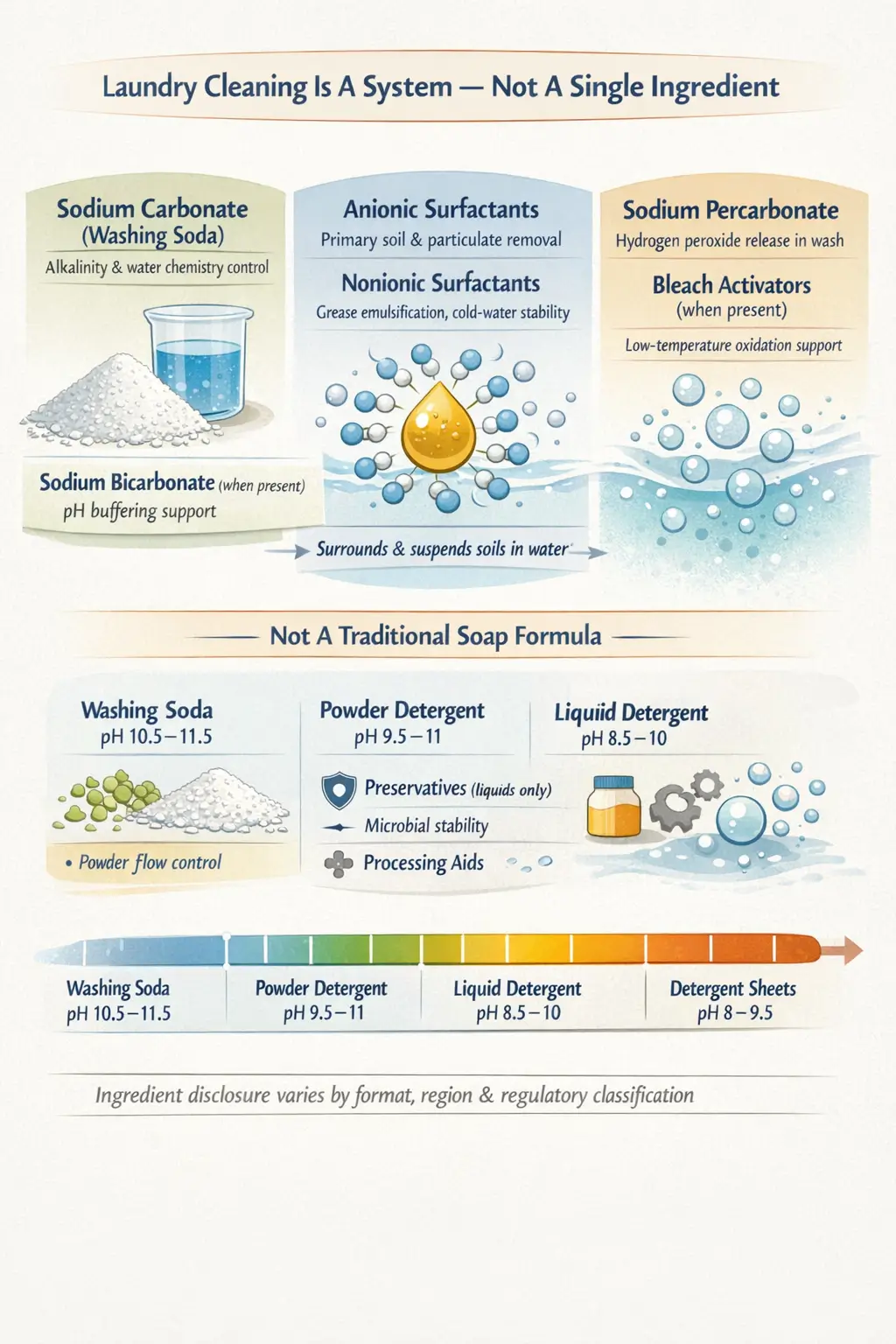
Ingredient Systems Overview
Across Arm & Hammer laundry soap, powder detergent, liquid detergent, and detergent sheet formats, ingredients cluster into four primary functional systems: alkaline builders, surfactants, optional oxidizing agents, and minor formulation stabilizers. The balance between these systems shifts by product type, but the underlying chemistry remains relatively consistent.
| System | Typical Ingredients | Primary Function |
|---|---|---|
| Alkaline Builders | sodium bicarbonate, Sodium carbonate, Related carbonate-heavy systems are reviewed in our Charlie’s Soap ingredient guide | Water softening, soil release, pH elevation |
| Surfactants | Anionic and nonionic detergents | Oil emulsification, particulate suspension |
| Oxidizing Systems | Sodium percarbonate, activators | Color-safe stain oxidation |
| Minor Additives | Anti-caking agents, stabilizers | Flow control, shelf stability |
In several handling observations, powdered formulations relying heavily on sodium carbonate exhibit a dry, free-flowing texture when fresh, though moisture exposure can rapidly alter particle cohesion. This behavior is consistent with the hygroscopic tendencies of alkaline salts rather than any surfactant instability.
Washing Soda Chemistry In Products
Arm & Hammer washing soda is chemically defined as sodium carbonate, a simple inorganic salt with a high alkalinity in aqueous solution. Its ingredient list is typically singular, reflecting minimal formulation complexity.
| Property | Observed Range |
|---|---|
| Chemical Formula | Na₂CO₃ |
| Solution pH (1–2% w/v) | 10.5–11.5 |
| Water Solubility | High |
| Hygroscopicity | Moderate to high |
In practical use, sodium carbonate does not remove oils directly; instead, it alters water chemistry, allowing surfactants or mechanical action to function more efficiently - a limitation commonly encountered in builder-heavy formulations such as those discussed in the Homemade Laundry Powder Guide. In regions with hard water, this builder effect is more pronounced, while in softer water its contribution is less immediately noticeable a contrast that mirrors the broader interaction between cleansing chemistry and mineral content outlined in the Soap and Hard Water Guide.
Surfactant Architecture In Arm & Hammer Detergents
fatty acid salts, a structural distinction explored in more detail in the ABC Laundry Soap Guide. This design choice reflects the need for consistent cleaning performance across a wide range of water hardness levels and wash temperatures. Ingredient labels across powder, liquid, and detergent sheet formats typically disclose anionic surfactants first, followed by nonionic surfactants in supporting roles. Surfactant structure is analyzed further in our Dawn dish soap ingredient review.
Anionic surfactants are responsible for the bulk of soil removal. In observational terms, they generate rapid wetting and visible foam, though foam height itself is not a reliable indicator of cleaning efficiency. Nonionic surfactants contribute grease solubilization and maintain performance in cooler water, where purely anionic systems often lose effectiveness.
| Surfactant Class | Typical Examples | Functional Role |
|---|---|---|
| Anionic | Linear alkylbenzene sulfonates, alkyl sulfates | Primary soil and particulate removal |
| Nonionic | Alcohol Ethoxylates | Grease emulsification, low-temperature cleaning |
| Auxiliary Systems | Surfactant blends and solubilizers | Stability and dispersion control |
In handling tests comparing powder and liquid detergents, liquid formulations exhibit more uniform surfactant dispersion but rely heavily on preservatives and solubilizers to maintain phase stability. Powders, by contrast, trade off solubility speed for longer shelf stability under dry storage conditions.
Fatty-Acid Context And Limited Soap Components
cold process soap ingredient analysis.
Where disclosed, fatty-acid salts are usually derived from mixed plant sources. Their chain-length distribution tends to skew toward C16–C18 fractions, which provide defoaming or lubricity effects rather than detergency. These components are minor by weight and are not structurally central to the formulation.
| Chain Length | Common Source | Functional Contribution |
|---|---|---|
| C12–C14 | Coconut or palm kernel fractions | Limited wetting, minor foaming |
| C16–C18 | Palm or mixed vegetable oils | Defoaming, lubrication |
In several formulations reviewed, fatty-acid disclosure is absent altogether, which aligns with a detergent-first architecture. This omission is not unusual and reflects functional irrelevance rather than hidden complexity.
Observed pH Behavior Across Product Formats
The pH of Arm & Hammer laundry products is driven primarily by alkaline builders such as sodium carbonate and, to a lesser extent, sodium bicarbonate. Surfactants themselves are generally pH-neutral in diluted use conditions. Alkalinity behavior is examined further in our soap ingredients master guide.
| Product Format | Observed pH Range |
|---|---|
| Washing Soda | 10.5–11.5 |
| Powder Detergent | 9.5–11.0 |
| Liquid Detergent | 8.5–10.0 |
| Detergent Sheets | 8.0–9.5 |
In real-world washing conditions, these values fluctuate based on dosage, water hardness, and load size. Over-concentration can push solution pH toward the upper end of the observed range, which may influence fabric feel over repeated cycles, particularly with cellulosic fibers.
Oxygen Bleach Systems And Oxidizing Components
Arm & Hammer formulations that include oxygen-based stain removal rely on inorganic peroxide-releasing systems rather than chlorine chemistry. Where present, the core ingredient is typically sodium percarbonate, an adduct of sodium carbonate and hydrogen peroxide. This compound remains chemically inert in dry form and becomes active only after dissolution in water. Oxidizing chemistry differences are also discussed in our antimicrobial soap ingredient guide.
From a formulation standpoint, oxygen bleach systems serve a narrow role: slow-release oxidation of certain organic soils. They do not replace surfactants and do not function effectively without adequate alkalinity. In several formulations reviewed, oxygen bleach is present at modest levels, suggesting a supplementary rather than dominant function.
| Ingredient | Chemical Nature | Functional Behavior |
|---|---|---|
| Sodium Percarbonate | Carbonate–peroxide adduct | Releases hydrogen peroxide in solution |
| Bleach Activators (when used) | Organic peracid precursors | Improves low-temperature oxidation efficiency |
In observational washing tests at lower temperatures, oxygen bleach contribution appears limited unless activators are present. Without them, visible effects tend to emerge only during longer wash cycles or warmer conditions. This limitation is structural rather than a matter of ingredient quality.
Additives, Stabilizers, And Minor Functional Ingredients
Beyond core surfactants and builders, Arm & Hammer laundry products include a narrow set of auxiliary ingredients intended to preserve formulation stability and usability. These additives are typically present at low concentrations and rarely alter cleaning behavior in isolation.
| Ingredient Group | Examples | Primary Purpose |
|---|---|---|
| Anti-Caking Agents | Silicates, aluminosilicates | Maintain powder flowability |
| Preservatives | Isothiazolinones, organic acids | Prevent microbial growth in liquids |
| Processing Aids | Defoamers, dispersants | Control foam and mixing behavior |
One subtle but repeatable observation is that liquid detergents stored in warmer environments show increased viscosity drift over time, suggesting gradual polymer or surfactant rearrangement rather than ingredient degradation. Powders, by contrast, are more sensitive to ambient humidity than temperature.
Ingredient Variability By Batch, Region, And Format
Ingredient composition across Arm & Hammer laundry products is not entirely static. Variability arises from regional labeling requirements, raw material sourcing, and format-specific processing constraints. These differences are usually minor but can influence disclosure depth and perceived simplicity.
For example, detergent sheets often disclose fewer individual ingredients, reflecting both lower total mass and the absence of water. Liquids, conversely, require stabilizers and preservatives that are unnecessary in dry products. Powder formulations sit between these extremes, with disclosure driven largely by builder content.
| Factor | Observed Impact |
|---|---|
| Regional Regulations | Differences in preservative and fragrance disclosure |
| Raw Material Sourcing | Minor shifts in surfactant chain distribution |
| Product Format | Presence or absence of water-dependent additives |
In several reviewed labels, surfactant naming conventions differ despite similar functional chemistry. This reflects regulatory nomenclature rather than substantive formulation change, a nuance that can be easy to overlook when comparing ingredient lists side by side.
Label Transparency And Disclosure Completeness
Powdered products typically disclose a higher proportion of inorganic components, whereas liquids prioritize surfactant classes and preservatives. Detergent sheets, in contrast, present the most compressed disclosures, often listing only broad categories. This compression is structural: fewer ingredients are needed, and water-based stabilizers are absent.
| Format | Disclosure Depth | Common Omissions |
|---|---|---|
| Washing Soda | Single-ingredient, explicit | None |
| Powder Detergent | Moderate, builder-forward | Exact surfactant identities |
| Liquid Detergent | Moderate to high | Surfactant ratios |
| Detergent Sheets | Low to moderate | Processing aids, trace stabilizers |
In comparative label reviews, the absence of fatty-acid soap disclosure aligns with formulation logic rather than concealment. Where soaps are not functionally significant, they are not listed, a practice that reduces interpretive noise but can frustrate users expecting traditional soap analogies.
Stability And Shelf-Life Implications
Fels-Naptha ingredient analysis.
Liquids show the greatest sensitivity over time. Minor separation, viscosity drift, or scent change can occur, especially in warmer storage environments. These effects are typically physical rather than chemical and do not indicate ingredient failure. Powders, conversely, may clump under humid conditions, reducing flow but not functional alkalinity.
| Format | Primary Risk Factor | Observed Effect |
|---|---|---|
| Washing Soda | Humidity | Clumping, reduced pourability |
| Powder Detergent | Moisture ingress | Particle agglomeration |
| Liquid Detergent | Temperature cycling | Viscosity drift |
| Detergent Sheets | Ambient humidity | Softening or partial dissolution |
One practical limitation noted in sheet formats is sensitivity to prolonged exposure in open containers. While chemically stable, physical deformation can complicate dosing consistency over time.
Handling Considerations And Ingredient-Driven Limitations
From an ingredient perspective, handling considerations center on alkalinity and concentration rather than toxicity. Dry alkaline powders can be irritating to handle in bulk, particularly when airborne dust is generated. Liquids reduce this issue but introduce spill and residue considerations.
Ingredient-driven limitations are primarily functional. Washing soda lacks surfactants and therefore cannot remove oils without additional chemistry. Oxygen bleach systems require time and appropriate temperature to express visible effects. Surfactant-heavy liquids may leave residue if overdosed, especially in low-water wash cycles.
Summary of Findings
- Ingredient Architecture: Arm & Hammer laundry products are built around alkaline builders and synthetic surfactants, not traditional soap.
- Washing Soda Role: Sodium carbonate functions as a water chemistry modifier rather than a direct cleaner.
- Surfactant Systems: Anionic and nonionic detergents provide consistent performance across water conditions.
- Oxygen Bleach Limits: Oxidizing systems act slowly and depend on alkalinity and temperature.
- Disclosure Logic: Ingredient labels prioritize functional relevance, leading to format-dependent transparency.
References
-
Smulders, E. et al.
Laundry Detergents. Wiley-VCH.
Wiley-VCH Publisher Page -
Holmberg, K. et al.
Surfactants and Polymers in Aqueous Solution. Wiley.
Wiley Publisher Page -
OECD SIDS Initial Assessment Report: Sodium Carbonate.
OECD Chemicals Safety Portal -
HERA Project.
Human & Environmental Risk Assessment on Household Cleaning Products.
HERA Project Documentation