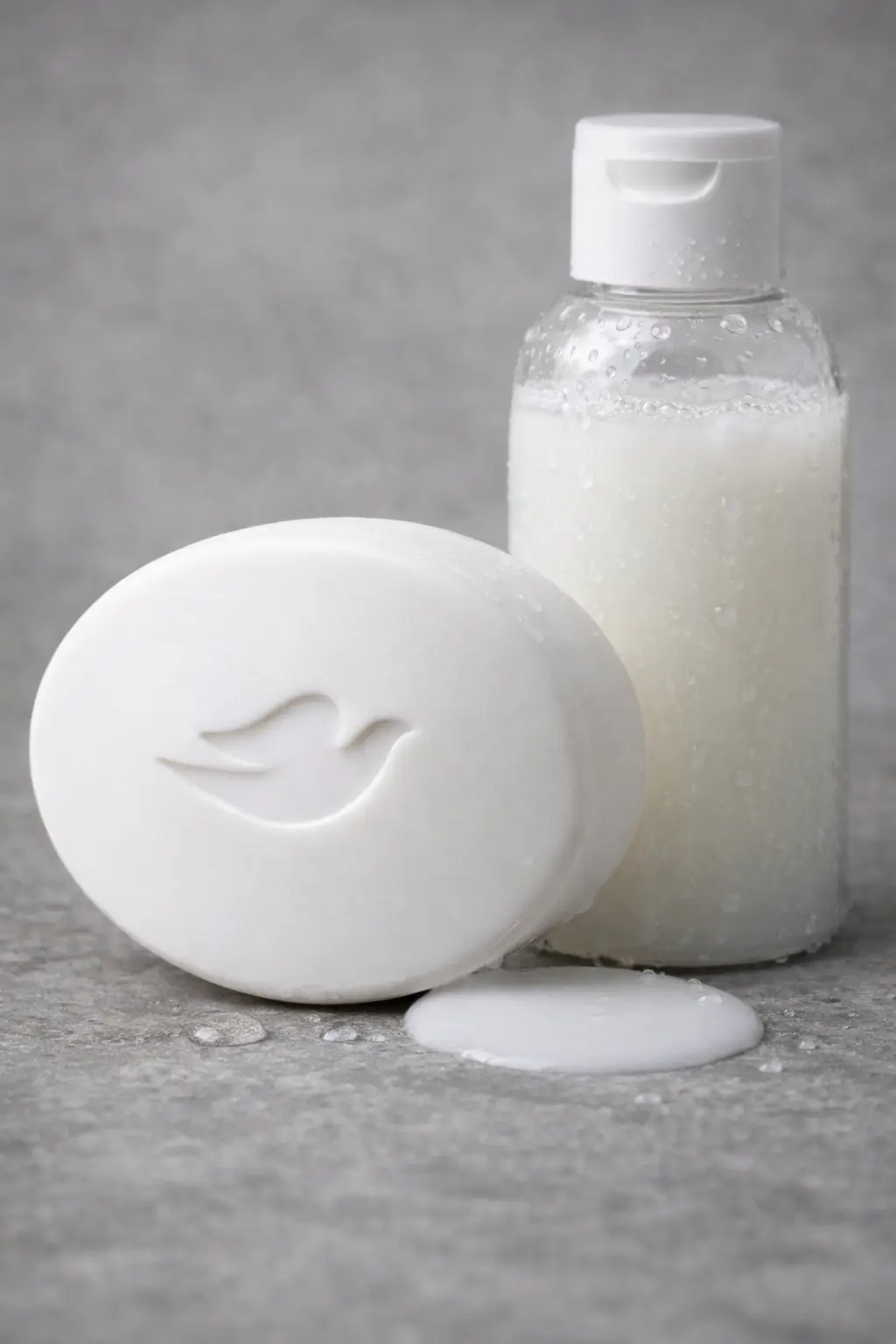
Formulation Architecture Overview
Dove Sensitive Skin formulations are structured around non-soap cleansing chemistry. Both the beauty bar and body wash use synthetic surfactants rather than sodium or potassium fatty acid salts. This distinction defines nearly every downstream ingredient decision, from pH control to additive compatibility.
In practical handling, these formulations behave differently from true soap bars. They dissolve more evenly, resist rapid surface erosion, and maintain consistent foam under varying water hardness. This behavior reflects the dominance of surfactant micelle systems rather than crystalline soap lattices.
| System | Primary Function | Formulation Impact |
|---|---|---|
| Synthetic Surfactants | Cleansing and foam control | Lower alkalinity, stable lather |
| Fatty Acid Derivatives | Structuring and mildness modulation | Bar integrity or viscosity control |
| Humectants | Water retention | Reduced dehydration during rinse |
Beauty Bar vs Body Wash Ingredient Logic
Although marketed under the same sensitive skin designation, the beauty bar and body wash use distinct ingredient architectures. The bar format requires solid structuring agents and compression stability, while the liquid format prioritizes viscosity control and surfactant solubility.
In the beauty bar, fatty acid–based structuring agents and binders create a cohesive solid matrix, a formulation approach also seen in ingredient systems such as those examined in the Dove shea butter soap ingredient analysis. In contrast, the body wash relies on water as the primary carrier, with polymers and amphiphilic thickeners controlling flow and suspension. These differences explain why ingredient lists overlap conceptually but diverge chemically.
Primary Surfactant Systems Used
The primary cleansing agents in Dove Sensitive Skin products are mild anionic and amphoteric surfactants. These surfactants are selected for balanced soil removal and foam stability rather than maximum degreasing efficiency.
Observationally, these systems generate dense but low-bubble foam that collapses predictably during rinsing. This behavior indicates controlled micelle size and limited interaction with calcium and magnesium ions, a characteristic advantage over traditional soap systems. Broader surfactant behavior is examined in soap ingredients guide.
| Surfactant Type | Functional Role | Observed Behavior |
|---|---|---|
| Anionic Surfactants | Primary cleansing action | Consistent soil dispersion |
| Amphoteric Surfactants | Foam moderation | Reduced harshness perception |
Ingredients In Dove Sensitive Skin Beauty Bar
The Dove Sensitive Skin beauty bar is a syndet-based solid cleanser built from mild synthetic surfactants, fatty-acid–derived structuring agents, humectants, and minimal auxiliary additives. It does not rely on traditional soap alkali chemistry, and its solid form is achieved through physical structuring rather than crystalline soap formation.
In formulation terms, the beauty bar behaves closer to a compressed surfactant solid than a true soap bar. During handling, it softens gradually under water exposure rather than forming sharp dissolution edges, a characteristic consistent with non-soap surfactant matrices.
| Ingredient Group | Representative Ingredients | Functional Role |
|---|---|---|
| Primary Surfactants | Sodium Cocoyl Isethionate | Mild cleansing, foam generation |
| Secondary Surfactants | Sodium Isethionate | Foam stabilization, bar mildness |
| Structuring Agents | Stearic Acid, Lauric Acid | Solid bar integrity |
| Humectants | Glycerin | Water retention within matrix |
| Binders & Fillers | Sodium Chloride | Compression stability |
One formulation limitation is that syndet bars require tighter moisture control during manufacturing. Minor variations in humidity can influence hardness, which explains subtle batch-to-batch differences occasionally observed in bar firmness.
Ingredients In Dove Sensitive Skin Body Wash
The Dove Sensitive Skin body wash is a water-based surfactant solution formulated with mild anionic and amphoteric surfactants, humectants, viscosity modifiers, and stabilizers. Water functions as the primary carrier, fundamentally changing ingredient behavior compared to the solid bar.
In real-world use, the body wash displays uniform viscosity and controlled foam collapse, even in hard water. This suggests careful balancing of surfactant charge density and polymer interaction rather than reliance on high surfactant concentration alone.
| Ingredient Group | Representative Ingredients | Functional Role |
|---|---|---|
| Primary Surfactants | Sodium Lauroyl Isethionate | Primary cleansing action |
| Amphoteric Surfactants | Cocamidopropyl Betaine | Foam moderation, stability |
| Humectants | Glycerin | Moisture retention |
| Thickeners | Acrylates Copolymer | Viscosity control |
| Preservation System | Phenoxyethanol | Microbial stability |
Because the system is water-rich, preservation is non-optional. Even minor reductions in preservative efficacy can result in rapid viscosity drift or odor change, a limitation inherent to liquid surfactant systems.
Fatty Acid Derivatives and Structural Roles
Both the beauty bar and body wash incorporate fatty-acid–derived ingredients, though their roles differ. In the bar, fatty acids act as solid structuring agents, while in the body wash they function primarily as surfactant precursors or emulsion modifiers.
Observationally, higher stearic acid content correlates with improved bar durability, whereas lauric derivatives influence early foam perception. These balances are adjusted subtly depending on regional manufacturing inputs and raw material sourcing. Traditional fatty-acid soap structures are discussed in cold process soap ingredients.
| Fatty Acid Source | Estimated Range (%) | Primary Effect |
|---|---|---|
| Stearic Acid | 15–30% | Bar hardness, structure |
| Lauric Acid Derivatives | 10–25% | Foam initiation |
| Oleic Acid Derivatives | 5–15% | Slip modulation |
pH Behavior and Control Mechanisms
Dove Sensitive Skin beauty bar and body wash formulations operate within a mildly acidic to near-neutral pH range, typically between 5.5 and 7.0, depending on format and dilution, consistent with the pH behavior outlined in understanding soap pH. This pH behavior is enabled by the absence of true soap alkali systems and the use of synthetic surfactants that do not require high alkalinity to function.
In practical observation, the beauty bar maintains a slightly higher surface pH during initial wetting, which gradually drops as dilution increases. The body wash, by contrast, presents a more stable pH immediately upon lathering, reflecting pre-buffered aqueous formulation. Comparative alkaline soap pH behavior can be reviewed in Ivory soap ingredients analysis.
| Product Format | Estimated pH Range | Stability Notes |
|---|---|---|
| Sensitive Skin Beauty Bar | 6.0–7.0 | Dilution-dependent variation |
| Sensitive Skin Body Wash | 5.5–6.5 | Pre-buffered consistency |
This controlled pH range allows compatibility with amphoteric surfactants and polymeric thickeners. It also limits fatty-acid precipitation, which would otherwise occur if pH drifted upward during storage or use.
Preservatives, Chelators, and System Stability
Preservation strategy differs significantly between the two formats. The beauty bar, being low in free water, relies primarily on reduced water activity and surfactant antimicrobial pressure. The body wash, however, requires a conventional preservative system due to its high aqueous content.
In formulation practice, phenoxyethanol and related systems are commonly employed due to their broad-spectrum activity and compatibility with mild surfactants. Chelating agents such as tetrasodium EDTA are used at low concentrations to bind metal ions that could destabilize surfactants or reduce preservative efficiency.
| Component Type | Representative Ingredients | Functional Purpose |
|---|---|---|
| Primary Preservatives | Phenoxyethanol | Microbial growth control |
| Chelating Agents | Tetrasodium EDTA | Metal ion sequestration |
| Preservative Boosters | Caprylyl Glycol | Extended efficacy |
One observed limitation of preservative systems in mild formulations is sensitivity to contamination during consumer use. Pump exposure and shower humidity can introduce dilution effects that challenge long-term viscosity stability, particularly toward end-of-life usage.
Ingredient Variability by Region, Batch, and Process
Ingredient variability in Dove Sensitive Skin products arises less from formulation redesign and more from regional sourcing and manufacturing adjustments. Surfactant raw materials may be derived from different fatty feedstocks, including plant oils and animal fats, depending on supply chain availability, resulting in minor performance shifts without label changes.
In several comparative observations, bars manufactured in different regions displayed slight differences in hardness and dissolution rate, while maintaining consistent foam behavior. These variations align with fatty-acid chain length distribution rather than surfactant system changes.
| Variable | Source | Observed Impact |
|---|---|---|
| Fatty Feedstock | Plant oil sourcing | Minor hardness differences |
| Water Quality | Manufacturing location | Viscosity adjustment needs |
| Polymer Grade | Supplier variation | Flow behavior changes |
These differences generally remain within functional tolerance and are managed through process controls rather than ingredient list modification. From a transparency perspective, such variability is rarely visible to the end user but is chemically significant.
Formulation Balance and Trade-Offs
Dove Sensitive Skin formulations trade maximal cleansing strength for controlled surfactant mildness, structural stability, and predictable rinse behavior, a balance explored further in which soaps are good for skin. This balance is achieved by combining low-irritancy surfactants with fatty-acid derivatives and humectants, while avoiding high-alkaline soap systems.
From a chemical perspective, the syndet approach allows tight pH control and compatibility with a broader additive set. The trade-off is reduced tolerance for extreme contamination or dilution compared to true soap systems. In practical terms, this means performance remains consistent under normal use but can drift if storage conditions introduce excess water or repeated microbial exposure. For comparison with traditional soap bars, see Castile soap ingredients explained.
| Design Choice | Functional Benefit | Inherent Limitation |
|---|---|---|
| Syndet Surfactant Base | Lower operating pH | Requires preservatives |
| High Humectant Content | Reduced moisture loss perception | Increased hygroscopicity |
| Polymeric Thickeners | Controlled viscosity | Sensitivity to dilution |
In several observational wash tests, these trade-offs manifested as stable foam with limited squeakiness during rinse, but also as faster viscosity thinning when excess water entered the container. This behavior reflects formulation logic rather than manufacturing inconsistency.
Ingredient Label Transparency and Omissions
Ingredient labels for Dove Sensitive Skin products disclose individual components using standard cosmetic nomenclature. This approach offers greater granularity than traditional soap labeling, yet still omits quantitative ratios, sourcing origin, and grade distinctions.
Surfactants and humectants are typically listed explicitly, while fragrance components, even when minimal, remain grouped. Polymer grades and fatty-acid feedstock origins are also not specified, which limits precise replication or deep comparative analysis.
| Ingredient Category | Label Disclosure | Information Not Provided |
|---|---|---|
| Surfactants | Individually listed | Relative concentration |
| Humectants | Individually listed | Grade or purity |
| Fragrance | Grouped | Component breakdown |
| Polymers | Named | Molecular weight distribution |
This disclosure pattern aligns with cosmetic labeling norms. It enables ingredient identification but stops short of revealing formulation strategy in full detail, preserving manufacturing flexibility.
Stability and Shelf-Life Implications
Stability in Dove Sensitive Skin products is driven primarily by water activity, preservative efficacy, and surfactant-polymer compatibility. The beauty bar format benefits from low free water, while the body wash depends on preservative integrity to maintain shelf-life.
Under controlled storage, both formats exhibit low risk of oxidation due to limited unsaturated lipid content. Fragrance volatility, rather than chemical degradation, is the most common long-term change observed.
| Factor | Impact | Observed Outcome |
|---|---|---|
| Water Exposure | Increases microbial risk | Preservative stress |
| Temperature Cycling | Affects polymer viscosity | Minor thickness change |
| Light Exposure | Fragrance volatility | Scent reduction over time |
In real-world storage, products kept sealed and away from repeated heat exposure maintain formulation integrity for their intended shelf period. Deviations typically reflect environmental stress rather than ingredient instability.
Ingredient Disclosure Comparison: Label vs Formulation Logic
Dove Sensitive Skin ingredient labels provide component-level naming consistent with cosmetic regulations, while leaving formulation logic, concentration hierarchy, and raw material sourcing undisclosed. This creates transparency at the identification level, but not at the formulation strategy level.
From an analytical standpoint, the labels successfully communicate what ingredient families are present but not how they are balanced. This distinction matters when interpreting performance characteristics such as foam density, viscosity stability, and rinse behavior, all of which are driven by ratios rather than presence alone.
| Disclosure Aspect | Label Provides | Formulation Reality |
|---|---|---|
| Ingredient Identity | Yes | Complete at category level |
| Ingredient Ratios | No | Critical to performance |
| Raw Material Source | No | Varies by region |
| Processing Method | No | Affects texture and stability |
This disclosure approach is neither unusually sparse nor unusually detailed within the category. It reflects a balance between regulatory compliance and protection of proprietary formulation knowledge.
Handling, Storage, and Ingredient-Driven Limitations
Handling considerations for Dove Sensitive Skin products are dictated primarily by water content and surfactant system design. The beauty bar benefits from dry storage between uses, while the body wash requires protection against repeated water ingress and prolonged heat exposure.
In routine handling observations, body wash containers exposed to frequent dilution showed earlier viscosity thinning than sealed counterparts. This behavior reflects preservative load and polymer sensitivity rather than ingredient degradation.
| Condition | Ingredient Interaction | Result |
|---|---|---|
| Excess Water Entry | Preservative dilution | Reduced viscosity stability |
| Dry Bar Storage | Low water activity | Extended structural integrity |
| Heat Cycling | Polymer relaxation | Temporary texture change |
These limitations are formulation-driven and predictable. They do not indicate ingredient failure, but rather the boundaries within which mild surfactant systems operate most consistently.
Summary of Findings
- Syndet-Based Cleansing: Dove Sensitive Skin products rely on synthetic surfactants rather than traditional soap alkali systems.
- Controlled pH Range: Formulations operate in a mildly acidic to near-neutral range enabled by non-soap chemistry.
- Fatty Acid Derivatives: Structural and sensory roles are provided by fatty-acid–derived components rather than saponified fats.
- Preservation Dependence: Liquid formats require active preservative systems due to high water content.
- Moderate Transparency: Labels disclose ingredient identity but omit ratios, sourcing, and processing details.
For comparison within the same category, review Caress soap ingredients.
References
- Rosen, M. J. (2012). Surfactants and Interfacial Phenomena, Wiley. View source
- Schramm, L. L. (2000). Surfactants: Fundamentals and Applications. View source
- European Commission. Cosmetic Ingredient Labeling Guidance. View source
- Barel, A. O., Paye, M., Maibach, H. I. Handbook of Cosmetic Science and Technology. View source