Definition And System Identity
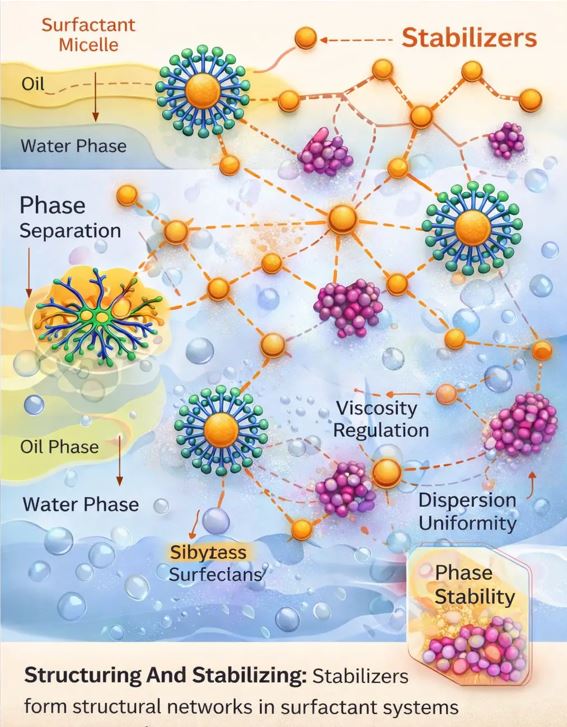
Stabilizers are a functional group of formulation components used to maintain the physical, structural, and performance consistency of a system over time. Rather than acting as a single ingredient type, stabilizers represent a formulation role fulfilled by different materials depending on system requirements.
In soap, detergent, and cosmetic systems, stabilizers are responsible for preventing undesirable changes such as phase separation, viscosity drift, foam collapse, or uneven dispersion. Their function is not tied to one chemical identity but to how they support the overall formulation structure.
Within a formulation, stabilizers operate alongside primary components such as surfactants, solvents, and oils, helping maintain system balance during storage and use.
They are commonly associated with broader additive systems, often appearing together with preservatives, rheology modifiers, and chelating agents as part of a supporting formulation network.
In practical terms, stabilizers determine whether a product remains uniform, consistent, and predictable, rather than separating, thinning, or degrading under normal conditions.
Quick Facts
| Property | Description |
|---|---|
| Category Type | Functional formulation role |
| Primary Function | Maintain stability of structure, dispersion, and performance |
| System Level | Works across entire formulation rather than single phase |
| Common Mechanisms | Viscosity control, network formation, dispersion stabilization |
| Physical Role | Prevents separation, sedimentation, and structural breakdown |
| Chemical Role | May support pH stability or reduce degradation (system dependent) |
| Typical Systems | Liquid soaps, detergents, emulsions, creams, gels |
| Interaction With Surfactants | Supports micelle structure and dispersion stability |
| Relation To Viscosity | Often linked with rheology modifiers |
| Relation To Preservation | Supports system integrity alongside preservatives |
| Solubility Behavior | Varies (can be soluble, insoluble, or polymeric network formers) |
| Dependence On System | Highly dependent on formulation design and ingredient interactions |
| Presence In Labels | Rarely labeled as “stabilizer”; appears as specific ingredients |
| Examples Of Ingredient Types | Polymers, fatty alcohols, electrolytes, co-surfactants |
| Failure Without Stabilizers | Phase separation, viscosity loss, foam instability |
| Usage Level | System-dependent (often <0.5% to several % depending on type) |
| Formulation Sensitivity | Strongly affected by pH, ionic strength, and surfactant system |
| Role In Performance | Indirect (supports consistency rather than cleaning action) |
| System Outcome | Improved uniformity, predictability, and shelf stability |
Why Stabilizers Appear On Labels
Stabilizers do not typically appear as a single named ingredient on labels. Instead, they are represented by individual components that perform stabilizing functions within the formulation.
These may include polymers, fatty alcohols, salts, or co-surfactants, each contributing to system stability in a different way. Their presence reflects a design requirement rather than a marketing feature.
In ingredient lists, stabilizing functions are often fulfilled by materials that are also classified under other categories such as rheology modifiers, surfactants, or structuring agents.
This means that the stabilizing role is embedded within the formulation rather than explicitly labeled, making it a functional concept rather than a standalone ingredient identity.
From a formulation perspective, their inclusion ensures that the product maintains uniform appearance, texture, and performance across its intended shelf life.
Functional Role In Soap And Cleansing Systems
Stabilizers operate at the system level, ensuring that different components within a formulation remain properly integrated during storage and use.
In surfactant-based systems such as liquid soaps and detergents, they support the structural balance between micelles, water phase, and dissolved materials. This balance is essential for consistent performance and appearance.
Within formulations, stabilizers contribute to multiple aspects of system behavior rather than a single isolated function.
Viscosity Stabilization
Stabilizers help maintain consistent thickness over time. Without this support, formulations may become too thin or too thick depending on temperature changes, ionic interactions, or ingredient redistribution.
Dispersion Stability
They prevent suspended particles from settling or separating. This is particularly relevant in systems containing pigments, insoluble additives, or partially dispersed materials.
Foam Stability
In cleansing systems, stabilizers support foam structure by maintaining the integrity of surfactant films. This ensures that lather does not collapse too quickly during use.
Phase Stability
In emulsions and mixed-phase systems, stabilizers help prevent oil and water separation by reinforcing interfacial structures and reducing instability.
Rinse Behavior Control
Stabilizers influence how a formulation behaves during rinsing by maintaining dispersion and preventing residue aggregation, especially in low-water or high-efficiency systems.
These roles operate together, meaning a single stabilizer may contribute to multiple aspects of formulation stability depending on system design.
Ingredient Interaction Logic
Stabilizers function through interaction rather than isolation. Their effectiveness depends on how they integrate with other components in the formulation.
In surfactant systems, stabilizers influence micelle structure and distribution. They can modify how surfactant molecules organize, indirectly affecting viscosity and clarity.
In formulations containing oils or dispersed phases, stabilizers help maintain uniform distribution by reducing the tendency of components to separate.
They often work alongside chelating agents, which control metal ion interactions, and preservatives, which maintain microbial stability.
Polymers and structuring agents can form networks that physically trap particles or droplets, while electrolytes influence ionic balance and surfactant packing behavior.
This interaction-based behavior means stabilizers cannot be evaluated independently. Their role emerges only within the full formulation system.
Phase Behavior And System Structure
Stabilizers influence how different phases within a formulation interact and remain stable over time.
In liquid systems, they help maintain suspension of particles and prevent sedimentation. This is particularly important in low-viscosity formulations where gravity-driven separation is more likely.
In emulsions, stabilizers reinforce the interface between oil and water phases, reducing the likelihood of coalescence and separation.
In solid systems such as soap bars, stabilizers contribute indirectly by supporting uniform structure formation during cooling and curing processes.
In systems built around surfactants, stabilizers influence how micellar structures respond to dilution, temperature changes, and mechanical agitation.
The result is a formulation that maintains consistent internal structure rather than undergoing visible or functional breakdown.
Comparison With Related Functional Roles
| Feature | Stabilizers | Rheology Modifiers | Preservatives |
|---|---|---|---|
| Primary Purpose | Maintain system stability | Control viscosity and flow | Prevent microbial growth |
| System Level | Whole formulation | Primarily structural/flow | Microbial environment |
| Direct Effect | Prevents separation and instability | Changes thickness and texture | Extends shelf life microbiologically |
| Overlap | Can include rheology modifiers and co-surfactants | May act as stabilizers | Works alongside stabilizers |
| Chemical Activity | Varies (physical + chemical) | Mostly physical structuring | Chemical/biological control |
| Label Presence | Indirect (via ingredients) | Indirect (via ingredients) | Directly listed as preservatives |
| Failure Without Them | Phase separation, instability | Improper viscosity | Microbial spoilage |
Ingredient Classes That Act As Stabilizers
Stabilization is achieved through different ingredient classes depending on formulation design. These materials are not exclusively stabilizers but perform stabilizing functions within specific systems.
| Ingredient Class | Stabilization Mechanism | Typical Role In Formulation |
|---|---|---|
| Polymers (e.g., Carbomer, Xanthan Gum) | Network formation and viscosity control | Prevents phase separation and particle settling |
| Fatty Alcohols (e.g., Cetyl Alcohol) | Lamellar structuring and thickening | Supports emulsion stability and cream structure |
| Electrolytes (e.g., Sodium Chloride) | Modifies ionic strength and micelle packing | Controls viscosity and surfactant behavior |
| Co-Surfactants | Improves interfacial film stability | Enhances dispersion and foam consistency |
| Emulsifiers | Reduces interfacial tension between phases | Prevents oil-water separation |
| Waxes And Structuring Agents | Solid-phase reinforcement | Maintains structure in creams and solid systems |
| Silicates And Mineral Additives | Particle stabilization and dispersion support | Prevents settling in detergents |
| Proteins And Biopolymers | Film formation and interface stabilization | Supports foam and surface stability |
| Chelating Agents | Bind metal ions that destabilize systems | Improves formulation consistency and longevity |
| Thickeners And Gelling Agents | Increase system viscosity | Reduce movement of dispersed particles |
| Solvent Systems | Maintain uniform solubility balance | Prevents precipitation or phase imbalance |
| Fragrance Solubilizers | Maintain dispersion of fragrance oils | Prevents separation or cloudiness |
Each of these classes contributes to stability through different mechanisms, and their effectiveness depends on how they are combined within the formulation.
Structural Limitations In Formulation
Stabilizers do not function independently of the formulation. Their effectiveness depends entirely on system design, ingredient compatibility, and processing conditions.
One key limitation is that stabilizers cannot compensate for fundamentally unstable formulations. If the balance between phases, surfactants, and solvents is not properly designed, stabilizers may delay but not prevent separation or degradation.
Overuse of stabilizing agents can also introduce issues such as excessive viscosity, reduced clarity, or altered texture. This can negatively affect product usability even if stability is improved.
In some systems, stabilizers are sensitive to pH, ionic strength, or temperature changes. This means their performance can vary depending on storage conditions or formulation adjustments.
Additionally, stabilizers do not replace the need for preservatives. While they help maintain physical stability, they do not prevent microbial growth or contamination.
These limitations highlight that stabilizers are part of a broader system and must be used in coordination with other formulation components.
Formulation References Using This Ingredient
- Homemade Laundry Powder
- Homemade Laundry Softener & Conditioner
- Aesop Mandarin Hand Soap
- Murphy Oil Soap Ingredients Analysis
- Sodium Metasilicate in Soap, Cosmetics & Detergents
- Aesop Soap Refill – Ingredients, & Stability
- Heman Bekele Soap Concept
- Alaffia Face Wash – Ingredients, Variants & Cleansing
- Defense Soap Ingredients Analysis
- ACE Soap Ingredients, pH Levels & Formulation Breakdown
- Himalaya Almond, Cucumber & Honey Soap Variants
Summary of Findings
- Classification: Stabilizers represent a functional formulation role rather than a single ingredient class.
- Core Function: They maintain structural, physical, and performance stability across formulation systems.
- System Behavior: Stabilizers operate through interaction with surfactants, polymers, and other components to prevent separation and inconsistency.
- Mechanisms: Their effects include viscosity control, dispersion stabilization, foam support, and phase balance.
- Ingredient Diversity: Multiple ingredient classes can act as stabilizers depending on formulation requirements.
- Limitations: Stabilizers cannot compensate for poor formulation design and must be used within a balanced system.