Etidronic Acid In Cleansing Formulations
Etidronic acid is an organophosphonic acid used in cleansing formulations as a chelating and stabilizing agent. In soap systems it functions primarily by interacting with dissolved metal ions that originate from water hardness, raw material impurities or processing equipment surfaces. Through this interaction the molecule limits unwanted mineral reactions that can interfere with the physical structure and stability of the soap matrix.
Chemically, etidronic acid belongs to the phosphonate family, a group of compounds characterized by carbon phosphorus bonds that enable strong coordination with calcium, magnesium and other multivalent metal ions. These coordination interactions are particularly relevant in soap formulations because fatty acid salts can react with these ions to form insoluble residues that alter lather performance and surface deposition behavior.
Within cleansing systems the ingredient does not function as a surfactant. Instead it acts as a system regulator that influences mineral balance in the formulation environment. By moderating the availability of reactive metal ions, etidronic acid contributes to maintaining formulation stability, visual clarity in certain systems and consistent cleansing performance across different water conditions.
This page is part of the CleanFormulation Ingredient Library, a research project that examines how cosmetic and cleansing ingredients behave within real formulation systems rather than evaluating them as isolated substances.
Quick Facts
| Property | Description |
|---|---|
| Ingredient Type | Chelating and stabilization agent |
| Chemical Class | Organophosphonic acid |
| Functional Role | Metal ion binding and mineral interference control in cleansing systems |
| Ionic Class | Anionic phosphonate compound |
| Typical Use Context | Bar soaps, liquid soaps, detergents and other water based cleansing formulations |
| Primary Formulation Purpose | Limiting reactions between soap salts and dissolved metal ions |
Why This Ingredient Appears On Cosmetic Labels
Etidronic acid appears on cosmetic and cleansing product ingredient lists because it performs a supporting function within the formulation environment. While the primary cleansing activity in soap is provided by fatty acid salts, the surrounding formulation contains water, dissolved minerals and multiple auxiliary ingredients that can influence the stability of the system.
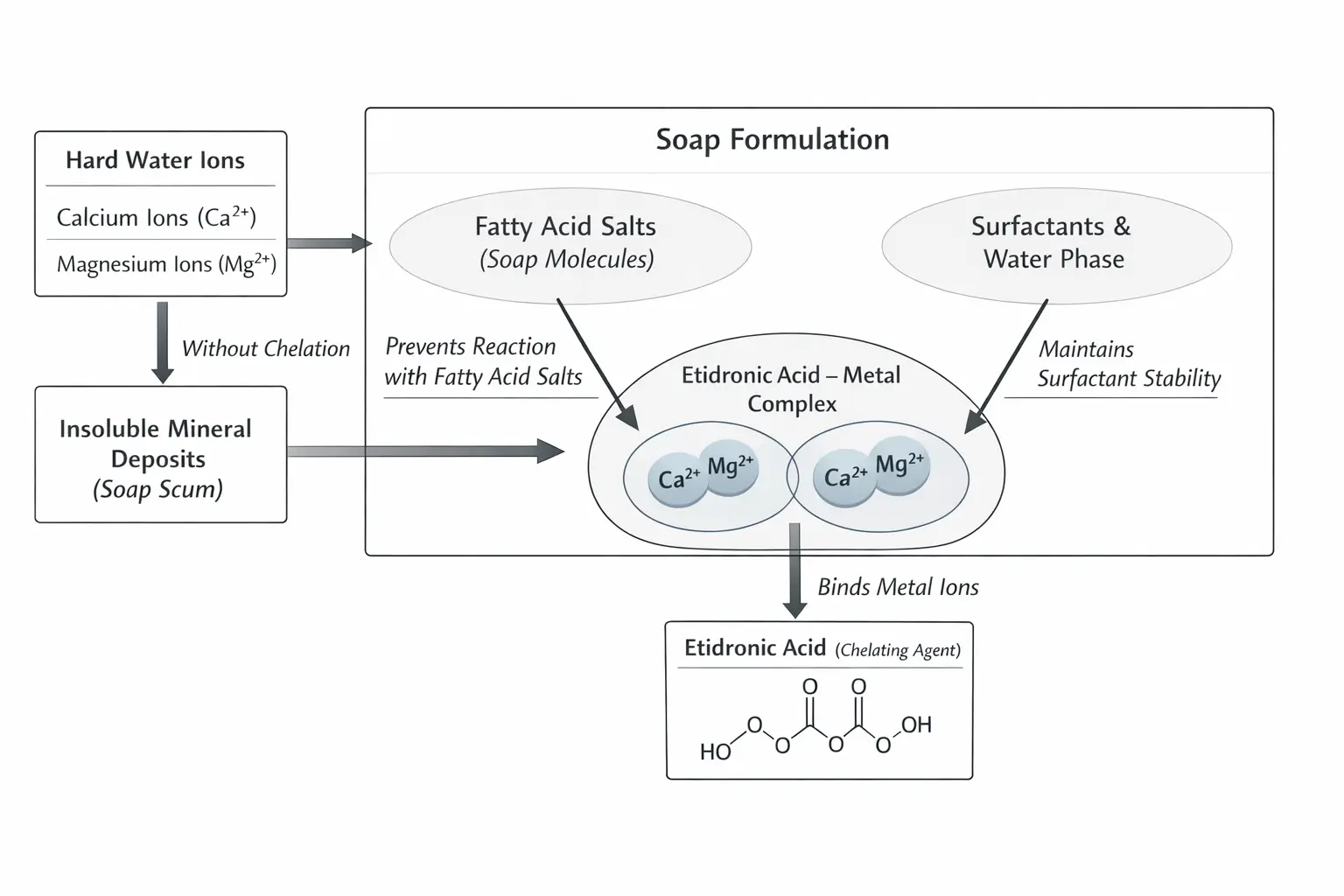
In many geographic regions water contains measurable amounts of calcium and magnesium ions. When these ions interact with soap salts they can form insoluble compounds sometimes referred to as soap scum. This interaction can influence lather formation, surface residue and the visual appearance of cleansing systems. Chelating agents such as etidronic acid reduce the availability of these ions by binding them into more stable complexes.
Because of this role, the ingredient may be listed even though it is not directly involved in cleansing. Its function operates at the system level, helping maintain consistent behavior of the primary surfactant structure under different water conditions and storage environments.
For readers encountering the name on an ingredient list, its presence usually indicates that the formulation includes a mechanism designed to manage mineral interactions rather than a component intended to alter fragrance, texture or cleansing intensity.
Ingredient Interaction Logic
Understanding the behavior of etidronic acid requires examining how it interacts with other components inside a cleansing formulation. Soap systems typically consist of fatty acid salts, water, humectants, fragrance compounds and sometimes additional stabilizing agents. Each of these components occupies a different role within the formulation matrix.
The interaction between etidronic acid and soap salts occurs indirectly through metal ion control. Calcium and magnesium ions normally react with sodium or potassium fatty acid salts to form insoluble compounds. By forming complexes with these ions, etidronic acid reduces the likelihood of these reactions occurring within the system.
Within the aqueous phase the molecule also interacts with other dissolved species. Humectants such as glycerin influence the hydration structure of the water phase, while other chelating agents may compete for the same metal ions. These overlapping interactions create a balance in which mineral availability, ionic strength and surfactant structure collectively determine the final behavior of the cleansing formulation.
Because these interactions occur at the molecular level, their effects are usually observed indirectly through formulation stability, reduced residue formation and more consistent lather performance when the product is used with mineral containing water.
Chemical Identity And Classification
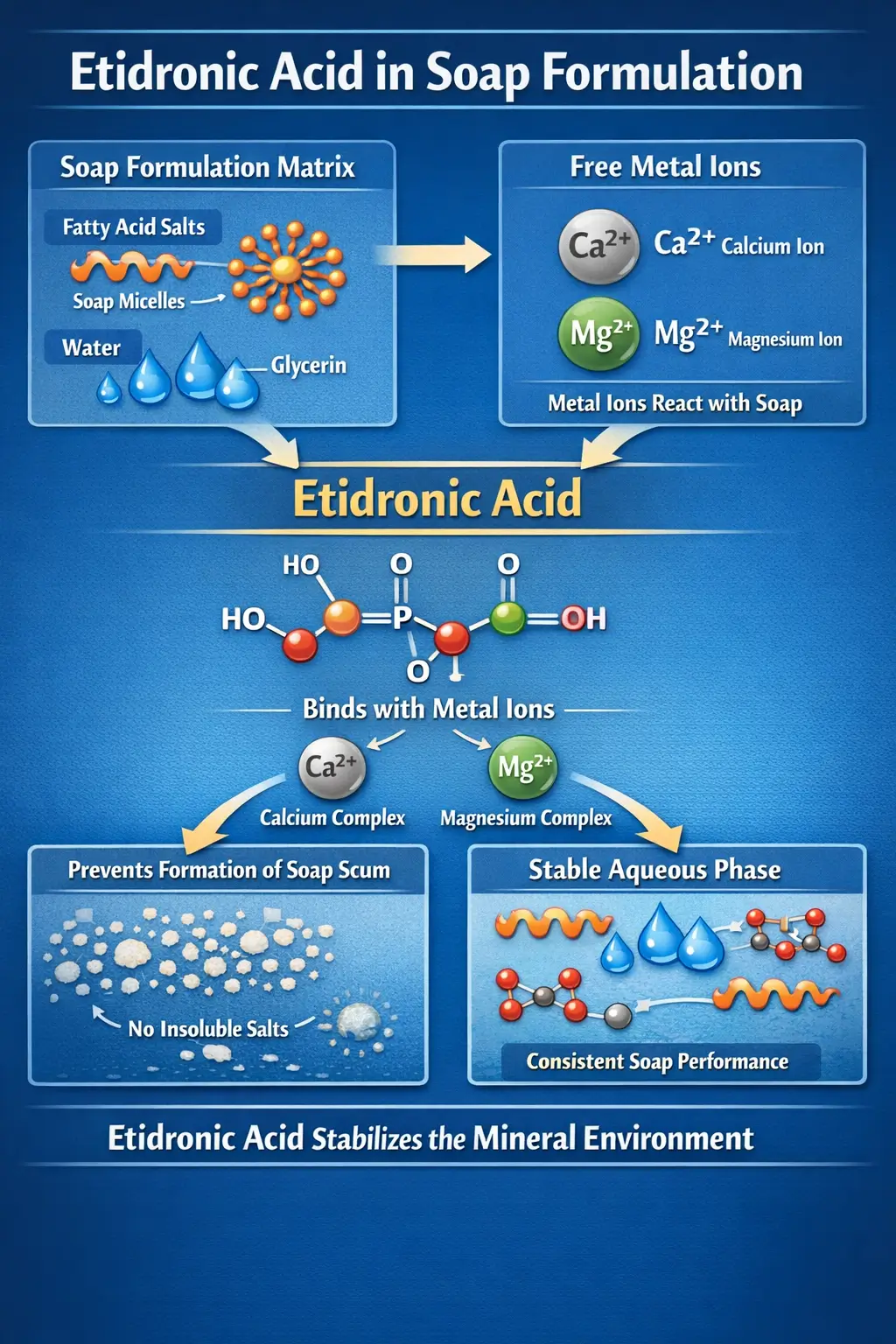
The INCI name etidronic acid refers to a phosphonate compound chemically known as 1 hydroxyethylidene 1,1 diphosphonic acid. The molecule contains two phosphonic acid groups attached to a carbon backbone, a structural arrangement that gives the compound strong affinity for multivalent metal ions. This configuration distinguishes phosphonates from other chelating agents because the carbon phosphorus bond is chemically stable and resistant to hydrolysis in many formulation environments.
From a molecular classification perspective etidronic acid belongs to the broader group of organophosphonates. These compounds are widely used in water treatment chemistry, industrial cleaning formulations and cosmetic products because of their ability to coordinate metal ions and inhibit scale formation. In cosmetic ingredient nomenclature the compound is typically declared as etidronic acid regardless of whether it is present in acid form or as a neutralized salt.
In aqueous environments the molecule behaves as an anionic species due to the ionization of its phosphonic acid groups. This ionic character enables electrostatic attraction toward positively charged metal ions such as calcium and magnesium. Once coordinated, these ions become part of a soluble complex rather than forming insoluble salts with fatty acid molecules.
The compound is generally synthesized through controlled phosphonation reactions that produce a stable phosphonate structure. While the production pathway is industrial, the functional importance of the molecule in cleansing systems arises from its ability to operate within aqueous environments where mineral ions are present.
Functional Role In Soap Systems
In soap based cleansing systems, etidronic acid functions primarily as a mineral interaction regulator rather than a cleansing agent. Soap itself is composed of fatty acid salts, typically sodium or potassium salts derived from natural oils or fats. These salts interact strongly with calcium and magnesium ions present in hard water, often forming insoluble precipitates that alter the behavior of the soap matrix.
Etidronic acid modifies this interaction by binding metal ions before they can react with fatty acid salts. The molecule forms coordination complexes with these ions, effectively keeping them dissolved in the aqueous phase. This interaction helps maintain the functional integrity of the soap system, particularly in environments where mineral content varies significantly.
In practical formulation terms, this mechanism can influence several observable characteristics of soap products. Lather formation tends to remain more consistent because fewer soap molecules are lost through precipitation reactions. Bar surfaces may remain visually cleaner during repeated use because insoluble mineral residues form less readily. Liquid cleansing systems may also maintain better optical clarity under mineral rich conditions.
The role of etidronic acid therefore operates at the system level rather than the surfactant level. It does not generate foam, alter fragrance behavior or modify viscosity directly. Instead it stabilizes the chemical environment in which the primary surfactants operate, allowing the formulation to behave more predictably across different water conditions.
Phase Behavior In Aqueous Cleansing Systems
Etidronic acid is highly soluble in water and therefore resides primarily in the aqueous phase of cleansing formulations. In this environment the molecule becomes partially ionized, allowing its phosphonic acid groups to interact electrostatically with metal ions present in the surrounding solution.
The solubility profile of the compound enables it to function effectively even at relatively low concentrations. Because chelation reactions depend on molecular coordination rather than bulk structural changes, only small amounts of the ingredient are typically required to influence mineral interactions within the formulation environment.
Temperature and pH can influence the ionization state of the molecule and therefore its chelating efficiency. Soap systems often operate under mildly alkaline conditions, which favor the deprotonation of phosphonic acid groups and increase their capacity to bind metal ions. Under these conditions the molecule remains stable and continues to operate as a mineral control agent within the aqueous phase.
Unlike some ingredients that contribute to structural phases such as crystalline networks or lamellar surfactant structures, etidronic acid does not normally form part of the structural matrix of soap bars or liquid surfactant systems. Its influence remains confined to the dissolved phase, where it moderates chemical interactions between ions and surfactant molecules.
Comparison With Related Chelating Ingredients
Etidronic acid belongs to a broader group of chelating agents used to regulate mineral interactions in cleansing formulations. Other compounds may perform similar functions but differ in chemical structure and coordination behavior. Comparing these ingredients helps illustrate how different chelating strategies operate within soap systems.
| Feature | Etidronic Acid | Tetrasodium EDTA |
|---|---|---|
| Chemical Class | Organophosphonate compound | Aminopolycarboxylate chelating agent |
| Primary Chelation Mechanism | Phosphonate groups coordinate with metal ions | Multiple carboxylate groups bind metal ions |
| Typical Use Context | Soap bars, liquid soaps, detergents | Wide cosmetic applications including shampoos and cleansers |
| Interaction With Soap Salts | Limits formation of insoluble mineral soap complexes | Also prevents mineral interference but through a different molecular structure |
| Molecular Family | Phosphonate based chelator | Aminocarboxylate chelator |
Regulatory Context
Within cosmetic ingredient regulation, etidronic acid is recognized as an established chelating and stabilizing agent used in a variety of water based formulations. The ingredient is identified in the International Nomenclature of Cosmetic Ingredients system under the name Etidronic Acid, which serves as the standardized label declaration used across cosmetic markets that follow INCI based ingredient disclosure.
In the European Union cosmetic regulatory framework defined by Regulation (EC) No 1223/2009, etidronic acid is listed as a permitted ingredient without classification as a restricted or prohibited substance when used according to general cosmetic product requirements. As with all cosmetic ingredients in the EU system, the finished product must undergo a safety assessment performed under the responsibility of the product manufacturer or responsible person before being placed on the market.
Ingredient naming rules require that the INCI designation appear in the ingredient list when the substance is present in a cosmetic formulation. This labeling system ensures that the same chemical identity is recognized consistently across different product categories including soaps, liquid cleansers and detergents.
Regulatory databases such as the European Commission Cosmetic Ingredient Database maintain standardized entries describing the functional category of the ingredient. In these records etidronic acid is typically classified under functional roles related to chelating activity and formulation stabilization.
Common Misunderstanding About Chelating Ingredients
A common misunderstanding surrounding ingredients such as etidronic acid is the assumption that every component listed on a cosmetic label directly contributes to cleansing activity or sensory performance. In reality many ingredients in cleansing formulations perform supporting roles that operate behind the visible properties of the product.
Chelating agents are a clear example of this formulation principle. They do not generate foam, alter fragrance or determine the primary cleansing mechanism of the product. Instead they influence the chemical environment in which surfactants operate. By coordinating with metal ions present in water or raw materials, they prevent interactions that could destabilize the formulation.
Because this function occurs at the molecular interaction level, the ingredient may not produce an immediately visible effect when examined independently. Its influence becomes noticeable only when the formulation is used under real conditions where water hardness and mineral presence can alter soap performance. The role of the chelating agent is therefore preventative rather than directly functional in the cleansing mechanism itself.
Structural Limitations In Formulation Systems
Although etidronic acid can influence mineral interactions in cleansing formulations, its performance is governed by several formulation variables. Chelation efficiency depends on the relative concentration of the ingredient compared with the concentration of metal ions present in the surrounding environment. In situations where mineral content is exceptionally high, additional chelating agents or complementary stabilization strategies may be required to achieve the desired formulation behavior.
Another limitation arises from pH dependent ionization. The chelating capability of phosphonate groups increases as they become deprotonated in alkaline conditions. Because traditional soap systems are naturally alkaline, this environment generally supports the functionality of the molecule. However in lower pH formulations its coordination behavior may differ depending on the protonation state of the phosphonic acid groups.
Compatibility with other formulation components also influences performance. Some chelating agents compete for the same metal ions, which can change the distribution of mineral complexes within the formulation. This interaction does not usually destabilize the system but can alter the relative contribution of each chelating ingredient.
These structural considerations illustrate that the ingredient operates as part of a broader formulation strategy rather than acting independently. The effectiveness of mineral control in a cleansing system therefore reflects the combined design of surfactants, water phase composition and chelating components.
Formulation References Using This Ingredient
Summary of Findings
Etidronic acid is an organophosphonate compound used in cleansing formulations to regulate interactions between metal ions and surfactant structures. The molecule belongs to a class of chelating agents capable of coordinating calcium and magnesium ions that would otherwise react with fatty acid salts in soap systems.
- Chemical Classification: Etidronic acid is an organophosphonic acid belonging to the phosphonate family of chelating compounds.
- Functional Role: Its primary formulation purpose is binding dissolved metal ions that could otherwise form insoluble mineral soap complexes.
- Interaction Logic: The ingredient operates within the aqueous phase of cleansing systems where it coordinates with mineral ions before they interact with surfactant structures.
- Formulation Context: By moderating mineral availability the compound supports stable lather formation and reduces residue formation associated with hard water reactions.
- System Boundaries: Its effectiveness depends on formulation conditions such as pH, mineral concentration and the presence of other chelating ingredients.