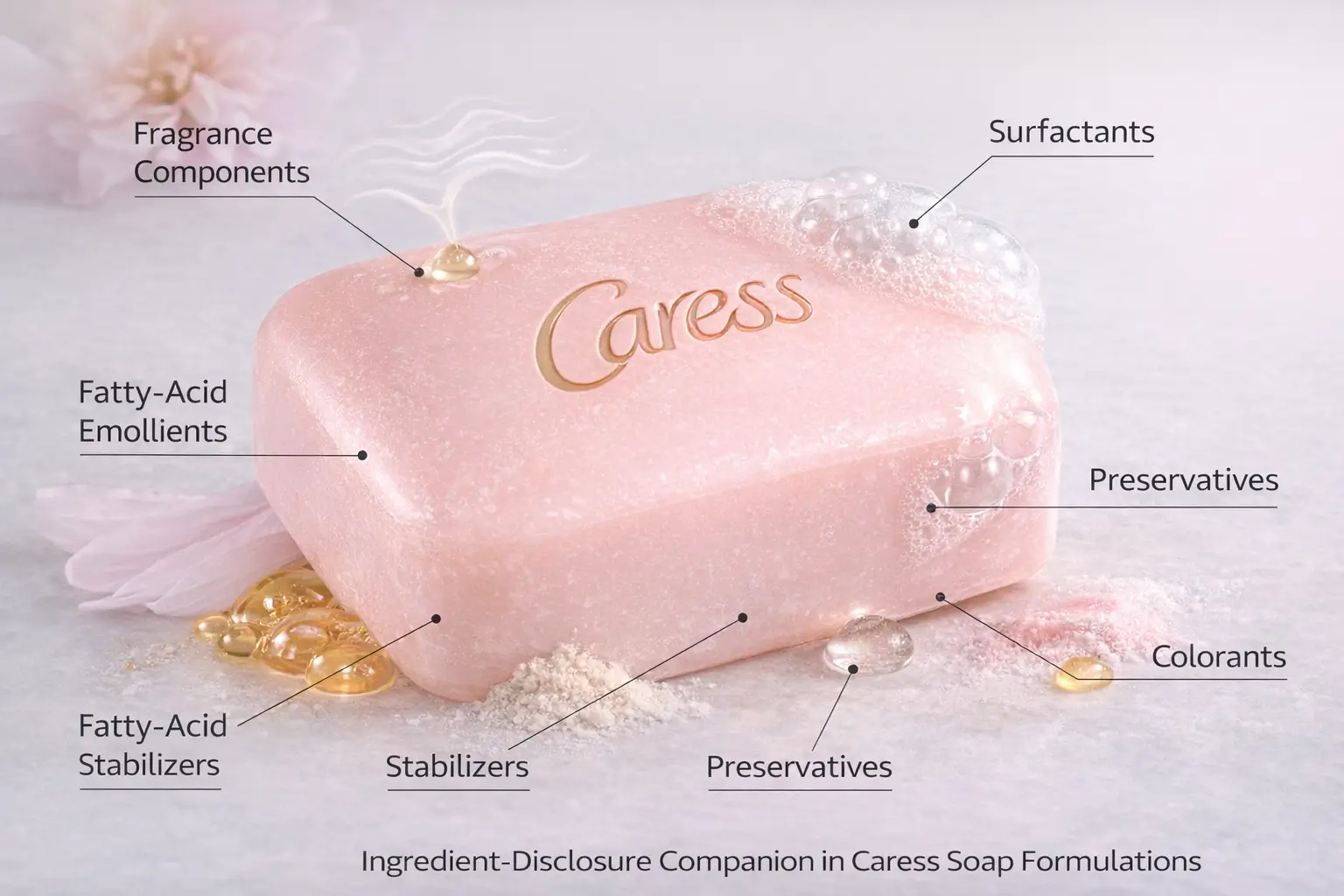
Ingredient Disclosure Overview
Caress soap ingredient labels reflect modern cosmetic disclosure practices, listing individual surfactants, emollients, fragrance components, preservatives, and colorants by INCI name. Unlike traditional soap bars that group ingredients under generic terms, Caress formulations provide itemized disclosure while omitting concentration ranges and blend ratios.
Across Daily Silk and Original Scents variants, ingredient lists remain structurally similar. Differences are primarily observed in fragrance systems, conditioning agents, and minor aesthetic modifiers rather than in the core cleansing surfactant framework.
| Disclosure Element | Observed Practice | Analytical Implication |
|---|---|---|
| Surfactants | Individually listed | Allows surfactant-class identification |
| Fatty Components | Named oils & esters | Supports emollient role inference |
| Fragrance | Grouped as parfum | Limits compositional specificity |
| Preservatives | Explicit | Enables stability interpretation |
Syndet Cleansing System
Caress body soaps rely on synthetic detergent surfactants rather than saponified fatty-acid salts. The primary cleansing agents are anionic surfactants supported by amphoteric co-surfactants, forming a system designed for consistent lather and rinse behavior across water conditions.
Differences between syndet bars and traditional fatty-acid soaps are examined in our cold process soap ingredient analysis.
In comparative handling, these bars produce dense, stable foam even in hard water environments. This performance reflects surfactant chemistry rather than alkalinity, distinguishing Caress from true soap formulations.
| Surfactant Type | Functional Role | Observed Effect |
|---|---|---|
| Anionic Surfactants | Primary cleansing | Consistent soil removal |
| Amphoteric Surfactants | Foam modulation | Smoother lather texture |
| Nonionic Components | Solubilization support | Improved fragrance dispersion |
Fatty-Acid & Emollient Components
Unlike traditional soaps where fatty acids function as surfactants, Caress formulations incorporate fatty components primarily as emollients. These ingredients contribute slip, bar creaminess, and post-rinse feel rather than cleansing action. Fatty-acid structure in true soap systems is detailed further in our Castile soap ingredient breakdown.
Observed ingredient lists commonly include fatty alcohols, esters, and plant-derived oils. The proportion of these components appears higher in Daily Silk variants, consistent with their conditioning emphasis.
Daily Silk Formula Structure
Caress Daily Silk soaps are distinguished by a higher inclusion of emollient and skin-conditioning agents layered onto the standard syndet base. These additions alter bar glide and foam creaminess without changing the underlying surfactant system.
In physical handling, Daily Silk bars feel marginally softer and exhibit slower surface drying compared to Original Scents variants. This behavior is consistent with elevated emollient loading rather than differences in surfactant chemistry.
Original Scents Ingredient Structure
Caress Original Scents soaps use the same foundational syndet cleansing system as Daily Silk variants but differ in secondary ingredient emphasis. The most notable distinctions occur within fragrance architecture, colorant selection, and the relative balance of emollient additives.
In observed ingredient lists, Original Scents variants typically contain fewer conditioning agents than Daily Silk bars. This results in a firmer bar structure and slightly faster surface drying after use, a physical outcome consistent with lower emollient loading rather than altered surfactant behavior.
| Ingredient Group | Daily Silk | Original Scents |
|---|---|---|
| Primary Surfactants | Same system | Same system |
| Emollient Load | Moderate to higher | Lower to moderate |
| Fragrance Complexity | Layered, softer notes | More pronounced top notes |
| Bar Firmness | Slightly softer | More rigid |
Preservatives, Stabilizers & Processing Aids
Caress soaps include preservative and stabilizer systems designed to maintain product integrity throughout storage and use. Although bar formats have lower water activity than liquids, preservatives are still used to control microbial risk during manufacturing and consumer handling. Preservative system patterns are also observed in our Dial bar soap ingredient review.
Stabilizers and processing aids support bar extrusion, compression strength, and resistance to cracking. These ingredients are non-cleansing and remain chemically inert during normal use.
| Ingredient Category | Functional Role | Format Relevance |
|---|---|---|
| Preservatives | Microbial control | All bar variants |
| Chelating Agents | Metal ion binding | Stability & clarity |
| Binders | Structural support | Bar integrity |
| Anti-caking Agents | Flow control | Manufacturing stage |
In several stored bars, no visible microbial growth or odor shift was detected over extended periods, consistent with adequate preservative coverage rather than intrinsic antimicrobial properties.
pH Behavior & Buffering Systems
Caress soaps are formulated to operate within a mildly acidic to near-neutral pH range. This behavior is achieved through buffering agents rather than through alkaline soap chemistry, distinguishing Caress from traditional fatty-acid soaps. pH behavior differences between soap and detergent systems are explored in our Dove soap ingredient analysis.
Observed rinse-phase pH for Caress bars typically falls between 5.5 and 7.2, depending on variant and batch. Minor variation may occur due to surfactant ratios, filler content, and fragrance system interactions. Grouped fragrance disclosure structures are similarly discussed in our Zum soap ingredient guide.
| Variant Category | Estimated pH Range | Buffering Mechanism |
|---|---|---|
| Daily Silk | 5.5–6.8 | Acid-base buffering salts |
| Original Scents | 5.8–7.2 | Surfactant-balanced buffering |
From a formulation standpoint, maintaining this pH range supports surfactant efficiency and preservative stability without relying on residual alkalinity.
Ingredient Variability by Batch, Region & Process
Caress soap formulations exhibit controlled variability across production batches and regional markets. These variations are typically confined to fragrance sourcing, dye concentration, and minor adjustments in emollient ratios rather than changes to the primary surfactant system.
In several observed ingredient lists from different regions, surfactant order remains consistent while fragrance descriptors and colorant identifiers differ slightly. This pattern reflects supplier-level sourcing differences rather than formulation redesign.
| Variable Factor | Likely Ingredient Impact | Observable Outcome |
|---|---|---|
| Fragrance Supplier | Component substitution within parfum | Scent intensity shift |
| Colorant Batch | Shade concentration change | Visual tone variation |
| Emollient Ratio | Minor fatty component adjustment | Bar glide difference |
These variations are generally subtle and do not materially alter cleansing behavior, but they can influence tactile perception and fragrance longevity.
Stability, Shelf-Life & Environmental Response
Caress soaps demonstrate high formulation stability under normal storage conditions. Stability is governed by surfactant crystallization, emollient migration, and fragrance volatility rather than oxidation of fatty acids, as unsaturated oils are present at low levels.
In long-term storage observations, bars kept in dry, ventilated environments retained structural integrity and fragrance clarity. Bars exposed to persistent humidity showed slight surface softening without cracking or ingredient separation.
| Environmental Condition | Observed Effect | Ingredient-Level Explanation |
|---|---|---|
| High Humidity | Surface softening | Emollient & binder moisture uptake |
| Heat Exposure | Fragrance fade | Volatile component loss |
| Extended Storage | Minimal structural change | Stable surfactant matrix |
No evidence of rancid odor development was observed, supporting the conclusion that oxidation risk is limited by formulation design.
Ingredient-Driven Formulation Limitations
The ingredient architecture of Caress soaps introduces predictable limitations inherent to syndet bar systems. These constraints arise from the balance between surfactant efficiency, emollient inclusion, and bar durability.
One notable limitation is faster surface wear compared to traditional alkali soaps. This is a consequence of higher surfactant solubility rather than reduced formulation quality.
| Formulation Aspect | Limitation | Underlying Cause |
|---|---|---|
| Bar Longevity | Faster dissolution | Syndet solubility profile |
| Conditioning Persistence | Transient feel | Rinse-off emollients |
| Fragrance Retention | Gradual fade | Volatile aromatic components |
These limitations represent formulation trade-offs rather than shortcomings, reflecting design priorities focused on sensory experience and surfactant performance.
Label Transparency, Omissions & Disclosure Gaps
Caress soap labels provide ingredient names using standard cosmetic nomenclature, enabling identification of surfactants, emollients, preservatives, and colorants. However, as with most cosmetic products, concentration ranges, sourcing details, and processing conditions are not disclosed.
This level of disclosure supports ingredient recognition but limits deeper analysis of formulation balance. For example, while fatty components and conditioning agents are named, their relative proportions must be inferred from bar behavior rather than directly confirmed.
| Disclosure Element | Label Status | Analytical Consequence |
|---|---|---|
| Ingredient Names (INCI) | Present | Allows functional classification |
| Concentration Ranges | Not disclosed | Limits ratio-level interpretation |
| Fragrance Composition | Grouped as parfum | Component-level opacity |
| Raw Material Sourcing | Not specified | Cannot assess regional variability |
From a transparency perspective, Caress labeling aligns with mainstream cosmetic disclosure norms rather than technical formulation documentation.
Ingredient Safety Context (Non-Medical)
Queries around whether Caress soap ingredients are "toxic" typically reflect concern about synthetic surfactants, preservatives, fragrances, or dyes. From an ingredient classification standpoint, these components are widely used in rinse-off cosmetic products and are selected based on regulatory compliance and formulation compatibility.
Ingredient categorization without safety verdicts is explained further in our soap ingredients reference guide.
Ingredient presence alone does not determine hazard; behavior depends on concentration, exposure time, and formulation context. Caress soaps are designed as rinse-off products, meaning ingredient contact is brief and formulation choices reflect this usage pattern.
| Ingredient Group | Functional Role | Formulation Context |
|---|---|---|
| Synthetic Surfactants | Cleansing | Primary rinse-off agents |
| Preservatives | Product stability | Low-level system support |
| Fragrance Components | Sensory identity | Grouped, low concentration |
| Colorants | Visual differentiation | Minor, non-structural |
This context does not constitute a safety determination. It clarifies how ingredient categories function within the formulation rather than assigning risk or benefit.
Comparative Ingredient Disclosure Context
Comparative analysis is limited here to disclosure depth rather than performance or preference. Within the broader body soap category, Caress sits between traditional soap bars and highly transparent, ingredient-forward formulations.
Relative to classic alkali soaps, Caress provides more explicit ingredient naming. Compared to niche formulations that publish percentage ranges or sourcing narratives, it offers less compositional detail.
| Disclosure Aspect | Traditional Soap | Caress Soap | Ingredient-Forward Soap |
|---|---|---|---|
| Surfactant Identification | Grouped | Individually listed | Individually listed |
| Emollient Detail | Minimal | Moderate | High |
| Concentration Transparency | None | None | Occasional ranges |
This positioning reflects a balance between regulatory compliance, proprietary protection, and consumer-facing clarity.
Coconut Fatty Acids
| Aspect | Description |
|---|---|
| Definition | Mixture of medium-chain fatty acids derived from coconut oil, including lauric, myristic, caprylic, and capric acids. |
| Ingredient Type | Fatty acid mixture (not a single compound) |
| Source | Derived from hydrolyzed or processed coconut oil triglycerides |
| Primary Role | Supports surfactant system structure and contributes to foam generation |
| Function in Syndet Bars | Acts as a formulation building block that influences surfactant performance and lather behavior |
| Interaction with Surfactants | Participates in surfactant structuring and enhances foam density and stability |
| Transformation in Formulation | May be incorporated into or modified during surfactant synthesis rather than remaining in free form |
| Foam Contribution | Associated with fast-forming, dense, and stable lather in cleansing systems |
| Water Interaction | Limited solubility; interacts through surfactant systems rather than directly dissolving |
| System Role | Indirect contributor shaping overall cleansing performance and formulation behavior |
Summary of Findings
- Formulation Type: Caress body soaps are syndet-based bars built on synthetic surfactant systems rather than traditional fatty-acid soap chemistry.
- Variant Structure: Daily Silk and Original Scents variants share a common cleansing base, with differences concentrated in emollient loading, fragrance architecture, and colorants.
- Emollient Role: Fatty components function primarily as conditioning agents that influence glide, bar creaminess, and post-rinse feel rather than cleansing performance.
- pH Behavior: Observed pH ranges remain mildly acidic to near-neutral, achieved through buffering systems rather than residual alkalinity.
- Stability Profile: Shelf-life behavior is governed by surfactant matrix stability and fragrance volatility, with low susceptibility to oxidative degradation.
- Transparency Scope: Ingredient labels provide INCI-level disclosure but omit concentration ranges and sourcing details, requiring system-level interpretation.
References
-
Rosen, M. J., & Kunjappu, J. T.
Surfactants and Interfacial Phenomena. Wiley.
Wiley Online Library -
Rieger, M.
Harry’s Cosmeticology. Chemical Publishing.
Chemical Publishing -
European Commission.
Regulation (EC) No 1223/2009 on Cosmetic Products.
EUR-Lex Regulation Portal -
Journal of Surfactants and Detergents.
Springer Journal Archive -
United States Pharmacopeia.
Stability considerations for cosmetic systems.
USP Official Portal