Definition And System Identity
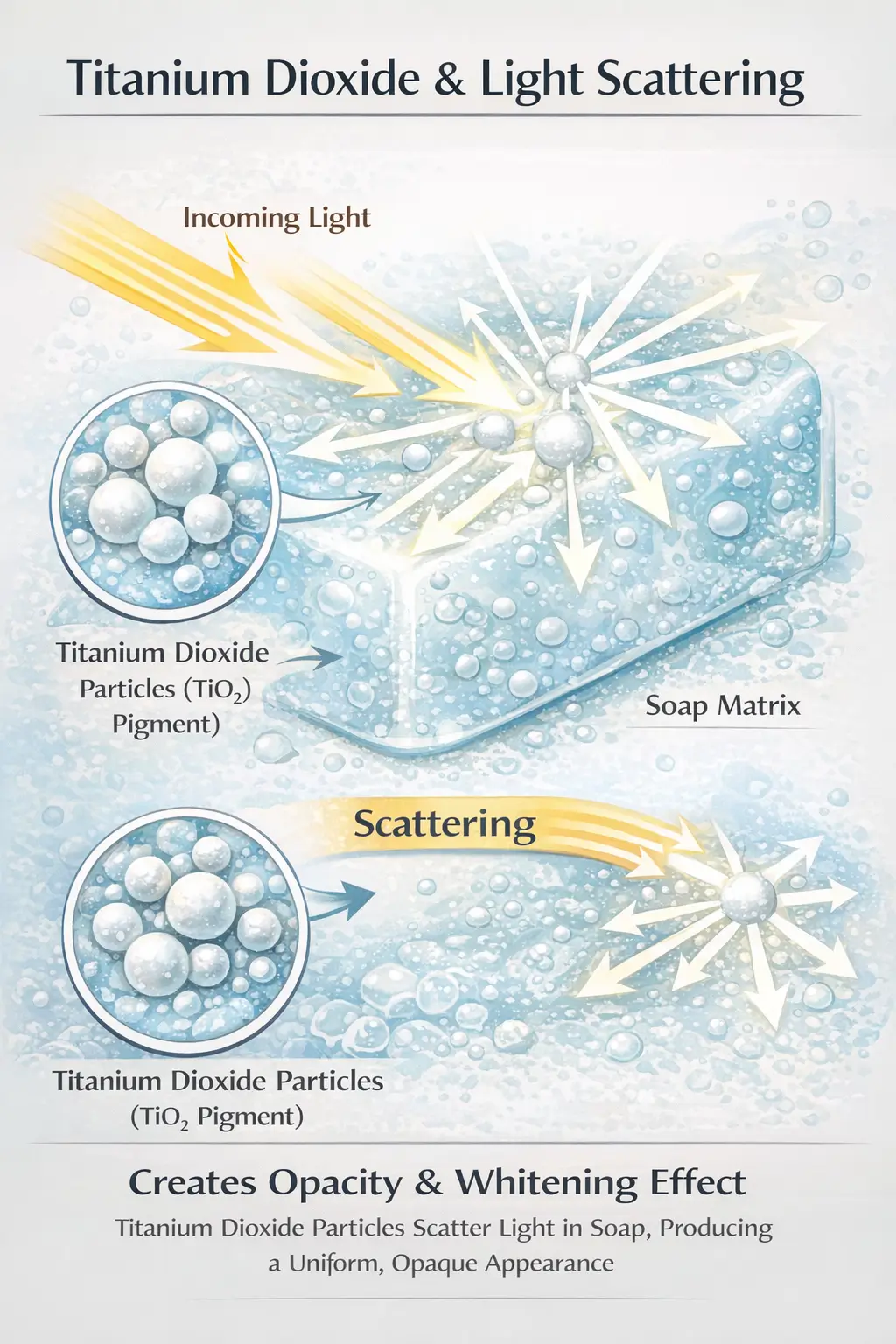
Titanium Dioxide is an inorganic pigment classified as a metal oxide additive used primarily as an opacifier and whitening agent in cleansing and cosmetic formulations. It does not participate in cleansing chemistry but modifies how the formulation appears and interacts with light.
Within soap and detergent systems, it exists as a finely divided solid dispersed throughout the formulation. Its function is physical rather than chemical, meaning it influences visual characteristics without altering the core surfactant or soap base behavior.
This ingredient belongs to the broader category of formulation additives that adjust system appearance, especially in opaque bars, creams, and liquid cleansers where visual uniformity is required.
In practical formulation terms, its presence determines whether a product appears bright white, creamy, or visually dense rather than translucent or clear.
Quick Facts
| Property | Description |
|---|---|
| Ingredient Type | Inorganic additive |
| Chemical Class | Metal oxide pigment |
| Functional Role | Opacifier and whitening agent |
| Ionic Nature | Non ionic particulate solid |
| Typical Use Context | Soap bars, liquid cleansers, creams, detergent systems |
| Solubility | Insoluble in water and oils |
| INCI Name | Titanium Dioxide |
| Chemical Formula | TiO2 |
| Molecular Weight | 79.87 g/mol |
| Crystal Forms | Anatase and rutile (rutile preferred for stability) |
| Refractive Index | ~2.5 to 2.7 (high light scattering efficiency) |
| Particle Size Range | ~0.2 to 0.4 µm (pigment grade), <100 nm (nano grade) |
| Opacity Mechanism | Light scattering based on refractive index difference: Δn = n(TiO₂) − n(medium) |
| Dispersion Requirement | Requires uniform dispersion to avoid agglomeration and streaking |
| Surface Treatment | Often coated (silica, alumina) to improve stability and reduce reactivity |
| Photostability | Rutile form offers higher UV stability than anatase |
| UV Interaction | Absorbs and scatters UV radiation (primarily UVB and some UVA) |
| pH Stability Range | Stable across wide pH range (~3 to 10) |
| Density | ~3.9 to 4.2 g/cm³ |
| Oil Absorption Value | ~15 to 25 g oil per 100 g pigment (affects formulation viscosity) |
| Whiteness Index | High brightness due to strong diffuse reflectance |
| Usage Level | Typically 0.5% to 5% depending on opacity requirement |
| Regulatory Status | Widely approved for topical use; restrictions may apply for inhalation forms |
| Compatibility | Compatible with most surfactants, oils, and emulsifiers |
| Sedimentation Tendency | High density may lead to settling in low-viscosity systems |
| Processing Consideration | Added during oil or dispersion phase with high shear mixing |
Why This Ingredient Appears On Labels
Titanium Dioxide appears on product labels because it is intentionally added to control visual appearance, particularly opacity and color uniformity. In formulations that would otherwise appear translucent or uneven, it provides a consistent white or opaque base.
In soap bars, it is used to create a bright, solid appearance that masks variations in fatty acid composition or curing behavior. In liquid systems, it reduces transparency and gives a more dense, creamy visual profile.
Its presence in an ingredient list does not indicate cleansing activity or preservation. Instead, it reflects a design choice in how the formulation should look when used or displayed.
From a user perspective, this translates into a product that appears more uniform, less see-through, and often visually associated with cream-based or structured formulations.
Chemical Identity And Classification
Titanium Dioxide is identified by the INCI name Titanium Dioxide and belongs to the class of inorganic metal oxides. It is composed of titanium and oxygen atoms arranged in crystalline structures, most commonly rutile and anatase forms.
These crystalline forms differ in how they interact with light, but both are used in formulation systems where strong light scattering is required. The ingredient does not dissolve in water or oil phases and instead remains as a dispersed solid.
From a formulation perspective, it behaves as a non reactive particulate material. It does not ionize, does not contribute to pH adjustment, and does not participate in surfactant activity.
Its classification as a pigment is based on its ability to reflect and scatter visible light, rather than absorb or chemically interact with other formulation components.
Functional Role In Soap And Cleansing Systems
In soap and detergent systems, Titanium Dioxide functions primarily as an opacifier. It reduces light transmission through the product, creating a solid or creamy appearance instead of transparency.
In bar soaps, it contributes to a visually uniform structure by masking internal variations in the soap matrix. This is particularly relevant in formulations where fatty acid distribution or curing conditions may otherwise produce uneven coloration.
In liquid cleansers and shampoos, it transforms a clear surfactant system into an opaque or milky system. This visual shift often aligns with how the product is positioned, even though the underlying cleansing chemistry remains unchanged.
It does not enhance cleansing, lather formation, or soil removal. Its role is limited to optical modification, but that modification can influence how the formulation is perceived during use.
In practical terms, the presence of this ingredient makes a formulation appear thicker, more structured, and less transparent, even when viscosity or surfactant concentration has not changed.
Ingredient Interaction Logic
Titanium Dioxide interacts with the formulation primarily through physical dispersion rather than chemical bonding. Its behavior depends on how evenly it is distributed within the system.
In soap matrices, it becomes embedded within the crystalline structure formed by fatty acid salts. This allows it to distribute throughout the bar without dissolving, maintaining consistent opacity across the product.
In liquid systems, it is suspended within the water phase alongside surfactants. Stabilization often depends on the viscosity of the system or the presence of structuring agents that prevent particle settling.
It does not interact directly with surfactants at a molecular level, but surfactant systems can influence how well it disperses. Poor dispersion can lead to uneven opacity or visible streaking.
When combined with fragrances or oils, it can help visually mask slight phase inconsistencies, but it does not stabilize those systems. Its role remains limited to modifying how those interactions are visually perceived.
Phase Behavior And Physical Characteristics
Titanium Dioxide is insoluble in both aqueous and oil phases, meaning it exists as a dispersed solid within the formulation rather than forming a true solution.
Its effectiveness depends on particle size and distribution. Fine particles create more efficient light scattering, resulting in higher opacity at lower concentrations.
In solid soap systems, it becomes physically locked within the crystalline network formed during saponification and curing. This gives long term stability to the visual appearance of the bar.
In liquid systems, its stability depends on suspension. Without adequate viscosity or structuring support, particles may settle over time, leading to separation or uneven appearance.
It remains stable across a wide pH range typically encountered in soap and detergent formulations and does not degrade under normal formulation conditions.
From a formulation outcome perspective, this results in stable opacity in solid systems and conditionally stable opacity in liquids depending on suspension design.
Comparison With Related Ingredients
| Feature | Titanium Dioxide | Zinc Oxide | Iron Oxides |
|---|---|---|---|
| Primary Function | Opacity and whitening | Opacity with additional functional roles | Color pigmentation |
| Color Output | White | White to off white | Red, yellow, black tones |
| Solubility | Insoluble | Insoluble | Insoluble |
| Role In Cleansing Systems | Visual modifier only | Visual and functional modifier | Color adjustment |
| Effect On Transparency | Strong opacity | Moderate opacity | Minimal opacity impact |
Regulatory Context
Titanium Dioxide is listed as a permitted colorant under cosmetic regulatory frameworks and is declared using its INCI name in ingredient lists. Its presence is typically associated with visual function rather than active performance.
In the European Union, it appears under the cosmetic regulation framework as a colorant substance and must be listed when used in formulations. The declaration reflects its role in altering product appearance rather than its concentration or formulation position.
In cleansing products such as soaps and detergents, it is not classified as an active cleaning agent. Its regulatory identity remains tied to its function as a pigment and opacity modifier.
Labeling requirements focus on transparency of inclusion rather than functional claims, meaning it is listed to indicate composition rather than performance contribution.
Common Misunderstanding
A common assumption is that a brighter or more opaque product indicates higher quality or stronger cleansing performance. This interpretation is not supported by formulation logic.
Titanium Dioxide does not enhance cleansing ability, surfactant efficiency, or formulation strength. It only modifies how the product interacts with light.
Two formulations with identical cleansing systems can appear completely different if one includes this ingredient and the other does not. The difference is visual rather than functional.
This distinction is important because appearance can influence perception, but it does not reflect changes in how the formulation behaves during use.
Structural Limitations In Formulation
One key limitation of Titanium Dioxide is its dependence on proper dispersion. Because it does not dissolve, uneven mixing can lead to streaking, clumping, or inconsistent opacity.
In liquid systems, it requires adequate suspension support. Without sufficient viscosity or structuring agents, particles may settle over time, leading to phase separation or uneven distribution.
It does not contribute to system stability. While it can visually mask minor inconsistencies, it does not prevent phase separation or improve formulation robustness.
Another limitation is that excessive use can create an overly dense or chalky appearance, which may alter the perceived texture of the product even though the underlying formulation remains unchanged.
These constraints mean that its effectiveness depends on formulation design rather than inherent chemical activity.
Formulation References Using This Ingredient
Summary of Findings
- Classification: Titanium Dioxide is an inorganic metal oxide pigment used as a formulation additive.
- Functional Role: It acts as an opacifier and whitening agent, modifying visual appearance without affecting cleansing performance.
- Interaction Logic: It disperses physically within soap and surfactant systems without participating in chemical reactions.
- System Behavior: It creates stable opacity in solid systems and conditionally stable suspension in liquid formulations.
- Formulation Limits: Its performance depends on dispersion quality and suspension design rather than chemical reactivity.