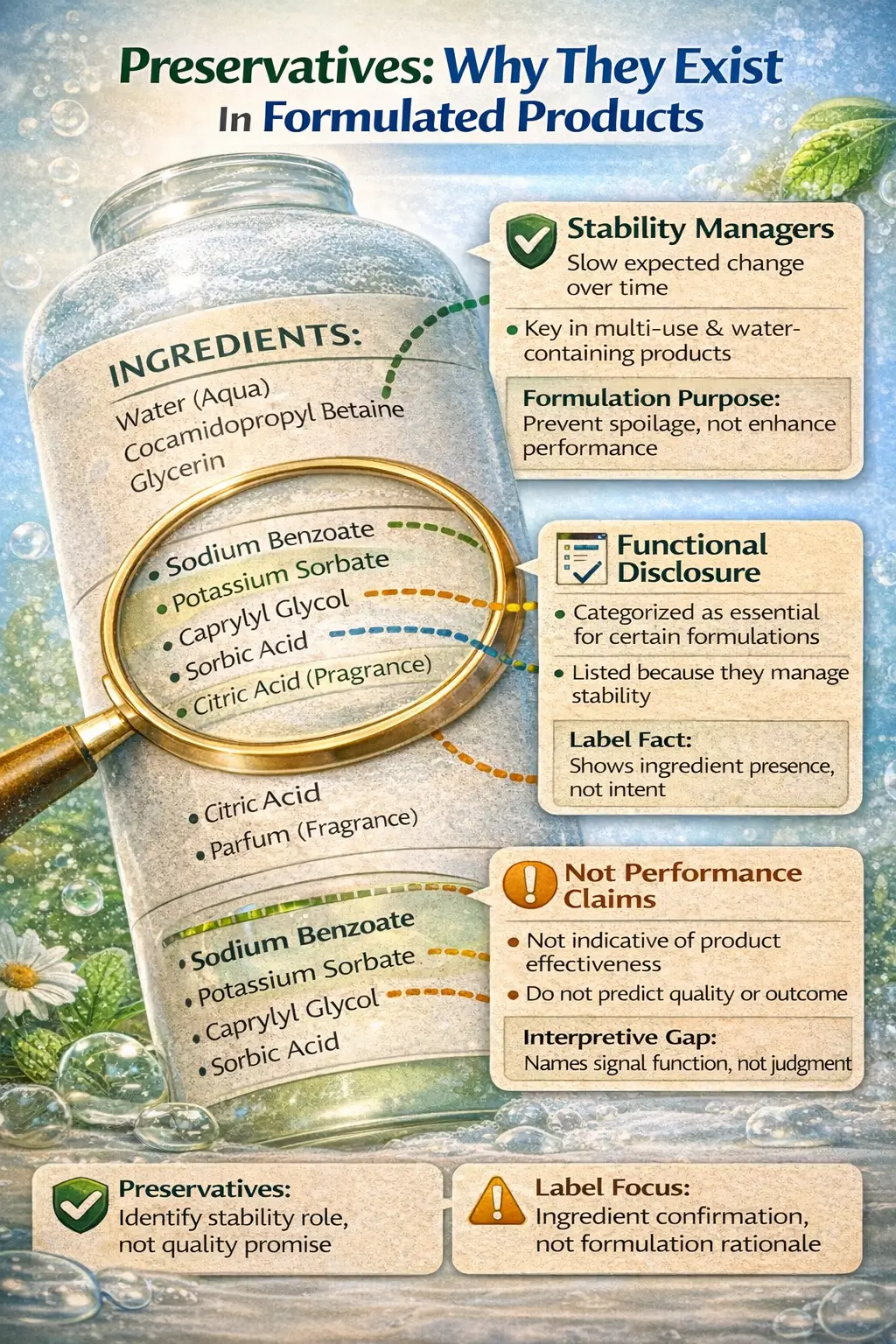
What Preservatives Exist To Do
Preservatives exist to manage change over time. In formulated products, especially those containing water or exposed to repeated handling, change is expected rather than hypothetical.
Their role is not to enhance performance or extend use indefinitely. Instead, preservatives aim to keep the product materially similar to how it was formulated, within the conditions for which it was designed.
From a formulation perspective, preservation is a stabilizing function, not a value statement.
Why Preservatives Appear On Ingredient Labels
Ingredient labels disclose composition, not formulation reasoning, a distinction outlined more broadly in the soap ingredients guide. Preservatives appear because they are present, not because they require special interpretation.
Under Regulation (EC) No 1223/2009, Article 19 requires cosmetic products to list ingredients using standardized INCI nomenclature in descending order of weight. Preservatives are disclosed under the same framework as all other ingredients. In addition, Annex V of Regulation 1223/2009 defines which substances are permitted for use as preservatives in cosmetic products and under what conditions. The regulation governs authorization and disclosure, not formulation preference or product positioning.
Under European labeling rules, preservatives are listed using the same disclosure logic as surfactants, fragrances, or structural ingredients, a pattern also discussed in fragrance function explained in context. The label does not distinguish between necessity, optionality, or design trade-offs.
Preservatives In Context: What Labels Show vs What They Mean
| Label Observation | Formulation Context | What It Does Not Indicate |
|---|---|---|
| Named preservative listed | Ingredient included to manage stability over time | Product lifespan or usage conditions |
| Multiple preservatives listed | Layered preservation approach for varied conditions | Greater strength or aggressiveness |
| Preservative near end of list | Lower inclusion relative to other ingredients | Lower importance within the formulation system |
Why "No Preservatives" Claims Create Confusion
Absence claims compress complex formulation strategies into a single message. Products without listed preservatives often rely on alternative constraints such as packaging control, limited exposure, reduced water activity, or shorter shelf expectations.
Regulation (EU) No 655/2013 establishes common criteria for cosmetic claims. Under this framework, absence claims such as "no preservatives" must not mislead consumers regarding product characteristics or safety. However, the claims regulation addresses promotional communication, not the scientific necessity of .
These constraints are not visible from the claim itself. As a result, absence messaging often removes context rather than adding clarity.
This does not make absence claims inherently misleading. It does mean they are incomplete without formulation context.
Why Preservation Needs Vary Across Products
Preservation requirements are not uniform. They vary with formulation structure, packaging design, and expected use. A solid bar stored dry behaves differently from a liquid kept in a shared bathroom environment.
Water content is often a dividing factor, but it is not the only one. Refill formats, wide-mouth containers, and repeated hand contact introduce variability that influences preservation strategy.
Labels confirm what is present. They do not explain why a particular strategy was necessary.
Limits Of Label-Based Interpretation
Labels cannot predict how long a product will remain unchanged once opened. They cannot describe how storage conditions will affect stability. They cannot communicate formulation compromises made during development.
These limits are structural, reflecting the boundaries of disclosure explained in the data and methodology used to interpret formulation information. Ingredient lists are disclosure tools, not formulation summaries or user guides.
A Practical Way To Interpret Preservatives On Labels
A more reliable interpretation is to view preservatives as indicators of formulation intent rather than signals of quality or risk.
Their presence reflects an attempt to manage predictable change under expected conditions of storage and use. Nothing more is implied, and nothing less is guaranteed.
Limits And Remaining Uncertainty
Even with context, uncertainty remains unavoidable. Formulations age differently across environments, and consumer handling introduces variability that cannot be standardized.
Preservatives reduce uncertainty, but they do not eliminate it. Labels cannot bridge that gap completely.
Summary Points
- Functional Role: Preservatives manage predictable change over time.
- Label Scope:ingredient lists disclose presence, not reasoning.
- Context Matters: Preservation needs vary by product structure and use.
- Interpretation Limit: Labels cannot explain stability strategies or trade-offs.
Regulatory Framework & Primary Sources
| Source | Authority | Relevance To This Article |
|---|---|---|
| Regulation (EC) No 1223/2009: Article 19 | European Parliament & Council | Establishes mandatory ingredient listing requirements (INCI disclosure). |
| Regulation (EC) No 1223/2009: Annex V | European Commission | Defines authorized preservatives and usage conditions in cosmetic products. |
| Regulation (EU) No 655/2013 | European Commission | Sets common criteria for cosmetic claims, including absence claims. |
| European Commission Technical Guidance on Cosmetic Claims | European Commission | Clarifies interpretation of marketing communication under EU framework. |