What Soap Labels Are Designed To Do
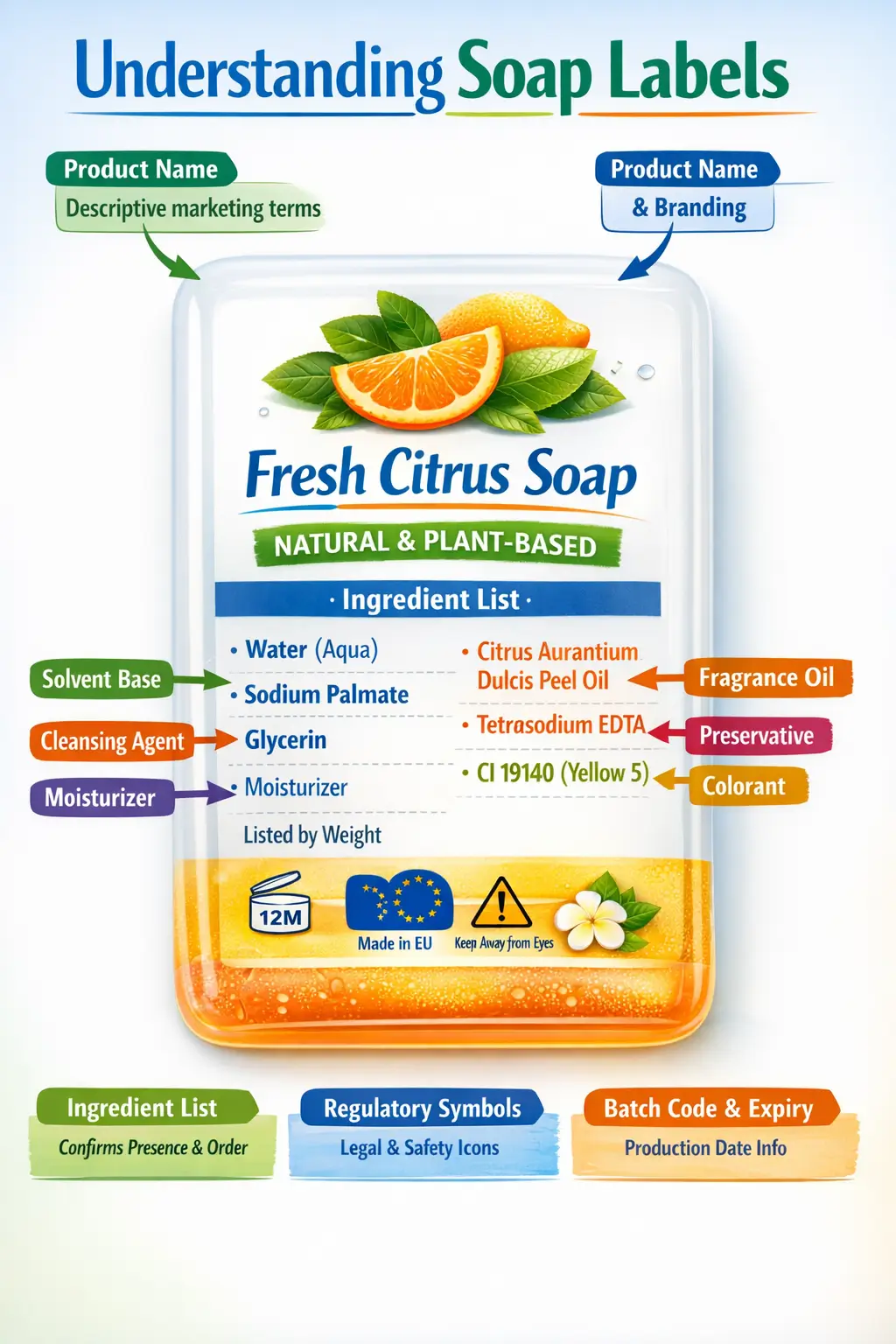
A soap label exists to satisfy regulatory obligations, not to guide interpretation. Its primary role is to identify the product within a legal framework, disclose required information, and establish responsibility for placing it on the market. Anything beyond that is incidental.
In the European Union, this means labels are written to be read by regulators, customs officials, and supply chain auditors as much as by consumers. Ingredient lists, weight declarations, and manufacturer details are formatted to meet consistency rules, not to explain formulation logic or real-world behavior.
This is why labels often feel incomplete. They are not summaries of formulation intent. They do not explain why certain ingredients were chosen, how they interact in water, or what trade-offs were accepted during development. Expecting them to do so places a burden on labels they were never designed to carry.
Where Meaning Gets Lost In Translation
Most confusion around soap labels arises when regulatory language is interpreted as performance language, a tension also examined in marketing language vs formulation reality. Terms that exist for classification or disclosure are often read as promises, signals of quality, or indicators of suitability, even though they were never intended that way.
For example, ingredient names describe chemical identity, not concentration, balance, or functional dominance. A listed oil or extract does not indicate how much of it remains after processing, nor how much it contributes to cleansing behavior. The label confirms presence, not influence.
Similarly, product names and descriptors may reflect historical usage rather than formulation reality. A product labeled as soap may not be a traditional soap in chemical terms, while a non-soap cleanser may still use familiar soap language to orient consumers. Labels rarely clarify this distinction directly.
Regulation vs Consumer Expectation
European labeling rules are designed around minimum transparency, not interpretive clarity. They ensure that consumers can identify ingredients, trace accountability, and compare products at a basic level. They do not attempt to explain formulation strategy or user experience.
This gap between what labels disclose and what consumers hope to learn is structural, not accidental. Regulations prioritize consistency and enforceability. Interpretation requires context, and context is deliberately kept outside the label to avoid subjective claims or implied guarantees.
In practice, this means that reading a soap label accurately requires understanding what it is not saying. Absence of information is not concealment, and presence of a term is not an endorsement of outcome. Labels describe compliance, not conclusions.
What Ingredient Lists Actually Communicate
An ingredient list on a soap label confirms composition, not emphasis, which is why broader context such as a soap ingredients guide is often needed to interpret what is listed. It tells you which substances are present above regulatory disclosure thresholds and how they are ordered by relative weight at the point of formulation, typically before curing, dilution, or finishing steps.
What it does not communicate is how dominant an ingredient is in real use. A material listed early may be structurally important but functionally quiet, while another listed later may shape sensory perception or rinsing behavior disproportionately. Labels are not weighted explanations of influence.
This distinction is easy to miss because ingredient lists look precise. They use standardized names and fixed ordering rules, which gives an impression of completeness. In practice, they are partial snapshots of a dynamic system that changes during processing and use.
Presence Does Not Equal Impact
One of the most common assumptions is that if an ingredient appears on a label, it must meaningfully affect performance. In formulation work, this is rarely a safe conclusion. Many ingredients are included for stability, processing tolerance, or regulatory completeness rather than direct user-facing effects.
For example, an oil, extract, or additive may be present at a level sufficient to justify disclosure but insufficient to materially alter cleansing strength, feel, or residue. The label confirms identity, not contribution.
This is not misleading behavior. It reflects how disclosure rules intersect with complex formulations. The alternative would require labels to explain formulation logic in detail, which current regulatory systems intentionally avoid.
What "Natural" & Similar Terms Usually Indicate
Terms such as natural, plant-based, or derived from are not standardized performance claims. In most cases, they describe sourcing origin or processing lineage rather than end behavior. A plant-derived ingredient may be chemically indistinguishable from one produced synthetically.
European regulations allow such descriptors when they are not misleading, but they do not require that the term explain processing steps, modification, or final functionality. As a result, these words often serve as orientation cues rather than technical descriptions.
When read carefully, these terms tell you where a material started, not how it behaves once formulated. Confusion arises when origin language is assumed to imply gentleness, strength, or suitability, none of which are guaranteed by the term itself.
Why Labels Avoid Explaining Trade-Offs
Formulation always involves trade-offs. Adjusting cleansing strength can affect residue. Improving stability can alter feel. Extending shelf life may require additional components. Labels do not describe these decisions because doing so would introduce interpretation and implied judgment.
Regulatory systems are deliberately conservative about explanatory language. Once a label explains why something was done, it risks implying that the outcome is desirable or superior. To avoid this, labels stay descriptive and avoid causal framing.
This restraint can feel unhelpful to consumers seeking clarity, but it is intentional. Labels are designed to remain neutral records, not argumentative documents.
How To Read Soap Labels Calmly
A useful way to approach a soap label is to treat it as a boundary marker rather than a verdict, an approach explored in more detail in label reading. It tells you what category the product belongs to, which regulatory framework applies, and which substances are present at meaningful disclosure levels.
It does not tell you how the product will feel in every context, how it will interact with local water conditions, or how it will compare subjectively to other products. Those interpretations sit outside the label by design.
When labels are read with this limitation in mind, they become less confusing. The goal shifts from extracting hidden meaning to understanding declared scope.
Summary of Findings
- Labels Describe Compliance, Not Outcomes: Soap labels exist to meet regulatory disclosure requirements and establish accountability, not to explain formulation behavior or user experience.
- Ingredient Presence Is Not Influence: An ingredient appearing on a label confirms identity and disclosure status, not its functional weight, concentration, or sensory impact in use.
- Descriptive Terms Are Contextual, Not Predictive: Words such as natural or plant-based usually indicate sourcing or lineage, not performance, suitability, or formulation intent.
- Interpretation Requires Restraint: Many misunderstandings arise from reading regulatory language as promises, when labels are intentionally non-interpretive by design.
References
- European Commission. Cosmetics Regulation (EC) No 1223/2009.
- European Commission. Guidance on the Scope of the Cosmetics Regulation.
- European Commission. Detergents Regulation (EC) No 648/2004.
- European Commission. Cosmetics Ingredient Nomenclature Guidance.
- European Chemicals Agency. Substance Identity and Disclosure Principles.
- European Consumer Organisation (BEUC). Product Labeling and Consumer Interpretation.