Definition and System Role
Sodium Isethionate is a sulfonate-based organic salt classified as a surfactant intermediate, used in cleansing formulations to support surfactant structure, processing behavior, and system stability.
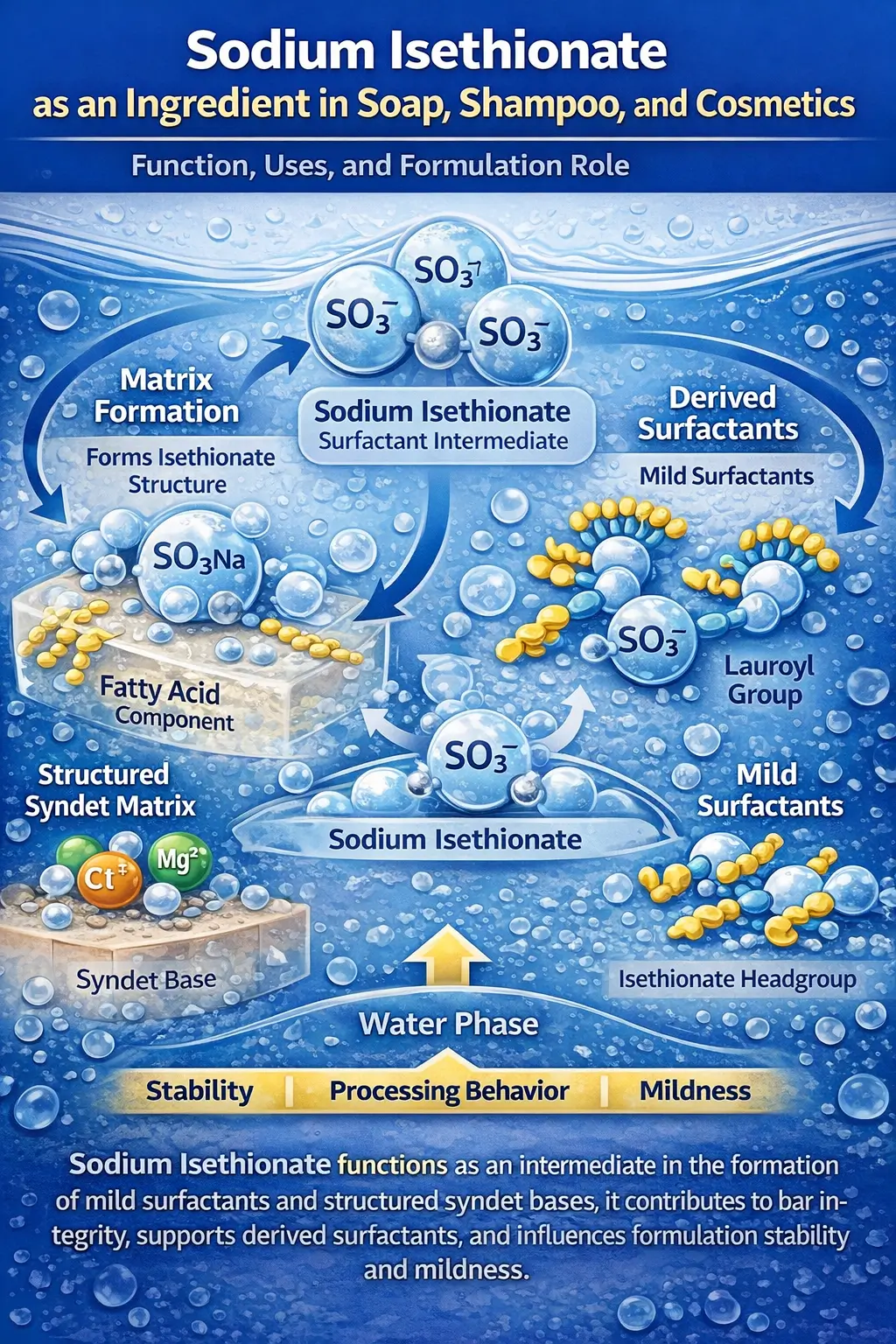
It does not function as a primary cleansing agent on its own. Instead, it acts as a precursor or structural component in the formation of mild surfactant systems such as isethionate-based cleansing agents.
Within soap and syndet systems, it contributes to matrix formation, influencing how surfactants are organized and how the bar maintains integrity during use.
This page is part of the CleanFormulation Ingredient Library, a research project focused on understanding how ingredients behave within real formulation systems rather than in isolation.
Quick Facts
| Property | Description |
|---|---|
| Ingredient Type | Surfactant intermediate |
| Chemical Class | Organic sulfonate salt |
| Ionic Character | Anionic |
| Primary Function | Structural and processing component in surfactant systems |
| Typical Use Context | Syndet bars, shampoos, and mild cleansing formulations |
| Solubility | Water-soluble under formulation conditions |
| Common Derivative Form | Used to produce Sodium Cocoyl Isethionate (SCI) |
| pH Stability Range | Stable in mildly acidic to neutral pH systems |
| Foaming Behavior | Supports dense, creamy, and stable foam structures |
| Mildness Profile | Low irritation potential compared to sulfate surfactants |
| Skin Compatibility | Suitable for sensitive and baby-care formulations |
| Hard Water Performance | Maintains functionality in presence of calcium and magnesium ions |
| Biodegradability | Readily biodegradable under standard environmental conditions |
| Thermal Stability | Stable under typical surfactant processing temperatures |
| Hydrophilic Nature | Highly hydrophilic due to sulfonate group |
| Compatibility with Surfactants | Compatible with anionic, amphoteric, and nonionic systems |
| Electrolyte Sensitivity | Moderate tolerance; excessive salts may affect viscosity |
| Viscosity Contribution | Indirect; contributes through structured surfactant systems |
| Processing Form | Typically used as flakes, granules, or powder intermediates |
| Hydrolysis Resistance | Stable against hydrolysis under normal formulation conditions |
| Role in Syndet Bars | Key structural component providing hardness and mild cleansing |
| Interaction with Oils | Facilitates emulsification and removal of sebum and oils |
| Foam Quality | Produces fine, velvety, and non-stripping foam |
| Environmental Profile | Considered more eco-friendly than sulfate-based systems |
| Storage Stability | Stable when kept dry and protected from moisture |
| Typical Formulation Role | Intermediate building block for mild surfactant systems |
Why This Ingredient Appears on Labels
Sodium isethionate appears on ingredient labels because it plays a role in constructing the surfactant system used in cleansing formulations. Its presence reflects how the formulation is built rather than how it cleans directly.
In syndet-based products such as those explained in caress soap ingredient systems, it contributes to the formation of milder surfactant structures compared to traditional soap salts.
For consumers reading labels, its inclusion indicates that the product relies on a synthetic surfactant architecture rather than a purely saponified fat system.
Chemical Identity and Classification
Sodium Isethionate is the sodium salt of isethionic acid, belonging to the family of alkyl sulfonates. It is structurally defined by a sulfonate group attached to a short hydrocarbon chain, which gives it water compatibility and ionic behavior.
Unlike traditional soap molecules formed through reaction with sodium hydroxide, this compound does not originate from direct fat saponification. Instead, it is produced through controlled chemical synthesis designed to create consistent sulfonate functionality.
Its anionic character allows it to interact with water and other charged components within a formulation. However, it is typically used as a building block rather than as a standalone surfactant.
This distinction is important because its behavior depends on how it is incorporated into larger surfactant structures rather than acting independently.
Functional Role in Cleansing Systems
Sodium isethionate contributes to the formation and stabilization of mild surfactant systems, particularly in syndet bars and liquid cleansers. Its role is not to drive cleansing directly, but to support the structure of surfactants derived from it.
In formulations where it is converted into derivatives such as sodium lauroyl isethionate, it becomes part of a system that produces controlled foam and reduced harshness compared to traditional soap systems.
Within solid cleansing bars, it helps maintain structural cohesion of the surfactant matrix. This affects how the bar resists breakdown during use and how it interacts with water.
From a user-observable perspective, formulations built on this chemistry tend to produce a smoother lather profile and a more uniform bar structure during repeated use.
Ingredient Interaction Logic
Sodium isethionate interacts primarily with other surfactant components within the formulation. It forms part of a network that determines how surfactants assemble and behave in water.
When combined with anionic surfactants such as those explained in surfactant systems, it contributes to a balanced charge distribution that influences foam formation and stability.
It also interacts with amphoteric surfactants, which help moderate system behavior and improve compatibility across different pH conditions. These interactions influence how the formulation performs during dilution and rinsing.
In the presence of water, it participates in the formation of organized structures that allow surfactants to surround and remove soil. Its role is indirect but essential to how the system operates.
It has limited direct interaction with oils or fatty acids, as its primary function remains within the surfactant phase rather than the lipid phase.
Phase Behavior and Solubility
Sodium isethionate is generally water-soluble, but its behavior depends on formulation conditions such as concentration and temperature. It does not form a separate oil phase and remains within the aqueous or surfactant matrix.
In solid systems, it contributes to a structured matrix rather than forming crystalline fats like triglycerides. Its presence influences how the bar holds together and how it dissolves during use.
In liquid systems, it remains dispersed and supports the formation of surfactant assemblies that enable cleansing action.
This leads to formulations that dissolve in a more controlled manner, avoiding rapid breakdown or uneven dispersion.
Comparison With Related Surfactant Components
Sodium isethionate is often discussed alongside finished surfactants derived from it, as well as conventional anionic surfactants. While they share chemical relationships, their functional roles within formulations differ significantly.
| Feature | Sodium Isethionate | Finished Isethionate Surfactants | Conventional Anionic Surfactants |
|---|---|---|---|
| Functional Role | Intermediate / structural component | Primary cleansing agents | Primary cleansing agents |
| Use in Formulation | Supports surfactant system formation | Directly provides cleansing and foam | Provides strong cleansing and rapid foam |
| System Contribution | Improves structure and mildness profile | Balances foam and cleansing efficiency | Enhances cleansing strength |
| Behavior in Water | Participates in surfactant matrix | Forms micelles and removes soil | Forms micelles with high detergency |
| Typical Context | Syndet bars and mild cleansing systems | Syndet bars, shampoos, facial cleansers | Detergents, shampoos, liquid cleansers |
Regulatory Context
Sodium isethionate is listed in ingredient declarations under its standard chemical name and is not classified as a restricted substance within typical cosmetic regulatory frameworks when used in conventional formulation contexts.
Within regulatory systems such as those applied in the European Union, it is considered a functional ingredient contributing to formulation structure rather than an active component associated with specific claims.
Its presence in finished products reflects its role in surfactant system construction, and regulatory evaluation focuses on the safety and composition of the final formulation rather than the intermediate in isolation.
In detergent systems, it is similarly treated as part of the formulation chemistry rather than as a standalone cleaning agent.
Common Misunderstanding
Sodium isethionate is often assumed to function as a primary surfactant due to its association with cleansing systems. In reality, its role is indirect and dependent on its transformation into or combination with other surfactant components.
Another common misunderstanding is that its presence alone determines product mildness. While it contributes to the structure of milder surfactant systems, the overall formulation—including surfactant balance and concentration—determines final behavior.
It is also sometimes interpreted as a direct replacement for traditional soap. However, it belongs to a different chemical system and contributes to a different type of cleansing architecture.
Structural Limitations
Sodium isethionate does not provide independent cleansing performance and must be combined with other surfactants to form a functional system. Its role is therefore dependent on formulation design.
In solid systems, improper balance can lead to reduced structural integrity or uneven dissolution if not combined with appropriate binders and co-surfactants.
Its performance is also influenced by pH and ionic conditions, which can affect how it interacts with other surfactants and how the system behaves during dilution.
Additionally, because it is not lipid-based, it does not contribute to structural properties derived from fatty materials, requiring combination with fatty acids or other structural components in solid formulations.
Formulation References Using This Ingredient
Summary of Findings
- Classification: Sodium isethionate is a sulfonate-based surfactant intermediate used in cleansing formulations.
- Functional Role: It supports the formation and stability of surfactant systems rather than acting as a primary cleansing agent.
- Interaction Logic: Interacts with anionic and amphoteric surfactants to influence system structure, foam behavior, and mildness profile.
- System Boundaries: Its effectiveness depends on combination with other surfactants and formulation conditions.