Definition
Sodium Stearate is a fatty acid sodium salt classified as an anionic surfactant, primarily formed through the reaction of stearic acid with sodium hydroxide. It functions as a foundational structural and cleansing component in traditional soap systems.
Within solid soap bars, it acts as a primary soap base material, contributing to both the physical structure and the surface-active behavior required for soil removal. Its presence is closely associated with firm bar formation and low solubility compared to potassium-based soap salts.
From a formulation perspective, it belongs to the group of alkali-derived fatty acid salts that define classical soap chemistry. These materials exhibit amphiphilic behavior, enabling interaction between water and oily residues.
In practical terms, its inclusion results in a harder, longer-lasting soap bar with controlled lather characteristics and slower dissolution during use.
Quick Facts
| Property | Description |
|---|---|
| Ingredient Type | Soap base component |
| Chemical Class | Fatty acid sodium salt |
| Functional Role | Cleansing agent and structural matrix builder |
| Ionic Class | Anionic surfactant |
| Typical Use Context | Solid soap bars, cleansing sticks, traditional soap formulations |
| Solubility Profile | Low to moderate water solubility |
| Physical Form | Waxy solid or crystalline soap matrix |
| Chemical Formula | C₁₈H₃₅NaO₂ |
| Molecular Weight | 306.46 g/mol |
| Carbon Chain Length | C18 saturated fatty acid chain |
| Melting Range | ~245°C to 255°C (decomposition range, not true melting) |
| Critical Micelle Concentration (CMC) | ~2 to 5 mmol/L in water (dependent on temperature and ionic strength) |
| pH Range in Use | Typically 9.5 to 10.5 in aqueous soap systems |
| Density | ~0.9 to 1.0 g/cm³ (compressed soap matrix) |
| Water Dissolution Rate | Slow surface erosion, not rapid bulk dissolution |
| Foam Structure | Compact, creamy foam with lower air incorporation ratio |
| Foam Volume Index | Moderate, typically lower than synthetic surfactants by 20 to 40 percent |
| Hardness Contribution | High, contributes up to 40 to 60 percent of bar rigidity depending on formulation |
| Water Activity Impact | Reduces free water mobility within the soap matrix |
| Interaction with Hard Water | Forms insoluble calcium and magnesium stearates (soap scum) |
| Hydrophilic-Lipophilic Balance (HLB) | Approx. 18 (strongly hydrophilic head group with long hydrophobic tail) |
| Crystalline Structure Type | Lamellar crystalline domains within solid soap matrix |
| Thermal Stability | Stable under standard processing, degrades above ~200°C |
| Saponification Origin | Derived from stearic acid + NaOH → sodium stearate + glycerol |
| Saponification Equation | C₁₇H₃₅COOH + NaOH → C₁₇H₃₅COONa + H₂O |
| Typical Usage Ratio in Bar Soap | Often 20 to 50 percent of total fatty acid composition in structured bars |
| Compatibility with Humectants | Moderate, increased glycerin can soften structure over time |
| Surface Activity Mechanism | Reduces interfacial tension via amphiphilic orientation at oil-water interface |
| Rinse Behavior | May leave residue in high mineral water conditions |
| Dissolution Layer Formation | Forms hydrated gel layer before releasing active molecules |
| Bar Longevity Impact | High, slower wear rate compared to more soluble soap salts |
Why This Ingredient Appears on Labels
Sodium stearate appears on ingredient lists because it represents the final saponified form of stearic acid in sodium-based soap systems. Instead of listing raw fats and alkali separately, many formulations disclose the resulting soap salt directly.
In label interpretation, this naming reflects compliance with INCI conventions explained in how to read ingredient list, where ingredients are declared in their chemically recognized form rather than their pre-reaction components.
Its presence typically indicates a formulation built around solid soap architecture, where fatty acid salts provide both cleansing functionality and structural integrity. This differs from systems dominated by synthetic surfactants or liquid detergent bases.
From a user-observable standpoint, products listing this component tend to exhibit firm texture, slower wear during use, and a more defined bar shape compared to highly soluble cleansing systems.
Chemical Identity And Classification
Sodium Stearate is the sodium salt of stearic acid, a long-chain saturated fatty acid typically derived from plant oils or animal fats. It is formed through a saponification reaction involving triglycerides and an alkaline base such as sodium hydroxide.
From a molecular classification standpoint, it belongs to the group of carboxylate salts, specifically fatty acid salts with a hydrophobic hydrocarbon chain and a hydrophilic ionic head group. This dual structure defines its amphiphilic behavior.
Its ionic nature is anionic, meaning that in aqueous environments it dissociates to release negatively charged carboxylate ions. This charge behavior influences interaction with water, minerals, and other formulation components.
In terms of origin, the fatty acid component is commonly sourced from palm, coconut, or tallow-derived stearic fractions, although the final material is chemically consistent regardless of source once saponified.
In observable terms, this chemical identity translates into a material that forms structured, solid matrices while still maintaining surface activity when exposed to water.
Functional Role In Soap Systems
Within soap formulations, sodium stearate operates as both a cleansing agent and a structural backbone. This dual function distinguishes it from many other surfactants that primarily contribute only to cleaning performance.
Its cleansing action arises from its ability to reduce interfacial tension, allowing water to interact with oily or particulate soil. The hydrophobic tail associates with non-polar residues, while the ionic head remains compatible with the aqueous phase.
At the same time, its relatively low solubility compared to potassium-based soap salts allows it to form dense crystalline domains within the soap matrix. These domains contribute to bar rigidity and resistance to rapid dissolution.
In lather behavior, sodium stearate typically produces a stable but less voluminous foam. The foam structure tends to be creamier and more compact rather than highly airy, especially when compared to synthetic surfactant systems.
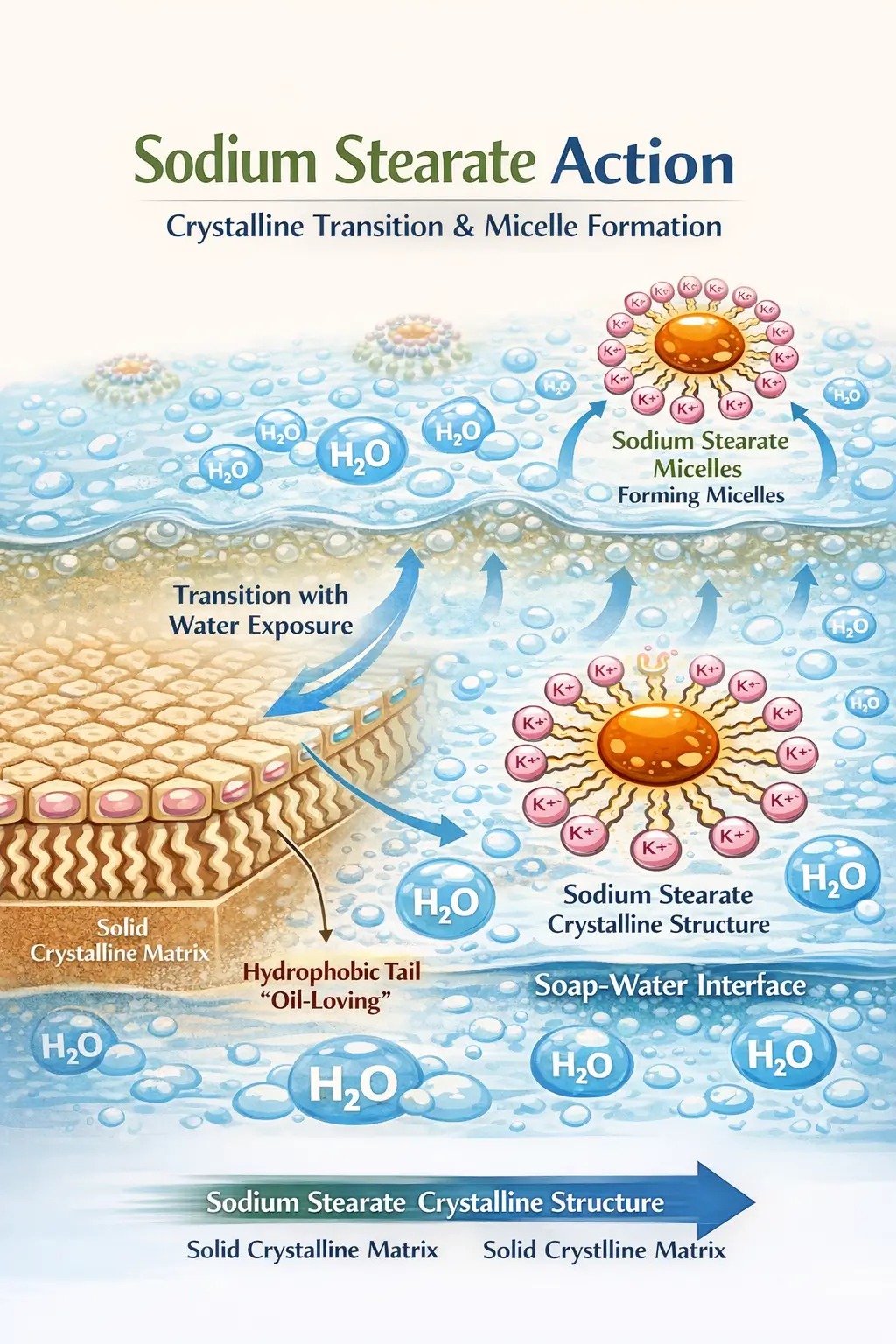
It also plays a role in controlling the rate of water uptake. As water penetrates the soap surface, the material gradually transitions from solid to a hydrated gel-like layer, enabling controlled release during use.
From a formulation outcome perspective, this results in bars that maintain shape, resist softening, and wear down gradually rather than rapidly dissolving.
Ingredient Interaction Logic
Sodium stearate does not operate in isolation. Its behavior is strongly influenced by how it interacts with other components within the formulation matrix.
In systems containing mixed fatty acid salts, such as those found in castile soap formulations, it contributes to hardness while shorter-chain or unsaturated soap salts adjust solubility and lather profile.
Interaction with water is central to its function. Upon hydration, the surface layer of the soap undergoes partial dissolution, forming a transient phase where micellar structures begin to organize and enable cleansing.
When combined with humectants such as glycerin, the hydration behavior can shift. Increased water retention at the surface may soften the bar over time, altering the rate at which the soap matrix breaks down.
In the presence of divalent metal ions, particularly calcium and magnesium, sodium stearate can form insoluble salts. This interaction is a key contributor to residue formation in hard water conditions and influences rinse characteristics.
Fragrance systems and minor additives are typically embedded within the soap matrix and released as the structure gradually erodes. The dense crystalline network created by sodium stearate can influence how evenly these components are distributed during use.
From a practical standpoint, these interactions determine whether a soap feels firm or soft, whether it rinses cleanly or leaves residue, and how consistently it performs across different water conditions.
Phase Behavior And Physical Structure
The phase behavior of sodium stearate is defined by its transition between solid crystalline structures and hydrated, semi-fluid surface layers during use.
In its dry state, it exists as a tightly packed crystalline network. These structures provide mechanical strength and define the rigidity of the soap bar.
Upon contact with water, the outer layer begins to hydrate and partially dissolve. This creates a thin, gel-like interface where surfactant molecules become mobile and capable of forming micellar assemblies.
The rate of this transition is influenced by temperature, water exposure time, and formulation composition. Higher temperatures and prolonged contact increase hydration and accelerate structural breakdown.
Unlike highly soluble surfactants, sodium stearate maintains a clear boundary between solid and hydrated phases. This controlled phase transition is essential for sustained product lifespan.
In observable terms, this behavior explains why soap bars develop a softened surface during use while retaining a solid core underneath.
Comparison With Related Ingredients
Sodium stearate is often compared with other soap salts that differ primarily in their counter-ion and fatty acid composition. These differences influence solubility, texture, and overall system behavior.
| Feature | Sodium Stearate | Potassium Stearate |
|---|---|---|
| Ionic Base | Sodium | Potassium |
| Solubility | Lower | Higher |
| Typical Form | Solid bar | Liquid or soft soap |
| Lather Profile | Dense and stable | Looser and more voluminous |
| Dissolution Rate | Slow | Faster |
| Structural Role | Provides rigidity | Provides fluidity |
This comparison highlights how the sodium ion contributes to a more structured and less soluble system, while potassium-based variants shift the formulation toward fluid or semi-liquid formats.
Regulatory Context
Sodium stearate is listed under the International Nomenclature of Cosmetic Ingredients (INCI) system as a recognized soap salt derived from stearic acid. Its naming reflects the final chemical structure rather than the original raw materials used in saponification.
Within the European Union cosmetic framework, ingredients are declared according to standardized INCI naming rules, as further explained in how soaps are regulated. This ensures consistency across product labeling and formulation disclosure.
It is typically classified as a cosmetic ingredient when used in cleansing products that do not make therapeutic or antimicrobial claims. The classification may differ if additional functional claims are introduced, affecting regulatory categorization.
From a labeling perspective, its presence does not indicate concentration hierarchy beyond its placement in the ingredient list, which follows descending order conventions defined in ingredient list interpretation guide.
Common Misunderstanding
A frequent misconception is that sodium stearate is a separate “added chemical” distinct from traditional soap. In reality, it is the actual chemical form of soap produced after the reaction between fatty acids and an alkali.
This misunderstanding often arises from label interpretation, where pre-reaction components such as oils and alkali are not listed separately. Instead, the final soap salt is declared, which can appear unfamiliar despite being the core functional material.
Another related confusion is the assumption that all cleansing ingredients behave similarly. However, sodium stearate belongs to a classical soap system, which differs structurally and functionally from synthetic surfactant-based cleansers discussed in soap cleansing mechanism explanation.
Understanding this distinction helps clarify why soap bars behave differently in terms of lather, residue, and interaction with water minerals.
Structural Limitations
Despite its functional importance, sodium stearate introduces several formulation constraints that define the boundaries of soap-based systems.
One primary limitation is its interaction with hard water. The presence of calcium and magnesium ions can lead to the formation of insoluble salts, which may reduce cleansing efficiency and contribute to visible residue.
Another constraint is its restricted solubility. While beneficial for maintaining bar integrity, this property can limit its effectiveness in applications requiring rapid dissolution or high foaming efficiency.
The alkaline nature of soap systems built around sodium stearate also imposes formulation boundaries. The system operates within a higher pH range, which is inherent to the chemistry of fatty acid salts rather than a variable that can be freely adjusted.
Additionally, its crystalline structure can limit compatibility with certain additives that require fully liquid or highly flexible systems. This affects formulation design when combining multiple functional components.
In practical terms, these limitations explain why sodium stearate is primarily used in solid soap formats and less commonly in modern liquid cleansing systems.
Formulation References Using This Ingredient
Summary of Findings
- Classification: Sodium stearate is an anionic fatty acid salt formed through saponification.
- Functional Role: It provides both cleansing action and structural integrity in solid soap systems.
- Interaction Logic: Its performance depends on interactions with water, other soap salts, and mineral ions.
- Phase Behavior: It transitions from a crystalline solid to a hydrated surface layer during use.
- System Boundaries: Solubility limits, alkaline conditions, and hard water interactions define its formulation constraints.