Definition and System Role
Sodium Lauroyl Isethionate is a mild anionic surfactant belonging to the isethionate family, used in cleansing formulations to enable controlled soil removal, stable foam formation, and structured surfactant systems.
It is derived from the reaction of fatty acid chains with isethionate chemistry, placing it within a class of synthetic surfactants designed to modify how cleansing occurs compared to traditional soap systems.
In soap bars and liquid cleansers, it contributes to how surfactants organize in water, influencing lather quality, cleansing balance, and product stability.
This page is part of the CleanFormulation Ingredient Library, a research-based system examining how ingredients behave inside real formulations rather than in isolation.
Quick Facts
| Property | Description |
|---|---|
| Ingredient Type | Anionic surfactant |
| Chemical Class | Fatty acid isethionate derivative |
| Ionic Character | Anionic |
| Primary Function | Cleansing and foam generation |
| Typical Use Context | Syndet bars, shampoos, facial cleansers |
| Solubility | Dispersible in water with structured surfactant behavior |
| Foaming Profile | Produces dense, creamy, and stable foam |
| Mildness Level | Very mild; suitable for sensitive skin applications |
| Skin Feel | Leaves a soft, conditioned, non-dry after-feel |
| Hard Water Tolerance | Maintains performance in presence of calcium and magnesium ions |
| pH Compatibility | Performs best in mildly acidic to neutral formulations |
| Biodegradability | Readily biodegradable under standard conditions |
| Thermal Stability | Stable under typical melt and processing conditions of syndet bars |
| Compatibility with Surfactants | Compatible with amphoteric and nonionic surfactants |
| Electrolyte Sensitivity | Moderate; excess salts may reduce viscosity |
| Viscosity Contribution | Contributes indirectly through structured surfactant networks |
| Processing Form | Supplied as noodles, flakes, or powder |
| Water Activity Impact | Helps control water structuring in solid and semi-solid systems |
| Role in Syndet Bars | Primary surfactant providing mild cleansing and bar integrity |
| Interaction with Oils | Efficiently emulsifies sebum and cosmetic oils |
| Foam Quality | Fine-bubbled, creamy, and long-lasting foam |
| Irritation Potential | Low compared to sulfate-based surfactants |
| Residue Profile | Minimal residue; rinses clean without buildup |
| Environmental Profile | Considered environmentally favorable compared to sulfates |
| Storage Stability | Stable when stored in dry, cool conditions |
| Typical Use Level | Commonly used as a primary surfactant in solid cleansing systems |
Why This Ingredient Appears on Labels
Sodium lauroyl isethionate appears on ingredient lists because it functions as a primary surfactant responsible for cleansing behavior in many modern formulations.
In products such as caress soap ingredient systems, it is part of a synthetic cleansing architecture where surfactants replace traditional soap salts to control pH and lather characteristics.
Its presence on a label indicates that the product relies on a surfactant-based cleansing system rather than a purely saponified oil system.
Chemical Identity and Classification
Sodium Lauroyl Isethionate is the sodium salt of a fatty acid ester linked to isethionic acid. It belongs to the broader group of anionic surfactants, specifically within the isethionate family.
It is derived from the reaction between fatty acid chains, typically lauric acid fractions, and sodium isethionate, which acts as the precursor building block in its synthesis.
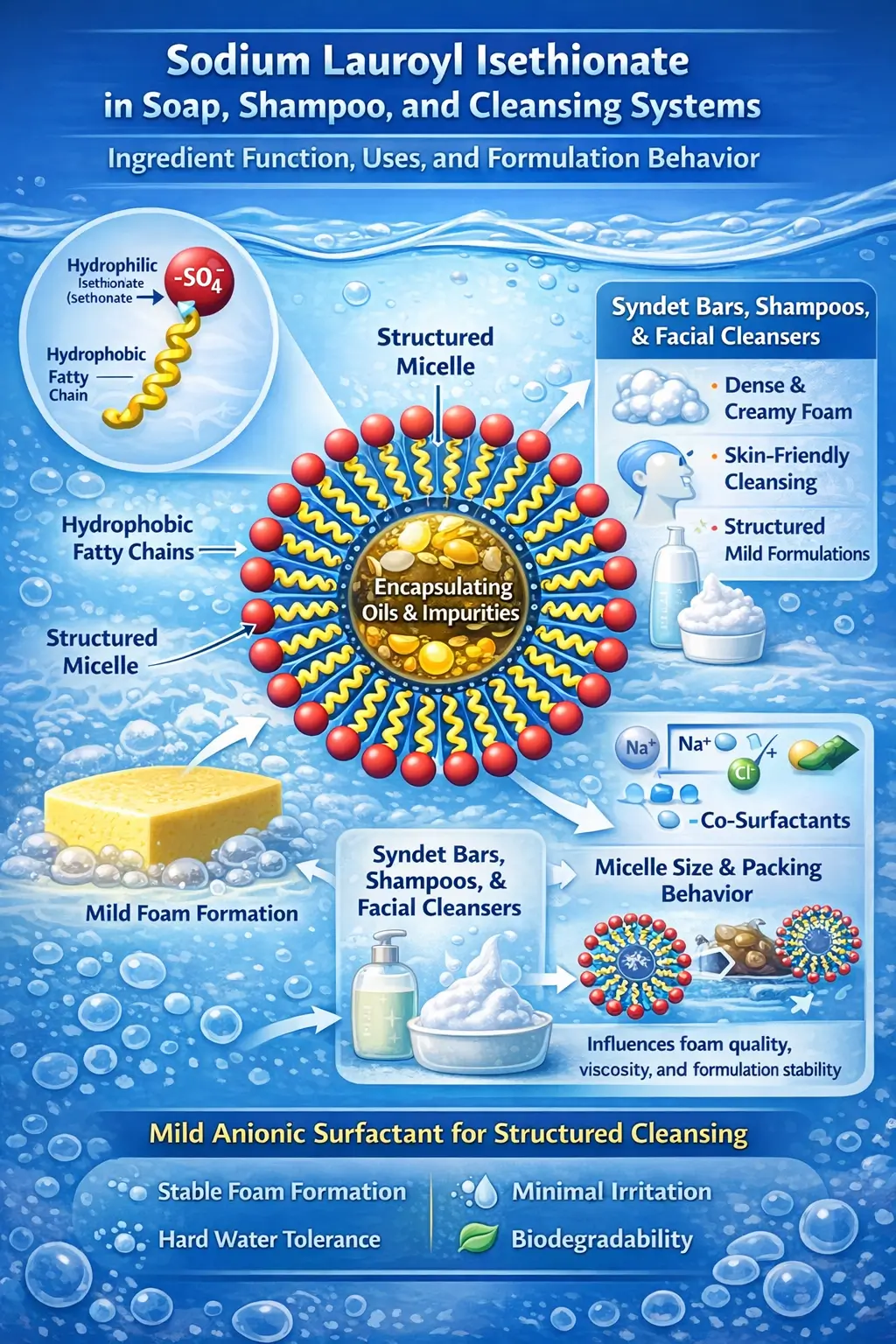
This structure combines a hydrophobic fatty chain with a hydrophilic sulfonate group, allowing the molecule to interact with both oils and water phases within a formulation.
Its ionic character remains negative in aqueous environments, which influences how it interacts with other charged ingredients and how it contributes to surfactant system behavior.
Functional Role in Soap Systems
Sodium lauroyl isethionate functions as a primary cleansing agent in syndet-based systems, contributing to controlled soil removal while maintaining a balanced surfactant profile.
It supports the formation of dense and stable foam, which develops more gradually compared to highly aggressive anionic surfactants. This influences how the cleansing process is perceived during use.
In solid cleansing bars, it contributes to the structural matrix of the bar, working alongside fatty components to maintain integrity during repeated wetting and drying cycles.
From a system perspective, formulations containing this surfactant often exhibit smoother lather, slower dissolution, and a more uniform bar surface over time.
Ingredient Interaction Logic
Sodium lauroyl isethionate operates within a network of surfactants and supporting ingredients that collectively define cleansing behavior.
When combined with other anionic surfactants such as sodium lauryl sulfate systems, it can moderate overall system intensity by contributing to a more controlled surfactant balance.
Its interaction with amphoteric surfactants helps stabilize foam and improve compatibility across different formulation conditions, particularly during dilution and rinsing.
It also interacts with fatty acids and structural lipids, which influence how the surfactant is embedded within solid bar matrices and how the bar responds to water exposure.
In aqueous systems, it participates in micelle formation, allowing surfactants to surround and remove oil-based soil efficiently.
Phase Behavior and Solubility
Sodium lauroyl isethionate is not fully soluble in water in the same way as smaller surfactants. Instead, it forms structured dispersions that influence how the formulation behaves during use.
In solid systems, it contributes to a semi-structured matrix that controls how the bar dissolves. This results in a slower and more uniform erosion pattern compared to traditional soap bars.
In liquid formulations, it requires appropriate formulation conditions to remain dispersed and function effectively within the surfactant system.
Its phase behavior is closely linked to temperature and concentration, which determine how it integrates into the overall formulation structure.
Comparison With Related Cleansing Systems
Sodium lauroyl isethionate is often compared with both traditional soap salts and other anionic surfactants. While these systems share the goal of cleansing, their behavior within formulations differs significantly.
| Feature | Sodium Lauroyl Isethionate | Traditional Soap Salts | Strong Anionic Surfactants |
|---|---|---|---|
| Chemical Basis | Fatty acid isethionate derivative | Saponified triglycerides | Sulfate or sulfonate systems |
| Cleansing Behavior | Controlled and balanced | Strong but pH-dependent | Rapid and high detergency |
| Foam Profile | Dense and creamy | Variable depending on water conditions | Fast-forming and abundant |
| Bar Structure | Structured syndet matrix | Crystalline soap structure | Typically used in liquids |
| Water Interaction | Less sensitive to mineral interference | Affected by hard water | Generally stable across conditions |
Regulatory Context
Sodium lauroyl isethionate is declared on ingredient lists using its INCI name and is recognized as a functional surfactant within cosmetic regulatory frameworks.
Under European Union regulations, it is classified as a cosmetic ingredient when used in cleansing products without therapeutic claims. Its evaluation is based on its role within the final formulation rather than as an isolated compound.
Its use is governed by general formulation and labeling rules rather than specific restriction categories when used within conventional formulation ranges.
In detergent contexts, it is similarly treated as part of the surfactant system contributing to cleaning performance.
Common Misunderstanding
Sodium lauroyl isethionate is often assumed to be a natural soap due to its association with fatty acid components. In reality, it is a synthetically derived surfactant designed to replicate and modify certain aspects of soap behavior.
Another misunderstanding is that its presence alone defines formulation mildness. While it contributes to a balanced surfactant system, overall behavior depends on the combination of surfactants and formulation design.
It is also sometimes interpreted as interchangeable with traditional soap salts, which operate through a different chemical mechanism and structural system.
Structural Limitations
Sodium lauroyl isethionate requires careful formulation to function effectively, particularly in liquid systems where dispersion and stability must be controlled.
In solid formulations, imbalance with structural components can affect bar integrity, leading to faster breakdown or inconsistent dissolution behavior.
Its performance is influenced by formulation pH and the presence of other surfactants, which determine how effectively it forms stable micellar structures.
Additionally, it does not provide the same structural rigidity as fully saturated soap systems, requiring combination with other ingredients to achieve desired physical properties.
Formulation References Using This Ingredient
Summary of Findings
- Classification: Sodium lauroyl isethionate is a mild anionic surfactant within the isethionate family.
- Functional Role: It acts as a primary cleansing agent contributing to foam formation and controlled surfactant behavior.
- Interaction Logic: Works with anionic and amphoteric surfactants to influence system balance, foam stability, and cleansing dynamics.
- System Boundaries: Its effectiveness depends on formulation design, phase behavior, and interaction with structural components.